

Choosing between two vehicles from the same brand at the same price point is an unusual problem, and Mazda is one of the few manufacturers where it happens regularly. The 2026 CX-5 and CX-50 share Mazda’s standard 2.5-liter engine, standard AWD, Mazda’s i-Activsense safety suite, and nearly identical base fuel economy. They sit within a few hundred dollars of each other at equivalent trims. From the outside, in a parking lot, a non-enthusiast would have to look carefully to tell them apart.
The 2026 model year makes this comparison more interesting than it has ever been — because both vehicles changed significantly for this year, and they changed in opposite directions. The CX-5 was completely redesigned for 2026: it dropped its turbo engine, grew its rear seat, gained more cargo space, and received a new 15.6-inch touchscreen that replaced the rotary controller that Mazda has used for the past decade. The CX-50 is the vehicle that now holds Mazda’s only turbo compact SUV option, its only hybrid compact SUV option, and its only 3,500-lb tow rating.
For a family choosing between them for weekend road trips, the differences are precisely in the variables that matter: rear passenger space, cargo volume, fuel economy, and the controls the driver uses repeatedly for four hours of highway driving.
Quick Takeaways
- The 2026 CX-5 is now the larger, more practical vehicle in cargo and rear passenger space — a reversal from prior generations when the longer CX-50 held the interior advantage; the redesigned CX-5 gains 33.7 cu ft cargo (vs. CX-50’s 31.4 cu ft) and 5.2 inches of rear knee clearance versus the CX-50’s 3.0 inches
- The 2026 CX-5 dropped its turbo engine entirely, making the CX-50 the only Mazda compact SUV with a turbo (256 hp, 320 lb-ft) and the only one with a factory hybrid (38 mpg combined, Toyota-sourced)
- Both vehicles return the same base fuel economy — 24 city / 30 highway / 26 combined — from the same 2.5L naturally aspirated engine; the CX-50’s fuel economy advantage only appears if you specifically choose the Hybrid trim
- The CX-5’s most controversial 2026 change: a new 15.6-inch touchscreen that removes the rotary controller entirely and routes climate functions through the screen — a road-trip ergonomics concern documented throughout this series
- The CX-50 Hybrid uses a Toyota-sourced hybrid system with eAWD (a rear electric motor, not mechanical AWD), which provides reduced AWD capability at low traction versus the CX-50’s standard mechanical i-Activ AWD; this matters for buyers choosing the Hybrid for genuine winter traction
- For towing: the CX-50 with the 2.5 Turbo is rated at 3,500 lbs; the standard CX-5 and base CX-50 have significantly lower tow ratings; if any trailer ever appears in your trip plans, the CX-50 Turbo is the only Mazda compact SUV that handles it
The Reversal: Why the CX-5 Is Now the Bigger, More Practical Vehicle
Prior to the 2026 redesign, the CX-50 was the larger vehicle — longer, with more rear space — and the CX-5 was the more compact, urban-focused option. The 2026 CX-5’s complete redesign changed this in two important ways for road trip buyers.
First, the rear seat. CarBuzz’s direct technical comparison of the 2026 models documents the knee clearance gap precisely: the CX-5 offers 5.2 inches of rear knee clearance; the CX-50 offers 3.0 inches; the CX-50 Hybrid offers just 2.1 inches (the battery pack modifies the rear seat geometry). That 2.2-inch gap between the standard CX-5 and CX-50 is meaningful on a three-hour drive with adult rear passengers — it is the difference between a comfortable rear seat and one that requires managing leg position actively.
For the CX-50 Hybrid specifically, the 2.1 inches of knee clearance is a significant constraint. The Toyota-sourced hybrid battery pack — the same architecture used in the RAV4 Hybrid — intrudes into the rear floor space in a way that reduces rear seat usability to below what either gas CX-50 or gas CX-5 provides. A family choosing the CX-50 Hybrid for its fuel economy should be aware that the rear seat is tighter than the non-hybrid CX-50 it replaces.
Second, cargo. The 2026 CX-5 offers 33.7 cu ft behind the rear seats and 66.5 cu ft maximum with seats folded. The CX-50 offers 31.4 cu ft behind the rear seats and 56.3 cu ft maximum. The CX-5’s 40/20/40 split-folding rear seats — a new configuration for 2026 — add practical flexibility that the CX-50’s 60/40 configuration does not: the center section folds independently, allowing a long item (ski bag, bicycle) to pass through while two rear passengers remain seated.
For a weekend trip where the rear seat is occupied and cargo still needs to go somewhere, the 2026 CX-5 is the more capable vehicle.
Fuel Math: When the Base Figures Are Identical, the Hybrid Is the Only Differentiator
The base fuel economy comparison between the CX-5 and standard CX-50 is, at highway cruise speed, a tie.
CX-5 2.5L AWD: 24 city / 30 highway / 26 combined (EPA) CX-50 2.5L AWD: 24 city / 30 highway / 26 combined (EPA) CX-50 2.5T Turbo AWD: approximately 22 city / 27 highway / 24 combined (EPA) CX-50 Hybrid AWD (e-AWD): 39 city / 37 highway / 38 combined (EPA, per Mazda USA official)
On a 500-mile highway round trip at $3.50/gal:
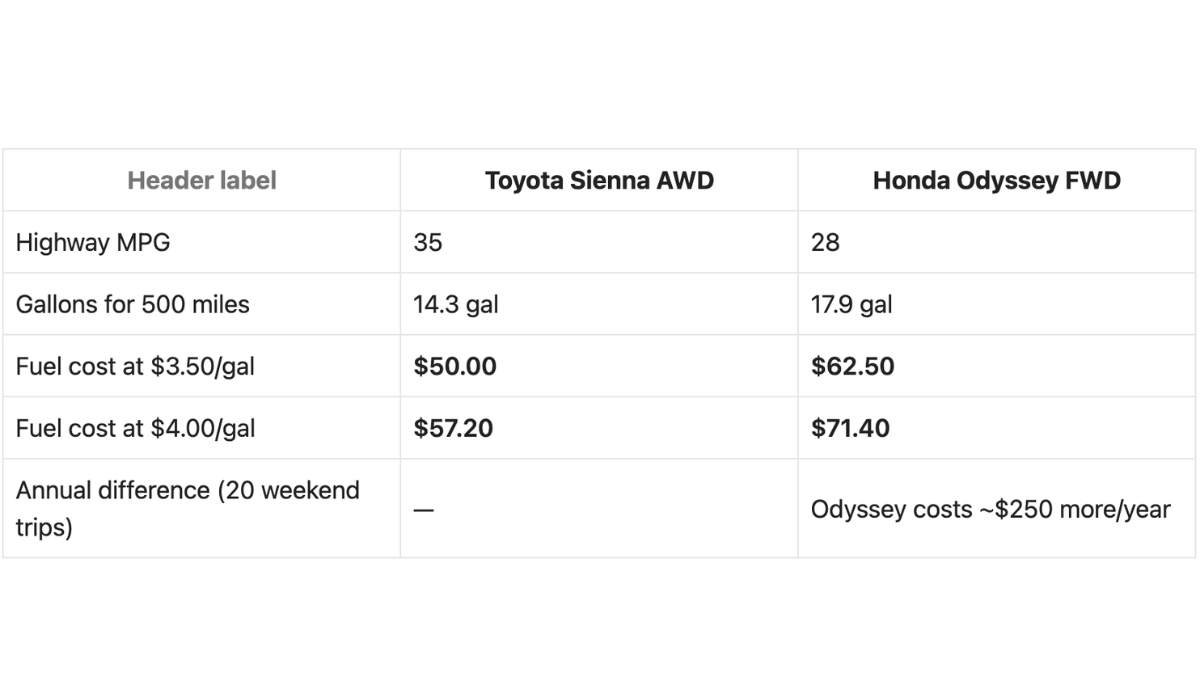
The Hybrid’s $11 per-trip fuel savings versus either gas variant accumulates to approximately $220/year over 20 weekend trips — real money. The turbo’s $6.50 per-trip fuel premium is the cost of its power, and it is a known trade-off.
The practical implication: if fuel economy is a priority, the CX-50 Hybrid is the only variant in this comparison that moves the needle meaningfully. The CX-5 and standard CX-50 are equivalent on highway fuel cost. The turbo costs more to fuel. The hybrid saves meaningfully — but at the cost of rear knee clearance (2.1 inches) and the eAWD substitution for mechanical AWD.
Canadian note: At $1.70/litre CAD, the CX-50 Hybrid’s highway advantage over the gas variants is approximately 1.3 L/100 km. On an 800 km round trip, that is approximately $18 CAD per trip. Over 15 annual summer trips, approximately $270 CAD — worthwhile, but not enough to override the rear seat penalty if adult rear passengers are a regular use case.
The Touchscreen Problem: The CX-5’s Biggest Road-Trip Liability
The 2026 CX-5’s most discussed change — and its most road-trip-relevant concern — is the removal of Mazda’s rotary controller in favor of a 15.6-inch touchscreen that handles infotainment, navigation, and climate functions.
This is the exact interface evolution this series has documented as a highway fatigue driver throughout multiple vehicle comparisons. Climate control through a touchscreen requires the driver to look at the screen, locate the function, touch it, and verify the result — a sequence that adds 2–4 seconds of visual attention per adjustment, multiplied across every temperature change, fan speed adjustment, or seat heat request over a 300-mile drive.
CarBuzz’s editorial review of the 2026 CX-5 notes the change directly: “It seems as if Mazda heard all the complaints about the controller knob and decided to go fully to the other extreme, with a giant screen and even less buttons and knobs than most other screen-heavy competitors.” For long-distance road trips, the direction Mazda moved with the CX-5 is the wrong direction for driver ergonomics.
The CX-50 retains a physical rotary controller and physical climate buttons on its current generation — the interface that earned Mazda its reputation for functional interiors. For road trip buyers who use this series’ guidance on physical controls (→ see “The Compact SUV Feature List Most Drivers Actually Need” in this series), the CX-50’s retained physical controls are a meaningful advantage over the redesigned CX-5’s touchscreen-only layout.
This single factor may be decisive for a buyer who prioritizes the driver ergonomics that the rest of this series documents as road-trip relevant. If physical climate controls matter — and the series’ consistent finding is that they do, at highway speed over multiple hours — the CX-50 is the correct choice regardless of the CX-5’s cargo and space advantages.
The Powertrain Decision: Three Options That Serve Different Trip Profiles
The CX-50’s powertrain optionality is its most distinctive advantage over the 2026 CX-5. Three engines serve three clearly different use cases:
2.5L Naturally Aspirated (both vehicles): The standard choice for buyers who want Mazda’s handling character and cabin quality at the base price. Adequate for all road trip use cases; not exciting under hard acceleration. Same fuel economy in both vehicles. The CX-5 at this level has better cargo and rear seat space. The CX-50 at this level has better controls and the option to upgrade.
2.5T Turbo (CX-50 only): 256 hp and 320 lb-ft of torque on premium fuel — the most powerful compact SUV Mazda makes. On mountain approaches, extended grades, or two-lane highway passes, the turbo delivers power that the naturally aspirated 2.5L reaches for. Also enables the CX-50’s 3,500-lb tow rating: the only Mazda compact SUV that can pull a small boat trailer, a cargo trailer, or a pop-up camper. For families whose road trips include towing or steep mountain driving, this trim is the meaningful choice.
Hybrid (CX-50 only): Toyota-sourced 2.5L hybrid system producing 38 mpg combined — the same architecture as the RAV4 Hybrid at a lower price point. The e-CVT transmission replaces the standard 6-speed automatic, and the eAWD system replaces mechanical AWD. The fuel economy case is strong; the rear knee clearance compromise (2.1 inches) and mechanical AWD loss are the costs.
Which One for Weekend Trips — The Decision
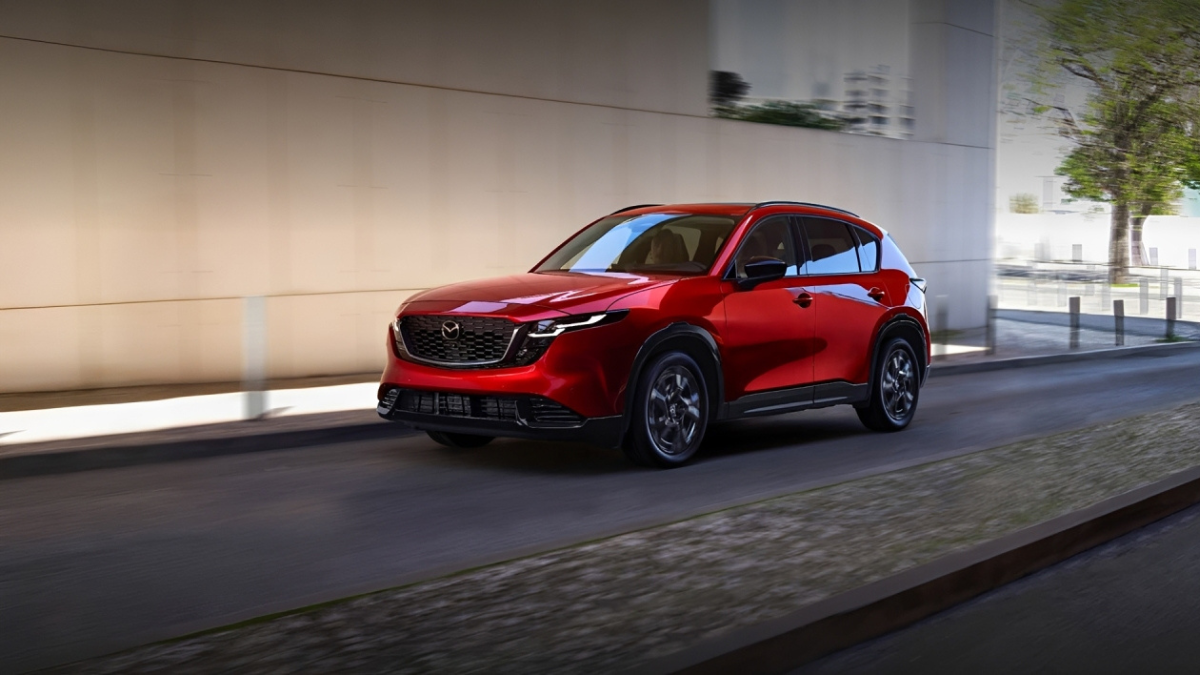
Choose the 2026 CX-5 if:
- Cargo space is a priority — 33.7 vs. 31.4 cu ft behind rear seats, and 66.5 vs. 56.3 cu ft maximum; the 40/20/40 split-rear seat adds real loading flexibility
- Your rear passengers are adults who will feel the 2.2-inch knee clearance advantage over three hours of driving
- You are buying the naturally aspirated engine and do not need the turbo or hybrid options, and you want the most practical packaging for that powertrain
- Note: verify comfort with the new 15.6-inch touchscreen-only interface before committing — test the climate controls specifically on the highway portion of the test drive
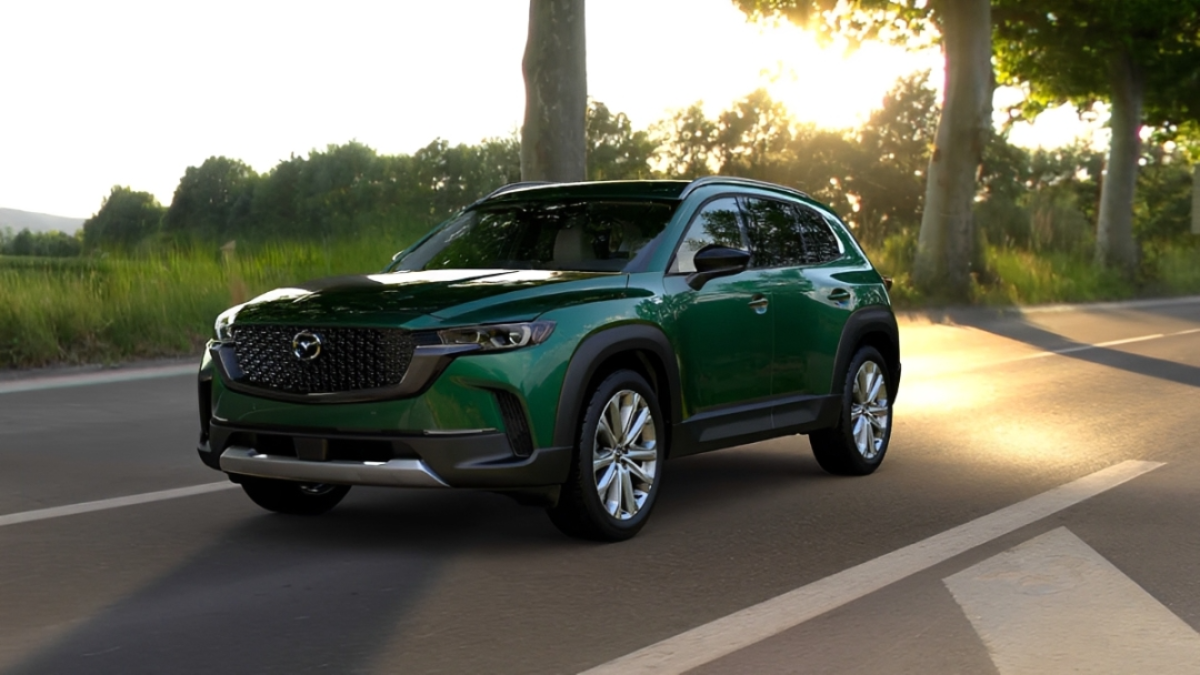
Choose the 2026 CX-50 if:
- Physical rotary controller and physical climate buttons are a priority for highway driving ergonomics — this is the CX-50’s most consistent road-trip advantage over the redesigned CX-5
- You want the turbo engine (256 hp, 320 lb-ft) for mountain driving confidence or the 3,500-lb tow rating for a trailer
- You want the hybrid powertrain’s 38 mpg combined fuel economy and understand the rear seat and eAWD trade-offs
- Ground clearance and off-road confidence on rough resort roads, beach access tracks, or seasonal unpaved routes are part of your trip profile (8.2 vs. 8.6 inches — both adequate, CX-50 framed as adventure-oriented with Mi-Drive modes)
The honest summary from CarBuzz: for most buyers who want a Mazda compact SUV for daily use and road trips in naturally aspirated form, the redesigned CX-5 is now the more rational choice on space and cargo. For buyers who want the turbo, the hybrid, or the physical controls that the CX-5 just gave up — the CX-50 is the right vehicle.
DISCLAIMER
EPA fuel economy figures are for 2026 model years as published at time of writing; verify current figures at fueleconomy.gov for your specific trim and configuration. CX-50 Hybrid uses eAWD (rear electric motor) rather than mechanical AWD — this provides reduced all-terrain capability compared to Mazda’s standard i-Activ mechanical AWD system; verify the specific AWD system for any trim before purchasing for winter or off-road use. Cargo volume, knee clearance, and interior dimension figures cited are from CarBuzz’s direct technical comparison of 2026 models and from Mazda USA official sources; figures may vary by trim configuration. Tow ratings depend on engine and configuration; the 3,500-lb rating applies to CX-50 with 2.5T Turbo; verify with Mazda before towing. MSRP figures are approximate and exclude taxes, fees, and dealer adjustments. This article does not constitute purchasing advice.
SOURCES
- Mazda USA official CX-5 vs. CX-50 comparison: CX-50 Hybrid 39/37/38 mpg combined; CX-50 2.5S base 24/30/26 mpg; CX-5 2.5S 24/30/26 mpg; CX-5 2.5 Premium Plus 26/30/28 mpg; confirmed primary Mazda source for all fuel economy figures
- U.S. DOE/EPA fueleconomy.gov: 2026 CX-50 hybrid and gas fuel economy by trim; primary EPA source for CX-50 figures
- U.S. DOE/EPA fueleconomy.gov: 2026 CX-5 fuel economy by trim; primary EPA source for CX-5 figures
- CarBuzz March 2026 direct comparison: CX-5 rear knee clearance 5.2 inches vs. CX-50 3.0 inches vs. CX-50 Hybrid 2.1 inches; CX-5 cargo 33.7 cu ft / 66.5 max vs. CX-50 31.4 / 56.3 max; CX-50 Hybrid uses Toyota-sourced system with eAWD not mechanical AWD; 2026 CX-5 dropped turbo engine; new 15.6-inch screen replaces rotary knob; “giant screen and even less buttons and knobs than most other screen-heavy competitors”; CX-5 2.8 inches taller than CX-50