

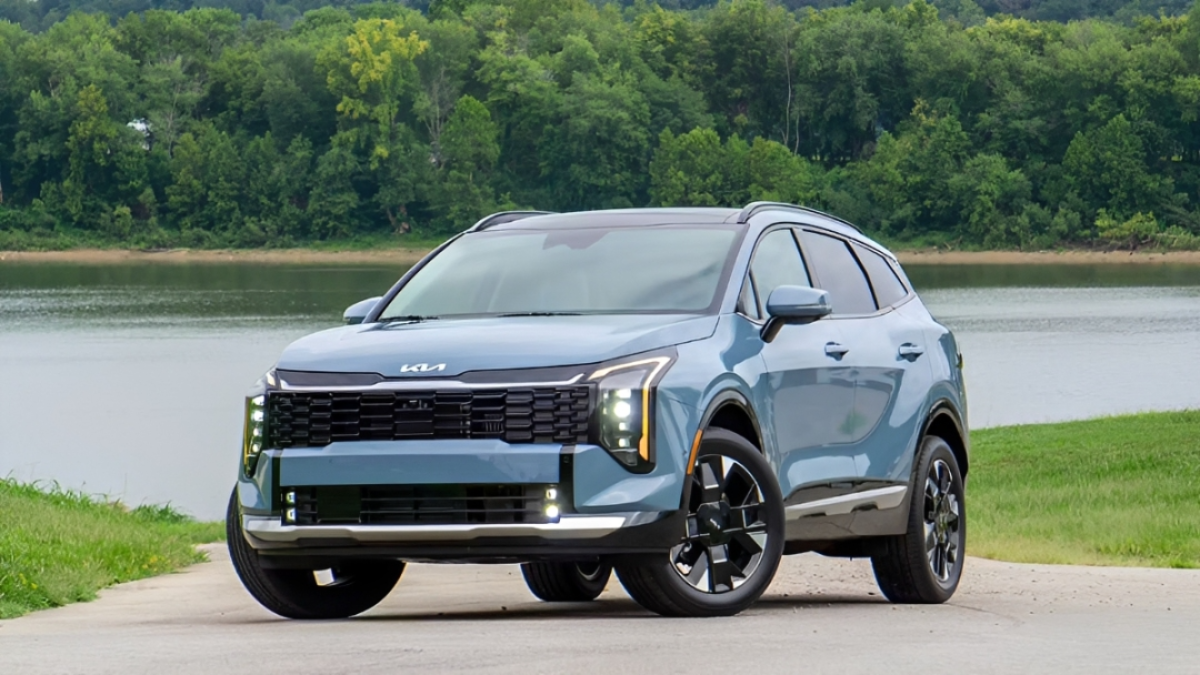
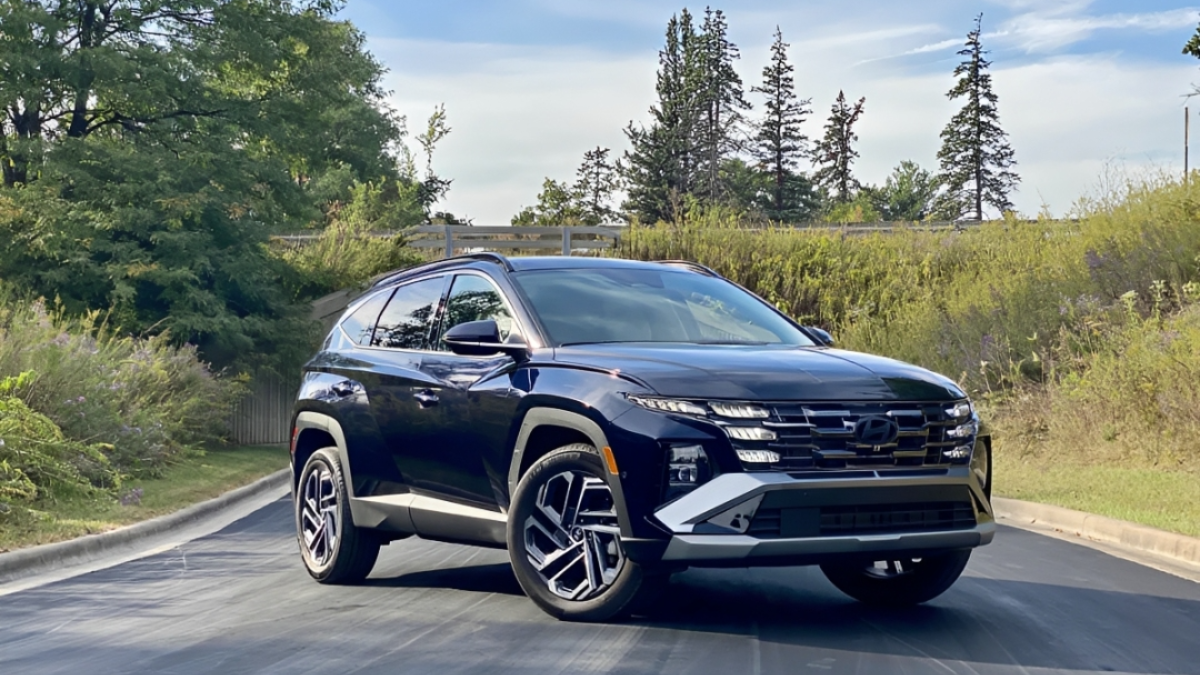
The 2026 Kia Sportage Hybrid and the 2026 Hyundai Tucson Hybrid are, in a meaningful technical sense, the same vehicle. They share the same platform, the same 1.6-liter turbocharged hybrid powertrain, the same 6-speed automatic transmission, and the same combined system output of 231–232 horsepower. They come from the same South Korean parent company. They are priced within a few hundred dollars of each other at equivalent trims. They return identical fuel economy with AWD. And yet the choice between them is not arbitrary — because the differences that do exist are precisely the ones that matter on a weekend road trip.
The Tucson’s return to physical climate controls. The Sportage’s available FWD at a meaningfully lower price. The Tucson’s larger cargo volume behind the rear seats. The Sportage’s trim structure that lets you enter the hybrid segment for less than any competitor. These are not spec-sheet abstractions. They are the variables that determine whether the driver adjusts the temperature while watching the road or while watching the touchscreen, and whether the family fits the camping gear behind the rear seats or starts looking for a roof box.
Here is the comparison that the shared powertrain makes genuinely interesting: when two vehicles are mechanically identical, the differentiation is entirely in the details — and those details are worth knowing before you sign.
The Shared Powertrain — And Why It Matters
Start with what is the same, because this shapes every comparison that follows.
Both vehicles use a 1.6-liter turbocharged four-cylinder paired with an electric motor and a 1.49 kWh lithium-ion battery pack. Both produce approximately 231–232 horsepower and 271 lb-ft of torque from the combined system. Both use a conventional 6-speed automatic transmission — not the e-CVT that characterizes Toyota’s and Honda’s hybrid systems.
That last point is the most consequential shared specification for road trip driving character. AutoGuide’s concurrent review of both vehicles documents the result: “Unlike most other hybrids that use an e-CVT, both the Tucson Hybrid and Sportage Hybrid use a conventional 6-speed automatic, which gives them the familiar feel of a regular gas car. Having real gear changes helps keep the engine quieter under hard acceleration.”
On a highway road trip, this distinction is audible. The RAV4 Hybrid and CR-V Hybrid both use e-CVT transmissions that can produce a pronounced engine-note rise under hard acceleration — the “rubber band” effect that some drivers find disconnected from the sensation of speed. The Sportage Hybrid and Tucson Hybrid do not do this. Their 6-speed automatics step through ratios in a way that feels conventional and quiet, which is a genuine comfort advantage over a long drive.
AutoGuide confirms what this translates to in practice: “Ride comfort is impressive; they absorb bumps well, cabins are quiet, and handling is secure and predictable.”
Fuel Math: What AWD vs. FWD Actually Costs on a 500-Mile Weekend Run
The fuel economy picture for these two vehicles is where the comparison gets specific — and where the Sportage’s FWD option creates a meaningful decision point.
Sportage Hybrid FWD: up to 42 mpg combined (41 city / 44 highway per EPA for select FWD trims), per GreenCars’ March 2026 comparison test Sportage Hybrid AWD: 36–38 mpg combined (trim-dependent), per GreenCars Tucson Hybrid: AWD standard across all hybrid trims — 35–36 mpg combined, per GreenCars
On a 500-mile highway-dominant weekend trip:
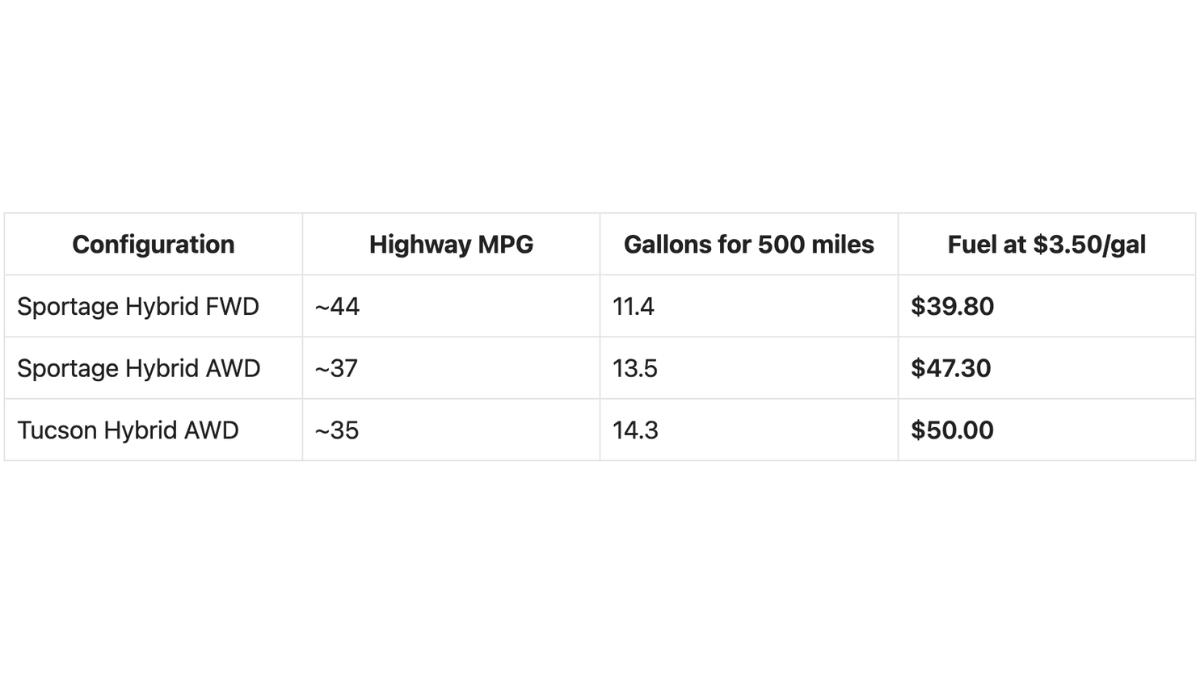
The FWD Sportage Hybrid’s fuel economy advantage — approximately $10 per 500-mile trip versus the AWD Tucson — accumulates to roughly $200/year over 20 weekend trips. That is a real annual savings, though the AWD decision should be made on traction grounds, not fuel grounds alone.
GreenCars’ analysis is precise on the AWD/FWD choice: “The Tucson hybrid is offered exclusively with all-wheel drive on all trim levels, while Kia offers a lower-cost entry LX trim with front-wheel drive only.” For families in cold-weather markets who make mountain or winter road trips, AWD is effectively mandatory and the Sportage’s FWD option is irrelevant. For families in the Sun Belt or Pacific Coast whose weekend trips run on dry or wet pavement — never snow or ice — the Sportage LX FWD is the most fuel-efficient and lowest-cost entry into this powertrain class.
Canadian note: At $1.70/litre CAD, the Sportage Hybrid FWD’s highway fuel advantage is approximately 0.6 L/100 km better than the AWD Tucson. On a 800 km round trip, the fuel savings are approximately $8 CAD — modest per trip, meaningful over a full summer season.
The Controls Issue: Physical Buttons vs. Touch Controls
This is the difference that has the largest day-to-day impact on a road trip, and it runs entirely in the Tucson Hybrid’s favor.
The Tucson Hybrid returned to physical climate controls for 2025 — a specific engineering decision that reversed the prior generation’s all-touch interface following owner feedback. The Sportage Hybrid uses a multi-modal touch control layout for climate functions that GreenCars describes as: “The Kia setup isn’t a deal-breaker once you get used to it, but it’s definitely not as good.”
On a highway road trip, the controls you use most frequently are: cabin temperature, fan speed, and seat heat. These are the functions you adjust without looking down, by feel, while watching the road. Physical controls allow this. Touch controls require looking at the screen, locating the function, tapping it, and verifying the result — a brief visual attention interruption that accumulates across a 300-mile drive into a form of driver micro-fatigue.
This series has documented this dynamic across multiple vehicle comparisons, and it consistently favors vehicles that retain physical climate controls for these functions. The Tucson Hybrid’s return to physical buttons is the most consequential ergonomic improvement in its most recent update — and it directly benefits drivers on long road trips more than on short commutes.
Both vehicles offer dual 12.3-inch displays for infotainment and instrument cluster, wireless Apple CarPlay and Android Auto standard, and comparable technology suites. The differentiation is specifically in climate control interface, not in screen size or infotainment quality.
Cargo Reality: 500 Miles Loaded
Both vehicles seat five adults and carry meaningful cargo, but the numbers favor the Tucson in ways that show up on a family weekend trip.
Tucson Hybrid: 41.2 cu ft behind rear seats / 80.3 cu ft maximum (seats folded) Sportage Hybrid: 39.6 cu ft behind rear seats / 74.1 cu ft maximum (seats folded)
The 1.6 cu ft gap behind the occupied rear seats is modest — a narrow cooler’s worth of additional volume. The 6.2 cu ft maximum cargo gap (seats folded) is more relevant for the scenario where the family needs to carry bicycles, camping equipment, or bulky gear that requires flattening the rear seats.
U.S. News’ direct head-to-head confirms: “The Tucson provides 41.2 cubic feet of room behind the rear seats and 80.3 cubic feet with the seats folded… The Kia Sportage touts 39.6 cubic feet of space behind the second row and 74.1 cubic feet with the seats folded. Larger loads are no problem thanks to the wide rear cargo door.”
Both vehicles include a compact spare tire under the cargo floor — a practical detail that AutoGuide specifically flags as an advantage over some hybrid competitors that eliminate the spare to save weight and battery space. Finding a nail in the sidewall at mile 400 of a weekend trip is meaningfully more manageable with a full spare than without.
Passenger volume: Tucson Hybrid offers 107.9 cubic feet of total passenger volume, per GreenCars. The Sportage’s passenger volume is not published by Kia, but GreenCars estimates it at approximately 105–106 cubic feet based on shared platform dimensions. The Tucson also has a slight headroom advantage — approximately half an inch in front without a sunroof, nearly an inch in rear with a sunroof — per GreenCars.
The Price Entry Point: Where the Sportage Wins Decisively
The Sportage Hybrid’s most significant advantage is not fuel economy, cargo organization, or driving character. It is the existence of the Sportage LX Hybrid FWD — a trim configuration that enters the 2026 hybrid compact SUV market at a lower price than any comparable hybrid competitor, including the Tucson Hybrid’s base AWD trim.
GreenCars’ March 2026 comparison is specific: “The most affordable of this pair by a margin of over $2,000 is the base Sportage LX with front-wheel drive.”
For a family whose road trips run entirely on paved highways in weather conditions that never include snow or ice, the Sportage LX FWD Hybrid offers the same 1.6T hybrid powertrain, the same 6-speed automatic, the same 42 mpg combined fuel economy — for $2,000 less than the lowest Tucson Hybrid entry point, and without the AWD traction equipment that their routes do not require.
The caveat that GreenCars provides is accurate: “For that extra money, the Hyundai gets leather seat upholstery compared to the synthetic SynTex material in the Kia.” Seat material is not a road trip performance variable, but it is a quality perception and durability question worth noting for a vehicle that will carry the family for a decade.
Long-Term Reliability: The Honest Uncertainty
Both vehicles carry strong warranty coverage: Kia’s 10-year/100,000-mile powertrain warranty (U.S.) is the longest in the segment. Hyundai’s comparable coverage runs similarly.
The honest uncertainty that AutoGuide’s review raises — and that is rarely acknowledged in comparison articles that focus on features and pricing — is the shorter track record of the HMG hybrid system relative to Toyota’s and Honda’s. AutoGuide notes: “Hyundai and Kia don’t have the same long hybrid track record as Toyota (and to a lesser extent Honda). This hybrid system has only been around since 2021, so it lacks long-term data.”
Toyota has sold hybrid vehicles since 1997 and the RAV4 Hybrid since 2016. Honda’s two-motor hybrid system has been in production since 2017. Both have accumulated real-world durability data across millions of vehicles. The Tucson/Sportage hybrid system, introduced in 2021, has four years of production history — more data than a new system but less than the Toyota and Honda baselines.
For families who plan to keep this vehicle 10–15 years, this uncertainty is worth acknowledging. The 10-year powertrain warranty mitigates the financial risk of early system failures. It does not eliminate the uncertainty about behavior at years eight through twelve that Toyota’s and Honda’s long ownership records address.
Which One for Weekend Trips — The Decision Framework
Choose the 2026 Tucson Hybrid if:
- You want physical climate controls that allow temperature and fan adjustments without looking at the screen — the single most road-trip-relevant interface advantage
- Your road trips include any winter or mountain driving where AWD is genuinely useful and the AWD-only hybrid lineup is a practical requirement
- Cargo volume matters: 6.2 cu ft more at maximum and slightly more usable space for bulky weekend gear
- Interior refinement is a priority — leather seating on higher Tucson trims versus SynTex in comparable Sportage trims
Choose the 2026 Sportage Hybrid if:
- The LX FWD trim’s lower entry price represents a meaningful budget advantage and your routes don’t require AWD
- You want the segment’s best fuel economy from a non-Toyota, non-Honda hybrid — up to 44 mpg highway in FWD configuration is genuinely competitive with the best in class
- The dual-level cargo floor organization matters for the way you pack gear on weekend trips
- You prefer the Sportage’s more aggressive exterior styling to the Tucson’s softer, rounder design
If AWD is required and budget is not the primary constraint: the Tucson Hybrid’s physical controls and slightly larger cargo volume tip the balance for weekend road trips. If AWD is not required: the Sportage LX FWD Hybrid’s $2,000+ price advantage and best-in-class fuel economy make it the economically stronger choice.
GreenCars’ March 2026 conclusion is the right framing: “Beyond [the price question], it’s really a toss-up. Given the nearly identical driving experience of these two siblings, the choice really comes down to which design and control layout you prefer.”
U.S. and Canada Note
In cold-climate U.S. markets (Upper Midwest, New England, Mountain West) and throughout Canada, the Tucson Hybrid’s AWD-standard hybrid lineup is the relevant configuration. The Sportage’s FWD option disappears as a practical choice in these markets.
For Canadian buyers, both vehicles are available through Kia Canada and Hyundai Canada dealer networks at pricing consistent with U.S. positioning. The Kia 10-year/160,000 km powertrain warranty (Canada) and Hyundai’s equivalent coverage apply. Verify Canadian warranty terms at purchase, as coverage periods may differ from U.S. specifications.
Highway 99 (Vancouver to Whistler) and Trans-Canada approaches to Banff and Jasper represent the AWD-relevant use case — grades, occasional winter surface conditions in shoulder season, and the type of sustained hill climbing where AWD traction at departure matters. For families on these routes, the Tucson Hybrid’s standard AWD requirement is a feature, not a limitation.
SOURCES
- GreenCars March 2026 direct comparison: shared 1.6T turbo hybrid platform; Sportage FWD up to 41 mpg combined; both AWD 36–38 mpg combined depending on trim; Tucson AWD-only on hybrid; Sportage LX FWD undercuts Tucson by over $2,000; Tucson physical controls better than Sportage multi-modal touch; “the Kia setup isn’t a deal-breaker once you get used to it, but it’s definitely not as good”; Tucson 107.9 cu ft passenger volume; Sportage ~105–106 cu ft estimated; Tucson half-inch headroom advantage; both have 1.49 kWh battery pack; dual 12.3-inch displays both vehicles
- U.S. News March 2026 head-to-head: Tucson cargo 41.2 cu ft behind rear seats / 80.3 cu ft max; Sportage cargo 39.6 cu ft behind rear / 74.1 cu ft max; Tucson wins cargo, interior quality, interior features, safety; Sportage wins lower price and higher predicted reliability; tie in seat comfort, acceleration, fuel economy, ride and handling; reviewer quote: Tucson “for as smooth as the Tucson rides, there’s surprisingly little drama when the road gets twisty”; Sportage narrowly lower starting price
- AutoGuide concurrent drive review: “unlike most other hybrids that use an e-CVT, both use a conventional 6-speed automatic, which gives them the familiar feel of a regular gas car”; “having real gear changes helps keep the engine quieter under hard acceleration”; “ride comfort is impressive; they absorb bumps well, cabins are quiet, and handling is secure and predictable”; compact spare tire under cargo floor in both; Kia 10-year/100,000-mile powertrain warranty; hybrid system only since 2021 — lacks long-term data versus Toyota/Honda; “Honda CR-V Hybrid and Toyota RAV4 Hybrid offer unbeatable value, proven reliability, better fuel economy, and typically stronger resale”
- U.S. DOE/EPA fueleconomy.gov: 2026 Kia Sportage Hybrid fuel economy figures by trim; FWD combined up to 42 mpg; AWD figures; primary EPA source for all Sportage fuel economy in this article
- U.S. DOE/EPA fueleconomy.gov: 2026 Hyundai Tucson Hybrid fuel economy figures by trim; AWD combined 35–36 mpg; primary EPA source for all Tucson fuel economy in this article