
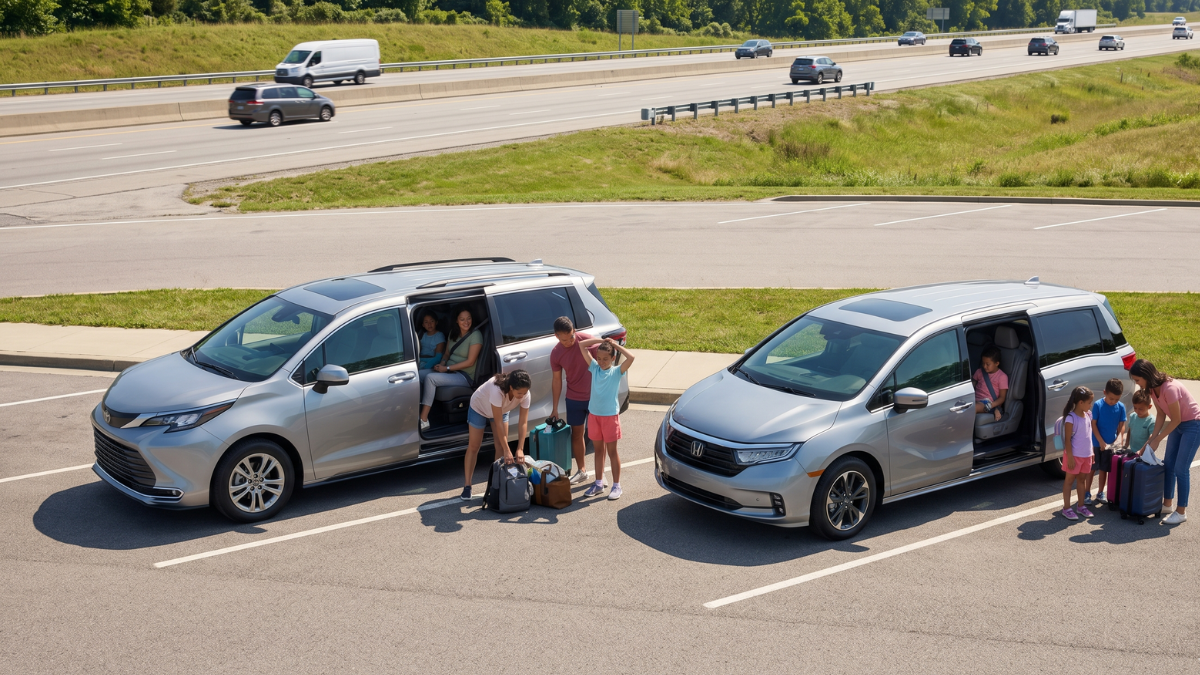
The Toyota Sienna and Honda Odyssey have been competing for the same family since the late 1990s. In that time, both vehicles have been comprehensively refined — and yet the comparison between them has never been more relevant than it is in 2026, because the two minivans now represent genuinely different answers to the same question. The Sienna is a hybrid-only vehicle with a base price near $42,000 and fuel economy that matches many compact crossovers. The Odyssey is a V6 vehicle starting near $44,000 that returns 22 mpg combined but produces more power, more cargo flexibility, and the most capable rear seating arrangement available in a minivan.
For a family planning a 500-mile weekend run or a week-long summer trip with five to eight passengers, the differences between these two vehicles are precisely the ones that show up during the trip rather than in the driveway. This comparison is organized around road trip performance specifically — fuel cost, cargo configuration, noise, seat comfort at hour four, and the specific features that make a nine-hour driving day something the family survives or something the family actually enjoys.
The Two Vehicles at a Glance
2026 Toyota Sienna (XLE AWD, most popular road-trip trim)
- Powertrain: 2.5L hybrid-only, standard AWD on all trims
- EPA fuel economy: 35 city / 35 highway / 35 combined (FWD); AWD: 35/35/35 mpg
- System output: 245 hp
- Cargo behind third row: 33.5 cu ft
- Maximum cargo: 101.0 cu ft
- Third-row legroom: 36.3 inches
- Starting MSRP (LE FWD): approximately $41,615
- Seating: 7 or 8
2026 Honda Odyssey (EX-L, most popular road-trip trim)
- Powertrain: 3.5L V6, FWD only
- EPA fuel economy: 19 city / 28 highway / 22 combined
- Output: 280 hp
- Cargo behind third row: 32.8 cu ft
- Maximum cargo: 140.7 cu ft
- Third-row legroom: 38.7 inches
- Starting MSRP (Sport): approximately $42,240; EX-L: approximately $46,175
- Seating: 7 or 8
Fuel Math: 500 Miles and What Each Powertrain Costs
The fuel economy gap between these two vehicles is the largest single differentiator in the comparison and the most consequential for a family that road trips frequently.
Sienna hybrid AWD: 35 mpg highway Odyssey V6 FWD: 28 mpg highway
On a 500-mile highway round trip:
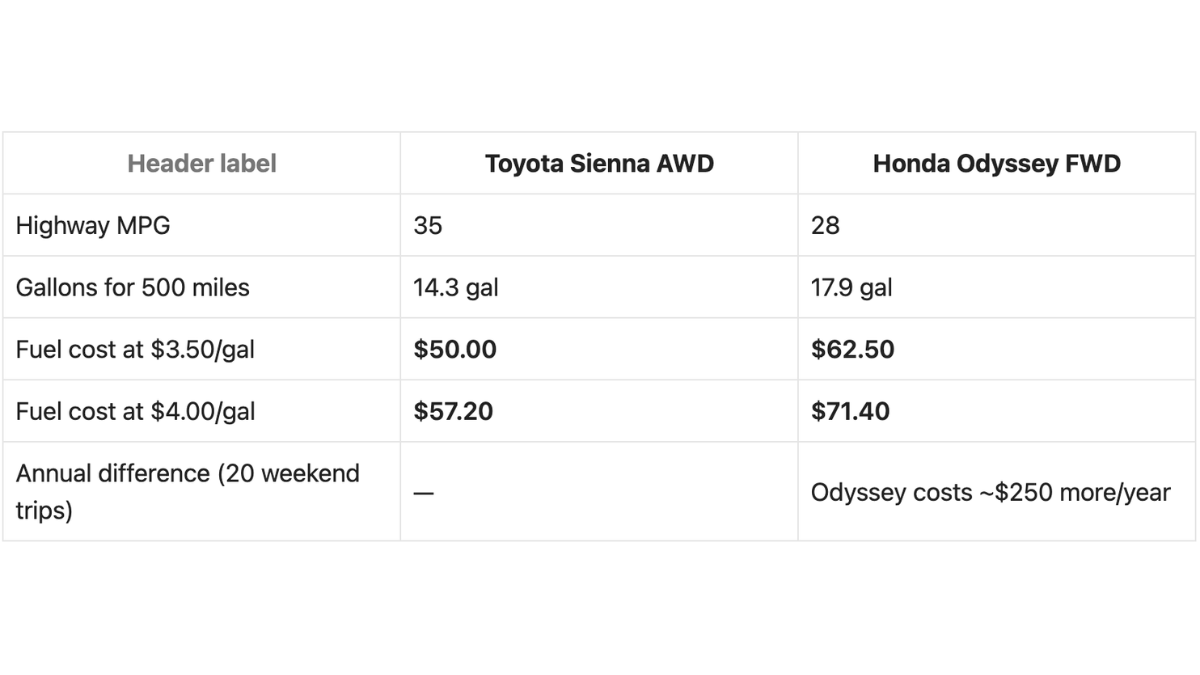
Over 20 weekend trips per year, the Odyssey costs approximately $250 more in fuel than the Sienna at $3.50/gallon — and approximately $285 more at $4.00/gallon. Over five years of ownership, the Sienna’s fuel savings amount to approximately $1,250–$1,425 at these prices.
Edmunds’ concurrent three-vehicle minivan comparison is precise on what this means for trip planning: “The Odyssey lags far, far behind at just 22 mpg combined, meaning its range suffers — around 430 miles out of a tank in the Odyssey, versus around 600 miles in the Sienna.” The practical consequence: a family driving 500 miles in an Odyssey requires a fuel stop each way. The Sienna can often complete the same trip — 300 miles one way — without stopping, depending on the tank state at departure.
The fuel verdict: The Sienna’s hybrid system delivers a genuine, compound advantage: lower per-mile fuel cost and longer range per tank, reducing both the dollar amount and the number of stops on a road trip.
Canadian note: At $1.70/litre CAD, the 7 mpg highway advantage translates to approximately 1.7 L/100 km less consumption for the Sienna. On an 800 km round trip, the fuel savings are approximately $23 CAD per trip. Over 15 annual summer trips, that is approximately $345 CAD in fuel savings — meaningful over a season.
Cargo: Almost Identical Behind the Third Row, Dramatically Different at Maximum
The behind-third-row cargo figures for the two vehicles are nearly equal:
- Sienna: 33.5 cu ft
- Odyssey: 32.8 cu ft
That 0.7 cu ft difference is irrelevant in practice. Both minivans carry the same family luggage load comfortably behind an occupied third row — a 2:1 advantage over most three-row midsize SUVs (→ see “Minivan vs. 3-Row SUV: Which One Actually Carries More” in this series).
Where the Odyssey separates from the Sienna dramatically is maximum cargo capacity:
- Sienna maximum: 101.0 cu ft
- Odyssey maximum: 140.7 cu ft
The Odyssey’s Magic Slide second-row seats are the source of this gap. Each second-row captain’s chair slides forward, back, and side-to-side independently, and the center section between them removes entirely, creating a flat cargo floor that extends further forward than any other minivan configuration. The result: a usable cargo volume that, with all seats cleared, approaches small cargo van territory.
For a family that uses the minivan for both passenger carrying and occasional large cargo loads — moving a college student, hauling furniture, transporting bicycles wheel-to-wheel — the Odyssey’s 140.7 cu ft maximum cargo is a functional advantage that the Sienna’s 101 cu ft cannot match. The Sienna’s seats stow in a different configuration and do not achieve the same flat floor extension.
The Odyssey also features a purpose-built second-row center storage unit — a deep, cooler-accessible bin between the captain’s chairs — that serves as both a practical storage solution and a pass-through between the front and second rows. This is the kind of feature that sounds minor until the road trip includes a three-hour stretch where someone in the second row needs to reach the snack bag that is behind the driver.
The cargo verdict: Behind the occupied third row — the figure that governs a loaded family trip — the two vehicles are essentially equal. For maximum cargo flexibility with seats configured, the Odyssey wins by a substantial margin.

Third-Row Comfort: The 2.4-Inch Legroom Advantage
The Sienna’s third row has 36.3 inches of legroom. The Odyssey’s has 38.7 inches. That 2.4-inch gap is the difference between a third row that adults use reluctantly on short segments and a third row that adults use without comment on two-hour drives.
Edmunds’ concurrent minivan comparison tests the Odyssey’s third row directly: the reviewer notes it accommodates adults for moderate segments, though it remains a child-preferred space on longer drives. The Sienna’s third row is consistently characterized in editorial reviews as appropriate for children and short stints.
For a family of six where two adults rotate into the third row for fairness on a long trip, the 2.4-inch difference is felt by every adult who takes a turn. For a family where the third row is exclusively occupied by children under 12, the difference is invisible.
The Odyssey’s third-row access is also superior. The Magic Slide second-row seats part to create a wider walk-through than the Sienna’s fixed-position captain’s chairs, making entry and exit easier for the third-row passengers who are rotating in and out at every rest stop.
Power Delivery: V6 vs. Hybrid on Mountain Approaches
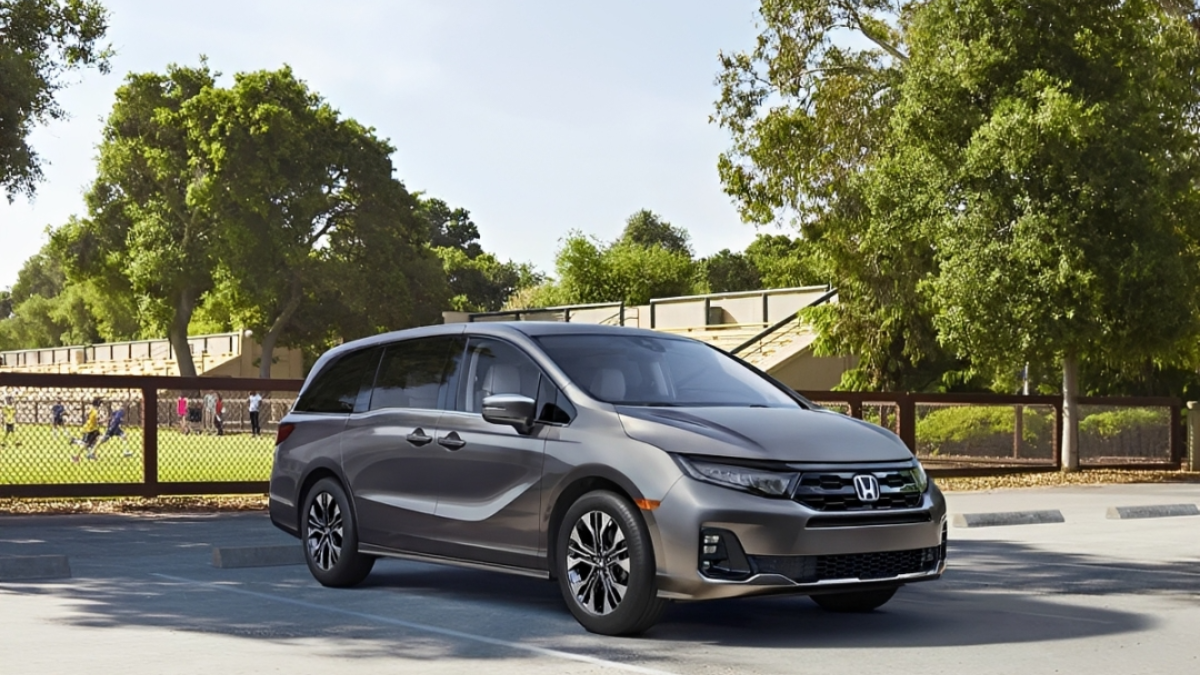
The powertrain character difference between these two vehicles is most apparent on grades.
The Odyssey’s 3.5L V6 at 280 hp and paired with a 10-speed automatic produces linear, responsive acceleration that Edmunds measured at 7.6 seconds to 60 mph. On mountain approach roads — the kind of extended climb that precedes ski resorts, national parks, and summer lake destinations — the V6 delivers its power in a conventional, immediate way that drivers find intuitive and the vehicle manages without drama.
The Sienna’s hybrid system at 245 hp reaches 60 mph in approximately 8.6 seconds per Edmunds’ testing — approximately one second slower. More relevantly, the Sienna uses a CVT (e-CVT) transmission. Under sustained full-throttle climbing, the CVT produces a higher engine note that does not correspond to the sensation of acceleration in the way a stepped automatic does. This is the “rubber band” effect familiar to hybrid drivers: the engine revs to maintain power output while the electric motors handle the torque delivery. Drivers who have not owned a hybrid may find this disorienting on their first extended mountain climb.
For the majority of road trip driving — sustained highway cruise, urban acceleration, freeway merging — both vehicles deliver adequate performance and the difference is minor. On the specific scenario of a loaded seven-passenger minivan climbing a 6 percent grade for 12 miles, the Odyssey’s V6 feels more confident and less strained.
Cabin Noise: Hybrid Quietude vs. V6 Refinement
The Sienna’s hybrid powertrain runs on electric power alone at moderate highway speeds and light loads, reducing cabin noise relative to a continuously running V6. At cruise, the Sienna’s cabin is quieter than the Odyssey’s by a margin that becomes noticeable on a three-hour highway run — particularly for the rear passengers who are furthest from the road noise sources but closest to the powertrain when the V6 is under load.
The Odyssey’s V6 is a refined, smooth engine by minivan standards, and Honda has invested in acoustic insulation across the current generation. But a running V6 at highway cruise produces a continuous powertrain note that the hybrid’s engine-off periods eliminate. After four hours of driving, this difference registers in the rear passengers’ comfort.
Consumer Reports’ assessment of the Sienna in its minivan comparison confirms the cabin quality advantage: the Sienna’s hybrid drivetrain contributes to a notably quiet highway cruising character. The Odyssey is not objectionably loud — it competes well against non-hybrid three-row SUVs — but it cannot match the Sienna’s engine-off highway quiet.
AWD: A Decisive Advantage the Odyssey Cannot Offer
Every Sienna hybrid trim is available with Toyota’s electric AWD — a system that uses a rear electric motor to drive the rear wheels independently, without a mechanical connection to the front drivetrain. This system is lighter and faster-responding than conventional AWD, and it is available at no additional cost on XLE and above trims.
The Odyssey is FWD only. There is no AWD option at any trim level or price point.
For families in cold-climate markets — the Upper Midwest, New England, the Rockies, all Canadian provinces — this distinction may be the deciding factor regardless of fuel economy or cargo preferences. A family making ski weekend trips from Denver to Summit County, or from Montréal to Tremblant, or from Seattle to Stevens Pass, cannot do so in an Odyssey on all-season tires with the same confidence as in a Sienna AWD.
The Odyssey in winter conditions is not unsafe — FWD minivans with winter tires perform adequately on most urban and highway snow conditions. But the Sienna’s AWD provides a traction margin that is specifically relevant for the mountain road trips that define many families’ annual calendar.
Price: Sienna Cheaper to Buy, Odyssey Cheaper at Its Base
The Sienna starts at approximately $41,615 (LE FWD). The Odyssey starts at approximately $42,240 (Sport). At base-level comparison, the Sienna is modestly less expensive.
However, the Odyssey’s EX-L — the trim with leather seating, power sliding doors, rear entertainment, and the features most road-trip buyers actually want — starts at approximately $46,175. The Sienna XLE, which is the directly comparable equipment level, starts at approximately $44,890 (FWD) or $47,615 (AWD).
At equivalent feature levels, the two vehicles arrive at similar prices — within $1,500–$2,000 of each other, with AWD adding approximately $2,700 to the Sienna. Over five years of ownership, the Sienna’s fuel savings (~$1,250–$1,425 at current prices) effectively eliminate this price premium.
Which One for Road Trips — The Decision
Choose the 2026 Toyota Sienna if:
- Fuel economy is your most-weighted road trip variable — $250 per year in fuel savings at 20 weekend trips compounds into real money over ownership
- Your road trips include any winter mountain access where AWD is relevant — the Sienna is the only mainstream minivan with electric AWD across multiple trims
- A quieter highway cabin at cruise is important for sleeping passengers and long rear-row comfort
- You value Toyota’s hybrid reliability track record for a vehicle you plan to keep 10+ years
Choose the 2026 Honda Odyssey if:
- Your road trips regularly require maximum cargo flexibility — the 140.7 cu ft maximum cargo and Magic Slide seats create a loadout that the Sienna cannot match
- The third row is occasionally occupied by adults or older teenagers where the 2.4-inch legroom advantage shows in comfort
- The V6’s immediate, conventional power delivery matters for mountain approaches and driver confidence under full load
- Your road trips never involve snow or ice, making the AWD advantage irrelevant to your route profile
Edmunds’ concurrent minivan comparison summarizes the choice well: the Sienna won their test overall for fuel economy and refinement; the Odyssey earned its recommendation for families with young children who need maximum second-row flexibility and cargo access. Both are correct — for different families.
SOURCES
- U.S. DOE/EPA fueleconomy.gov: 2026 Sienna hybrid FWD 36/36/36 mpg; AWD 35/35/35 mpg; primary EPA source for all Sienna fuel economy in this article
- U.S. DOE/EPA fueleconomy.gov: 2026 Odyssey 19/28/22 mpg; primary EPA source for all Odyssey fuel economy in this article
- Edmunds concurrent three-vehicle minivan comparison: Sienna winner at 8.3/10; Odyssey 8.1/10; Sienna ~600-mile tank range vs. Odyssey ~430-mile range; Odyssey 0–60 in 7.6 seconds; Sienna 0–60 ~8.6 seconds; Odyssey best for families with young children; Sienna best for fuel economy and refinement
- Edmunds Sienna vs. Odyssey 2026 specs: Sienna 33.5 cu ft behind third row, 101 cu ft max; Odyssey 32.8 cu ft behind third row, 140.7 cu ft max; Sienna third-row legroom 36.3 in; Odyssey 38.7 in; Odyssey 280 hp V6 with 10-speed; Sienna 245 hp hybrid with e-CVT; Magic Slide seats described
- The Weekly Driver April 2026: Sienna starts $41,615; Odyssey EX-L starts $44,290 (confirmed range); Sienna AWD electric rear motor standard on XLE+; Odyssey FWD-only confirmed; Sienna cabin quiet advantage at highway cruise; Carnival Hybrid 32 mpg combined noted for context
- Consumer Reports minivan overview: Sienna hybrid drivetrain contributes to quieter highway cruise character; Odyssey cabin refinement adequate but V6 produces continuous powertrain note at highway cruise; cargo comparison methodology using occupied-seat measurements