

Most three-row SUV buyers have a number in their head. The SUV has third-row seating and substantial cargo capacity, and the family will fit everyone and everything on the annual summer drive to the lake house. The number they have in their head is usually the vehicle’s total maximum cargo volume — the figure that appears in every review, usually somewhere between 84 and 100 cubic feet — measured with every seat folded flat and no human being in the vehicle.
On a family road trip, no seat is folded flat. All seven seats are occupied. The relevant number is not maximum cargo capacity. It is the cargo capacity behind the raised third row — the space that exists when the family is actually in the vehicle.
When you compare minivans and three-row midsize SUVs on this specific figure, the comparison stops being close. The Honda Odyssey offers 32.8 cubic feet behind the occupied third row. The Toyota Highlander offers 16 cubic feet. The Kia Carnival offers 40.2 cubic feet. The Kia Telluride offers approximately 21.5 cubic feet. These are not rounding differences. They are the difference between fitting all five bags behind the third row and fitting half of them, while the other half land on laps, in footwells, or on top of the roof box you had to buy because you didn’t know these numbers before purchasing the vehicle.
Quick Takeaways
- The cargo volume figure in most vehicle reviews is measured with all seats folded flat and the vehicle empty — not the number that applies to a loaded family road trip; the figure that matters when seven people are traveling is cargo behind the raised third row
- The Honda Odyssey offers 32.8 cu ft behind the occupied third row; the Toyota Sienna offers 33.5 cu ft; the Kia Carnival offers 40.2 cu ft — versus the Toyota Highlander’s 16 cu ft, the Honda Pilot’s approximately 18.8 cu ft, and the Kia Telluride’s approximately 21.5 cu ft
- A family of five traveling for four days with adult bags needs a minimum of 13–16 cu ft of cargo space behind the third row (five carry-on-sized bags at approximately 2.7 cu ft each); minivans meet this requirement with meaningful margin; most three-row midsize SUVs meet it with little or no margin and no room for camping gear, sports equipment, or a cooler
- Consumer Reports’ independent cargo testing methodology — measuring the largest rectangular box that fits through the rear opening with the hatch closed — confirms that manufacturer-stated cargo figures often overstate usable space; the real-world loading dimension (cargo opening width and height) further limits what can be carried regardless of the cubic-foot spec
- The Weekly Driver’s April 2026 minivan comparison is specific: “A $42,000 Sienna holds more cargo, offers easier child-seat access through sliding doors, and returns better fuel economy than comparably priced three-row SUVs like the Toyota Highlander or Kia Telluride”
- For families whose primary summer trip involves seven occupied seats and a full set of luggage, the minivan is not a compromise. It is the vehicle designed for the use case — and the three-row SUV is the vehicle that requires a roof box to compensate for what its packaging cannot deliver
The Number Everyone Uses — and Why It’s Wrong for Road Trips
The automotive press, manufacturer websites, and dealership floor conversations all reference total maximum cargo volume. This is the figure measured with every rear seat folded to the floor, producing the largest possible empty cavity behind the front seats. It is a reasonable comparison metric when you are moving an apartment or carrying a kayak — scenarios in which passenger seats are not in use.
It is not the figure that applies to a family of seven on a summer road trip. In that scenario, seven seats are occupied, six sets of luggage need to go somewhere, and the available cargo space is whatever exists between the back of the occupied third-row seat and the closed rear hatch.
Consumer Reports specifically addresses this in its cargo testing methodology: “Our auto engineers also measure the luggage capacity behind the raised third row. Automakers market three-row vehicles as ‘family-friendly,’ but anyone who has packed for a road trip knows that the space behind a raised third-row seat rarely can hold much luggage. We evaluate this space to see how many bags can fit when each row is occupied.”
The behind-third-row figure is the one that determines whether the road trip works without supplemental roof storage. For most three-row midsize SUVs, this number ranges from 14 to 22 cubic feet. For most minivans, it ranges from 30 to 40 cubic feet. The gap is roughly 2:1 in favor of the minivan for the specific use case that three-row vehicles are marketed to serve.
The Numbers, Side by Side
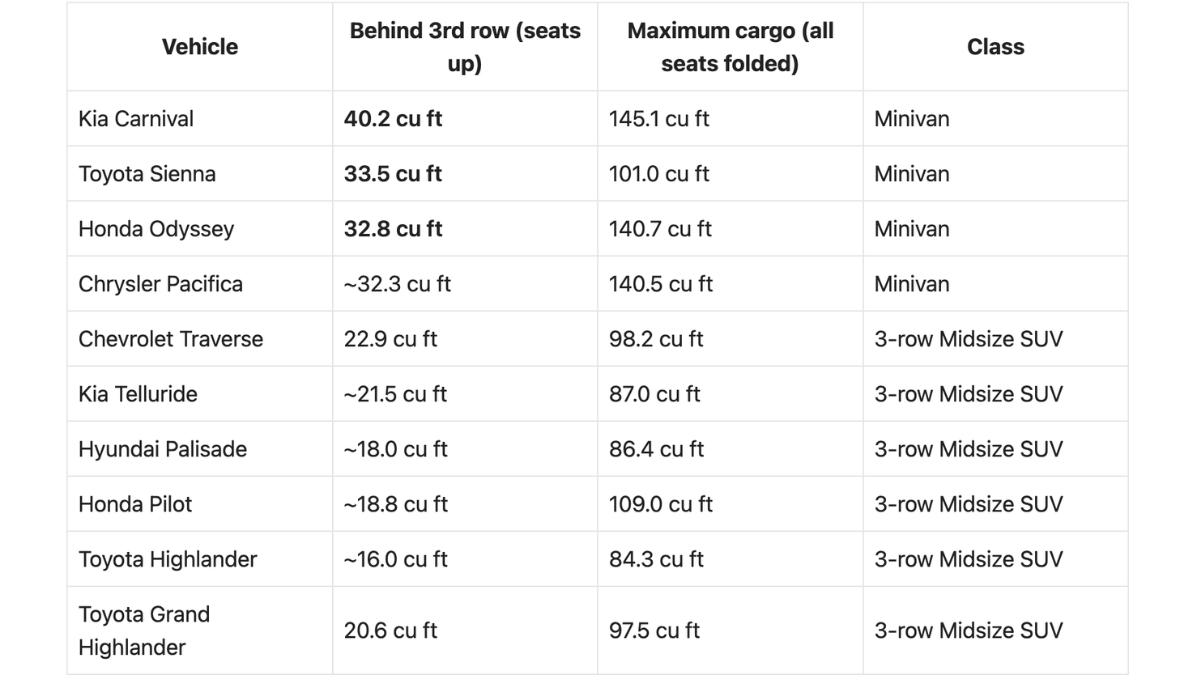
The Carnival’s 40.2 cu ft behind the occupied third row is the segment-leading figure in all of passenger vehicles under $55,000. The Sienna’s 33.5 and Odyssey’s 32.8 are closely competitive. The Chevrolet Traverse leads three-row midsize SUVs at 22.9 — still 10 cubic feet less than the Odyssey.
The Honda Pilot’s maximum cargo (109 cu ft, seats folded) looks competitive against the Sienna’s 101 cu ft — until you note that the Pilot’s behind-third-row figure is approximately 18.8 cu ft, nearly half the Sienna’s 33.5. Maximum cargo volume is a comparison of what happens when the vehicle becomes a delivery van. Behind-third-row volume is what happens when it is a family vehicle.
The Carry-On Arithmetic
A standard airline carry-on bag — approximately 22 × 14 × 9 inches — occupies approximately 2.7 cubic feet. A typical family of five traveling for a weekend generates five bags of roughly this size, plus one large duffel or checked-bag-equivalent per couple.
Minimum cargo needed for a five-person weekend trip: approximately 5 bags × 2.7 cu ft = 13.5 cu ft, before a cooler, a beach bag, a stroller, or any sports equipment.
For a one-week trip with larger bags: 5 checked-bag-sized items × 5.5 cu ft = 27.5 cu ft minimum, before camping equipment, beach chairs, or bicycle gear.
How the vehicles perform against these thresholds:
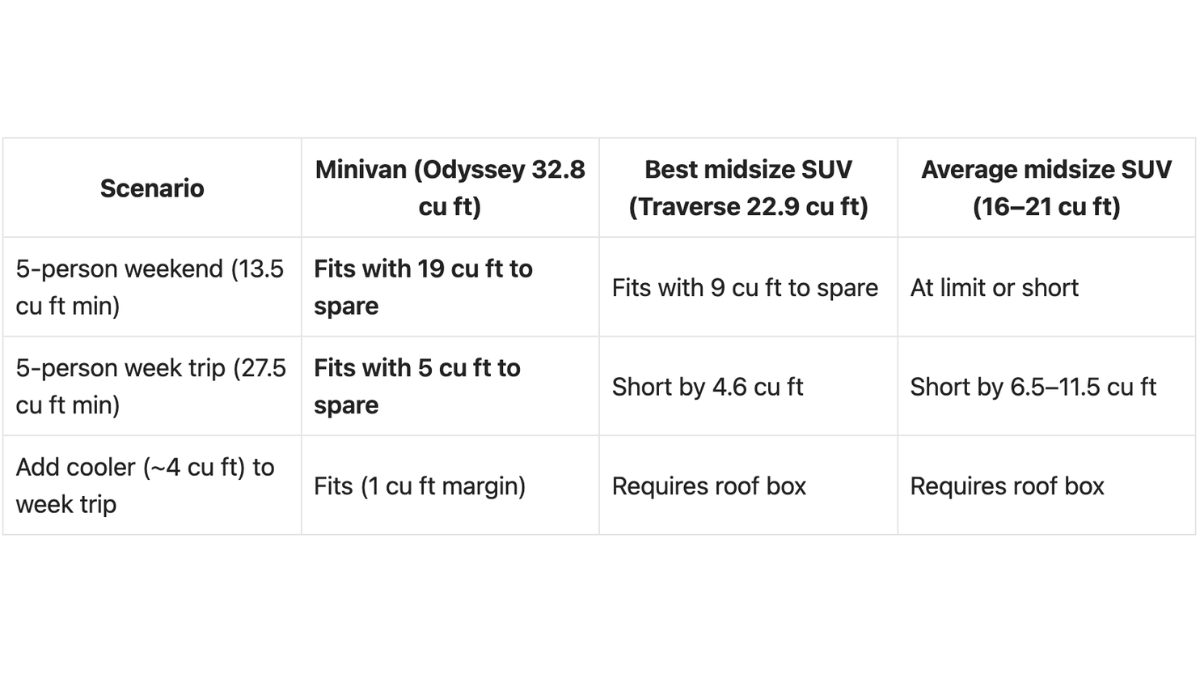
The Traverse is the three-row midsize SUV with the best chance of carrying a family’s week-trip luggage without supplemental roof storage. Most three-row midsize SUVs do not make it past a five-person weekend trip with a cooler without requiring either a roof box or a philosophical conversation about how many shoes each person actually needs.
The Cargo Opening: The Dimension That Overrules the Spec Sheet
Cubic feet is a volume figure. What can actually be loaded depends also on the size of the opening through which the cargo must pass — the width and height of the rear hatch aperture.
A minivan’s rear hatch opens to a wide, tall, squared aperture that allows bulky items — strollers, folded bikes, large coolers, camping duffels — to load directly without rotation or diagonal insertion. Consumer Reports’ pipe-frame box methodology captures this: “Our adjustable pipe-frame box lets Consumer Reports’ auto testers measure the largest item you can fit through the cargo opening and into the vehicle.”
A three-row SUV’s rear hatch aperture is narrower and typically lower than a minivan’s, because the sloped roofline that gives the SUV its styling also reduces the opening height at the rear. Items that pass through a minivan’s cargo opening without adjustment sometimes require tilting or rotating to enter a midsize SUV’s cargo bay. This practical loading difference does not appear in any cubic-foot comparison.
For families loading a stroller, a pack-n-play, a large dog, or a bicycle wheel-to-wheel: the loading aperture matters at every stop. A minivan’s squared rear opening is specifically designed for this task. A three-row SUV’s sloped-back aperture is a styling compromise that trades loading ease for visual profile.
Where the Three-Row Midsize SUV Still Wins
The cargo case for minivans is strong and consistent for loaded family travel. The three-row SUV is not the wrong answer for every family.
AWD across the full lineup. Consumer Reports confirms: “Every three-row SUV is available with all-wheel drive, plus they have added ground clearance that can be helpful when leaving pavement.” Only two minivans — the Toyota Sienna and the Chrysler Pacifica — offer AWD, and the Pacifica’s plug-in hybrid is discontinued for 2026. For families who access unpaved campsites, mountain roads in shoulder season, or winter ski resort approaches, the SUV’s AWD across all trims and its additional ground clearance are genuine functional advantages that the minivan cannot fully match.
Towing. Most three-row midsize SUVs tow 5,000 lbs or more with AWD. Minivans are limited to approximately 3,500 lbs. A family towing a boat trailer, camper, or utility trailer on the same trip needs an SUV.
Social calculus. The Weekly Driver’s April 2026 minivan comparison addresses this directly: minivans remain underrepresented on roads “partly due to social perception.” This is a real factor in purchasing decisions. A family that will not buy a minivan regardless of its cargo and passenger advantages will still be better served by the Chevrolet Traverse (22.9 cu ft) or Toyota Grand Highlander (20.6 cu ft) than by the Highlander or Pilot — and should prioritize the Traverse specifically for its class-leading behind-third-row cargo volume among three-row midsize SUVs.
The Roof Box as the Hidden Cost of the Wrong Vehicle
Families who buy three-row midsize SUVs and discover the behind-third-row cargo limitation typically respond with a cargo carrier. A rooftop cargo box — Thule, Yakima, and similar — adds approximately 14–18 cubic feet of storage and costs $400–$900 plus installation hardware.
Adding a rooftop box to a Highlander or Telluride effectively converts a 16–21 cu ft behind-third-row capacity into a 30–39 cu ft combined capacity — which is approximately where the Odyssey and Sienna start, without any additional hardware.
The NREL’s aerodynamic research documents the fuel economy penalty of a rooftop cargo box: 5–15 percent highway fuel economy reduction at cruise speed, depending on box size, shape, and vehicle design. On a 600-mile summer road trip in a Telluride (21 mpg combined), a 10 percent rooftop cargo box penalty adds approximately 3 gallons of fuel consumed — approximately $10 per trip.
Over 20 trips per year, the roof box fuel penalty amounts to approximately $200 annually, in addition to the $400–$900 purchase cost and the loading and unloading effort at every stop. The minivan delivers the same combined cargo capacity without the hardware cost, the aerodynamic penalty, or the height restriction at parking garages.
Which Vehicle for Which Family
Choose a minivan if: You travel with all seven seats occupied more than twice per year and need to carry full luggage behind the occupied third row. The cargo math resolves decisively in the minivan’s favor for this use case — the Carnival (40.2 cu ft), Sienna (33.5), and Odyssey (32.8) all carry two to three times the behind-third-row cargo of most three-row midsize SUVs.
Choose the Chevrolet Traverse or Toyota Grand Highlander if: You need an SUV specifically but want the best cargo performance available in the midsize three-row SUV class. The Traverse at 22.9 cu ft and Grand Highlander at 20.6 cu ft lead the class.
Choose any other three-row midsize SUV if: The third row is used occasionally by children rather than regularly by adults, and weekend trips never fully load all seven seats simultaneously. In this usage profile, the behind-third-row cargo figure is less frequently the binding constraint.
U.S. and Canada Note
The cargo argument for minivans applies most acutely on the summer family road trip routes that define North American family travel: the drive to Myrtle Beach or the Outer Banks from the Mid-Atlantic, the Trans-Canada run from Toronto to the Maritimes, the annual Yellowstone or Glacier trip from the Mountain West, the Banff or Jasper run from Calgary. These are week-long trips with full family occupancy and full luggage loads — exactly the use case where the behind-third-row cargo figure is the binding constraint, and where the 2:1 minivan advantage in available space translates directly into the difference between arriving with everything and arriving with everything except what’s in the overloaded cargo net.
SOURCES
- Consumer Reports cargo methodology: pipe-frame box measures largest item fitting through rear opening; luggage test measures bags fitting behind raised third row when all rows are occupied; Kia Carnival Hybrid tested; rankings within class by third-row luggage capacity; confirms manufacturer specs often overstate usable cargo
- The Weekly Driver April 2026: “A $42,000 Sienna holds more cargo, offers easier child-seat access through sliding doors, and returns better fuel economy than comparably priced three-row SUVs like the Toyota Highlander or Kia Telluride”; Carnival 40.2 cu ft behind third row, 145.1 cu ft max; Sienna 33.5 cu ft behind third row, 101 cu ft max; Odyssey 32.8 cu ft behind third row, 140.7 cu ft max; Odyssey 22 mpg; Sienna/Carnival Hybrid 35–36/32 mpg; Pacifica Stow ‘n Go noted
- Consumer Reports minivan vs. SUV overview: “Every three-row SUV is available with all-wheel drive, plus they have added ground clearance that can be helpful when leaving pavement”; Chrysler Pacifica and Toyota Sienna only AWD minivans; Sienna hybrid; Pacifica PHEV discontinued 2026; towing limits minivans ~3,500 lbs vs. SUVs 5,000+ lbs
- Edmunds Odyssey: 32.8 cu ft behind third row; 140.7 cu ft maximum; Magic Slide second-row seats 68 lbs each; Honda refreshed exterior and cabin for 2025, carried into 2026; 22 mpg combined confirmed
- U.S. News Toyota Highlander: approximately 16 cu ft behind third row; 84.3 cu ft maximum cargo; third row for children per editorial consensus; Hybrid 35 mpg combined confirmed
- MotorTrend: Kia Telluride approximately 21.5 cu ft behind third row; 87 cu ft maximum; segment cargo comparison table; Traverse 22.9 cu ft leading midsize SUV class behind third row
- NREL aerodynamic accessories: rooftop cargo box reduces highway fuel economy 5–15% at cruise speed; adds 14–18 cu ft typical storage; combined cargo capacity with box approaches minivan base capacity