

The 2026 Ford Bronco Sport is a genuinely excellent vehicle for a specific set of tasks. It has real off-road capability at a price that dedicated off-road vehicles cannot match. Its boxy shape and upright windshield give it a visual identity that no compact crossover competitor can replicate. It has a flip-up rear window, Trail Turn Assist, terrain-specific G.O.A.T. modes, and a personality that makes a grocery run feel like a prelude to an adventure. For a driver who values all of this and uses the off-road hardware, the Bronco Sport is the right vehicle.
It is not, however, a great road trip vehicle — and the reasons are structural, not incidental. The same engineering decisions that make it a capable trail machine work against it on the sustained highway cruise that a family road trip requires. The upright windshield that gives it character and visibility is also a sail that catches highway wind and generates noise. The off-road suspension tuning that absorbs rutted trails is also a ride that feels stiff on Interstate expansion joints at 70 mph. The large frontal area that clears obstacles also costs fuel economy in a way that compounds visibly on a 500-mile run.
Nobody mentions any of this at the dealership, because the Bronco Sport’s off-road story is compelling and the highway story is not. Here is the highway story.
Quick Takeaways
- The 2026 Bronco Sport with the base 1.5L EcoBoost engine returns approximately 25–26 mpg combined per U.S. News real-world testing — against the 2026 Honda CR-V Hybrid’s 37 mpg combined and Toyota RAV4 Hybrid’s 42 mpg combined; on a 500-mile road trip, this fuel difference costs approximately $22–$26 more per trip versus a comparable hybrid compact SUV
- The Bronco Sport is classified as a subcompact SUV at 173 inches long — approximately 9 inches shorter than the Honda CR-V and 11 inches shorter than the Toyota RAV4; its interior dimensions reflect this: 32.5 cu ft cargo with seats up, against the CR-V’s 36+ cu ft and RAV4’s 37.8 cu ft
- U.S. News’ 2026 Bronco Sport review lists its notable weaknesses explicitly: “Can feel underpowered, stiff ride, tight rear seat” — three of the four factors that most directly affect road trip comfort
- The Bronco Sport’s upright windshield and boxy profile, which create excellent forward visibility and trail capability, also produce measurably more aerodynamic drag than sloped-roof crossovers at highway speed — contributing to both higher fuel consumption and cabin wind noise at 70 mph
- The Bronco Sport has no hybrid powertrain option and no announced hybrid variant for 2026; buyers who want the Bronco Sport’s off-road identity with better highway fuel economy have no factory solution — the vehicle is the vehicle
- Three alternatives that serve road trips better in each relevant category: Honda CR-V Hybrid (fuel economy and rear passenger space), Mazda CX-50 (highway NVH and seat support), Toyota RAV4 Hybrid (fuel economy and towing); all three cost less to fuel on a highway run and none of them require trading away meaningful daily-use capability to get there
The Fuel Number That the Adventurous Branding Obscures
The Bronco Sport’s marketing is built around trails, elevation gain, and gear. This framing is legitimate — the vehicle genuinely does trail things better than most compact crossovers. It is also effective at making fuel economy feel like a secondary specification, the kind of thing that matters to a different type of driver.
On a 500-mile road trip, fuel economy is the primary operating cost variable. And the Bronco Sport’s fuel economy is significantly below the compact hybrid SUV segment it is priced against.
U.S. News’ 2026 Bronco Sport review documents the real-world result: in a mix of on- and off-road driving, the tester returned 25.4 mpg — in line with EPA estimates of approximately 26 mpg combined for the base 1.5L EcoBoost. The uplevel 2.0L EcoBoost, used in the Badlands and Wildtrak trims, is EPA-rated at approximately 22–23 mpg combined.
At $3.50/gallon, on a 500-mile highway trip:
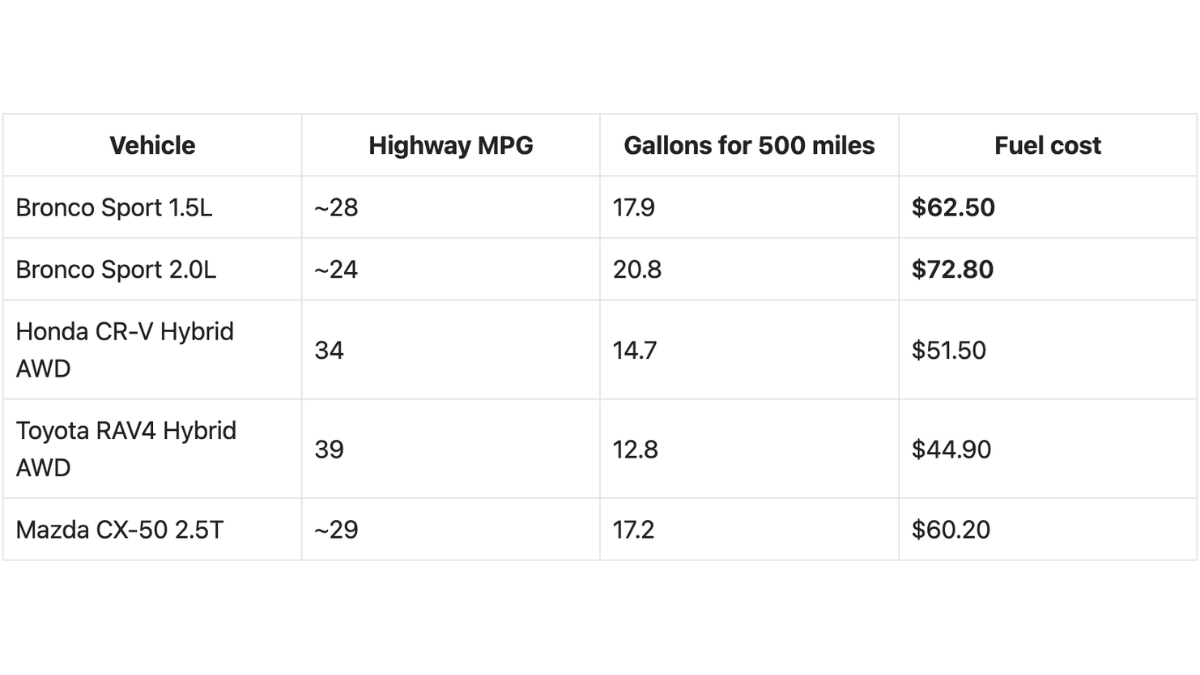
The base Bronco Sport costs approximately $11 more in fuel per 500-mile trip than the CR-V Hybrid, and $18 more than the RAV4 Hybrid. The Badlands or Wildtrak costs approximately $21–$28 more per trip than the CR-V Hybrid. Over 20 weekend trips per year, the Bronco Sport owner pays approximately $220–$560 more in fuel than a hybrid compact SUV owner — in addition to a purchase price that is broadly comparable.
The Bronco Sport has no hybrid option. Ford has not announced one. For buyers who want the Bronco Sport and make frequent long highway runs, there is no factory path to improving this number.
The Ride Quality Problem at Highway Speed
U.S. News characterizes the 2026 Bronco Sport’s ride as “stiff” — and attributes this specifically to the off-road suspension tuning that defines the vehicle’s trail capability.
This is an accurate description of an engineering trade-off, not a manufacturing defect. The Bronco Sport’s suspension is calibrated for articulation, obstacle clearance, and rough-surface stability. These calibrations require a firmer spring rate and less compression compliance than a highway-comfort-focused compact crossover. On a rutted trail or a washboard gravel road, this suspension is an asset — it maintains composure, reduces bottoming out, and keeps the tires in better contact with irregular surfaces.
On Interstate concrete at 70 mph, the same suspension transmits more road texture to the occupants than a ride-comfort-tuned compact SUV. Highway expansion joints, road surface transitions, and the micro-texture of concrete slabs — the constant low-frequency inputs of a 500-mile highway drive — are felt more clearly in the Bronco Sport’s cabin than in the CR-V or CX-50.
This is not a dealership-conversation item because it requires sustained highway exposure to perceive. In a 15-minute test drive on suburban roads, the Bronco Sport’s suspension feels capable and reasonably controlled. At mile 180 of a summer road trip, the cumulative effect of slightly stiffer highway compliance is a form of fatigue that the driver notices without always identifying its source.
The Wind Noise Problem at 70 MPH
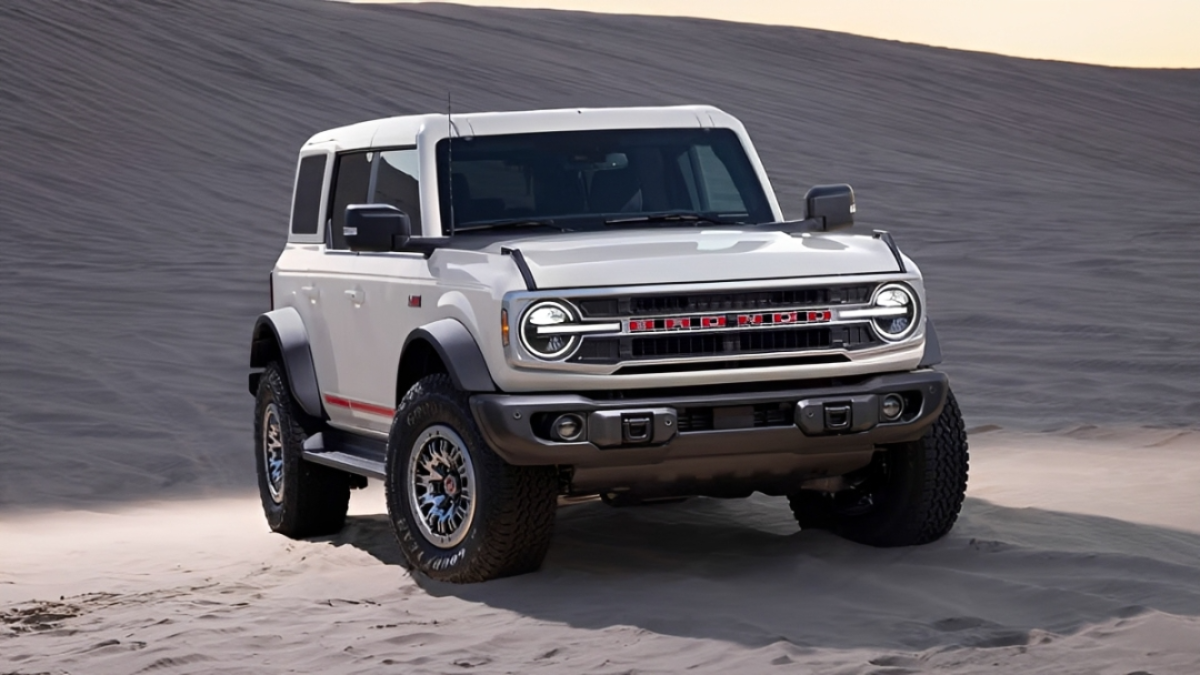
The Bronco Sport’s upright windshield is one of its most distinctive design elements and one of its most practical assets on a trail — it gives the driver an unobstructed forward view of the terrain immediately ahead of the front bumper, which matters when placing a tire precisely on a rock. At 70 mph on the Interstate, the same upright windshield is a large, vertical surface meeting the airstream at close to a 90-degree angle.
Aerodynamic drag scales with the square of velocity and is heavily influenced by frontal area and shape. A flat, upright surface creates significantly more drag than a sloped, tapered one at the same frontal area. This aerodynamic reality does two things simultaneously: it increases fuel consumption (contributing to the mpg figures described above), and it generates wind noise that enters the cabin at highway speeds.
U.S. News’ 2026 Bronco Sport review does not single out wind noise as a standout failing — the acoustic story is not catastrophic. But the vehicle’s boxy profile and upright windshield produce a higher highway wind noise floor than aerodynamically optimized competitors like the Mazda CX-50, which Edmunds describes as settling “down nicely on the highway, with only a mild amount of wind and road noise.” The comparison is not Bronco Sport versus a library. It is Bronco Sport versus the quieter cabins that comparable-priced crossovers deliver when their rooflines are shaped for highway air rather than trail visibility.
The Size Reality: Subcompact, Not Compact
The Bronco Sport is marketed alongside compact SUVs in most cross-shopping conversations, and it competes with them at overlapping price points. Its footprint is not the same.
At 173 inches long, the 2026 Bronco Sport is classified as a subcompact SUV. The 2026 Honda CR-V is 182 inches long. The 2026 Toyota RAV4 is 180 inches long. That 9–11 inch length difference translates directly into interior dimensions that affect road trips:
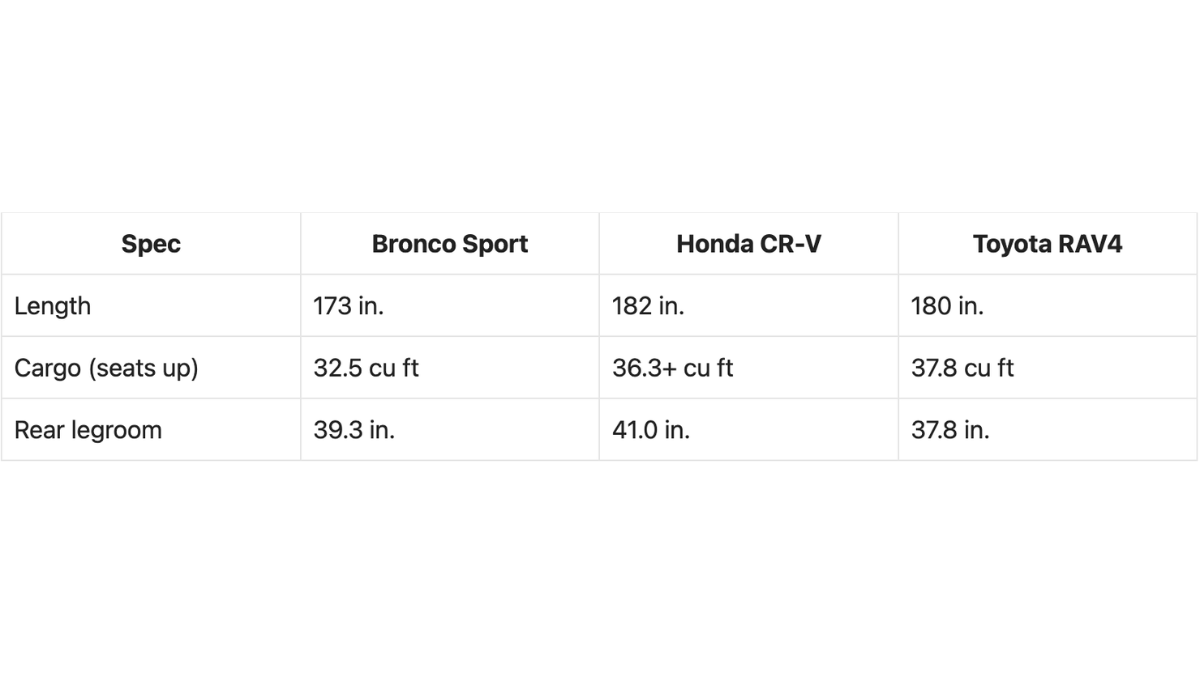
The Bronco Sport’s rear legroom (39.3 inches with the bench in the rearmost position) is meaningful — it accommodates two adults for shorter drives. U.S. News’ characterization is “tight rear seat” for a longer trip. The 1.7-inch gap versus the CR-V’s 41.0 inches is the same order of magnitude as the comfort differences documented in this series for three-hour highway drives.
Cargo is more constrained. At 32.5 cu ft with seats up, the Bronco Sport is below both the CR-V and RAV4 — vehicles that are nominally the same category and price range. For a family weekend trip with four passengers and their luggage, the cargo margin behind four occupied seats is smaller in the Bronco Sport than in either alternative.
What the Bronco Sport Gets Genuinely Right — And When It Wins
Contrarian discipline requires honesty about the vehicle’s legitimate advantages. The Bronco Sport has them, and they matter for the buyer for whom they are relevant.
Real off-road capability at compact SUV prices. The Bronco Sport with the Badlands package — low-range transfer case, locking rear differential, advanced 4×4 system — provides genuine boulder-crawling and mud capability that neither the CR-V, RAV4, nor CX-50 can approach. If the road trip includes a dirt road, a beach access track, a seasonal forest road, or a campsite that requires low-range traction, the Bronco Sport earns its price premium over highway-optimized alternatives.
Unique character that matters to the buyer. The Bronco Sport is the only vehicle in its price class that looks, sounds, and drives the way it does. For a buyer who has chosen a lifestyle identity that the Bronco Sport represents — weekend trail running, overlanding, outdoor community — the intangibles are real and durable. A vehicle that the driver looks forward to driving every day is worth something that fuel economy tables cannot quantify.
Adaptive cruise control that works. U.S. News’ reviewer specifically noted: “the adaptive cruise control with lane centering worked quite well… it does make long highway drives much easier.” For a vehicle with a stiff ride and higher highway noise, having functional adaptive cruise control that reduces the steering and speed management burden on a long run is a meaningful partial offset to its highway limitations.
Reliability. U.S. News gives the 2026 Bronco Sport a predicted reliability score of 88/100 — “Great” by their classification. This is not a vehicle that will strand you at mile 400 of a road trip. Its highway compromises are comfort and fuel cost, not mechanical dependability.
Who Should Still Buy It — And Who Should Look Elsewhere
Buy the Bronco Sport if: Your road trips consistently end at a trailhead, a campsite, or a location that requires more than paved road access. If the last 10 miles of every trip involve a dirt road or a two-track, the Bronco Sport’s off-road hardware pays for the highway fuel premium on every trip. The vehicle is doing what it was built for.
Look elsewhere if: Your road trips are predominantly highway miles that end at a hotel, a beach house, a ski resort with a paved parking lot, or a family member’s house. If the “adventure” is the drive itself — 400 miles of Interstate, two overnight stops, a national park loop on paved roads — the Bronco Sport’s off-road hardware is dead weight that costs fuel on every mile and contributes to highway noise without providing any benefit for the trip profile.
For this buyer, the right alternatives are clear: the Honda CR-V Hybrid AWD for rear passenger space and fuel economy; the Mazda CX-50 for highway composure, quieter cabin, and better seats; or the Toyota RAV4 Hybrid for the strongest fuel economy and 3,500-lb towing if a small trailer is ever part of the equation.
The Bronco Sport is not a bad vehicle. It is a vehicle optimized for a specific use case — one that is not a highway road trip.
SOURCES
- U.S. News 2026 Bronco Sport review: real-world 25.4 mpg in mixed driving in line with EPA estimates; “Can feel underpowered, stiff ride, tight rear seat”; adaptive cruise control with lane centering “worked quite well” and makes long highway drives easier; predicted reliability 88/100; classified as subcompact SUV; 173.1–173.4 in. long; seating for five; headroom generous front and rear
- U.S. DOE/EPA fueleconomy.gov: 2026 Bronco Sport 1.5L EcoBoost AWD fuel economy; 2.0L EcoBoost Badlands/Wildtrak figures; primary EPA source for all Bronco Sport fuel economy in this article
- U.S. DOE/EPA: 2026 CR-V Hybrid AWD 40/34/37 mpg; primary EPA source for CR-V comparison figures
- U.S. DOE/EPA: 2026 RAV4 Hybrid LE/SE AWD 46/39/42 mpg; primary EPA source for RAV4 comparison figures
- U.S. News CR-V vs. RAV4: confirmed CR-V rear legroom 41.0 in.; cargo 36.3+ cu ft; RAV4 rear legroom 37.8 in.; cargo 37.8 cu ft; both confirmed against Bronco Sport dimensions
- Edmunds CX-50: “settles down nicely on the highway, with only a mild amount of wind and road noise”; confirmed highway NVH advantage over Bronco Sport’s boxy profile; seat support praised