

A 600-mile round trip is the most common American road trip that families actually take: a long weekend to a national park, a beach town three states away, a grandmother’s house that is just far enough to require one overnight. It is long enough that fuel cost matters and short enough that most families attempt it without planning fuel stops in advance.
In 2026, the same trip in three different vehicles — a hybrid compact SUV, a gas-only compact SUV, and an electric SUV — costs a meaningfully different amount and requires a meaningfully different logistical effort. The gap between the cheapest and most expensive options is not trivial. The gap between the most convenient and least convenient is not either. And spring — when EV ranges are partially recovered from winter lows but highway speeds are still cold enough to affect the math — is a specific seasonal context that changes the calculation in ways that neither the winter cold-weather data nor the summer baseline fully captures.
Here is the honest, fuel-math-first answer for all three.
The Three Vehicles and Why They Were Chosen
This comparison uses three compact SUVs that a family of four can reasonably cross-shop in 2026 at overlapping price points, representing each powertrain category honestly:
Hybrid: 2026 Toyota RAV4 Hybrid AWD (LE trim) — 39 mpg highway per EPA, 13.2-gallon tank, $33,350 starting MSRP. The segment’s fuel economy leader among hybrid compact SUVs and the best-selling hybrid in North America.
Gas: 2026 Honda CR-V AWD (EX trim) — 34 mpg highway per EPA, 14.0-gallon tank, approximately $34,000 starting MSRP. Chosen because the 2026 RAV4 is now hybrid-only across all trims; the CR-V represents the segment’s most competitive non-hybrid compact SUV for direct comparison.
Electric: 2026 Chevrolet Equinox EV AWD — approximately 280 miles EPA range (LT AWD), 17.7 kWh per 100 miles, approximately $34,995 starting MSRP. Chosen for its competitive pricing against the hybrid and gas options — the most direct price-to-price EV comparison available in this class.
The Fuel Math: 600 Miles, Three Ways
Spring conditions assumed: Temperatures of 45–60°F at departure, highway-dominant driving at 65–70 mph, fully loaded family vehicle. These are representative mid-April through May conditions across most of the U.S. and Canadian southern corridors.
Hybrid: 2026 RAV4 Hybrid AWD

At 39 mpg highway (EPA LE AWD), the RAV4 Hybrid covers 600 miles on:
- Gallons needed: 15.4 gallons
- Fuel cost at $3.50/gal: $53.90
- Fuel cost at $4.00/gal: $61.60
- Fuel stops: 1 stop (13.2-gallon tank × 39 mpg = 515-mile tank range; one stop needed at approximately mile 400 outbound, fuel at destination, return non-stop or one brief top-up)
Real-world spring caveat: At 65–70 mph highway speed, real-world hybrid fuel economy runs 5–10 percent below EPA. A realistic spring highway figure for the RAV4 Hybrid AWD is approximately 35–37 mpg. At 36 mpg real-world: 16.7 gallons, $58.40 at $3.50/gal. This article uses EPA figures for the primary comparison and notes the real-world adjustment.
Gas: 2026 Honda CR-V AWD

The 2026 CR-V AWD EX is rated 34 mpg highway (EPA). At highway speed in spring conditions:
- Gallons needed: 17.6 gallons
- Fuel cost at $3.50/gal: $61.80
- Fuel cost at $4.00/gal: $70.60
- Fuel stops: 1–2 stops (14.0-gallon tank × 34 mpg = 476-mile range; one stop required, second stop likely on return if not topped off at destination)
The CR-V’s higher highway MPG (34 vs. typical 25–28 mpg for older non-hybrid compact SUVs) makes it a more efficient gas option than the segment average. A less efficient gas compact SUV at 26 mpg highway would cost $80.77 for the same 600 miles at $3.50/gal — 50 percent more than the hybrid.
Electric: 2026 Chevrolet Equinox EV AWD

The Equinox EV AWD is EPA-rated for approximately 280 miles of range. Spring conditions (45–60°F) are meaningfully better for EVs than winter but still below the 70°F EPA test conditions. Recurrent’s large-fleet analysis found EVs retain approximately 78 percent of rated range at 32°F and approximately 88–92 percent at 45–55°F — a reasonable spring estimate. At 90 percent of rated range: approximately 252 usable miles per charge in spring conditions.
600 miles requires approximately 2.4 charges from near-empty — meaning 2 full charging stops plus a partial top-up, or 3 stops with conservative planning.
Electricity cost: The Equinox EV uses approximately 17.7 kWh per 100 miles (EPA). For 600 miles: approximately 106 kWh consumed.

The realistic scenario for a 300-mile one-way trip in an Equinox EV AWD (252 usable spring range): one DC fast charging stop each way, approximately 20–30 minutes per stop at a functional 150 kW charger. If departing with a full charge and returning to a home charger overnight, total charging cost for the round trip is approximately:
- 2 DC fast charging stops × approximately 50 kWh each × $0.43 = $43
- Home charging for overnight top-up: approximately 30 kWh × $0.16 = $4.80
- Total energy cost: approximately $48
At $3.50/gal gas prices, the EV energy cost ($48) is lower than the hybrid ($54) and meaningfully lower than the gas CR-V ($62). The economic case for the EV holds — if the charging stops work as planned.
The Full Cost Comparison Table
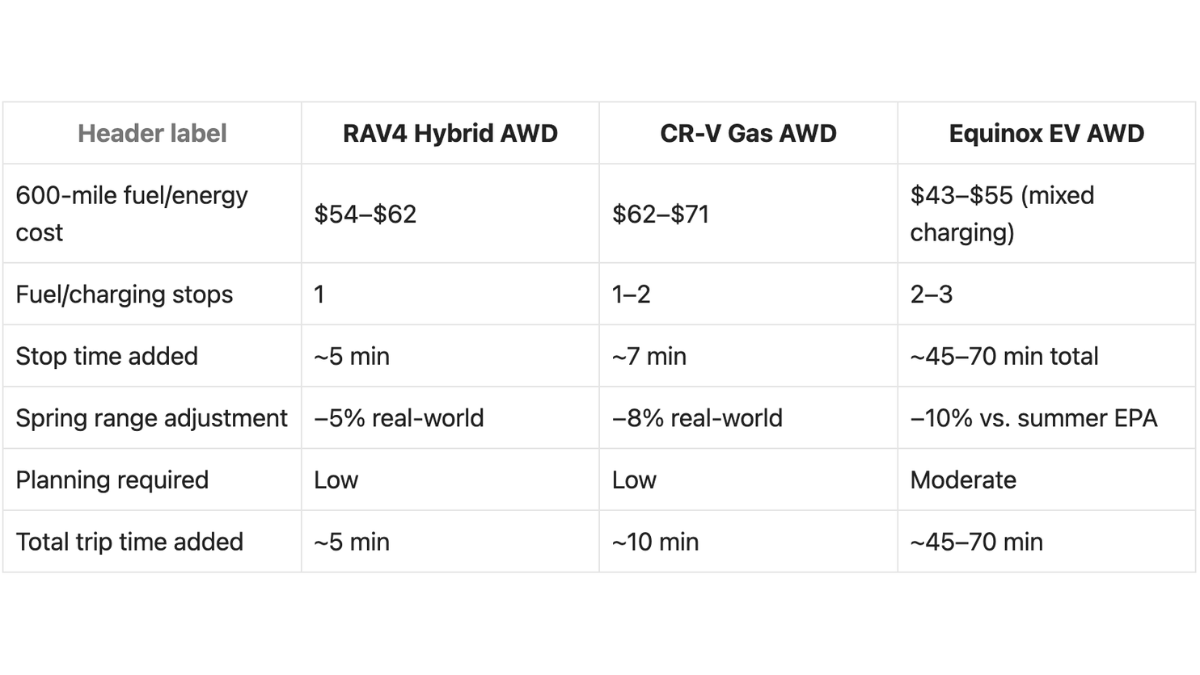
The hybrid wins on total trip time. The EV wins on per-mile energy cost in the home-charging scenario and is competitive in the DC fast-charging scenario. The gas CR-V is the most expensive option in fuel and the slowest to refuel when stops align poorly with route geography.
The Spring EV Context: Better Than January, Not as Good as July
Spring is the most misunderstood season for EV range planning, because it sits between the two data sets most people have: the winter horror stories (25–50 percent range loss, slow charging) and the summer EPA baseline (rated range, fast charging).
The reality at 45–60°F is more favorable than winter in three specific ways:
Range is closer to rated. At 50°F, most EVs deliver approximately 88–92 percent of EPA range, per Recurrent’s fleet analysis. The Equinox EV’s 280-mile rated range becomes approximately 250–258 usable miles — meaningfully better than the 196–220 miles that characterize cold January performance. A 300-mile one-way leg is manageable with one charging stop rather than the two stops that might be needed in deep winter.
Cabin heating load is lower. Spring temperatures above 40°F allow the heat pump (on EVs that have one) to operate efficiently rather than relying on the resistive heating backup that draws 3,000–5,000 watts. As documented in this series’ cold-weather range article, switching from full cabin heat to seat heaters and a lower temperature setpoint in spring conditions is both comfortable and range-extending. The Equinox EV uses a heat pump as standard equipment.
Charging speed is closer to rated. DC fast charging acceptance is significantly better at 50°F than at 20°F. EnergySage documents that cold batteries accept approximately 36 percent less energy at 32°F than at 77°F. At 50°F, this deficit shrinks to approximately 10–15 percent. A 150 kW charger that delivered 60 kW to a cold-soaked January battery may deliver 110–130 kW to a spring-temperature battery — reducing the charging stop from 45 minutes to 25–30 minutes.
The practical implication for the 600-mile spring trip in an Equinox EV: plan one charging stop each way, arriving at the charger with 15–20 percent remaining after approximately 230–250 miles of driving. Budget 25–35 minutes per stop. The trip is manageable and the planning effort is moderate, not heroic.
Where the Money Goes After the Gas Station
Fuel cost is the most visible cost difference between these three powertrains on a single trip. It is not the only one, and for families evaluating the economics over a full summer of road trips, the full-cost view matters.
AAA’s 2025 Your Driving Costs study puts the all-in cost of new vehicle ownership at approximately 77 cents per mile for a typical new vehicle — a figure that includes depreciation, insurance, maintenance, and fuel. But the per-trip variable costs (the costs that change based on miles driven) are where the powertrain comparison is most actionable:
Maintenance cost advantage: EVs eliminate oil changes (approximately $80–$120 each, typically every 5,000–7,500 miles), transmission fluid, and several other service items. On a 600-mile road trip, the incremental maintenance cost per mile is approximately 2–3 cents lower for an EV than for a gas vehicle. Over 20 weekend trips per year (12,000 road-trip miles), that is approximately $240–$360 in maintenance savings annually.
Hybrid maintenance: Hybrid vehicles retain oil change requirements but extend intervals relative to most gas vehicles due to lower engine load from the electric motor sharing propulsion. The RAV4 Hybrid’s maintenance costs are competitive with the CR-V gas on a per-mile basis but lower than a non-hybrid equivalent.
Five-year cost summary (illustrative, 15,000 miles/year, 20 weekend trips × 600 miles):
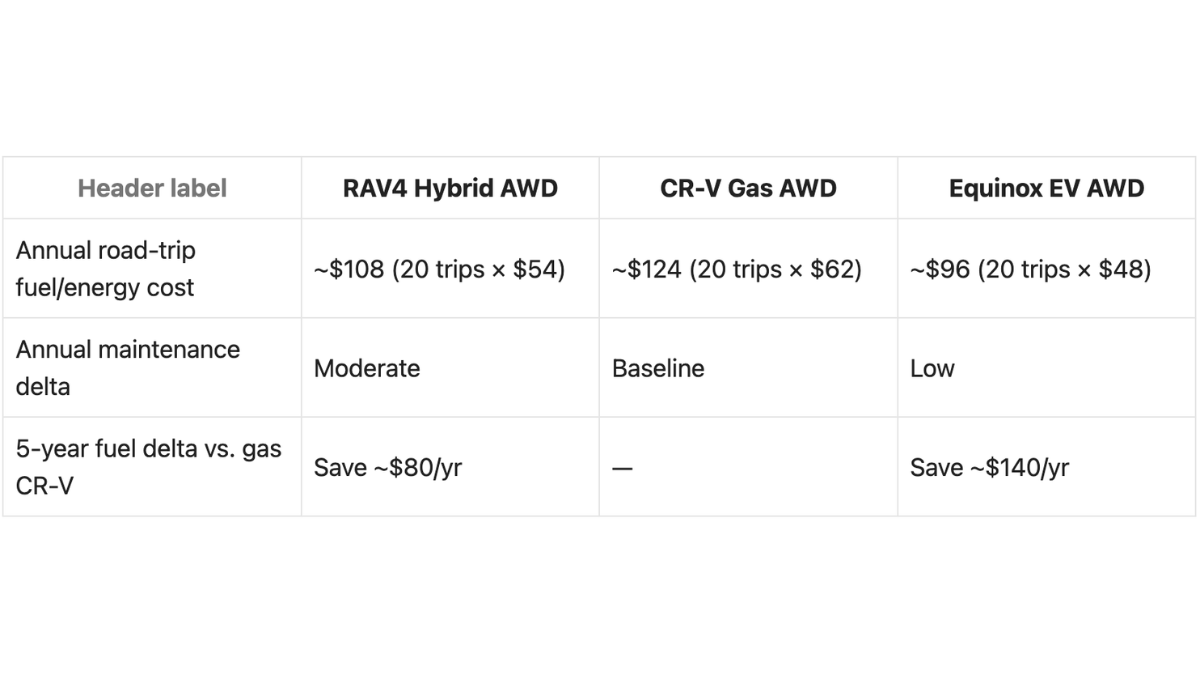
The EV’s annual fuel savings advantage over the gas option (~$28/year on 20 road trips alone) is modest for road trips specifically — both the hybrid and EV are competing against the gas vehicle, not each other, on fuel cost. The EV’s larger advantage accrues on daily commute and urban driving miles, not on 600-mile highway runs where DC fast charging narrows the cost gap.
The Charging Stop as the Real Decision Variable
For most families, the fuel cost difference between hybrid ($54) and EV ($48) on a 600-mile trip is too small to drive a powertrain decision — it is approximately $6 per trip. What actually differentiates these vehicles for a road trip buyer is the charging stop.
The hybrid stops once for gas, for approximately 5 minutes. This is invisible — it fits into a natural rest stop cycle.
The EV stops twice for charging, for 25–35 minutes each. This is not invisible. It is 50–70 minutes of planned waiting time added to the trip. For a family with young children, 35 minutes at a charging station is a bathroom break, a snack, and a park around the rest stop area — manageable but deliberate. For a family with adults who simply want to drive efficiently, it is an extra hour added to a two-day weekend trip that already involves eight hours of driving.
The question is not whether the EV costs less to drive (it often does) or whether the charging stops are enjoyable (some families find them useful; others find them disruptive). The question is whether your family’s weekend-trip style is compatible with two planned 30-minute stops per 600-mile round trip.
If your weekend trips regularly extend to 700+ miles one-way or your routes pass through areas with limited fast charger coverage, the EV’s logistical demand increases significantly. The 2026 charging infrastructure in the U.S. and Canada has improved substantially compared to 2023, but coverage outside Interstate corridors and major travel routes is still uneven.
Which Powertrain for Which Family
Choose hybrid if: You want the lowest total road-trip effort — one fast fuel stop, no planning, familiar refueling anywhere in North America, and fuel cost meaningfully below a gas-only vehicle. The RAV4 Hybrid AWD at $54 per 600-mile trip and one 5-minute stop is the path of least resistance for most road-tripping families in 2026.
Choose gas if: The purchase price is the primary driver and the annual fuel premium ($8–$15 per trip over the hybrid, $124 vs. $108 annually for 20 trips) is acceptable for the lower entry cost. The 2026 CR-V gas AWD at approximately $34,000 offers excellent interior space and ride quality (see compact SUV comfort article in this series) at a price that makes the fuel premium negligible in the context of total vehicle cost.
Choose EV if: Your home charging setup makes daily driving essentially free; road trips are a modest fraction of total annual mileage; your typical trip routes run along well-covered fast-charging corridors (I-95, I-70, I-90, Trans-Canada through Ontario); and your family is genuinely comfortable planning around 30-minute charging stops as part of the trip rhythm rather than as an inconvenience. The economics favor the EV for high-mileage owners whose road trips supplement predominantly city/suburban driving.
U.S. and Canada Spring Route Note
Spring road trip season in Canada and the northern U.S. spans April through mid-June — a window when highway temperatures in the 40–60°F range are consistently favorable for EV range recovery but mountain passes and northern routes may still see sub-40°F temperatures that push EV range back toward the winter penalty range. For Canadian families planning May road trips through the Rockies, Laurentians, or northern Ontario, adding a 10–15 percent range buffer to the spring EV estimates used here is appropriate.
Canadian electricity costs vary significantly by province: BC and Quebec offer some of the lowest residential rates in North America ($0.09–$0.12/kWh), which improves the EV home-charging cost advantage substantially. Ontario’s time-of-use pricing ($0.08–$0.17/kWh) still favors off-peak overnight charging. DC fast charger pricing in Canada runs approximately $0.35–$0.55 CAD/kWh depending on network.
SOURCES
- U.S. DOE/EPA: 2026 RAV4 Hybrid LE/SE AWD 46/39/42 mpg; confirmed primary EPA source for all RAV4 Hybrid fuel economy figures
- U.S. DOE/EPA: 2026 CR-V AWD 40/34/37 mpg combined; CR-V gas AWD 29 mpg highway; confirmed primary EPA source for CR-V figures
- U.S. DOE/EPA: 2026 Chevrolet Equinox EV AWD EPA range and efficiency; 17.7 kWh/100 miles; approximately 280-mile AWD range; primary EPA source for Equinox EV figures
- Recurrent Auto 30,000+ vehicle fleet analysis: EVs retain average 78% of range at 32°F; approximately 88–92% at 45–55°F spring temperatures; heat pump provides 10–15% range advantage; model-specific variation documented
- EnergySage: EV batteries accept approximately 36% less energy at 32°F vs. 77°F; this deficit narrows to approximately 10–15% at 50°F; DC fast charging speed improves significantly from winter to spring temperatures
- AAA 2025 Your Driving Costs: total annual ownership $11,577; depreciation $4,334; fuel 13 cents/mile; maintenance variable; all-in cost approximately 77 cents/mile at 15,000 miles/year
- Cars.com: 2026 Equinox EV AWD starting approximately $34,995; LT AWD approximately 280-mile EPA range; standard heat pump; DC fast charging capability up to 150 kW; charging from 10–80% approximately 26–30 minutes at 150 kW
- U.S. News: CR-V Hybrid AWD 40/34/37 mpg; RAV4 Hybrid AWD LE/SE 46/39/42 mpg; CR-V rear legroom 41.0 in; highway fuel economy comparison confirmed