
According to AAA’s Your Driving Costs 2025 study, average all‑in ownership costs vary sharply by vehicle category—AAA lists a Small Sedan at 55.87¢/mile, a Compact SUV at 68.53¢/mile, and a Midsize Pickup at 79.11¢/mile under standardized assumptions. Those averages are why “bigger is always more expensive” is usually true. But weekend trips create a different kind of math: a bigger vehicle can reduce or eliminate extra trips, extra rentals, or high‑drag add‑ons that quietly cost more than the size upgrade itself. The goal here is not to argue for bigger vehicles. It’s to show the specific weekend scenarios where “bigger” can be the cheaper (and lower‑drama) choice.
Quick takeaways
- Bigger is usually costlier per mile, and AAA’s cost-per-mile categories reflect that. The flip happens when “small” forces extra costs that big avoids.
- The most common flip trigger: one weekend turns into two trips (two cars, or two runs) because the smaller vehicle can’t carry people and gear together.
- The second trigger: the “small car workaround” (roof box, hitch basket, extra rental, delivery fees) costs more than the bigger vehicle’s fuel hit.
- The third trigger: parking and access rules can punish a bigger vehicle, but some destinations punish a smaller vehicle if it means multiple cars and multiple fees.
- Best method: price the weekend as a system: vehicles + trips + add-ons, not just mpg.
The baseline truth: bigger often costs more per mile
Start with the honest baseline. AAA’s all‑in averages list higher cost-per-mile for larger categories on average, driven by depreciation, tires, insurance, and fuel. That is why “bigger is cheaper” is not a default claim.
Weekend math becomes interesting only when the smaller vehicle creates a second layer of costs that are easy to overlook.
The weekend math you should actually use
Think of weekend cost as:
Total weekend cost = (vehicle operating cost) + (add-ons) + (extra trips) + (risk costs)
Fuel is only one piece. The flip usually happens in the other three.
Scenario 1: One small vehicle forces two vehicles (two cars, two fees)
This is the cleanest “bigger can be cheaper” case.
Example pattern:
- Family + grandparents, or
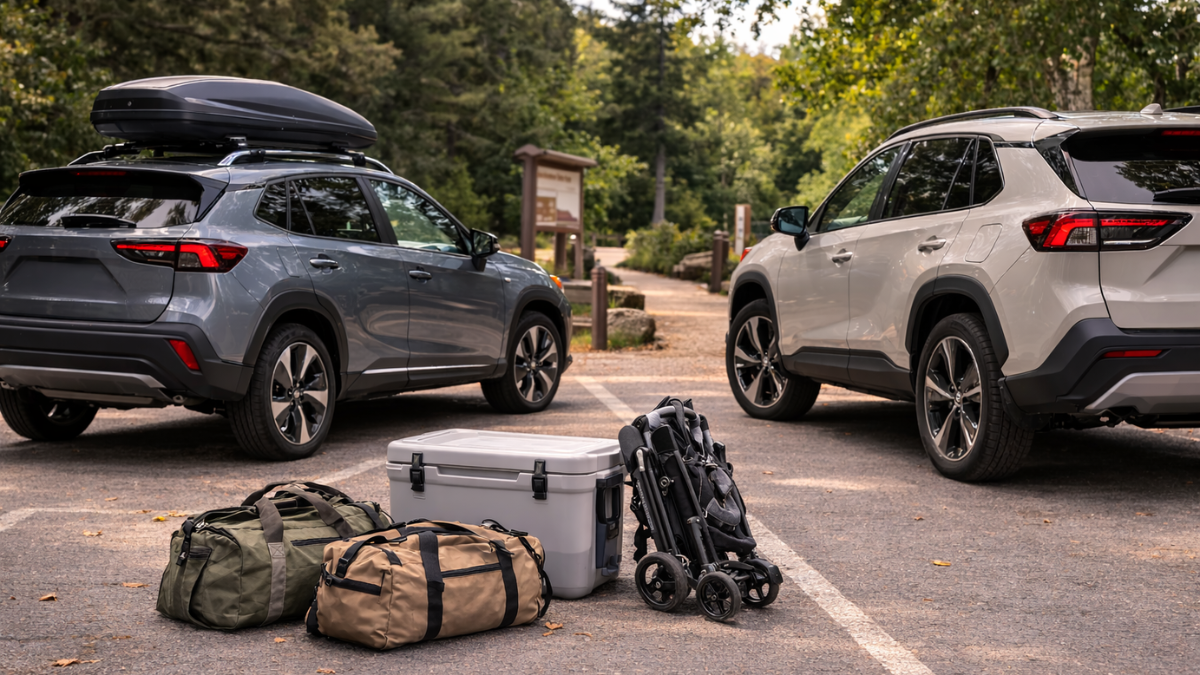
- two adults + kids + bulky gear (stroller/cooler), or
- friends + skis + overnight bags.
When the smaller vehicle can’t carry passengers and gear together, people often solve it with:
- a second car following, or
- a second run (drop people, then return for gear).
That can add:
- another tank of fuel,
- a second parking fee,
- a second toll set,
- and another driver’s time.
If the destination charges per vehicle (common at attractions and busy parking areas), two cars can cost more than one larger vehicle that carries everyone in one trip.
Scenario 2: The “cargo workaround” costs more than the size upgrade
A smaller vehicle often becomes a bigger weekend tool by adding gear:
- roof box,
- roof basket,
- hitch basket,
- rear cargo tray.
Those add-ons have two costs:
1) The money cost (purchase/rental and setup time)
2) The drag cost (more fuel at highway speed)
Consumer Reports’ testing has found rooftop carriers reduce fuel economy. Car and Driver testing has also shown a roof box can cost more MPG than a rear hitch carrier on the same route.
Weekend takeaway:
- If the only way the smaller car works is adding a roof box for most trips, a bigger vehicle that avoids that add-on can become cheaper over repeated weekends.
Scenario 3: Last-mile conditions make the small vehicle “riskier,” and risk is a cost
A bigger vehicle is not automatically safer or better in bad conditions. But some weekends include:
- steep gravel driveways,
- unplowed side roads,
- deep slush berms,
- or snow chain requirements.
When the smaller vehicle struggles, “cost” shows up as:
- wasted time,
- towing or recovery,
- or a second attempt (another day, another booking window).
This is not a license to buy huge vehicles. It is a reminder that a “weekend system” can fail. A vehicle with sufficient clearance and proper tires can reduce the failure risk, and that can be worth more than small differences in mpg.
Scenario 4: Rental pricing makes the bigger car cheaper than expected
If you’re renting for the weekend, the price relationship can invert.
Common reasons:
- limited inventory of small cars at peak times,
- promotions on midsize SUVs,
- or fee structures that make “one vehicle for everyone” cheaper than “two smaller rentals.”
The safe approach is not to assume. It’s to compare:
- a single larger rental versus two smaller rentals,
- and to include taxes/fees and the coverage choice you actually want.
The FTC notes collision damage waivers (CDW/LDW) are optional, and credit-card CDW terms often require declining the rental company’s coverage. Those choices can change totals—so the cheapest base rate is not always the cheapest weekend.
Scenario 5: Your “small” vehicle is costly per mile, while the “bigger” one isn’t
This sounds counterintuitive, but it happens.
Examples:
- a small, older car with high repair risk or poor highway mpg,
- a “small SUV” with large wheels/tires and higher running costs,
- or a smaller vehicle that requires premium fuel while a larger hybrid does not (varies by model).
AAA’s category approach is useful because it reminds you: per-mile cost is not strictly about size. Maintenance condition, tires, insurance, and depreciation are often bigger drivers than a few mpg.
What changed in 2026: why “system cost” is the right lens
Two 2026 anchors reinforce the system approach:
- The IRS 2026 standard mileage rate is 72.5¢/mile, a reminder that all-in costs matter beyond fuel.
- Fuel volatility remains real, and it can widen or shrink the “add-on drag” penalty on a given weekend. (When fuel is higher, the cost of roof-drag and extra trips becomes more painful.)
The implication: the weekend decision stays more stable when you price the whole system.
What this means in the U.S.
In the U.S., the most common weekend cost traps are:
- paying twice for parking/entry because two cars are required,
- hauling extra cargo with rooftop gear that costs MPG,
- and last-mile conditions that force a reroute or a second attempt.
Those are the contexts where a bigger vehicle can truly be cheaper.
What you can do: the 9-minute “bigger cheaper” check
1) List passengers and bulky items: stroller/cooler/skis/dog crate.
2) Decide: one trip or two? If “two,” write down the second car’s costs (fuel + parking + tolls).
3) Add the workarounds: roof box/hitch tray/delivery fees.
4) Estimate the drag penalty: if a roof box is required, treat it as a recurring fuel add-on (CR and C&D testing show rooftop cargo reduces MPG).
5) Price the single bigger option: one vehicle, one set of fees, one driver.
6) Compare totals, not mpg.
7) If totals are close, choose lower drama: fewer vehicles, fewer stops, simpler loading.
Bottom line
A bigger vehicle is only “cheaper” on a weekend trip when it prevents costs that a smaller vehicle creates—most often a second car, a cargo add-on, or a failed last mile that forces a redo. AAA’s cost-per-mile categories show why bigger usually costs more; the flip is the exception, not the rule.
The practical move is to price the weekend as a system. If one larger vehicle replaces two smaller ones—or eliminates a roof-box workaround that hurts MPG—“bigger” can be the cheaper (and calmer) weekend tool.