
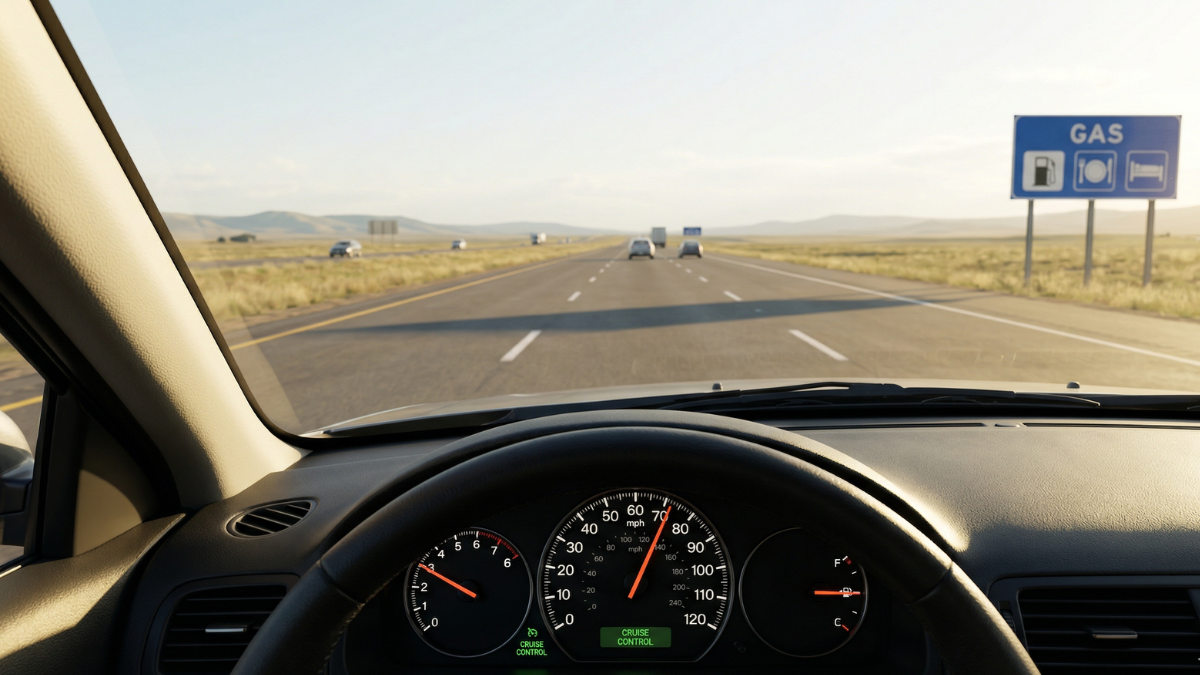
The instinct is logical: leave later, drive faster, arrive at the same time. A 400-mile drive to the mountains, the beach house, or the family reunion happens every few months, and gaining 30 or 40 minutes of it back by pushing the cruise control ten miles an hour higher seems like a reasonable trade. Most drivers who do this have never actually run the math. The time saved is real but significantly smaller than the feel of driving fast suggests. The fuel cost it adds is also real, and significantly larger than most drivers notice at the pump.
Both numbers become clear when you work through them explicitly instead of estimating by feel. The answer to how much time 80 mph saves on a 400-mile drive is specific, verifiable, and considerably less impressive than the sensation of passing traffic implies.
Quick Takeaways
- A 400-mile drive at a true average of 80 mph takes 5 hours 0 minutes. The same drive at a true average of 70 mph takes 5 hours 42 minutes. The difference is 42 minutes
- That 42 minutes assumes a pure, uninterrupted highway segment. One fuel stop, one construction zone, or one rest break eliminates most of the advantage — because those pauses happen regardless of cruising speed
- The U.S. Department of Energy, citing an Oak Ridge National Laboratory study of 74 light-duty vehicles, found that going from 70 to 80 mph reduces fuel economy by an average of 15.4% across the vehicle range — with some vehicles losing up to 25%
- At $3.50/gal, a midsize SUV getting 28 mpg at 70 mph and 23.7 mpg at 80 mph burns approximately $10 more in fuel on the 400-mile run — in exchange for those 42 minutes
- At $4.00/gal, that fuel cost difference rises to approximately $12. The time cost of stopping for the extra fuel is not counted in most drivers’ mental arithmetic
- Speed limits on U.S. Interstate highways are 70–80 mph in most western and southern states, making this calculation directly applicable to legal limit decisions, not just speeding scenarios
The Time Arithmetic
The relationship between speed and travel time is an inverse function — not a linear one. This is what makes faster driving feel more time-efficient than it actually is at highway speeds.
At low speeds, the time savings from going faster are substantial. Adding 10 mph to a 30 mph city drive cuts travel time by 25 percent. The same 10 mph added at highway speeds — from 70 to 80 — cuts a much smaller fraction of total time, because you are already moving through distance quickly.
The precise calculation for a 400-mile trip:
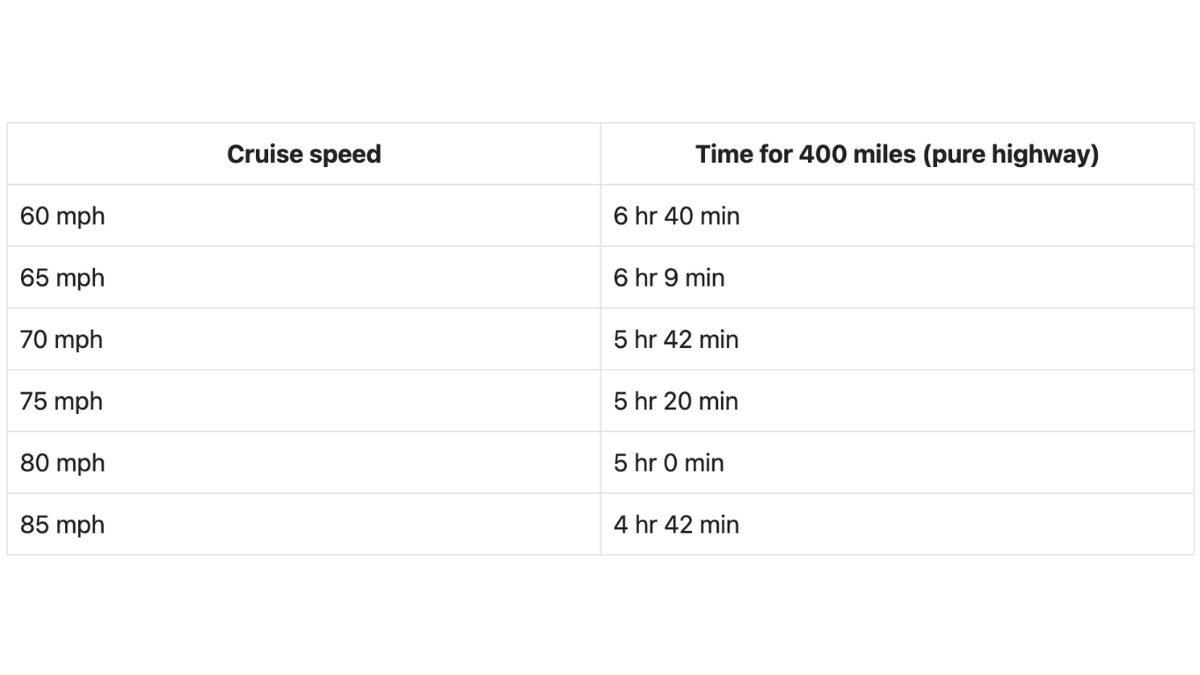
Going from 70 to 80 mph saves 42 minutes on a pure 400-mile highway segment. Going from 75 to 80 mph saves only 20 minutes — for the same 5 mph increase. The marginal return on additional speed shrinks as speed rises, because time = distance ÷ speed, and the denominator effect weakens at larger values.
The 42 minutes figure is also the theoretical maximum. Real-world factors compress it considerably:
Traffic, construction zones, and reduced-speed segments apply the same time penalty to both scenarios. If the route includes a 30-mile construction zone at 55 mph, that segment takes 32.7 minutes at 80 mph and 32.7 minutes at 70 mph — identical, because the limiting speed is the same. Every mile not driven at cruise speed reduces the time advantage proportionally.
Fuel stops. A vehicle with a 16-gallon tank getting 28 mpg at 70 mph can cover approximately 448 miles on a full tank — enough to complete the 400-mile run without stopping. The same vehicle at 80 mph, down to approximately 23.7 mpg, covers about 379 miles on a full tank — requiring one fuel stop somewhere on the route. A fuel stop — pulling off, waiting for a pump, filling, returning to speed — typically costs 8 to 12 minutes. That single stop eliminates 19 to 29 percent of the time advantage before accounting for any other delays.
Rest stops and driver fatigue. Sustained 80 mph driving on a 400-mile run is more physically and cognitively demanding than 70 mph, particularly for the second half of the drive (→ see “Lane Centering vs. Adaptive Cruise” in this series for the research on highway driving fatigue). Drivers who need a rest stop at the 300-mile mark at 80 mph may not have needed one at 70 mph. The fatigue stop itself takes back most of the saved time.
The honest net time savings on a real 400-mile trip, accounting for realistic route conditions: 20 to 35 minutes, not 42.
The Fuel Arithmetic
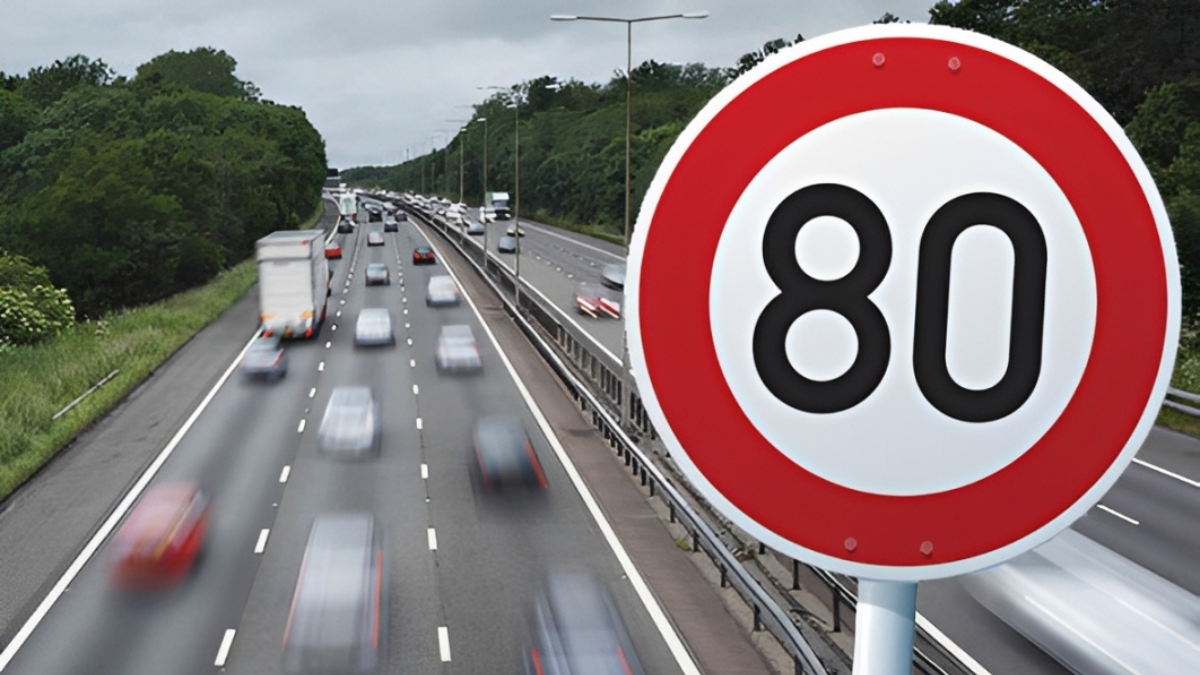
The time saved at 80 mph costs money in proportion to how much harder the engine works against aerodynamic drag at higher speed. The U.S. Department of Energy’s Fact Sheet #982, sourced to an ORNL study of 74 light-duty vehicles, documents the average fuel economy penalty for each 10-mph speed increment:
- 50 to 60 mph: −12.4% fuel economy
- 60 to 70 mph: −14.0% additional fuel economy loss
- 70 to 80 mph: −15.4% additional fuel economy loss
This is the key number for the 70-versus-80 comparison: an average 15.4% fuel economy reduction across the vehicle range when driving at 80 mph versus 70 mph. Some vehicles lose as little as 12%; vehicles with cylinder deactivation that switches back on at high speed, or certain V8 engines, can lose 21–25%.
Worked calculation for a midsize SUV:
Assumed 70 mph fuel economy: 28 mpg (approximate for a current midsize SUV in combined highway use at legal highway speeds)
80 mph fuel economy (−15.4%): 28 × 0.846 = 23.7 mpg
Gallons used for 400 miles at 70 mph: 400 ÷ 28 = 14.3 gallons Gallons used for 400 miles at 80 mph: 400 ÷ 23.7 = 16.9 gallons
Difference: 2.6 gallons of additional fuel per 400-mile trip
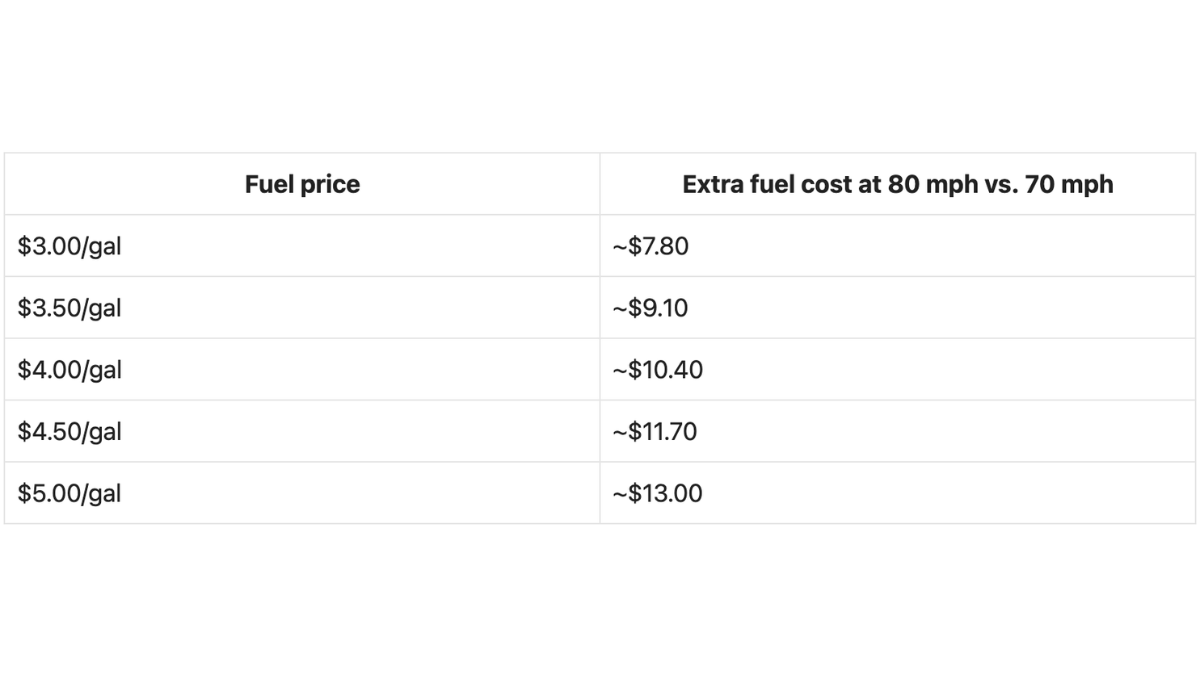
The cost in exchange for the 42-minute theoretical maximum time savings (or the 20–35 minute real-world savings) is roughly $8–$13 per 400-mile trip at current U.S. fuel prices — about the price of one fast food meal.
Stated as a cost-per-saved-minute: at $3.50/gal and 35 minutes of real-world savings, you are paying approximately $0.26 per saved minute by driving 80 instead of 70 mph. At 20 minutes of real-world savings, that rises to $0.46 per saved minute.
Neither of these is an obviously poor trade on any individual trip. The question is whether it is the right trade — and that depends on the trip, the vehicle, and whether the driver is honest about what the time savings actually enables.
What the Saved Time Is Actually Worth
This is the question the arithmetic cannot answer directly, but the arithmetic helps ask it better.
If the 35 minutes of real-world time savings means arriving at a destination before an important event starts — a reservation, a check-in deadline, a family gathering — then the fuel cost is clearly worth it. The math supports the decision.
If the 35 minutes of savings means arriving at 7:05 PM instead of 7:40 PM to a lake cabin where dinner is at 8:00 PM — the savings becomes discretionary. The cabin does not care whether you arrive at 7:05 or 7:40. The extra fuel cost is pure expenditure with no functional return.
Most drivers who drive at 80 mph habitually are in the second situation most of the time. The time savings is real; the destination’s relationship to the early arrival is often negligible.
The more useful framing is the annual one. If a family drives 400 miles round-trip to a weekend destination six times per year, the fuel cost difference between consistent 70 mph and consistent 80 mph is approximately $55–$78 per year (at $3.50/gal, 2.6 gallons × 2 legs × 6 trips). The cumulative time saved at 80 mph on the same schedule is approximately 7 hours per year — 42 minutes × 2 legs × 6 trips × a 0.83 real-world factor.
Seven hours of annual time savings costs $55–$78 in additional fuel. Whether that trade makes sense is a personal calculation — but it is a much easier calculation to make honestly when the numbers are visible.
Speed Limits and the Legal Context
On U.S. Interstate highways, speed limit variation by state directly affects how much of this calculation involves legal driving versus speeding:
- Texas (I-10, I-20, I-35): Up to 85 mph on some rural stretches; 75–80 mph is typical on most Interstates
- Nevada, Utah, Wyoming, Montana: 80 mph on rural Interstates
- Florida, Georgia, South Carolina: 70 mph standard; some 75 mph rural sections
- California: 70 mph standard; 65 mph in many urban areas
- Northeast (I-95 corridor): 65–70 mph
In states where 80 mph is the posted limit, the comparison above applies to legal decisions — whether to drive at 70 or 75 mph rather than the posted 80 — not speeding decisions. The fuel arithmetic is the same regardless of which speed is legal. The question of whether to drive 10 mph below a posted 80 mph limit to save fuel is structurally identical to whether to drive 10 mph above a 70 mph limit to save time.
For Canadian drivers: the arithmetic applies equally to the 110 km/h versus 120 km/h decision on Trans-Canada highway segments, or 100 versus 110 km/h on provincial highways. The fuel penalty for driving 120 km/h versus 110 km/h on a 640-kilometre round trip is approximately 2.4–3.0 litres of additional fuel at current Canadian fuel economy estimates for midsize SUVs, costing approximately $4–$6 CAD at $1.65/litre. The time saved on a 640-kilometre run: approximately 34 minutes at the theoretical maximum, somewhat less in practice.
A Realistic Planning Note
One tool changes this calculation meaningfully: adaptive cruise control with lane centering.
At 70 mph with ACC engaged, the driver’s workload for sustained highway segments drops to near zero. At 80 mph without ACC, sustained driving requires more active management — particularly on interstate segments with traffic that requires speed variation and passing. If the vehicle has ACC, the fatigue argument for driving faster (get there before you’re too tired) weakens considerably, because ACC extends the comfortable drive range at any speed (→ see “Lane Centering vs. Adaptive Cruise” in this series).
The practical upshot: a driver using ACC at 70 mph typically arrives at a 400-mile destination less fatigued than one driving unassisted at 80 mph, despite taking 42 minutes longer. The fatigue itself has a cost — in the first hours at the destination.
SOURCES
- U.S. Department of Energy Fact #982: average fuel economy decrease 70 to 80 mph = 15.4%, sourced to ORNL study of 74 light-duty vehicles including SUVs; 50-to-60 mph decrease 12.4%; 60-to-70 mph decrease 14%
- DOE Fact of the Week #1240: fuel economy at 80 mph is about 27% lower than at 60 mph; Oak Ridge National Laboratory study of 74 light-duty vehicles
- DOE Fact of the Week #1155: average decrease in fuel economy from 50 to 80 mph was 36%; most vehicles peak efficiency near 40 mph
- fueleconomy.gov: each 5 mph over 50 mph is equivalent to paying approximately $0.20 more per gallon; roof cargo boxes reduce fuel economy 10–25% at Interstate speeds; rear-mount cargo reduces 1–5%
- Green Car Congress: ORNL study detail — most vehicles lose 12.5–17.5% fuel economy from 70 to 80 mph; V8 vehicles with cylinder deactivation can lose 21–26%; protective enrichment at high loads an additional factor above 75–80 mph
- Mathematics of Speeding: inverse relationship between speed and time; diminishing returns of each additional mph at highway speeds; detailed trip time calculations by speed