

According to Honda’s 2026 CR‑V specifications, the CR‑V lists 39.3 cu ft of cargo space behind the second row with the seats in place—enough for many weekend loads when the rear seat is occupied by child seats. But the “child seat + cooler + stroller” problem is a different test: it’s bulky gear plus passengers, without folding seats, and without turning the cabin into storage. Honda’s 2026 Pilot trim chart lists 18.6 cu ft of cargo behind the third row (up to 22.4 by trim), while Car and Driver lists the Toyota Sienna at 33.5 cu ft behind the third row. Those numbers explain why some families feel fine in a 2‑row SUV and others hit the “this is getting annoying” wall fast. This guide shows which vehicle type most reliably passes the seats-up weekend kit test in 2026—and how to verify it in one parking-lot check.
Quick takeaways
- Most reliable “seats-up” winner: a minivan tends to pass the stroller + cooler test with all seats in use because it keeps meaningful space behind the third row (Car and Driver lists 33.5 cu ft behind row three for Sienna).
- Best 3-row SUV scenario: a 3‑row SUV can work seats-up, but the trip often hinges on cargo behind row three (Honda lists 18.6–22.4 cu ft behind row three for a 2026 Pilot, by trim).
- 2-row SUV can still pass—if the passenger count is low: a 2‑row SUV like the CR‑V can be perfectly fine for one child seat + weekend gear because Honda lists 39.3 cu ft behind the second row with seats up.
- The real failure mode: when gear spills into footwells or seats, “cramped” increases fast even if legroom numbers are decent.
- Fast verification: a 7-minute packing check beats any spec debate: stroller + cooler with the seats set the way your family actually travels.
The simple test: “seats-up weekend kit”
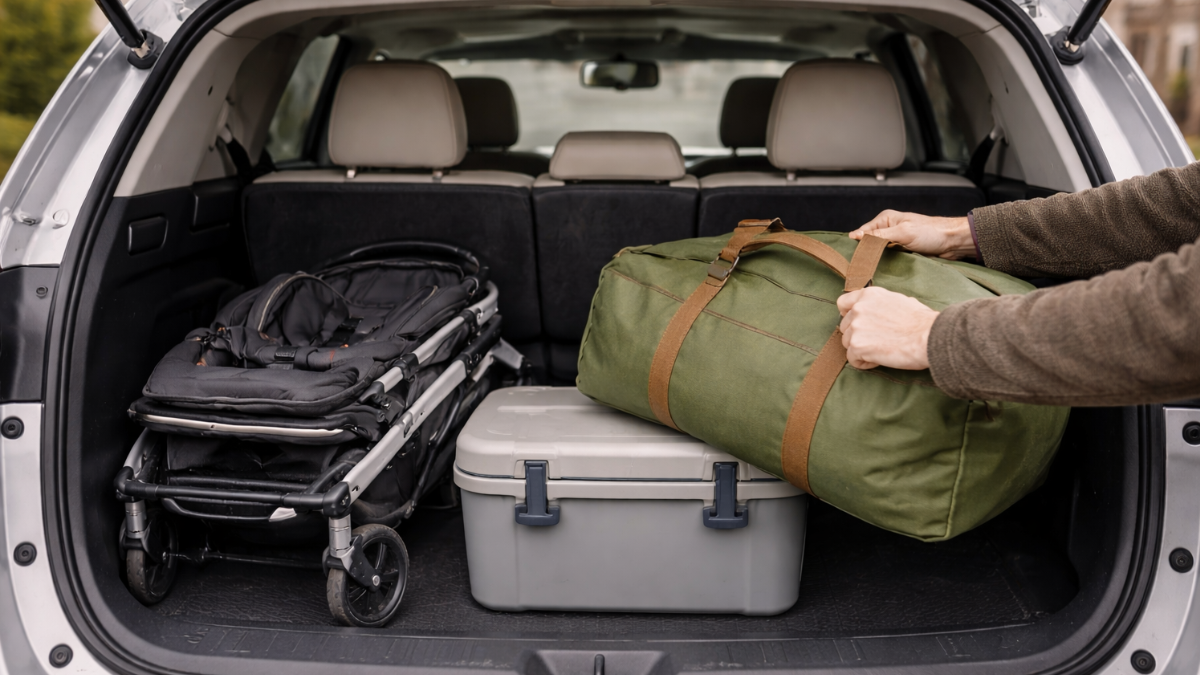
Define the kit before comparing vehicles. A practical family weekend kit looks like:
- folded stroller (or wagon),
- medium hard cooler,
- two duffels (or one duffel + one backpack bin),
- and a small “chaos bag” (snacks/wipes/jackets).
The rule is strict: no folding seats and no stacking above the window line.
Why it matters: a weekend trip has lots of stop cycles. If packing is fragile, every stop becomes a re-pack.
Vehicle type #1: 2-row SUV (works until it doesn’t)
A 2-row SUV can be the cleanest option if the trip is:
- two adults + one child seat, or
- two adults + two child seats (but no extra passenger),
and the cargo area is allowed to do all the work.
Honda’s 2026 CR‑V specs list 39.3 cu ft of cargo space behind the second row. That is the kind of number that usually fits a folded stroller and a cooler—especially if the stroller folds compactly and the cooler is not oversized.
Where the 2-row SUV starts failing
- the moment an extra passenger is added,
- or when the stroller is large and the cooler is tall,
- or when you also need a pack‑and‑play, sports gear, or bulky winter layers.
The “not enough” feeling usually arrives as cabin spillover, not as “the trunk is small.”
Vehicle type #2: 3-row SUV (works, but the third-row-up number is the trap)
A 3‑row SUV sounds like the automatic fix. In reality, it depends on how often the third row is actually used.
With all seats in use, the key number becomes cargo behind the third row:
- Honda’s 2026 Pilot trim chart lists 18.6 cu ft behind the third row (up to 22.4 by trim).
That can be enough for a careful pack, but it usually demands:
- a smaller cooler,
- a stroller that folds flatter,
- and tighter “soft bag” discipline.
What makes a 3-row SUV get annoying faster
- stacking bags high (rear visibility drops),
- placing bags on the third-row seat (access becomes a mess),
- putting items in footwells (kids’ feet lose space and comfort).
A 3‑row SUV becomes much easier if the third row can stay folded for part of the trip. But if the third row is up for the whole weekend, the cargo math tightens.
Vehicle type #3: Minivan (the least fragile packing solution)
Minivans keep their advantage in a very specific situation: all seats in use plus bulky items.
Car and Driver lists the Toyota Sienna at 33.5 cu ft of cargo space behind the third row. That is nearly a different class of “seats-up usability” compared to many three-row SUVs.
What that buys on a weekend
- stroller fits without diagonal gymnastics,
- cooler stays in back (not on a seat),
- bags stay low (rear visibility stays clean),
- and the cabin stays less cluttered across multiple stops.
The other advantage is access: sliding doors make “hands full” loading and car-seat buckling easier in tight parking lots. That’s not a spec-sheet victory, but it’s a repeatable weekend-life improvement.
What changed in 2026 (why families notice this more now)
Two trends make the “seats-up kit” more relevant:
- more families are doing short, gear-heavy weekend trips (cooler + stroller is a normal load), and
- many 3‑row SUVs prioritize styling and posture, which can limit how much space remains behind the third row when everyone is seated.
The result is a predictable pattern: families buy a 3-row SUV, then realize the third-row-up cargo is the real bottleneck.
What this means in the U.S.
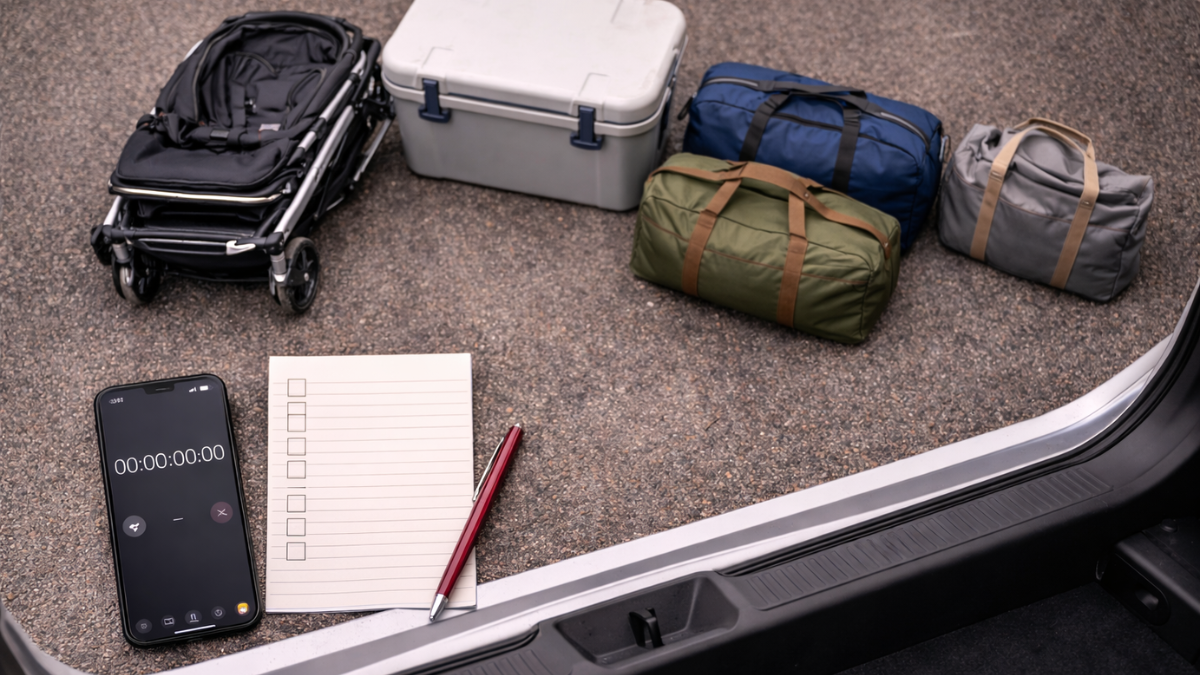
In the U.S., weekend trips often involve:
- highway cruising,
- tight hotel parking,
- and weather layers that take up space fast.
That environment rewards the vehicle type that keeps gear contained and doors easy. The more stop cycles in the plan, the more the “packing fragility” of a tight cargo setup becomes the actual cost.
What you can do: the 7-minute parking-lot packing check
Do this at the dealership or in a friend’s driveway:
1) Set the seats exactly as your family travels (child seat installed).
2) Load the stroller first (it’s the shape that dictates everything).
3) Add the cooler.
4) Add two soft bags.
5) Check the rules: nothing on seats, nothing in footwells, rear visibility not blocked.
If the 2‑row SUV passes, it’s still enough. If it fails, decide between:
- a 3-row SUV that keeps row-three-up cargo workable for your kit, or
- a minivan if you expect to use all seats and carry bulky items often.
Bottom line
If the goal is “child seat + cooler + stroller” without folding seats, the best answer is usually determined by one question: are all seats in use?
- If the trip is 2–4 people and the second row can stay occupied without adding passengers, a 2‑row SUV can still work (CR‑V’s 39.3 cu ft behind row two is a strong baseline).
- If the trip uses a third row regularly, the decision becomes third-row-up cargo—and a minivan is often the least fragile solution (Sienna: 33.5 cu ft behind row three, per Car and Driver).
- A 3‑row SUV can work, but it is the most sensitive to trim and packing discipline (Pilot: 18.6–22.4 cu ft behind row three, per Honda).
The “best” vehicle type is the one that keeps the cabin calm and the packing repeatable—every stop, every weekend.