
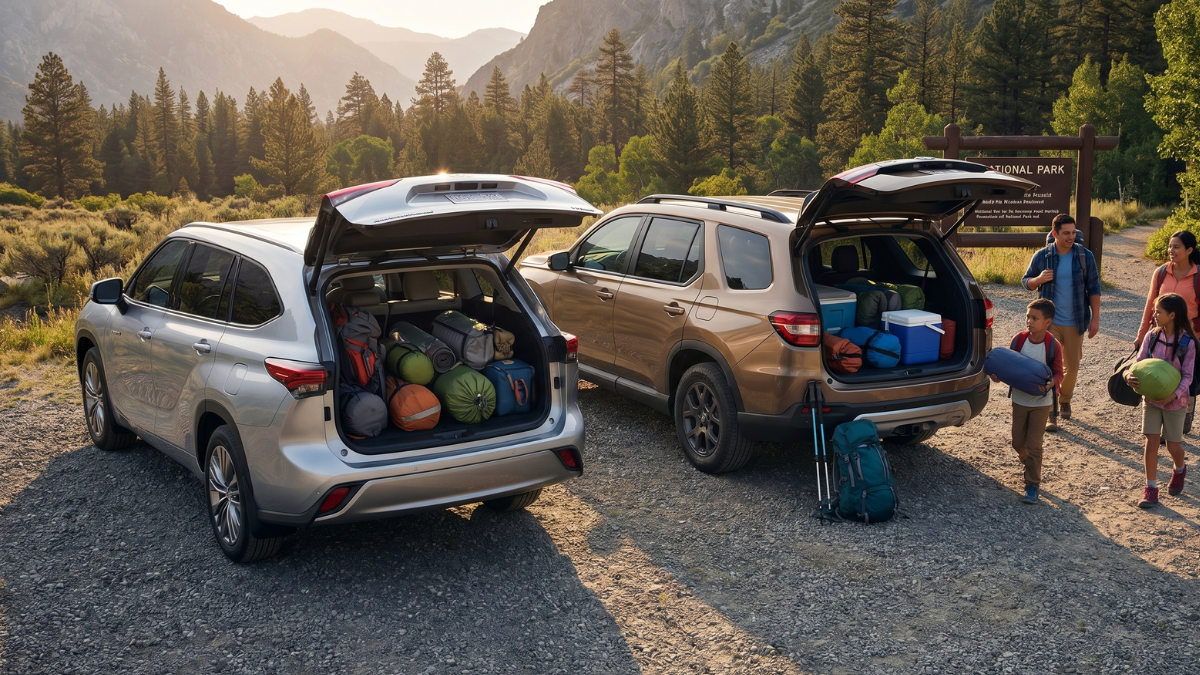
There is a meaningful asterisk on the 2026 Toyota Highlander Hybrid that no comparison article mentions in its opening paragraph: this is almost certainly the last year you can buy one. Toyota has confirmed the Highlander transitions to an electric-only powertrain for 2027. What is on sale now is the final version of a vehicle that has been the benchmark hybrid three-row SUV in North America for over two decades — and it is competing against a 2026 Honda Pilot that just received its most significant refresh in the current generation.
The practical question for a family planning weekend road trips with three rows of seating and a need for cargo space behind those rows is which vehicle actually works better for the specific task. Both seat seven or eight. Both tow 5,000 pounds with AWD. Both have new 12.3-inch touchscreens for 2026. The differences are real and consequential, but they are concentrated in three areas: fuel economy, third-row usability, and driving dynamics — and the weight you assign to each determines which vehicle belongs in your driveway.
Quick Takeaways
- The 2026 Highlander Hybrid is rated at 35 mpg combined AWD across all trims — against the Pilot’s 21 mpg combined AWD for non-TrailSport configurations; on a 500-mile highway weekend trip, that gap costs Pilot drivers approximately $34 more in fuel at $3.50/gallon, and roughly $680 per year across 20 weekend trips
- The 2026 Highlander Hybrid’s third row is by all editorial consensus suitable for children only — Edmunds calls it “for occasional situations at best, and most adults will fight to avoid sitting back there”; the Pilot’s third row fits adults “in a pinch” per Edmunds, with 32.5 inches of legroom versus the Highlander’s more limited rearmost space
- The Honda Pilot starts at $42,195 (Sport FWD) versus the Highlander Hybrid at $47,620 (XLE AWD, entry hybrid trim) — a difference of approximately $5,400 that the Highlander partially recovers through fuel savings but does not fully offset within typical five-year ownership
- The 2026 Pilot received meaningful updates for this model year: a new standard 12.3-inch touchscreen (replacing the previously inadequate 7-inch screen), additional sound insulation, and retuned steering — addressing the model’s most-cited weaknesses
- 2026 is the final year of the gasoline Highlander Hybrid before the nameplate transitions to electric power for 2027; this is a genuine purchasing consideration for buyers who want the Toyota hybrid powertrain’s proven reliability record
- Both vehicles tow 5,000 lbs with AWD and carry comparable total cargo capacity; the Pilot edges the Highlander in cargo behind the third row (18.6 vs. 16 cu ft), while the Highlander has more cabin passenger volume in the front rows
The Fuel Math: What 35 mpg vs. 21 mpg Actually Means on a Road Trip
The fuel economy gap between these two vehicles is the largest single differentiator in the comparison, and it is significant enough to change the total-cost math over a family ownership period.
Highlander Hybrid AWD (all trims): 35 mpg combined (35 city / 35 highway per EPA for XLE and XSE; Limited/Platinum 35/34) Honda Pilot AWD: 21 mpg combined (19 city / 25 highway per EPA for non-TrailSport AWD trims)
On a 500-mile weekend round trip:

Over a five-year ownership period with 20 highway-heavy weekend trips per year, the Highlander Hybrid’s fuel economy advantage accumulates to approximately $2,000–$2,300 in fuel savings. This meaningfully narrows the $5,400 MSRP gap between the two vehicles, though it does not eliminate it within a typical ownership window.
KBB’s analysis of the Highlander Hybrid is precise on this point: “The Highlander Hybrid’s efficiency is in the ballpark with all-wheel-drive versions of the Hyundai Santa Fe Hybrid and Kia Sorento Hybrid, even though it’s a larger vehicle. According to EPA estimates, the monthly fuel cost of the Highlander Hybrid is about $50 less than the non-hybrid Highlander with all-wheel drive.”
Edmunds, in its 2026 Pilot review, acknowledges the gap directly: the Pilot’s fuel economy results are “on par with top V6 competitors but well off the segment’s efficiency leader, the turbo four-cylinder Toyota Highlander, without offering any quicker acceleration.”
Canadian note: At $1.70/litre CAD, the 10-mpg highway fuel economy advantage translates to approximately 2.4 L/100 km less consumption for the Highlander Hybrid. On an 800 km round trip, that is approximately $28 CAD per trip — over 20 trips per year, approximately $560 CAD annually. In Canada, where summer road trips frequently run 700–900 km per direction, the fuel argument for the Highlander Hybrid is proportionally stronger than in the U.S.
Third Row Reality: Children or Adults?
This is where the Pilot earns its most defensible advantage over the Highlander Hybrid for a specific family profile.
Toyota Highlander Hybrid: U.S. News describes the third row as suitable for children but not adults for sustained drives. Edmunds is specific: “most adults will fight to avoid sitting back there.” The Grand Highlander Hybrid — which Toyota offers as a separate, longer model — specifically addresses this with 33.5 inches of third-row legroom, but that vehicle starts at approximately $47,780 for the hybrid XLE AWD and is reviewed separately. The standard Highlander Hybrid’s third row has been the persistent editorial complaint since this generation’s debut, and the 2026 model does not change the rearmost seat geometry.
Honda Pilot: The third row accommodates adults “in a pinch” per Edmunds, with 32.5 inches of legroom. MotorWeek’s road test is candid: “Now I can fit in this seat, I just wouldn’t want to spend a ton of time back here.” The Pilot’s assessment is consistent across reviews — the third row is more usable than the Highlander Hybrid’s but is not a comfortable long-distance seat for adults. It is, however, the right choice when the third row is occasionally occupied by teenagers or a second adult couple on a shorter weekend segment.
The practical family segmentation:
For a family of five with three children under 12: the Highlander Hybrid’s third row is adequate. No child under 12 has strong opinions about 32 inches of legroom.
For a family of five with one teenager and two younger children: the Pilot’s third row handles the teenager more gracefully, and the physical seat access — the Pilot’s one-press fold-forward second-row access and separate stowable center seat section — is practical for mixed third-row use.
For a blended family or carpool situation requiring seven adults or near-adults: neither vehicle is appropriate for a long road trip. The Kia Telluride and Hyundai Palisade serve this use case better.
Cargo behind the occupied third row: Pilot has 18.6 cu ft per MotorWeek’s road test measurement; Highlander has approximately 16 cu ft per U.S. News. The two-plus cubic foot advantage for the Pilot is real but not transformative — a narrow cooler, a backpack, and a few flat bags fit in either vehicle.
The 2026 Pilot’s New Strengths — And Its Remaining Limitations

The 2026 Honda Pilot is meaningfully better than the outgoing model in its two weakest areas, and buyers cross-shopping the 2025 and 2026 versions should register this:
New 12.3-inch touchscreen: The prior standard 7-inch screen was, as Edmunds put it, “woefully smaller than what its rivals offered.” The 2026 screen is class-appropriate in size and incorporates wireless Apple CarPlay and Android Auto at no additional charge. Cars.com calls it “the biggest news here” — which accurately reflects how much of a liability the old screen was.
Additional sound insulation: Cars.com confirms that 2026 Pilot updates include “more standard equipment” and “extra sound deadening depending on trim.” Honda specifically added tempered door glass, door insulators, and hood insulation to reduce what was a noted cabin noise complaint at highway speed. The result, per Cars.com testing: “reduces cabin noise, which is especially beneficial when driving on busy highways or during long trips.”
What the Pilot does not change: The powertrain. The 3.5L V6 is unchanged — 285 hp, 10-speed automatic, same EPA figures. The Pilot has no hybrid option and no announced one. Buyers choosing the Pilot over the Highlander Hybrid are specifically trading fuel economy for lower entry price and (for some families) more adult-accessible third-row space. Edmunds’ summary of the updated Pilot is honest: “The Pilot is pretty easy to live with… [but] it comes across to us as the victim of an identity crisis. This jack-of-all-trades approach means it’s a master of none.”
The Highlander Hybrid’s Strengths — And the 2027 Consideration

The Highlander Hybrid’s case for weekend trips is straightforward: it is the most fuel-efficient non-electric three-row SUV in the segment, it rides with the composed, smooth character that comes from Toyota’s long hybrid development history, and its reputation for long-term reliability is the strongest in the class.
The front seats, per U.S. News’ 2026 review, “offer multiple power adjustments with nice bolstering and padding, making for a comfortable place to sit for extended drives” — a more specific endorsement of highway comfort than the Pilot receives. The second-row captain’s chairs (standard on all trims above XLE) are equally comfortable, with good legroom and headroom for adult passengers in the row most families actually use on road trips.
The powertrain matters on mountain approaches. The Highlander Hybrid’s 2.5L four-cylinder hybrid system produces adequate power for highway cruising but is not quick. Edmunds’ real-world route test returned 33 mpg — excellent for the class. U.S. News’ winter test returned 26.6 mpg — significantly below the EPA estimate, consistent with what the EV cold-weather range series has documented about cold-temperature hybrid performance. For summer weekend trips in typical conditions, 32–35 mpg real-world is a realistic expectation.
The 2027 consideration: Toyota has confirmed the Highlander transitions to electric-only for 2027. For buyers who want the Toyota three-row hybrid — not the EV — this is the last model year. The practical implications are two-fold. First, buyers who want this specific powertrain now have a clear purchase window. Second, dealers will have 2026 Highlander Hybrid inventory into late 2026 and potentially into early 2027 as the transition occurs — which historically has supported dealer flexibility on pricing for the outgoing generation.
Driving Feel: Hybrid CVT vs. Natural-Aspiration V6
The experience of driving these two vehicles on a five-hour road trip is different in character, and this matters for the driver who spends that five hours behind the wheel.
The Highlander Hybrid uses a CVT (continuously variable transmission) with the hybrid system’s electric motors managing the power split. At highway cruise, the CVT is smooth and unobtrusive. When the driver demands more power — for a passing maneuver or a grade — the engine note rises in a way that some drivers find unrelated to the sensation of acceleration. U.S. News describes the driving dynamics as “not very exciting,” and Edmunds’ review notes “underwhelming driving dynamics” relative to the power available. This is accurate: the Highlander Hybrid is a composed, quiet highway vehicle that prioritizes efficiency over engagement.
The Pilot’s 3.5L V6 with the 10-speed automatic provides a more conventional, responsive feel. The power delivery is linear and the gearbox steps through ratios in a way that feels intuitively connected to throttle input. Honda retuned the steering for 2026, and Cars.com notes the result: “on-center weight” is improved. The Pilot will not win a road test, but it feels more alert to driver input than the Highlander Hybrid at identical speeds.
For a family whose primary driver values engagement and a conventional powertrain feel: Pilot. For a family whose primary driver does not think about the powertrain and measures the drive in miles-per-gallon: Highlander Hybrid.
Which One for Weekend Trips
Choose the 2026 Highlander Hybrid if:
- Fuel economy is your most-weighted variable over five-plus years — the $400+ annual savings compound
- Your third-row passengers are children — the seat limitation is irrelevant for kids
- You prioritize Toyota’s reliability track record and want to buy the last year of the proven hybrid powertrain before electrification
- AWD on all hybrid trims at no additional cost matters for your winter and shoulder-season routes
Choose the 2026 Honda Pilot if:
- The $5,400+ price difference matters for your purchase decision and you prefer the lower entry point
- Your third row is occasionally occupied by adults or older teenagers where the extra legroom makes a real difference
- You prefer a conventional V6 feel over a hybrid CVT on long highway runs
- You want more cargo space behind the third row (18.6 vs. 16 cu ft) for fully-loaded trips
SOURCES
- KBB: 2026 Highlander Hybrid 35/35/35 mpg AWD; starts $48,515 / fair price ~$48,200; AWD standard on all hybrid trims; KBB owner reliability rating 4.8/5; third-row seating for children; monthly fuel cost $50 less than non-hybrid Highlander
- Edmunds 2026 Highlander Hybrid review: 35 mpg most trims; real-world 33 mpg on test route; third row “for occasional situations at best, most adults will fight to avoid sitting back there”; starts ~$47,620; “cramped third-row remains one of its biggest sticking points”; Edmunds prefers Grand Highlander Hybrid; 2026 is final model year before electric transition
- U.S. News 2026 Highlander Hybrid review: 26.6 mpg in January cold test; 34 mpg in warm-weather test; front seats “comfortable for extended drives” with multiple power adjustments; confirmed 2027 electric-only transition; good fuel economy, well equipped, cramped third row
- Toyota.com: Highlander Hybrid 35 mpg combined confirmed; AWD with Dynamic Torque Vectoring; 265 hp for gas model; hybrid powertrain description
- Edmunds 2026 Pilot review: 20–22 mpg combined depending on trim; real-world 22 mpg on test route; third row fits adults “in a pinch”; “competent but lacks standout traits — jack-of-all-trades approach means it’s a master of none”; physical climate buttons retained; new 12.3-inch screen the biggest 2026 update; prior 7-inch screen “woefully smaller than rivals”
- Cars.com 2026 Pilot: confirmed new 12.3-inch touchscreen replacing 7-inch; wireless CarPlay/Android Auto now standard; added sound deadening — tempered door glass, door insulators, hood insulation; retuned steering; “smidge better” than prior model; engine unchanged at 285 hp
- MotorWeek road test: Pilot AWD Elite 19/25/21 mpg; real-world average 21.8 mpg; starts $43,690 Sport; “I can fit in this seat, I just wouldn’t want to spend a ton of time back there” — third row assessment; 18.6 cu ft behind occupied third row; stowable second-row center seat noted
- Honda official: 2026 Pilot AWD non-TrailSport 19/25/21 mpg; FWD 19/27/22 mpg; 285 hp / 262 lb-ft; AWD tow 5,000 lbs; FWD tow 3,500 lbs; front legroom 41 inches
- U.S. News roomiest midsize SUVs: confirms Highlander cargo behind third row approximately 16 cu ft; Grand Highlander 20.6 cu ft; third-row usability for adults characterized for both vehicles; Pilot noted for passenger volume advantage across all rows