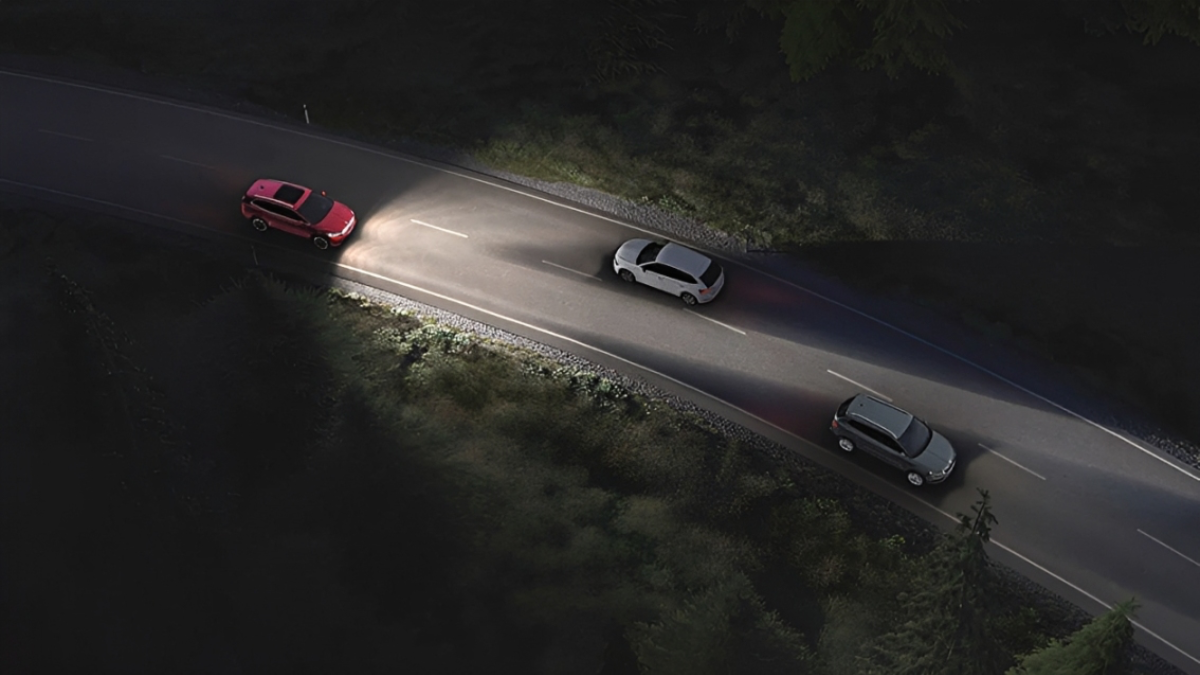
The squinting starts around hour two on a dark two-lane road — not from a single oncoming car, but from the cumulative effect of switching between full darkness and bright oncoming beams for hours. Modern adaptive matrix headlight systems exist specifically to break that cycle. They are also expensive, fragile, and — here is the detail most buyers do not know going in — not yet legally available on any U.S.-market vehicle with true glare-free high beams, despite being common in Europe for over a decade. Understanding what these systems actually do, what standard LEDs already do well, and what light color does to your alertness over a long night drive is more useful than the brochure pitch.
Quick Takeaways
- True adaptive driving beams — systems that carve a shadow around oncoming vehicles while keeping high beams on the rest of the road — are not yet available on any U.S.-market vehicle as of late 2024, per IIHS; they are common in Europe
- Standard LED headlights with a good IIHS rating already reduce nighttime single-vehicle crashes by 19% versus vehicles with poor headlights — the baseline improvement is real and available now
- Modern LED headlights emit more short-wavelength blue light than halogen; that blue content suppresses melatonin more strongly, which can keep you alert on a two-hour drive but may work against you on a four-hour night trip
- Wearing blue-light-blocking glasses at night removes the melatonin-suppressing alert signal, making drowsiness worse — not better
- Full matrix LED assembly replacement after a stone chip or minor impact: $800–$2,500 for mainstream vehicles, more for luxury brands with coding requirements
- The IIHS headlight rating is the most useful free tool for comparing headlight quality before buying; checking it takes two minutes
What Night-Drive Eye Fatigue Actually Is
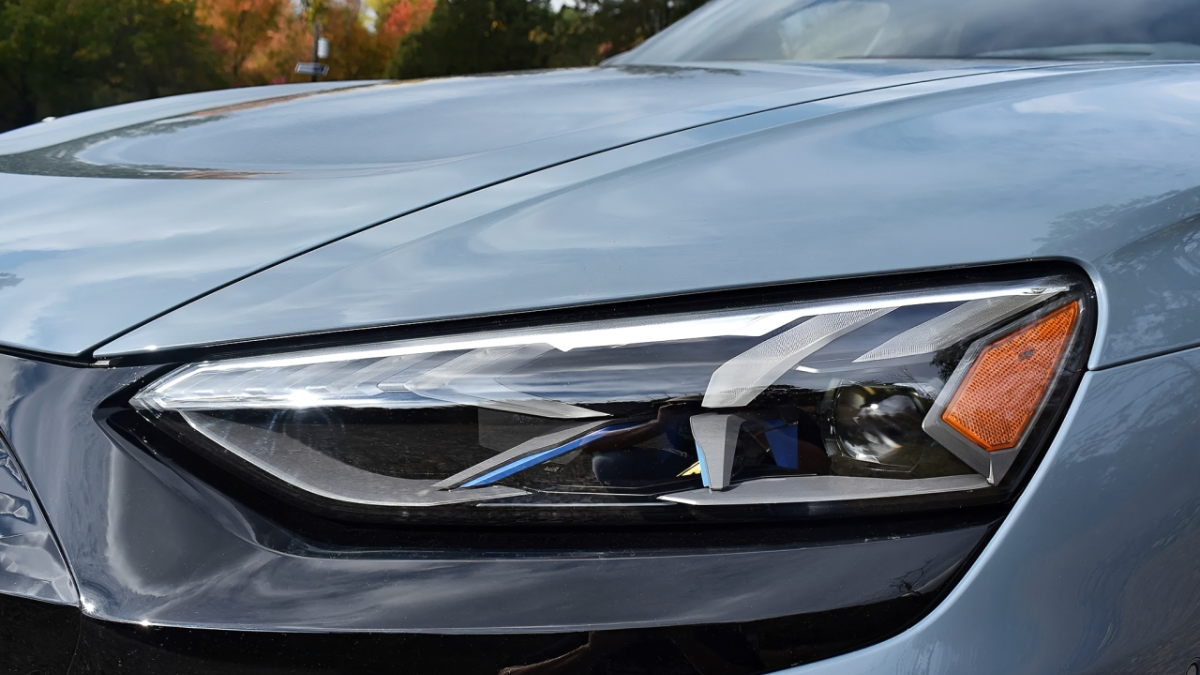
Eye fatigue on a long night drive is not primarily about the total amount of darkness. It is about the work the pupil does managing repeated light-to-dark transitions, and the cognitive load of navigating with limited visual information for extended periods.
Every time an oncoming vehicle approaches with high beams engaged — or even well-aimed low beams — the driver’s pupil contracts sharply to manage the sudden brightness. When the vehicle passes, the pupil re-dilates for darkness. That cycle, repeated dozens of times per hour on a busy two-lane highway, is not catastrophically harmful in isolation. But accumulated over several hours, the repeated pupil adjustment and the subconscious tension of anticipating each oncoming light produces the dry-eye, unfocused, forehead-pressure sensation that drivers describe as eye fatigue after a night run.
Adaptive matrix systems target this mechanism directly. Instead of the driver receiving a full-intensity high beam from approaching traffic, the oncoming driver’s matrix system creates a localized shadow — a dark zone carved around the approaching vehicle — while keeping the full high beam pointed at everything else. The receiving driver sees less sudden intensity spike. The delivering driver never has to drop to low beams, keeping the road broadly illuminated.
The technology works. It is well-established in Europe. The problem for North American buyers is a regulatory one.
The U.S. Regulatory Gap Nobody Mentions at the Dealership
IIHS, which has been pushing for improved headlight performance since 2016, confirmed in a 2025 study that no vehicles on the U.S. market were equipped with true adaptive driving beams (ADB) as of the end of 2024. NHTSA began allowing these systems in 2022, but differences between U.S. standards and European regulations have continued to slow the actual rollout. The European fleet has had glare-free high beams for over a decade. U.S. buyers are still waiting.
What this means practically: when a North American vehicle’s brochure describes “adaptive LED matrix headlights” or “intelligent high-beam control,” it typically describes one of two more modest systems. The first is automatic high-beam assist — a camera that detects oncoming traffic and switches the full beam off, dropping to low beams entirely when another vehicle is detected. This is better than manual switching but still eliminates the full high beam entirely when traffic is present. The second is curve-adaptive headlights, which pivot the beam direction as the steering turns, improving corner illumination without any interaction with oncoming glare.
Neither of these is the same as a true glare-free high beam that carves a shadow around specific vehicles while maintaining high-beam output everywhere else.
This does not make modern LED headlights on U.S.-market vehicles useless for reducing night fatigue. It does mean that the most dramatic version of the technology — the one that eliminates the pupil-hammering light flash from oncoming traffic — is not yet here.
What Standard LEDs Already Do Well
Before dismissing non-matrix headlights as inadequate, the IIHS data on standard LED performance is worth reading carefully.
IIHS began rating headlight systems in 2016. That year, only one out of more than 80 systems tested received a good rating. By model year 2025, 51 percent of tested systems earn a good rating. The program has pushed automakers to improve headlight aim, increase illumination distance, and reduce excessive glare from low beams — and the real-world results show.
A 2021 IIHS study of police-reported crashes found that vehicles with good-rated headlights had 19 percent fewer nighttime single-vehicle crashes and 23 percent fewer nighttime pedestrian crashes compared with vehicles whose headlights received a poor rating. Good headlights in this context means well-aimed LED or HID systems with adequate illumination distance and controlled low-beam glare — not necessarily matrix or adaptive technology.
Separately, IIHS studied curve-adaptive HID headlights on the Mazda 3 and found nighttime collision claim rates 10 percent lower and property damage liability claim rates 15 percent lower than the same vehicle with standard halogen lamps.
The practical takeaway: checking the IIHS headlight rating before buying a vehicle, and specifically checking whether the trim level being purchased has the good-rated headlight package rather than a marginal or poor-rated standard system, is the most impactful and most underused headlight decision a buyer can make. The rating is publicly available on the IIHS website at no cost. Many vehicle models offer their best-rated headlight option only on mid or upper trims — confirming the rating for the specific trim matters.
The Blue Light Problem That Cuts Both Ways
Modern LED headlights — both the oncoming traffic’s lights and the driver’s own lights — emit more short-wavelength blue light than the halogen systems they replaced. This is not incidental. LED technology naturally produces a cooler, bluer spectrum, and most automotive LED systems run somewhere between 5,500K and 6,500K in color temperature.
This matters because blue light, at wavelengths around 446–480 nanometers, is the primary signal the human circadian system uses to suppress melatonin production. Research published in the Journal of Applied Physiology established that blue LED light produces a dose-dependent suppression of melatonin at these wavelengths. Research from Harvard Health confirmed that blue light suppresses melatonin for about twice as long as green light of comparable brightness.
A PMC study (2025) that directly compared blue and red LED light over three-hour evening exposures found that blue light maintained melatonin suppression throughout the exposure period, while red light allowed melatonin recovery after the first hour.
For a night drive, the effect of blue-content light from oncoming headlights and road lighting cuts both ways. On a one-to-two-hour drive starting in the evening, the blue light from ambient traffic and your own headlights is likely keeping you more alert than you would otherwise be — melatonin suppression at 10 PM is reducing the onset of drowsiness. On a four-to-six-hour overnight drive that extends past midnight, that same melatonin suppression has been running for hours. The circadian body has been artificially held in a daytime-alert state. When the drive ends, the sudden drop into darkness and the deferred melatonin release can hit quickly. The “crash” after a long night drive is partly this mechanism.
There is also a separate issue for oncoming traffic. IIHS has documented that while glare contributes to only one to two nighttime crashes per thousand across the U.S. states studied, the subjective discomfort is disproportionately reported. Older drivers — those over 50 — have reduced pupil response speed and need two to three times more light to perceive the same brightness as younger drivers, making them more affected by the repeated high-blue-content flash of oncoming LED headlights.
What Wearing Blue-Light-Blocking Glasses Actually Does at Night
The intuition behind wearing tinted glasses for night driving is understandable: glare from LED headlights is uncomfortable, the tinted lens softens it, the experience feels more comfortable. The problem is what else those glasses do.
Orange or amber-tinted blue-light-blocking glasses remove most of the blue and green light spectrum — precisely the wavelengths that signal alertness and inhibit melatonin production. Blocking those wavelengths at night increases melatonin release, which promotes drowsiness. A driver wearing orange-tinted glasses on a four-hour night run may feel their eyes less irritated by glare while becoming measurably sleepier faster than they would without the glasses. The reduced glare discomfort and the increased drowsiness are happening simultaneously, and the drowsiness is the more dangerous of the two outcomes.
The guidance from multiple vision and light science sources is consistent: wear blue-light blocking glasses in the evening before bed if screen use is disrupting sleep. Do not wear amber-tinted versions while driving at night if alertness matters.
What Matrix Assembly Damage Actually Costs
Before specifying a matrix LED headlight package on a new vehicle — typically a $1,000–$2,500 option upgrade depending on brand and trim — the replacement cost after physical damage is worth knowing.
Matrix LED headlight assemblies on mainstream vehicles typically run $800–$2,500 for the full assembly, according to published repair estimates from Jerry and Hawkglow. At luxury brands — BMW, Mercedes-Benz, Audi — the same repair at a dealer can reach the high end of that range or beyond, particularly when the replacement unit requires software coding. A single stone impact that cracks the lens housing of a sealed modern LED unit frequently requires full assembly replacement because many LED headlight modules are sealed units — the LED board and optics cannot be serviced independently.
KBB notes directly that design trends are partially to blame: many newer models have sealed, non-serviceable headlight assemblies where a single bulb failure means replacing the entire unit. Matrix and adaptive headlight systems add complexity — sensors, control modules, actuators, camera calibration — that further increases what goes wrong and what it costs to fix.
For vehicles driven on road-chip-heavy routes — gravel approaches, highway construction zones, mountain roads with debris — the upgrade premium plus the elevated repair probability is a genuine cost calculation, not an abstract one. Comprehensive insurance typically covers impact damage to headlights after the deductible, but that still means a claim, a deductible, and potentially a premium effect.
The practical note: if buying a vehicle where matrix LED is an option rather than a standard, verify whether it is covered under the factory warranty for manufacturing defects, confirm the repair cost estimate through the dealer’s parts department before signing, and check whether the comprehensive insurance deductible makes a claim worthwhile for an $800 repair versus out-of-pocket.
What to Check Before the Next Night Trip
Look up the IIHS headlight rating for your trim. The IIHS website (iihs.org) maintains headlight ratings by vehicle model and trim. Check whether the trim you own or are considering has a good or acceptable rating, or whether the better headlight option is only available at a higher trim. Upgrading from a marginal-rated standard package to a good-rated LED option is frequently worth the trim cost purely on night safety.
Prioritize headlight aim and brightness over brand names. The IIHS program rates output and glare together. A well-aimed standard LED system at a mid-trim price point can outperform a poorly aimed matrix system on a higher trim of a different vehicle.
Plan long overnight drives for the early part of the night rather than the middle. The blue-light melatonin suppression effect is strongest in the early evening hours when the body’s melatonin production is just beginning. By 2–3 AM, melatonin levels that have been suppressed all evening produce stronger drowsiness when the drive ends. If a long overnight drive is unavoidable, the physiologically safer window is 9 PM to 1 AM rather than 1 AM to 5 AM.
Do not filter blue light with amber glasses while driving at night. Address glare discomfort by keeping the windshield clean, reducing instrument panel brightness, and if purchasing a new vehicle, checking the IIHS headlight rating for oncoming glare. The glare rating penalizes headlights that produce excessive low-beam intensity for the opposing driver — it is directly relevant to the squinting problem.
U.S. and Canada Note
The adaptive driving beam technology gap is most relevant in Canada, where two-lane rural highway driving is a larger part of normal long-distance travel than in urban U.S. corridors. On the Trans-Canada through northern Ontario or in the Prairie provinces at night, the combination of long dark stretches and significant truck traffic makes the high-beam management problem more acute than on urban interstates. European drivers on comparable routes have had glare-free high beams for years.
For Canadian buyers, the same guidance applies as for U.S. buyers: the IIHS headlight rating is the most useful single data point for night safety, and the curve-adaptive and good-illumination properties available on well-rated LED systems are a genuine upgrade over halogen baselines even without full ADB capability.
SOURCES
- IIHS 2025: no U.S. vehicles had ADB as of end of 2024; 51% of 2025 headlights rate good; glare in 1-2 per thousand nighttime crashes; NHTSA allowed ADB in 2022 but regulatory gap persists
- IIHS headlight topic page: curve-adaptive headlights reduce Mazda 3 nighttime claims 10-15%; vehicles with good headlights 19% fewer single-vehicle crashes vs. poor
- IIHS: good-rated headlights linked to ~20% fewer nighttime crashes per mile vs. poor-rated
- Journal of Applied Physiology: blue LED 446-480nm produces dose-dependent melatonin suppression; dose-response curve confirmed
- Harvard Health: blue light suppresses melatonin twice as long as green light; circadian rhythm disruption mechanism
- PMC 2025: blue light vs. red light — blue maintained melatonin suppression throughout 3-hour exposure; red allowed recovery after 1 hour
- Scientific Reports: cool-white LED 12.3% melatonin suppression vs. warm LED 3.6%; incandescent 1.5% — hierarchy confirmed
- Jerry: luxury/adaptive LED headlight assemblies $800–$2,500; adaptive headlights need aim/calibration $50–$300 and coding after module replacement
- KBB: sealed non-serviceable assemblies; matrix LED complexity drives higher replacement costs
- Block Blue Light: amber-tinted glasses increase melatonin → drowsiness while driving at night; safety concern