
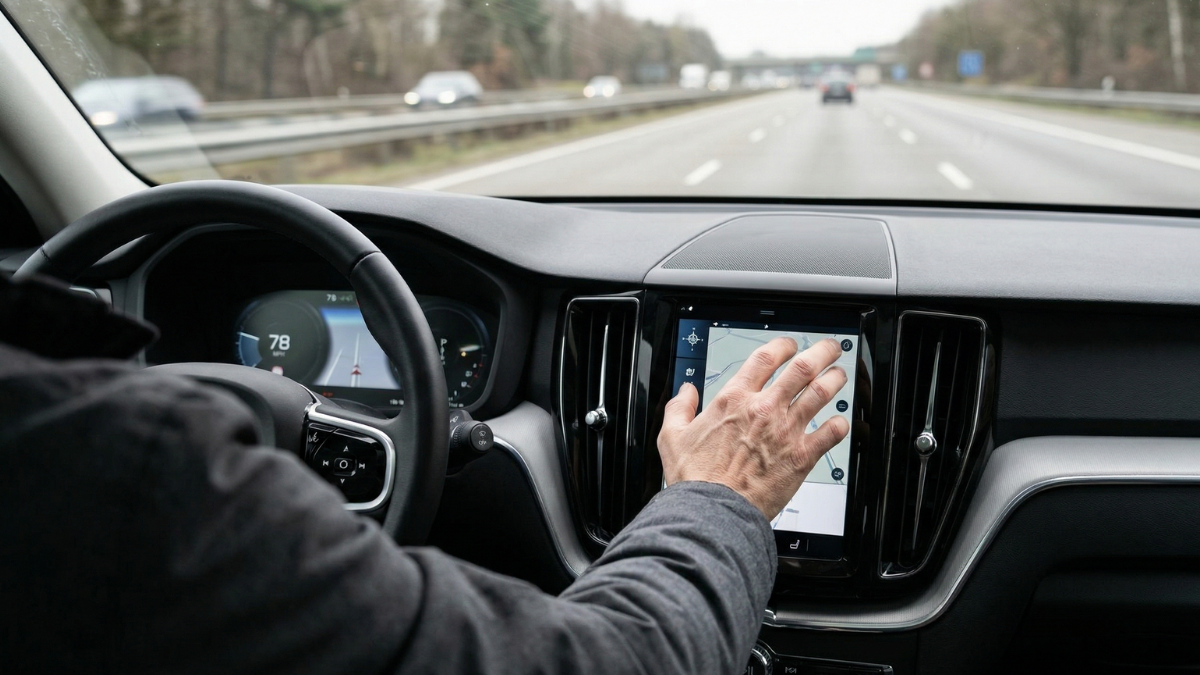
The dashboard of a new SUV looks cleaner than ever. One wide screen, no knobs, no buttons, nothing to interrupt the sweep of glass and carbon trim from door to door. It photographs beautifully and sells the car in the showroom. Then someone in the back seat needs more air, the driver reaches for the touchscreen at 75 mph, and the next two to three seconds happen with no eyes on the road. That distance — roughly the length of a football field — passes before a single vent adjustment is confirmed. Manufacturers know this. Regulators have started acting on it. And a small but meaningful number of 2025–2026 vehicles are reversing course and bringing physical climate controls back.
Quick Takeaways
- Adjusting climate controls via touchscreen takes a driver’s eyes off the road for approximately 2.5 seconds under NHTSA-referenced estimates; research by the U.K. Transport Research Laboratory found touchscreen interactions can exceed 12 seconds eyes-off-road in complex tasks
- At 75 mph, 2.5 seconds of eyes-off-road covers roughly 275 feet — just under a football field; at the worst-case TRL figure of 16 seconds, that exceeds 1,700 feet
- NHTSA considers any eyes-off-road task exceeding 2 seconds to be beyond safe limits; touchscreen climate adjustment routinely crosses this threshold
- TRL research found touch control produced a 57% delayed reaction time — worse than texting (35% delay) and considerably worse than the 12% delay associated with driving at the legal blood-alcohol limit
- From January 2026, Euro NCAP requires physical controls for five critical functions to achieve a five-star safety rating; physical climate buttons earn additional points
- Vehicles returning physical climate controls: 2026 Hyundai Palisade (dedicated physical climate panel), Volkswagen (committing to physical buttons for temperature, volume, hazard lights on all future models starting with ID.2all), 2026 Subaru Outback (separate climate panel), 2026 Honda Civic, Toyota Corolla
- Vehicles going the opposite direction: 2026 Mazda CX-5 moved all climate controls into a 15.6-inch touchscreen; 2026 Toyota RAV4 shifted most climate functions to screen with only temperature buttons retained
Why Muscle Memory Matters at Speed
Physical controls work because of muscle memory. A dial is always in the same position at the same location. A button has tactile feedback — a click or resistance — that confirms it has been pressed without requiring the eyes to verify. A driver who has adjusted the fan speed in a given car a hundred times can do it in the dark, in gloves, at highway speed, without removing attention from the road. That is not a minor convenience. It is the ergonomic principle the automotive industry developed over a century and then, in the space of roughly a decade, began systematically dismantling.
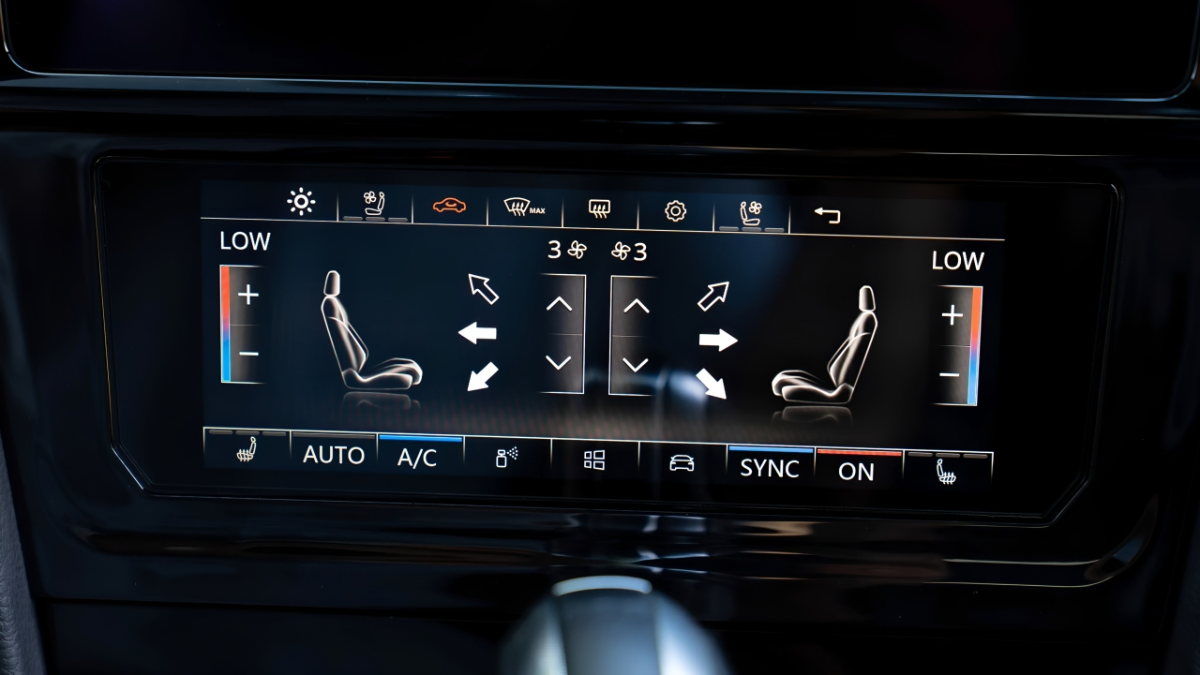
Touchscreens have no fixed position for any function. Every interaction requires the eyes to locate a target on a flat glass surface before the finger can find it. There is no click, no detent, no physical confirmation that the right input occurred. After a touch, the driver must look again to verify the action registered. That two-look sequence — locate, touch, verify — is the source of the time penalty. For simple inputs on a familiar screen, the time is short. For adjusting vent direction, fan speed, or temperature while navigating an unfamiliar menu, it is not.
NHTSA guidance is explicit: eyes-off-road tasks that exceed two seconds are beyond safe limits for driving. The agency uses the benchmark of reading or sending a text at 55 mph — five seconds, the length of a football field — as the standard illustration of dangerous distraction. Adjusting climate controls via touchscreen, at an estimated 2.5 seconds for a straightforward task, is already over that threshold before the task becomes complicated.
What the Research Actually Found
The most cited study on in-car touchscreen distraction comes from the U.K. Transport Research Laboratory, conducted using Apple CarPlay and Android Auto. Drivers interacted with the systems through both voice and touch control while driving a simulated route.
Using touch control, drivers took their eyes off the road for as long as 16 seconds — equivalent to more than 1,640 feet at 70 mph. That figure covers complex tasks involving navigation or messaging. More relevantly, even routine touch interactions exceeded 12 seconds of combined eyes-off-road time in the study, a level that violates NHTSA guidelines by a factor of six. Reaction times while using touch control were 57% slower than the baseline — worse than texting (35% delay) and substantially worse than driving at the 0.08% blood-alcohol legal limit, which produced only a 12% delay. Drivers in the study also significantly underestimated how long they were looking away, by as much as five seconds.
A separate data point from published safety reporting: adjusting climate controls via touchscreen specifically takes approximately 2.5 seconds of eyes-off-road time. At 75 mph — the posted speed limit on many U.S. interstates and standard cruising speed in Canada — 2.5 seconds covers roughly 275 feet. That is close to a football field for a task that in an older vehicle with physical knobs would require zero seconds of visual attention.
Euro NCAP’s data on the broader trend is direct: distraction-related crashes in Europe rose by nearly 20 percent since 2020, a period that overlaps with the widespread adoption of screen-only interiors.
Neither the TRL study nor the NHTSA guidance was aimed specifically at climate controls. They addressed touchscreen interaction broadly. The climate-control application is a direct consequence of the mechanism: any touchscreen task requires eyes-off-road time that physical controls eliminate.
The Children-in-the-Back-Seat Problem
The most common real-world scenario in which a driver urgently needs to adjust ventilation at highway speed is not navigation or entertainment. It is a child in the back seat who is too hot, too cold, or showing signs of motion sickness.
This is not a trivial use case. It is the defining drive condition for every family road trip in a three-row SUV. The driver, occupied with highway traffic, needs to make a rapid ventilation change to a rear climate zone — something that in a vehicle with physical controls is a half-second reach to a dedicated rear temperature dial, and in a touchscreen-only vehicle requires navigating from the main screen to the climate menu, locating the rear zone control, adjusting the setting, and confirming the change.
No responsible driver makes that interaction at highway speed without slowing, pulling over, or delegating to a passenger. In practice, many do make it at speed because the need is urgent and the highway has no immediate shoulder. The touchscreen design does not create this conflict — the need to adjust rear climate exists regardless of interface. But it determines whether the driver can resolve it safely with zero eyes-off-road, or unsafely with two-plus seconds of attention withdrawn from the road.
Vehicles with rear climate zone controls on a dedicated physical panel — or with rear climate accessible to a second-row passenger rather than routed entirely through the driver’s screen — eliminate this problem by design. Euro NCAP’s 2026 rules specifically reward physical buttons for commonly used functions with additional scoring points, citing consumer feedback that these features reduce distraction during real-world driving.
The specific Euro NCAP 2026 requirements are: physical controls mandatory for turn signals, hazard lights, horn, windshield wipers, and emergency SOS to achieve a five-star rating; additional credit for physical controls for climate and other commonly used functions. Compliance scales from 60% of qualified vehicles in 2026 to 80% by 2028.
Which 2025–2026 Vehicles Are Getting the Buttons Back

The trend reversal is real, but inconsistent. Some manufacturers are moving toward physical controls; others are simultaneously moving away. Buyers need to verify the specific trim and model year rather than relying on brand reputation.
Hyundai Palisade (2026). The redesigned Palisade, confirmed by multiple review sources including Wolfchase Hyundai and AutoGuide, retains separate physical controls for the climate system. A “zero-fuss setup for climate controls” is noted specifically by reviewers as a deliberate Hyundai response to customer feedback about physical buttons. The Palisade Hybrid received the same treatment.
Volkswagen (2026 onward, starting ID.2all). VW design chief Andreas Mindt told Autocar in March 2025: “We will never, ever make this mistake anymore.” The company confirmed that physical buttons for volume, temperature, and hazard lights will return to all future VW models. The first production vehicle to implement this will be the ID.2all EV, set to launch in 2026, which will have a dedicated row of physical buttons below the infotainment screen for climate functions and hazard lights. VW noted the change is rolling forward to every model in the lineup.
Subaru Outback (2026). The 2026 Outback adopted a smaller screen paired with a dedicated physical climate control panel, a reversal from the previous generation which had shifted climate functions into the touchscreen — a move that drew consistent criticism from automotive press.
Honda Civic and Toyota Corolla (ongoing into 2026). Both have maintained physical climate control knobs and buttons on most trims, resisting the all-screen interior trend that swept through higher-segment vehicles. These are not reversals; they are examples of brands that held the line.
Going the opposite direction — the cautionary examples:
The 2026 Mazda CX-5 is the sharpest reversal of previous Mazda philosophy. For years, Mazda was the brand most often cited for resisting touchscreen-only interiors, maintaining physical dials and a rotary controller as part of its driver-focused identity. The 2026 CX-5 eliminates all of that. Climate controls move to a 15.6-inch touchscreen — one of the largest in any mainstream vehicle — with the rotary dial removed. Mazda’s project lead cited voice control and the Gemini AI assistant as the proposed solution to distraction. Automotive press coverage of the announcement, particularly from Carscoops, noted it is likely to be controversial among existing Mazda owners.
The 2026 Toyota RAV4 is a partial reversal. Temperature is still controlled by physical buttons, but fan speed, vent direction, and secondary climate functions move to the touchscreen. AutoGuide’s review called this “a miss” and noted that the previous RAV4 had physical knobs for all of these functions. The RAV4 is the bestselling SUV in North America; the change affects a high volume of family buyers.
What to Check Before the Test Drive
The showroom visit does not reveal this problem. A parked car with a running touchscreen feels intuitive. The climate interface is responsive and the icons are clear. The test is not whether you can find the temperature control at rest. The test is whether you can adjust the rear vent zone without looking at the screen while maintaining speed in traffic.
Ask the sales consultant to let you drive the vehicle on a highway segment — not a parking lot. While at speed, attempt to adjust the rear climate zone using only the touchscreen without looking away from the road for more than two seconds. If this is impossible — which it will be in most touchscreen-only setups — that is the purchase-decision information. Ask whether any trim level offers physical climate controls or whether the function can be delegated to a rear-seat passenger without going through the driver’s screen.
For owners of vehicles already purchased with touchscreen-only climate, two practical mitigations: configure the climate system before reaching highway speed, and accept a passenger in the front seat or second row as the climate operator for any adjustments needed en route. Voice control is an option on most recent systems, and TRL’s study found that voice-based interactions stayed within NHTSA safe limits in all tested conditions — it is the interaction mode that does not require eyes-off-road time.
U.S. and Canada Note
Euro NCAP’s 2026 physical button requirements are a European standard and do not directly apply to U.S. or Canadian vehicles. NHTSA in the United States has not issued equivalent mandatory rules, though the agency’s own 2-second eyes-off-road guideline is established and widely cited. The practical effect for North American buyers is that vehicles sold globally — which includes most mainstream SUVs — will often meet the Euro NCAP standard anyway, since manufacturers are not going to produce separate button-equipped European versions and screen-only North American versions of the same vehicle.
Canadian highway driving conditions make this issue particularly relevant. The long open stretches of Trans-Canada driving, the cold-climate need for frequent heating adjustment between sun and shadow on winter trips, and the high proportion of family road trips in three-row SUVs all increase the frequency of mid-drive climate adjustments relative to urban driving. A touchscreen-only climate system that requires 2.5 or more seconds of eyes-off-road time on every adjustment is a different risk profile at 110 km/h on an empty Trans-Canada straightaway than on a 50 km/h city street.
SOURCES
- WardsAuto / TRL study: touch control produces 57% delayed reaction time vs. 12% for 0.08% BAC; eyes off road for as long as 16 seconds at 70 mph = 1,640+ feet; touch control worse than texting
- NHTSA: texting = 5 seconds eyes off road at 55 mph = football field length; 2-second threshold as beyond safe limits
- Visual Distractions data compilation: adjusting climate via touchscreen = ~2.5 seconds eyes off road; NHTSA guidelines
- Euro NCAP official: 2026 protocol — physical buttons for indicators, hazard lights, horn, wipers, eCall required for 5-star; credit for physical climate controls; HMI evaluation introduced
- Euro Weekly News: compliance scaling 60% in 2026 to 80% by 2028; distraction-related crashes up nearly 20% since 2020
- Autoblog: VW design chief Mindt confirmed physical buttons returning to all future VW models; “We will never, ever make this mistake anymore”; ID.2all first 2026 implementation; physical buttons for volume, temperature, hazard lights
- Wolfchase Hyundai: 2026 Palisade — “Separate physical controls are retained for the climate system”
- AutoGuide: “Hyundai has heard the comments about physical controls and provided a zero-fuss setup for climate controls”
- Carscoops: 2026 Mazda CX-5 moves all climate controls to 15.6-inch touchscreen; rotary dial and HVAC panel eliminated; “bound to be controversial”; Subaru Outback went opposite direction with smaller screen + physical climate panel
- AutoGuide: 2026 RAV4 — temperature still physical buttons, but fan/vent detail in screen; “a miss”; prior RAV4 had physical knobs for all climate functions