
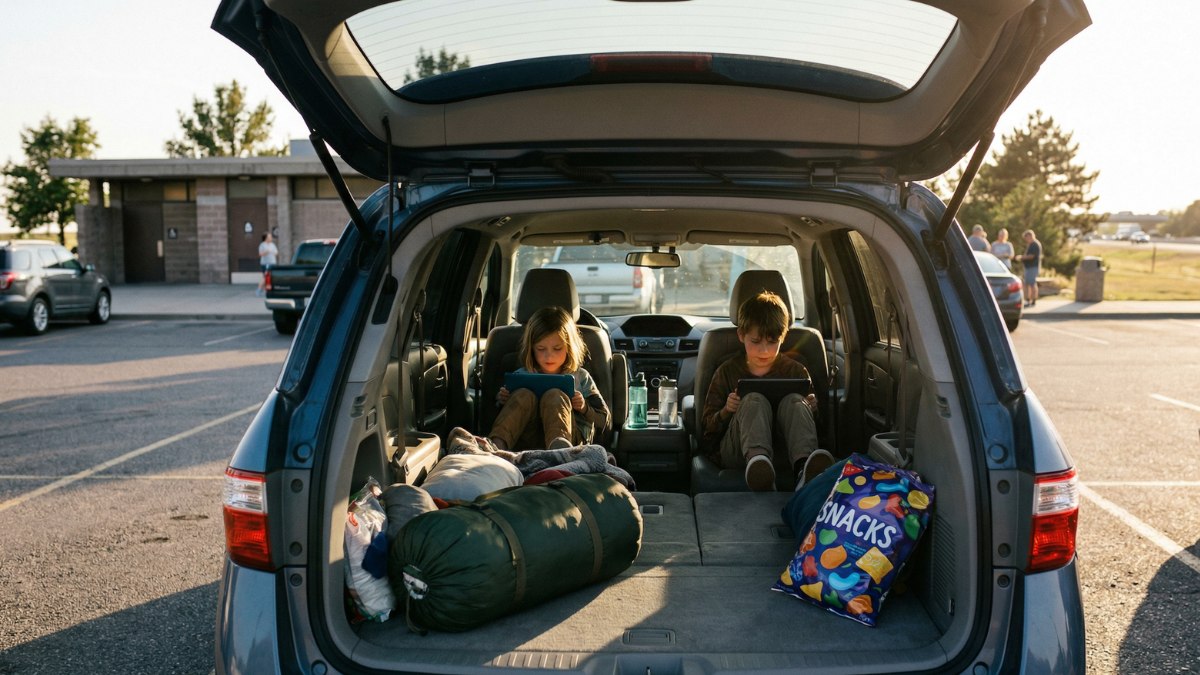
The third row is where the trip either works or it doesn’t. Not for the driver — for the seven-year-old who has been back there since Illinois, who is now reporting that it is too hot, whose tablet just died, who cannot reach the cupholder without unbuckling, and who has fifteen minutes left on a bladder that wanted a rest stop forty-five minutes ago.
A vehicle that handles this reality well is not just spacious on paper. It has cold air delivered to the third row from above, not from a vent at knee level three feet away. It has USB-C ports within arm’s reach of every seat. It has a suspension that does not rock the back row side-to-side on every lane change. And it has an intercom system, or at least windows tall enough that the parent in the front seat can hear what is happening back there without turning around at 75 mph.
These are the criteria that actually determine whether a family road trip is comfortable. Not cargo-with-all-seats-folded. Not 0-60. Not the sunroof. This guide applies them specifically to the third row.
Quick Takeaways
- The most important third-row feature for a long drive is not legroom — it is ceiling vents: cold air delivered from above reaches seated rear passengers effectively regardless of how far they are from the front evaporator; floor or console vents at this distance are significantly less effective (→ see “Which 3-Row SUVs Stay Cooler in the Back” in this series)
- The second most important feature is USB-C charging within reach of third-row passengers: a dead tablet or phone at hour three is the primary source of rear-row complaints on a long drive, and a port in the second-row seatback that requires leaning forward does not count
- Third-row legroom in midsize SUVs varies between approximately 31 and 35 inches — the difference between a comfortable drive for a 10-year-old and an uncomfortable one for anyone with a longer femur; verify actual legroom for the children who will occupy the row
- The rear suspension matters more for third-row passengers than any other occupants: the third row sits aft of the rear axle, making its occupants most sensitive to lateral rocking from rough pavement and multilink independent suspension meaningfully reduces this (→ see “Why Your Backseat Passengers Keep Getting Carsick” in this series)
- An in-cabin intercom system — currently offered by Hyundai on the Palisade — allows the driver to speak to third-row passengers without shouting or turning; at highway speeds with road noise, this changes the parent-child communication dynamic meaningfully
- The in-cabin intercom aside, cargo behind the third row determines what fits on the trip: 22+ cubic feet handles a large dog crate, a cooler, and a stroller simultaneously; below 19 cubic feet requires compromise (→ see “Dog + Cooler + Stroller” in this series)
What Kids in the Third Row Actually Need
The standard midsize SUV review evaluates third-row quality on two axes: legroom and ease of access. Both matter, but neither is the feature that determines whether a child has a good experience on a six-hour drive.
Temperature. The third row is the farthest point from the front climate evaporator. Cold air from console-mounted rear vents travels a short distance at knee height; it does not reach the upper body and head of a third-row passenger effectively, particularly on a full-family trip where the second row is also occupied and blocking airflow. Ceiling vents mounted above the second and third rows deliver cold air downward from directly overhead — the only configuration that works reliably for third-row comfort in summer heat (→ see “Which 3-Row SUVs Stay Cooler in the Back” in this series for the full ceiling-vs-console vent analysis).
Charge. The realistic tablet battery life for a child’s device on a seven-hour drive is four to six hours. A USB-C port in the second-row seatback — common on most vehicles — requires the third-row passenger to lean forward to reach it, often while buckled in a seatbelt that prevents comfortable bending. A USB-C port integrated into the third-row seatback or the side panel next to the third-row seat means a child can charge their device without contortion. This is the difference between a dead screen at hour four and a screen that lasts to the destination.
Motion. The third row sits aft of the rear axle. Published biomechanics research — cited in the backseat carsickness article in this series — documents that passengers seated behind the rear axle experience amplified lateral oscillation compared to those in front of it: every bump that one rear wheel absorbs arrives at the third-row seat magnified by the lever-arm distance. On a vehicle with a multilink independent rear suspension, that oscillation is partially absorbed before reaching the occupant. On a vehicle with a torsion beam, both wheels are coupled and the rocking is more pronounced (→ see “Why the Third Row Makes Adults Carsick” in this series).
Sound. At 70 mph on a typical Interstate, cabin noise in a midsize SUV ranges from approximately 65 to 74 dB — enough to require raised voices for front-to-rear conversation. The Hyundai Palisade offers a feature called Passenger Talk, which uses the driver’s voice projected through rear speakers so that communication with third-row passengers happens at normal volume without head-turning. The practical result: a parent can check on a child in the third row without taking eyes off the road. No other midsize SUV in this price range currently offers an equivalent.
The Third-Row Comparison Table
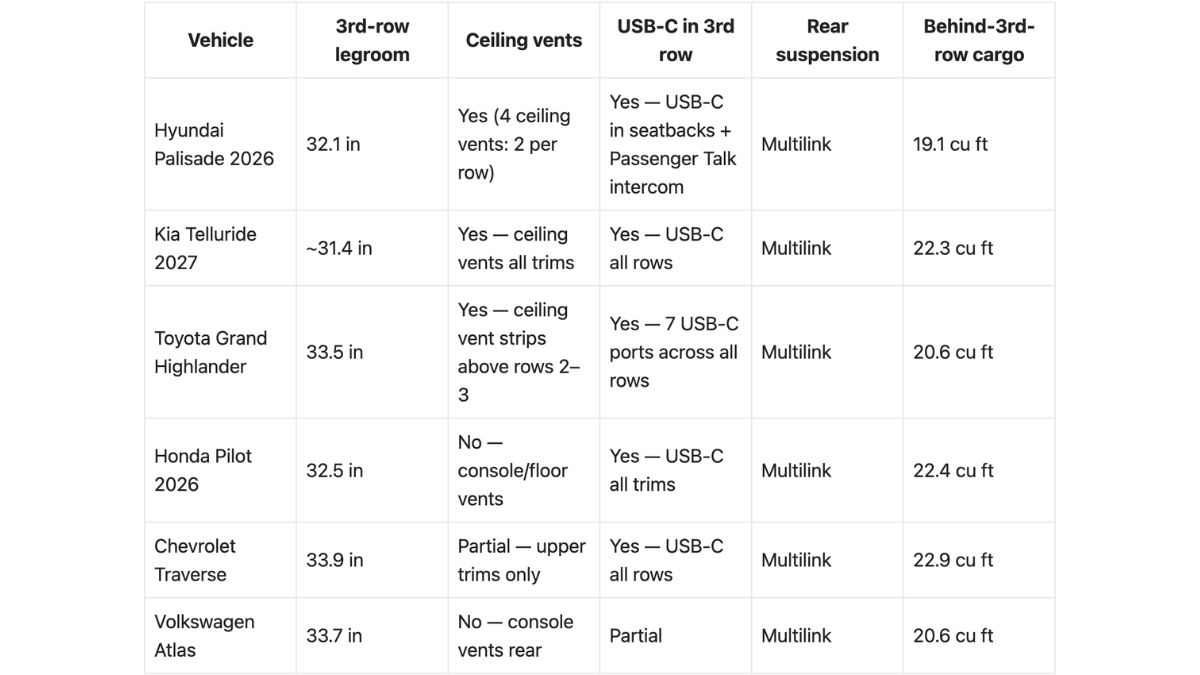
Legroom figures per published manufacturer specifications. Ceiling vent status per reviewer documentation. USB-C availability varies by trim; verify before purchase.
Five Vehicles That Work for the Third Row
Hyundai Palisade 2026 — Best Overall Third-Row Experience
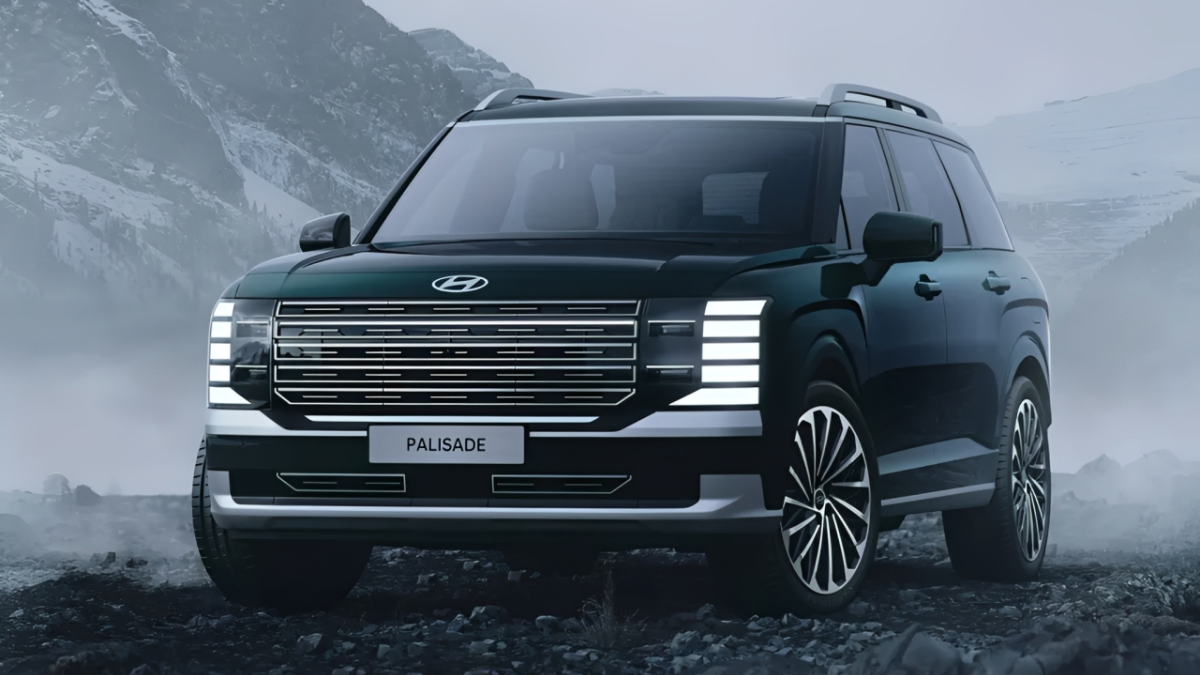
The 2026 Palisade is the only vehicle in the mainstream midsize segment that addresses third-row passenger welfare at a systems level rather than as a trim-level add-on. Four ceiling vents — two positioned over the second row and two over the third — deliver cold air downward to every rear passenger simultaneously, per A Girl’s Guide to Cars’ review of the redesigned model. USB-C ports are integrated into the seatbacks accessible to third-row passengers. And the Passenger Talk in-cabin intercom — standard on every 2026 Palisade trim — projects the driver’s voice through rear speakers, resolving the front-to-back communication problem without requiring the driver to turn around.
The third row also received specific improvements for the 2026 redesign beyond the standard comfort features. As The Car Mom’s certified child passenger safety review documents: “The third row has ceiling vents, its own charging ports, cup holders, and even heated seats.” The Car Mom also confirms that Hyundai added lower anchors to the passenger-side third-row seat for forward-facing car seats — providing installation flexibility on both outboard third-row positions.
The Autoblog parent reviewer who tested the 2026 Palisade hybrid specifically with toddlers noted: “I rode in the third row of the all-new hybrid coming later this year during a first drive event, and was very impressed with the seat’s comfort, outward visibility, accommodations, and adjustability. I was able to slide the seat back as far as it would go, and the person in front of me was able to slide their seat forward to give me enough space.”
The honest limitation: as The Car Mom notes, the third-row middle seat “is so small it’s only realistic for a small child or maybe an American Girl doll.” The Palisade is a six-passenger vehicle in practical use. The seventh seat exists for a small child or emergency use. Plan accordingly.
Best trim for road trips with kids: SEL Convenience (~$44,000) — gets the hands-free smart liftgate, ventilated second-row seats, and the full ceiling vent system, without reaching into Limited or Calligraphy pricing.
Kia Telluride 2027 — Best Third-Row Architecture at a Lower Entry Price

The 2027 Telluride skipped the 2026 model year to arrive with a full redesign. Two characteristics make it specifically strong for third-row road trips: ceiling vents are standard on every trim including the base LX, and the third-row cargo space at 22.3 cubic feet is the highest in the mainstream midsize segment — giving families the most room for gear behind occupied seats.
Per Ray Skillman Northeast Kia’s coverage of the 2027 lineup: “Tri-zone automatic climate control comes standard everywhere, with ceiling-mounted rear vents keeping third-row passengers comfortable.” This is the critical differentiator from vehicles where ceiling vents are reserved for upper trims: a family in the base LX at $39,190 gets the same ceiling vent architecture as a buyer in the top SX Prestige.
Third-row legroom of approximately 31.4 inches is adequate for children but tight for adults. The TorqBull comparison of midsize SUV third rows describes the Telluride’s “single-hand operation” of the second-row slide for third-row access as a specific engineering strength — reducing the physical effort of loading children into the back on every stop.
USB-C ports are available in all three rows. The 2027 redesign specifically added climate-controlled second-row captain’s chairs at SX Prestige, improving the front-of-trip comfort for the adult passengers in row two on a vehicle where children occupy row three.
Per Edmunds’ comparison: “Both [Palisade and Telluride] come with a lot of desirable features, including seat heating and ventilation, heated third-row seats, seven USB-C ports and easy-to-use multimedia systems.” The Telluride’s 27W USB-C charging rate versus the Palisade’s 100W is noted — the difference matters for fast-charging older children’s tablets on a long drive.
Best trim for road trips with kids: EX ($46,090 estimated) — adds synthetic leather, second-row sunshades, and ceiling vents (standard all trims) without reaching SX territory.
Toyota Grand Highlander — Best Third-Row Legroom + Widest Cargo Floor
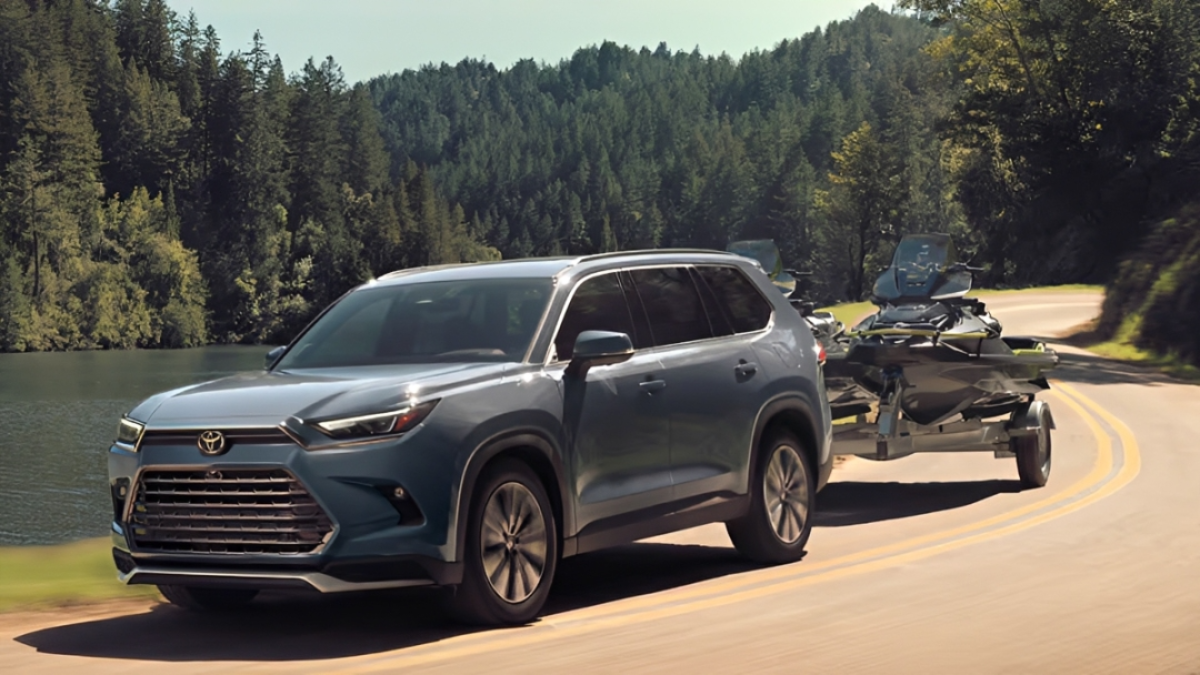
The Grand Highlander offers 33.5 inches of third-row legroom — the most in the mainstream midsize segment — and the widest cargo floor in class as confirmed by the Autoblog luggage test (wider than the Chevy Tahoe or Ford Expedition, not just other crossovers). For a family with an older child in the third row who can no longer fit comfortably in the 31-inch spaces that sufficed at age eight, the extra two inches of legroom is meaningful on a six-hour drive.
The ceiling vent design — strips integrated into the headliner above both the second and third rows — delivers airflow to all rear passengers simultaneously without directional adjustment. Toyota’s physical climate control layout (confirmed by KBB’s control review and Autoblog’s top physical controls ranking) means rear temperature adjustments happen without screen navigation, including while keeping eyes forward (→ see “Which New SUVs Have the Easiest Climate Controls” in this series).
The Grand Highlander Hybrid is EPA-rated at 36 mpg combined — relevant on a 600-mile round trip where the difference between 36 and 22 mpg amounts to approximately $35 in fuel savings per trip. Over a summer of weekend drives, that gap covers the cost of a tank of gas.
Seven USB-C ports are distributed across all rows. Power liftgate is standard; a hands-free foot-activated version is available on upper trims — specifically useful when a parent has a child on their hip and a bag in the other hand at a rest stop.
Limitation: No second-row or third-row ventilated seats. Front seat ventilation is available; rear passengers on hot drives rely entirely on the ceiling vent airflow. In the hottest summer climates, the Palisade’s ventilated second-row seats add meaningful comfort for the passengers between the driver and the third-row children.
Best trim for road trips with kids: XLE Hybrid (~$48,000). Gets multilink rear suspension, physical climate controls, ceiling vents, hybrid powertrain, and hands-free liftgate.
Honda Pilot 2026 — Best Third-Row Access and Hidden Cargo
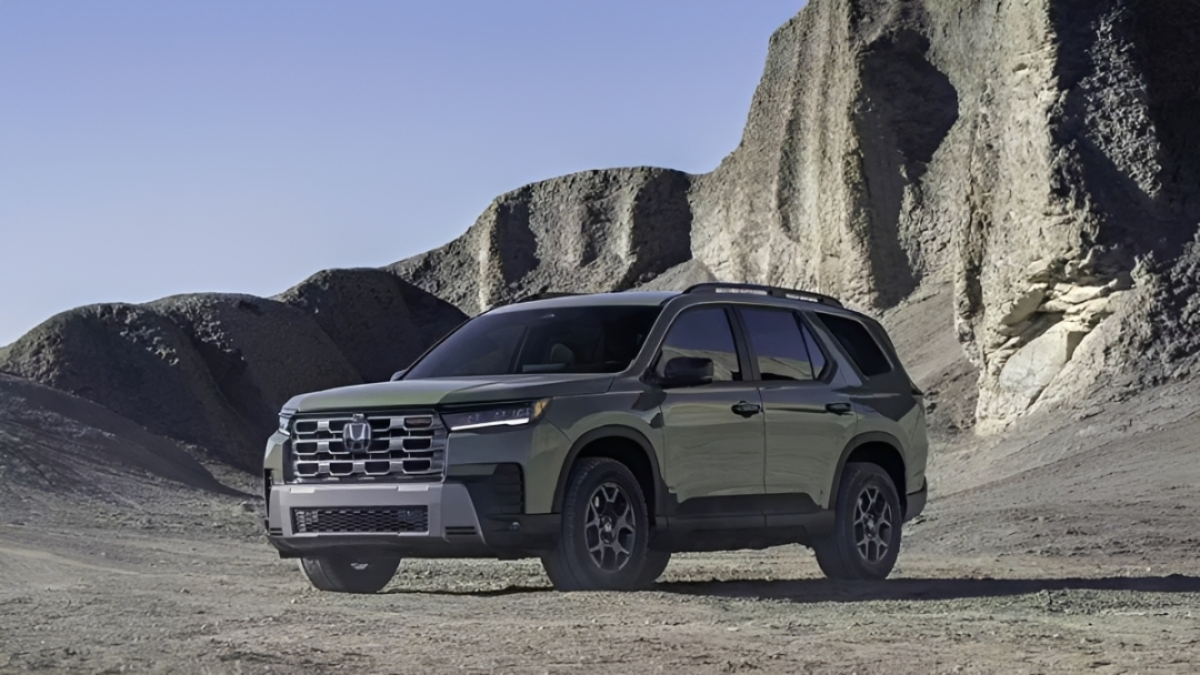
The Pilot’s specific advantage for families is not its third-row space — 32.5 inches of legroom is adequate but not leading — but the access architecture that makes loading children into the third row on repeated stops less physically demanding.
The stowable center seat in the second row (available on Touring, Elite, and Black Edition trims) removes the center seatback entirely and stores it under the rear cargo floor, creating a walk-through aisle to the third row without any folding, tilting, or moving of occupied seats. Community Honda’s 2026 Pilot review specifically addresses the practical impact: for families with children in car seats in the second row who also need to reach a child in the third row, the walk-through access eliminates the contortion that second-row tilt-and-slide mechanisms require.
The 2026 Pilot refresh added a standard power liftgate across all trims, including the base Sport — directly relevant for parents loading and unloading at rest stops. Upper trims include a hands-free foot-activated version.
USB-C ports are available in all three rows. The Pilot does not have ceiling vents for the third row — rear AC is delivered through console and floor vents. In hot-climate summer use, this is a meaningful gap relative to the Palisade and Telluride. The Pilot’s console ventilation is adequate in moderate weather; in sustained high-heat conditions on a long drive, the absence of ceiling vents for the third row becomes noticeable for the children seated there.
Limitation: No ceiling vents for row 3. Rear AC delivered via console vents at knee level — less effective for head and body cooling in summer heat. (→ see the ceiling vs. console vent analysis in “Which 3-Row SUVs Stay Cooler in the Back” in this series)
Best trim for road trips with kids: Touring (~$47,000). Gets the stowable center seat, walk-through aisle, hands-free liftgate, Honda Sensing standard, and 22.4 cu ft cargo with underfloor storage for the road trip essentials.
Chevrolet Traverse — Best Behind-Third-Row Cargo Space
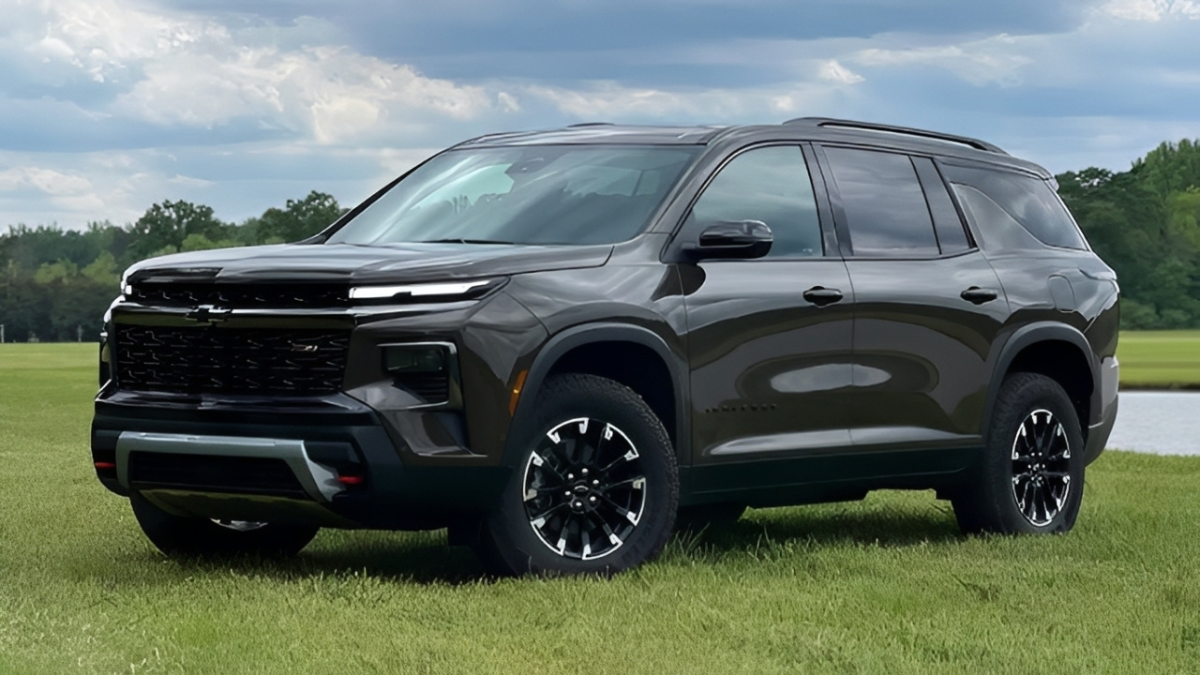
The Traverse’s primary road-trip advantage for families is the most practical one: 22.9 cubic feet behind the third row — the largest in the mainstream midsize segment — accommodating a large dog crate, a full-size cooler, and a stroller simultaneously without any folding (→ see the Dog + Cooler + Stroller article in this series).
Third-row legroom of 33.9 inches is the second-longest in the segment, behind only the Volkswagen Atlas at 33.7 inches. Tri-zone automatic climate control is standard on every Traverse trim, confirmed by Chevrolet’s own documentation — meaning the rear passengers can set their own temperature independently of the front from the base model upward.
The limitation is the ceiling vent coverage: ceiling vents are available on upper trims (RS, Premier, High Country) but not on the base LS or LT. A family that needs maximum cargo space and ceiling vents on a budget trim may find that the Traverse requires upgrading past the base configuration to get both.
For pure cargo-plus-passengers utility — a family that needs all seven seats occupied and maximum gear behind them — the Traverse solves the packing problem better than any other midsize three-row.
Best trim for road trips with kids: RS or Premier (~$45,000–$51,000) — gets ceiling vents, physical cargo floor rails, tri-zone climate, and the widest rear cargo opening in the class.
The Pre-Trip Third-Row Checklist
Before any long family drive with children in the third row:
Five things to verify before leaving the driveway:
1. Test the ceiling vents at the third row — not the console vents. Turn the rear AC to maximum and walk to the third row. If you feel cold air from above, the system will work for the kids back there. If the only airflow is from the knee-level console vents, plan for heat complaints in warm weather.
2. Charge the devices before departure, not at the first stop. A fully charged tablet lasts longer than one charged in the car en route. Identify the USB-C port closest to each child’s position before the trip begins so they can plug in without assistance.
3. Set the rear climate zone before the highway, not after. Third-row passengers often cannot reach the ceiling climate panel without unbuckling. Set the rear temperature and fan speed while parked, then advise passengers not to touch it unless they call to the driver.
4. Pack the third row before the cargo area. Anything a third-row passenger will need mid-trip — snacks, a backup charger, a small blanket — goes in the third-row seatback pocket or within reach before departure. Stopping to dig through cargo for a child’s item costs 10 minutes per stop.
5. Verify the rest stop spacing before the route. A third-row child’s comfort range is shorter than an adult’s. On routes with 90-plus-mile gaps between facilities — common on western Interstates — plan the stop before the child announces the need, not after.
U.S. and Canada Note
For Canadian families driving summer routes — Highway 17 through Northern Ontario, the Trans-Canada through the Rockies, BC Highway 99 — the third-row summer heat problem presents differently. Canadian mountain routes at 2,000–4,000 metres altitude in July can produce intense solar radiation even when ambient temperatures are moderate. The glass roof on upper-trim Palisade and Telluride models absorbs solar heat and re-radiates it downward to the third row regardless of whether the shade blind is closed (→ see “The Panoramic Sunroof Penalty” in this series).
The practical implication: for Canadian mountain summer drives with children in the third row, the ceiling vent advantage of the Palisade and Telluride is partially offset by the glass roof heat load on vehicles with panoramic configurations. The Kia Telluride base LX trim — no panoramic roof, ceiling vents standard — may provide better sustained third-row summer temperature on mountain routes than a higher-trim competitor with full glass overhead.
AWD is also a consideration for Canadian families on unpaved cottage roads or shoulder-season drives. The Grand Highlander Hybrid and both the Palisade and Telluride offer AWD as an option across most trims; confirm AWD is included in the specific configuration before purchase.
SOURCES
- A Girl’s Guide to Cars: 2026 Palisade four ceiling vents — two for second row, two for third row; ceiling climate control panel; Passenger Talk in-cabin intercom; Rear Seat Quiet Mode
- The Car Mom CPST: third row ceiling vents, USB-C in seatbacks, cup holders, heated third-row seats confirmed; lower LATCH anchor on passenger-side third-row seat new for 2026; honest assessment of third-row middle seat practicality
- Autoblog parent reviewer: Palisade third-row comfort and adjustability confirmed in hybrid first drive; Grand Highlander third row noted with USB ports, AC vents, large windows, panoramic sunroof contribution to brightness
- Ray Skillman: “Tri-zone automatic climate control comes standard everywhere, with ceiling-mounted rear vents keeping third-row passengers comfortable” — all Telluride trims
- Edmunds Palisade vs. Telluride Hybrid: seven USB-C ports standard both SUVs; Palisade 100W vs. Telluride 27W charging rate; heated third-row seats both; ride quality and comfort compared
- U.S. News: third-row tight for tall adults on long trips; both receive high marks for comfort all three rows; Palisade 32.1 in third-row legroom; both Nappa leather top trims
- Edmunds most comfortable SUVs: Grand Highlander all three rows comfortable for adults; 33.5 inches third-row legroom; controls easy to use; good visibility
- Autoblog luggage test: Grand Highlander cargo floor “wider than every three-row crossover tested”; seven USB-C ports confirmed across all rows
- Community Honda of Orland Park: 2026 Pilot stowable center seat with underfloor storage compartment; walk-through aisle; power liftgate standard all 2026 trims; 22.4 cu ft behind third row
- Chevrolet: tri-zone climate standard all Traverse trims; rear automatic climate control adjusts independently to passenger-set temperature