

According to the IRS, the 2026 standard mileage rate for business use is 72.5 cents per mile, a widely used “all‑in” yardstick that bundles fuel, depreciation, maintenance, insurance and other ownership costs into one number. AAA’s Your Driving Costs 2025 analysis shows why that framing matters: total cost-per-mile varies by vehicle category and is driven heavily by ownership costs, not just fuel. Meanwhile, the U.S. Department of Energy notes hybrids can see notable fuel-economy drops in cold weather, especially on short trips. Put together, the practical question for weekend travelers is specific: if most getaways are 200 miles or less, does paying extra for the hybrid trim actually “work harder,” or does the math stay too small to matter?
Quick takeaways
- For sub-200-mile weekends, fuel savings alone are often smaller than people expect. The extra cost only “pays back” fast if the hybrid gains meaningful MPG in your real driving and gas prices stay high.
- Where hybrids usually shine: stop‑and‑go and mixed driving. DOE’s Alternative Fuels Data Center notes hybrids typically improve fuel economy versus similar conventional vehicles.
- Cold-weekend reality check: DOE’s Energy Saver says hybrids can see substantial fuel-economy drops in cold weather, especially on short trips—exactly the pattern many winter getaways create.
- The payback question is an “all‑in” decision. IRS 2026 mileage rate (72.5¢/mi) and AAA cost-per-mile data both reinforce that depreciation and insurance can matter more than fuel.
- Best method: compute break-even miles using your hybrid price premium and your realistic fuel-savings-per-mile, then apply a “stress value” for fewer fuel stops and calmer driving.
Step 1: Define what “worth it” means for a 200-mile getaway

A 200‑mile weekend typically looks like:
- one long highway leg out,
- one leg back,
- plus short local trips for groceries, coffee, trailheads, and kid activities.
“Worth it” can mean three different things:
1) Pure dollars (fuel saved minus extra purchase cost)
2) Time and effort (fewer fuel stops, less range anxiety)
3) Stress (calmer driving, smoother low-speed operation)
This guide focuses on the dollars first, then explains when the non-dollar benefits justify the premium even when payback is slow.
Step 2: The fuel math that actually decides a short weekend
Fuel cost is the easiest part to compute.
Fuel cost = miles ÷ real MPG × local gas price
So the fuel “advantage” of a hybrid depends on:
- the real-world MPG gap between trims,
- how much of the trip is highway vs local errands,
- and the gas price on your route.
A key nuance for 200-mile weekends:
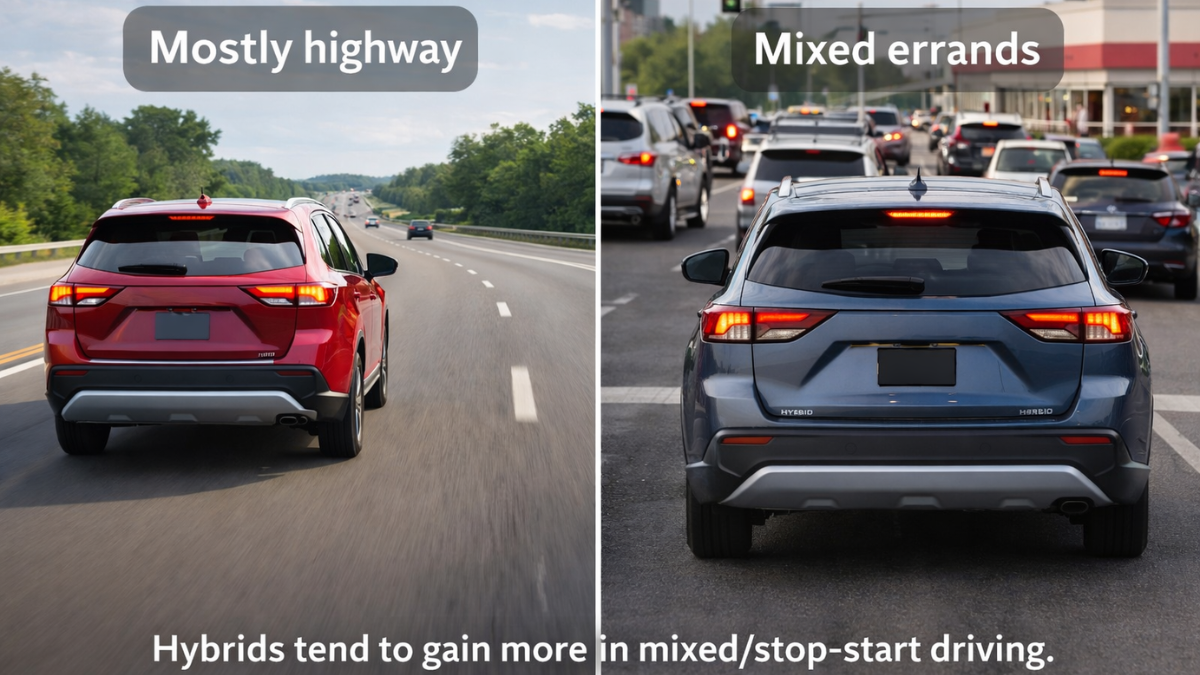
- If most miles are highway at steady speed, the hybrid’s advantage may be smaller than in city driving.
- If the weekend includes lots of short errands and stop-and-go, hybrids often do better.
DOE’s Alternative Fuels Data Center explains why hybrids tend to help in those conditions: the electric motor and regenerative braking can reduce fuel use, especially when speeds vary and braking is frequent.
Step 3: The cold-weather weekend problem (why the label can feel optimistic)
Many “200-mile or less” getaways happen in shoulder season or winter—ski weekends, cabin weekends, wet-weather breaks.
DOE’s Energy Saver guidance notes fuel economy drops in cold weather, and for hybrids the drop can be substantial, especially on short trips. That matters because short errands at the destination are exactly where cold-start losses pile up:
- the engine runs richer until warmed,
- cabin heat demand rises,
- and the system spends energy warming itself instead of moving you efficiently.
Practical takeaway: if your getaways are often cold and short-trip-heavy, the hybrid still works—but the “fuel savings” portion may be smaller than expected unless your driving is largely in the hybrid’s sweet spot.
Step 4: The payback math (the part most people skip)
The simplest payback model avoids invented pricing and works for any trim premium:
Break-even miles = Hybrid premium ÷ fuel savings per mile
Where:
- Hybrid premium = the extra you pay for the hybrid trim compared with the gas trim (out-the-door difference you can verify locally).
- Fuel savings per mile = (gas cost per mile) − (hybrid cost per mile).
Fuel cost per mile can be computed from your real MPG and gas price:
- Gas cost per mile = price per gallon ÷ MPG.
A clean example (clearly hypothetical to show structure)
- Hypothetical gas price: $3.50/gal
- Hypothetical MPG: gas 28, hybrid 36
- Gas cost/mi: 3.50/28 = $0.125
- Hybrid cost/mi: 3.50/36 = $0.097
- Fuel savings/mi: $0.028
If the hybrid premium is $2,500, break-even miles ≈ 2,500 / 0.028 ≈ 89,000 miles.
That is the core message: for short trips, hybrids can still be great, but pure fuel payback often requires a lot of miles unless the premium is small or gas prices are high.
Step 5: When the math flips in real life (even under 200 miles)
Hybrids can be “worth it” before strict fuel payback for three practical reasons.
1) Your driving is mixed, not highway-only
If most weekends include in-town errands and stop-start traffic, the hybrid advantage tends to show up more often. That can shrink payback miles, especially if the gas trim is relatively thirsty in city use.
2) Fuel volatility changes short-weekend totals
EIA’s weekly U.S. regular gasoline series shows the national average can move quickly week to week (early March 2026 provides a clear example of a sharp jump). When price swings are large, the “savings-per-mile” can widen—temporarily or seasonally—which changes the feel of the decision.
3) The hybrid changes the weekend experience
Even on a 200-mile loop, the “value” can be:
- fewer fuel stops (or the ability to skip the pricey station near the destination),
- easier low-speed driving,
- and a calmer sense of margin in bad weather.
This is not a spreadsheet claim; it is a practical travel claim. If the hybrid reduces one stressful stop per weekend, many families consider that worth money even if fuel payback is slow.
What changed in 2026 (why the all-in lens matters)
Two 2026 anchors help keep the decision honest:
- All-in driving costs: the IRS set the 2026 mileage rate at 72.5¢/mile, reinforcing that depreciation and maintenance are real costs even when you mostly “feel” fuel spend.
- Cold-weather realism: DOE’s cold-weather guidance highlights that hybrids can see large percentage drops in fuel economy on short trips, which applies directly to winter getaways.
The implication is not “don’t buy a hybrid.” It is: do not judge the decision only by a best-case MPG expectation.
What this means in the U.S.
For U.S. weekend travel patterns, most sub-200-mile getaways are:
- a highway approach plus errands,
- with occasional cold-weather or rain-heavy driving,
- and at least one high-price fuel zone near resorts or rural towns.
In that reality:
- hybrids can reduce fuel stress, but
- the pure fuel payback may be slow unless you drive a lot of total annual miles.
So the best decision is not “hybrid or not.” It is “hybrid as a comfort + efficiency tool” versus “gas as the lower-cost baseline.”
What you can do: the 6-minute hybrid decision checklist
1) Find your real weekend miles: 200 round-trip plus typical local miles.
2) Estimate your pattern: mostly highway, or mixed errands?
3) Use conservative MPG gaps: avoid best-case assumptions; remember cold-weekend losses per DOE.
4) Compute fuel savings per mile: gas price ÷ MPG for each trim.
5) Compute break-even miles: premium ÷ savings-per-mile.
6) Add one “stress value”: fewer fuel stops, calmer low-speed driving, and weather confidence.
If the break-even miles feel too large but the stress value feels meaningful, the hybrid can still make sense. If both feel small, stay with the gas trim and invest in tires and maintenance for reliability.
Bottom line
If most getaways are 200 miles or less, paying extra for a hybrid trim can still be a smart choice—but it is rarely a quick “fuel payback” story. The decision works best when your weekends include lots of mixed driving and you value fewer fuel-station hassles. It works less well when trips are mostly steady highway and cold-start-heavy, because DOE notes hybrids can lose a substantial share of efficiency on short cold trips.
The most reliable approach is simple: compute break-even miles using your real premium and a conservative MPG gap, then decide whether the hybrid’s lower-drama weekend experience is worth the remaining difference.