

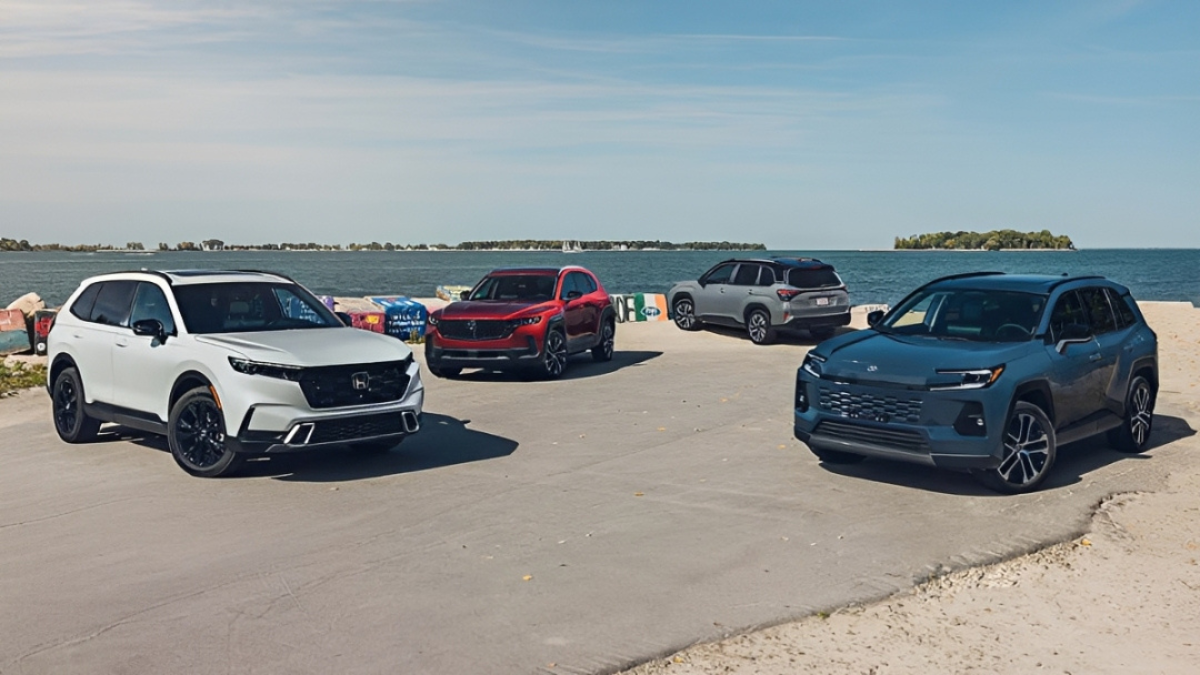
According to Car and Driver’s 2026 hybrid compact-SUV comparison road trip, the Honda CR‑V Hybrid Sport Touring delivered the calmest, most “set-and-forget” highway experience among four popular AWD hybrids, edging the Toyota RAV4 Hybrid, Mazda CX‑50 Hybrid, and Subaru Forester Hybrid. That matters on long drives because stress rarely comes from one big problem—it comes from dozens of small corrections: steering nudges, suspension bobble, wind noise, and driver-assist that feels jumpy instead of smooth. This guide turns that test into a practical “least-stress” checklist for 2026 shopping, then shows what to verify on a real weekend route before committing. The focus is the U.S. market, where long interstate stretches and high-speed limits amplify noise, ride motion, and assist tuning.
Quick takeaways
- Least-stress “feel” is usually a mix of three things: quiet cabin, controlled ride, and driver-assist that behaves predictably at highway speeds.
- In Car and Driver’s 2026 hybrid compact-SUV road-trip comparison, the CR‑V Hybrid finished first for overall comfort and refinement; the RAV4 Hybrid was second.
- The Mazda CX‑50 Hybrid can feel “less digital-stressful” for some drivers because of its physical controls and cabin ergonomics—worth a seat-and-controls check even if it did not win the test.
- A “least stress” pick can change by trim: wheel size, tire type, and whether the best assist package is included often matter more than the badge.
- Before buying, replicate a 40–60 minute highway segment and do three checks: noise at 70 mph, steering micro-corrections on grooved pavement, and adaptive cruise smoothness in light traffic.

What “least stress” actually means on a long drive
Long-drive stress tends to come from “background load,” not drama. A vehicle can be fast and efficient and still feel tiring if it asks for constant tiny inputs.
A practical way to score stress is to watch for:
- Noise load: wind hiss, tire roar, powertrain buzz, and how much the stereo has to “fight” at speed.
- Motion load: head toss over broken pavement, rebound after freeway joints, and whether the body keeps floating after a bump.
- Assist load: adaptive cruise that brakes late, lane centering that ping-pongs, and alerts that feel intrusive rather than helpful.
- Human factors: seat support after hour two, knee angle, armrest placement, and how many essential controls are buried in screens.
This is why an outlet’s road-trip test can be more useful than a short city loop: it forces the vehicle to live at highway speed, in crosswinds, over expansion joints, and through the small variability that makes drivers tense.
The strongest single data point for 2026: a four-SUV road-trip test
Car and Driver’s 2026 hybrid compact-SUV comparison test ran a road trip and judged comfort, cabin calm, and overall “easy to live with” behavior across four AWD hybrids: CR‑V Hybrid, RAV4 Hybrid, CX‑50 Hybrid, and Forester Hybrid. The CR‑V Hybrid Sport Touring placed first, with the magazine citing a refined ride, quiet cabin, and a consistently satisfying overall experience; the RAV4 Hybrid was second. The CX‑50 Hybrid placed third, and the Forester Hybrid fourth.
That does not mean the CR‑V is “best for everyone.” But it is strong evidence for the specific question here—least stress on long drives—because the winning traits are exactly the stress levers: noise, ride control, and consistency.
Why the CR‑V Hybrid often feels calmer at speed
In the same comparison, Car and Driver described the CR‑V Hybrid as having a quiet cabin and refined ride—the sort of “less busy” behavior that reduces the need to brace for impacts or correct steering mid-corner. Edmunds’ 2026 CR‑V rating review also describes a smooth and comfortable ride and notes that its advanced driver assist features work well (while also observing that rivals can offer more assist features depending on trim).
The key point is not that a CR‑V is magically silent. It is that, across two different evaluation styles, the CR‑V is repeatedly described as smooth and easy to settle into. For long drives, “settling in” is the whole game.
A quick buyer tip: if two trims exist, the calmer long-drive version is often the one with smaller wheels and more tire sidewall, even if the brochure trim looks less sporty.
Why the RAV4 can be “low stress” for some drivers—despite second place
Car and Driver’s same test put the all-new 2026 RAV4 Hybrid second and described it as well-equipped and family-friendly, while also noting behavior that can feel less calm under certain conditions (such as body roll and a buzzy response under throttle).
If the long-drive stress trigger is uncertainty rather than noise, Toyota’s safety/assist packaging may matter. Toyota’s pressroom says every 2026 RAV4 model includes the latest Toyota Safety Sense system as standard and frames it as an update to detection capabilities for features like pre-collision detection and lane tracing assist. That does not automatically equal “least stress,” but it supports a real-world pattern: a well-tuned lane-and-cruise system can reduce workload, especially in steady-speed highway traffic.
A practical reality check: on the test drive, pay attention to how the RAV4 holds the center of the lane (gentle and steady vs correction-and-correction) and whether adaptive cruise brakes smoothly when a car merges in front.
Why the CX‑50 Hybrid is a sleeper pick for “controls stress”
Not all stress is motion. Some drivers hate “screen stress”: touch controls, menu hunting, and glance time. The CX‑50 has become known in some coverage for sticking with physical controls and a more traditional interface approach compared with many rivals, which can reduce cognitive load on a road trip.
In Car and Driver’s four-SUV comparison, the CX‑50 Hybrid finished third overall, praised for an upscale interior and engaging feel, but with practicality tradeoffs versus the top two. That places it in a specific lane: it may be a “least stress” choice for drivers who value cockpit usability and a more connected steering feel, but it may not be the quietest or softest at speed depending on wheel/tire setup.
The Forester: visibility and comfort strengths, but check assist feel
Subaru positions EyeSight as standard on every 2026 Forester, and Consumer Reports’ Forester road-test summary highlights outward visibility, a roomy cabin, and a comfortable ride as core virtues. Those traits can be stress-reducing—especially visibility on unfamiliar interchanges.
At the same time, the Forester Hybrid placed fourth in Car and Driver’s hybrid compact-SUV comparison, with criticisms that included sluggishness and infotainment age. The takeaway is to separate the Forester’s classic strength (day-in, day-out usability and sightlines) from the specific “least stress on interstates” goal.
If the Forester is on the list, the test-drive priority should be: lane centering at highway speed, wind noise around mirrors, and seat comfort after 30 minutes.
What this means in the U.S.
U.S. interstates create a specific stress profile: long stints at 65–80 mph, frequent concrete joints, and crosswinds. That puts extra weight on:
- Cabin quiet at speed (wind + tires)
- Suspension damping (how quickly it stops moving after a bump)
- Adaptive cruise behavior in mixed-speed traffic
- Lane centering consistency on wide lanes and worn striping
For this environment, the best single “least stress” signal from current public testing is the Car and Driver road-trip result with the CR‑V Hybrid finishing first for refinement and quietness. If a buyer wants to widen the net beyond those four hybrids, use the same method: look for road-trip evaluations that explicitly describe noise, ride, and driver-assist behavior at speed—not just horsepower and 0–60.
What changed (and why 2026 shopping is not the same as “last year”)
Two 2026 changes matter for stress, not bragging rights:
1) Driver-assist suites are becoming more central to the trim walk. Toyota’s pressroom emphasizes Toyota Safety Sense as standard for 2026 RAV4, and Subaru continues to center EyeSight as standard for Forester. Feature availability can shift quickly by trim and package.
2) Hybrid powertrains are now “default mainstream,” which changes long-drive behavior: quiet low-speed transitions, different engine load patterns on grades, and—sometimes—more powertrain buzz if the calibration is aggressive.
The practical implication: do not shop by “model” alone. Shop by the specific trim’s wheels/tires, seat spec, and the exact assist package included.
What you can do: a 10-minute least-stress test drive script
Use this mini script to make the decision feel obvious:
- 70 mph noise check: set the climate fan to low, audio off, and listen for wind around the A-pillars and tire roar.
- Expansion-joint ride check: find a section of freeway with regular joints. Count how many seconds it takes the body to stop moving after one joint. “One bounce and done” is calming.
- Assist smoothness check: set adaptive cruise in light traffic. Watch whether it brakes smoothly for a merge-in, or reacts late then over-brakes.
- Lane centering check: with hands on the wheel, note whether it gently holds center or repeatedly nudges side-to-side.
- Seat check: after 20 minutes, scan for hot spots: lower back, outer thigh, and shoulder tension.
This test drive method works even if the final shortlist is different from the four hybrids in the Car and Driver comparison.
What to watch next
Two things can shift the “least stress” answer over the 2026 model year:
- Mid-year trim and tire changes. A quieter tire compound or smaller wheels can transform a vehicle’s highway feel without a major redesign.
- Software updates to driver-assist behavior. Toyota’s pressroom points to software foundations for the new RAV4 platform; in the broader industry, assist tuning can evolve across updates and model-year changes.
For shoppers, the simplest rule is to verify the exact trim on the lot, then repeat the same 10-minute script. If the vehicle feels calm when it is doing nothing dramatic, it is likely to stay calm at hour three.