
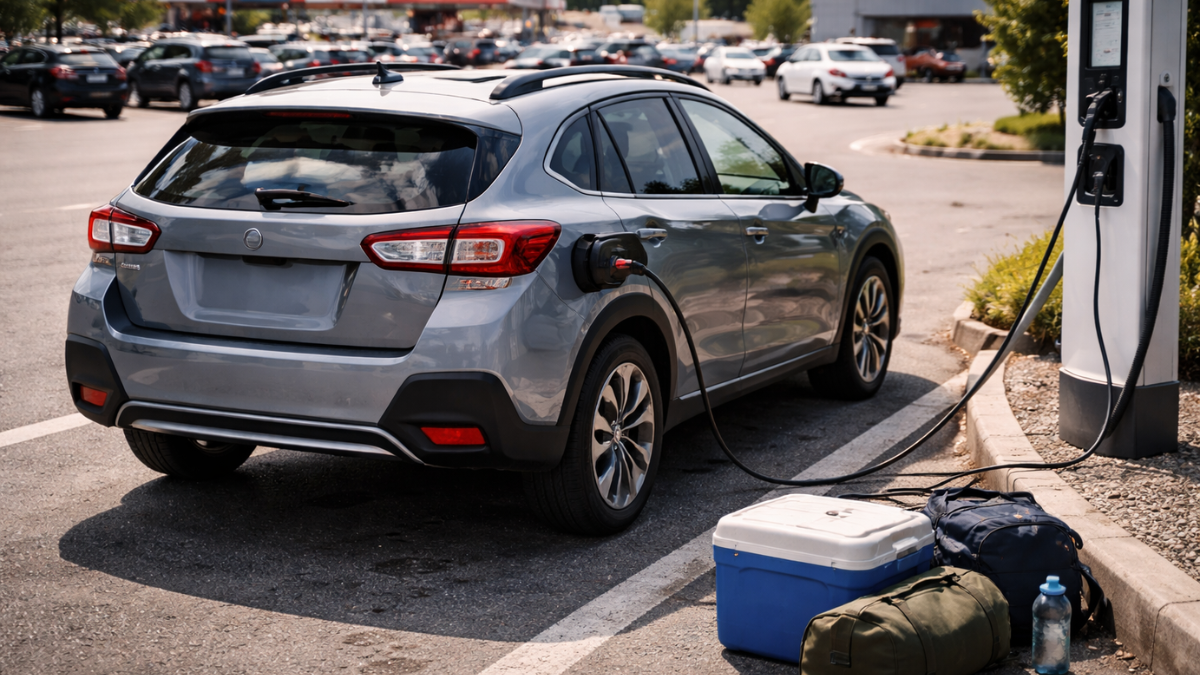
Plug-in hybrids make beautiful sense in town. Charge at home, burn less gas, use the battery for errands, and feel clever every morning. The trap shows up when the trip gets long and the charger is no longer sitting in your garage. Public charging sounds like the obvious fix, but the time math often turns ugly on a real weekend. On current Hyundai Tucson models, the plug-in hybrid can take less than two hours for a full charge on a 240V charger, while the standard hybrid just keeps going. That is the useful 2026 question: when does a PHEV stop feeling like the smarter road-trip tool and start feeling like a delay you paid extra to create?
Quick takeaways
- A PHEV is usually at its best when it leaves home charged and comes home charged.
- A standard hybrid is usually better at simply eating highway miles because it never asks for a charging stop in the middle of the trip.
- The trap is time, not only fuel. U.S. DOT says Level 2 charging can refill a PHEV in roughly 1–2 hours. That is a long stop for a small battery.
- The gas-only penalty can be real once the battery is empty. EPA data for the 2024 Hyundai Tucson family shows the Tucson Plug-in Hybrid at 35 mpg on gasoline after depletion, versus 38 mpg for the Tucson Hybrid Blue.
- On a 400-mile weekend, the public-charge stop can save less fuel than drivers expect and cost more time than they will tolerate.
The hidden trap is not electricity. It is the stop.
This article is not anti-PHEV. A plug-in hybrid can be a terrific daily driver.
The problem starts when buyers quietly assume that a weekend road trip works like city life:
- start on battery,
- top up somewhere,
- keep the savings going.
That sounds reasonable until the charging stop becomes part of the route instead of part of the driveway.
DOE’s charging guide says Level 2 charging typically provides about 25 miles of range per hour, and the U.S. Department of Transportation says Level 2 can recharge a PHEV in about 1–2 hours. AFDC says public charging typically uses Level 2 or DC fast charging and is often placed where drivers stay parked for longer stretches, such as shopping centers, hotels, airports, and similar destinations.
That is the clue.
A PHEV road-trip charging stop is usually not “fueling.”
It is parking with a cable.
Why the standard hybrid often wins the trip
A standard hybrid is much less interesting in the driveway and much less annoying on the highway.
It does not ask the driver to decide:
- whether a charger is worth the stop,
- whether the charger is occupied,
- whether the charging session is worth the app setup,
- or whether 90 minutes parked for a small battery refill is actually rational.
That is why hybrids keep making sense for long weekend use. They turn the fuel-saving mission into something passive. The driver just goes.
A PHEV, by contrast, is really two vehicles in one:
- excellent when the battery is part of the routine,
- less convincing when the trip forces it to behave like a regular gas crossover with extra battery weight.
That split is the whole article.
The Hyundai Tucson family shows the problem clearly
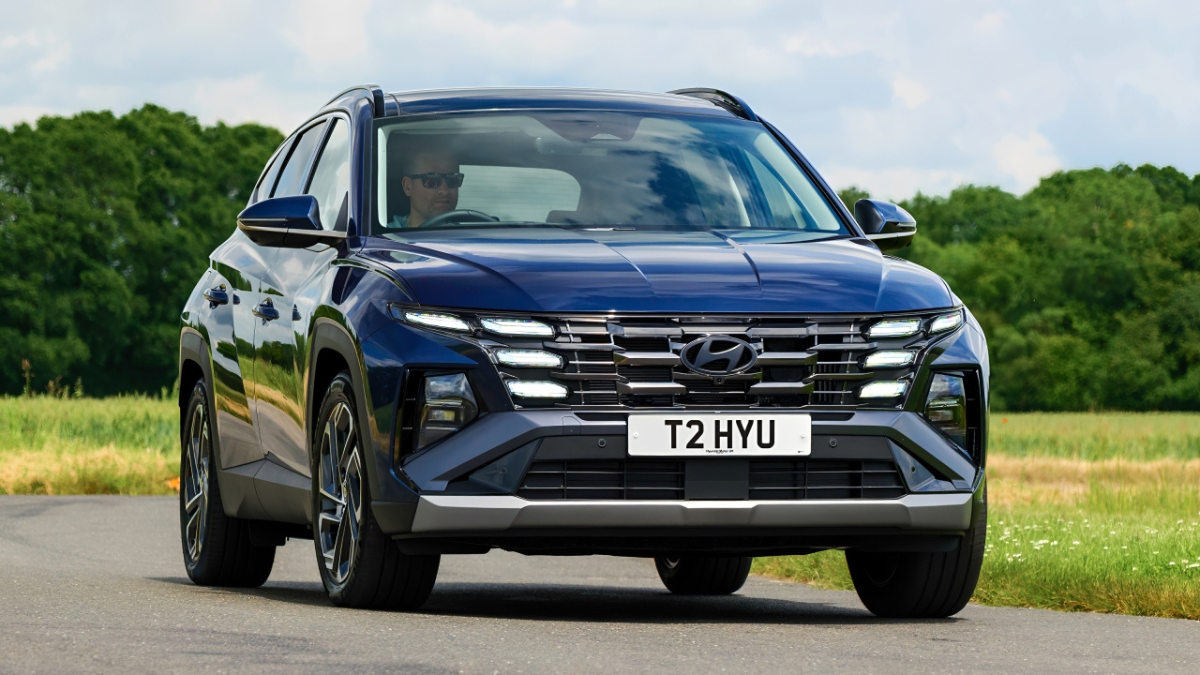
The Tucson family is useful because the numbers are easy to read. To keep the math honest, this section uses the 2024 Tucson family as a clean EPA case study, while the current Hyundai pages show how the same plug-in-versus-hybrid logic still holds in the current lineup.
EPA data for the 2024 Hyundai Tucson Plug-in Hybrid says:
- 33 miles of electric range,
- 80 MPGe combined when using electricity,
- and 35 mpg once it is running on gasoline.
For the 2024 Hyundai Tucson Hybrid Blue, EPA says:
- 38 mpg combined,
- with a total range of 521 miles.
Hyundai’s current Tucson Plug-in Hybrid page says a full charge takes less than two hours on a 240V charger.
That gives the article a very clear real-world split:
- the PHEV is excellent if the battery starts full and the trip can use that first 33 miles well,
- but once the battery is empty, the standard hybrid is actually the better gasoline road-trip machine.
The 400-mile trip math is where the public-charging trap shows up
This is the added-value section that makes the article worth publishing.
Scenario A: standard hybrid
Using the EPA figure for the Tucson Hybrid Blue at 38 mpg combined, a 400-mile trip takes about:
- 400 ÷ 38 = 10.5 gallons
No charging stop. No charging app. No waiting.
Scenario B: PHEV, leave home full, do not charge publicly
Using the Tucson Plug-in Hybrid EPA figures:
- first 33 miles on electricity,
- remaining 367 miles on gasoline at 35 mpg
That means the gasoline part of the trip takes about:
- 367 ÷ 35 = 10.5 gallons
That is the surprising part. On a long highway-heavy trip, the PHEV does not open some massive fuel gap over the standard hybrid once that first electric chunk is used.
Scenario C: PHEV, stop to recharge publicly once
Now the trap.
If the driver stops for a full Level 2 recharge and gets another 33 miles of electric range, that avoids about:
- 33 ÷ 35 = 0.94 gallons of gasoline
Using AAA’s March 26 national average of $3.98 per gallon, that is about:
- 0.94 × $3.98 = about $3.74 in gasoline avoided
And what did it cost in time?
Hyundai says a full charge can take less than two hours on 240V. U.S. DOT says Level 2 for a PHEV is generally 1–2 hours.
That is the hidden public-charging trap:
roughly an hour or two parked to avoid less than one gallon of gas.
For a lot of weekend travelers, that is not “efficient.” It is dead time.
Why PHEVs still make sense anyway
This should not turn into a cheap anti-PHEV piece.
A PHEV still makes excellent sense when:
- daily driving is short,
- home charging is easy,
- the first 20–40 miles matter a lot,
- and weekend trips are occasional rather than constant.
DOE’s EV guidance says PHEVs work best when they are actually charged. That sounds obvious, but it is the whole ownership principle.
A PHEV is not a bad road-trip tool because it is electrified.
It becomes a compromised road-trip tool when the owner tries to use public charging like gas-station refueling.
That is not the same thing.
What drivers should do on a 400-mile weekend
This is the route-fit section.
If the vehicle is a PHEV
- Leave home fully charged.
- Use the EV miles where they matter most: city departure, stop-and-go towns, slow scenic stretches.
- Do not automatically assume a public Level 2 stop is worth it mid-trip.
- Treat public charging as a bonus if the vehicle will already be parked for a long meal, hotel night, or planned stop.
If the vehicle is a standard hybrid
- Just drive it.
- This is the whole point.
That difference is why the standard hybrid keeps winning the long-haul common-sense case.
What this means in the U.S. and Canada
This topic lands in both markets because the trip logic is basically the same.
In the U.S., the trap often shows up on:
- interstate weekends,
- family retail stops,
- scenic routes with sparse or awkward charging options,
- and trips where nobody wants to sit around for 90 minutes to save a few dollars.
In Canada, the same issue can hit even harder on longer regional drives, especially when weather, charger spacing, and highway speeds complicate the route.
The conclusion stays the same:
- PHEV is strongest as a home-charged daily machine that can also road-trip
- standard hybrid is strongest as the no-drama long-trip tool
Bottom line
The hidden public-charging trap on a weekend trip is not that a PHEV stops working. It is that the charging stop often makes less sense than buyers expect. Official charging guidance says a public Level 2 stop can take roughly one to two hours for a PHEV. Official EPA data on the Hyundai Tucson family shows why that can feel so underwhelming on a 400-mile trip: once the battery is empty, the Tucson Plug-in Hybrid runs at 35 mpg on gasoline, while the Tucson Hybrid Blue runs at 38 mpg all trip long. That is why the standard hybrid keeps winning the long-haul logic test. The PHEV still makes sense. It just makes the most sense when the charger is at home.