
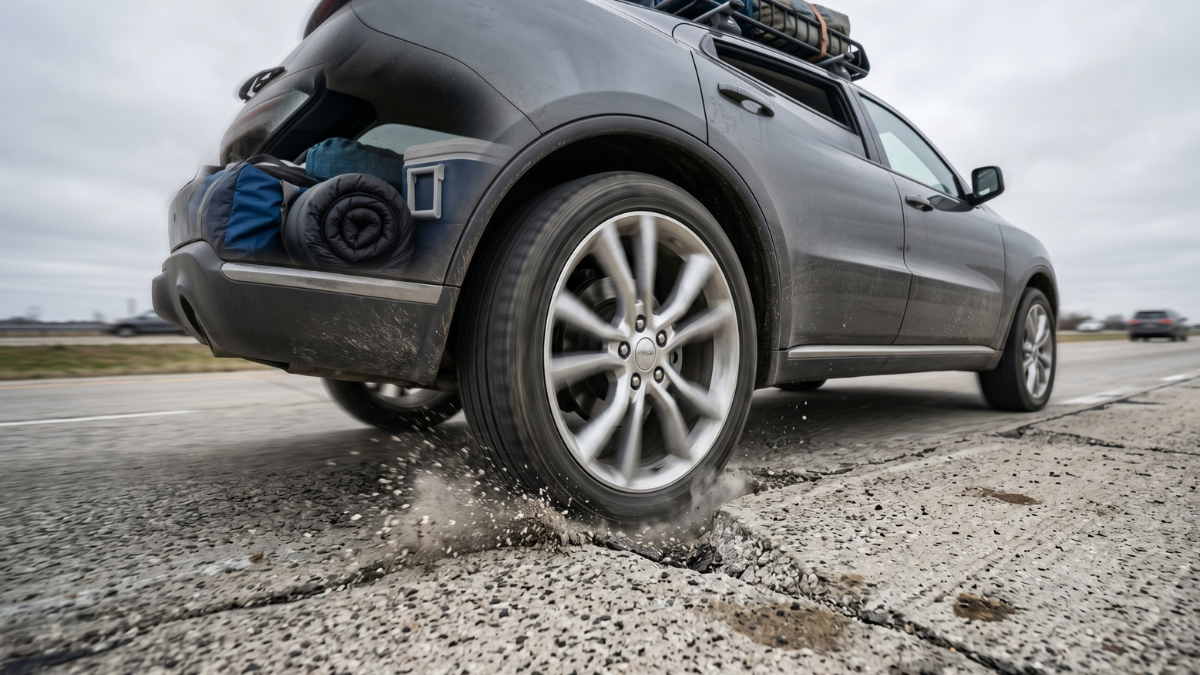
Dealership showrooms are designed to sell a look, and nothing sells a modern SUV like a set of massive, 20- or 21-inch polished alloy wheels. But for drivers in the U.S. and Canada planning a long-distance trek to a mountain cabin or a lake rental, those “upgraded” rims often become the primary source of trip fatigue. What looks sharp under halogen spotlights can turn a four-hour highway stint into a jittery, bone-shaking chore because of one missing ingredient: the tire sidewall.
Quick takeaways
- The Sidewall Sacrifice: Larger wheels require thinner tires (low profile), removing the first layer of suspension that absorbs road vibration.
- Cumulative Fatigue: High-frequency vibrations from 20-inch wheels tire out passengers significantly faster than 18-inch setups.
- Replacement Risk: Finding a specialized 21-inch tire in a rural town on a Sunday is nearly impossible compared to standard sizes.
- Fuel and Cost: Heavier wheels increase unsprung weight, often slightly reducing highway MPG.
The physics of the “Thud”
The math of wheel sizing is a zero-sum game. If the wheel gets larger, the air cushion—the tire sidewall—must get thinner to fit inside the wheel well. On a smooth showroom floor, this does not matter. On I-95 or the Trans-Canada Highway, it changes everything.
A standard 18-inch wheel on a family SUV provides a thick rubber buffer that swallows bridge expansion joints and frost heaves. When you jump to a 20- or 21-inch rim, that buffer shrinks to a narrow strip of stiff rubber. Instead of the tire flexing to absorb a pothole, the impact passes directly through the rim and into the cabin. After two hours of “micro-impacts,” the driver’s hands feel buzzy, and passengers often develop that specific, low-level road weariness that ruins the first evening of a vacation.
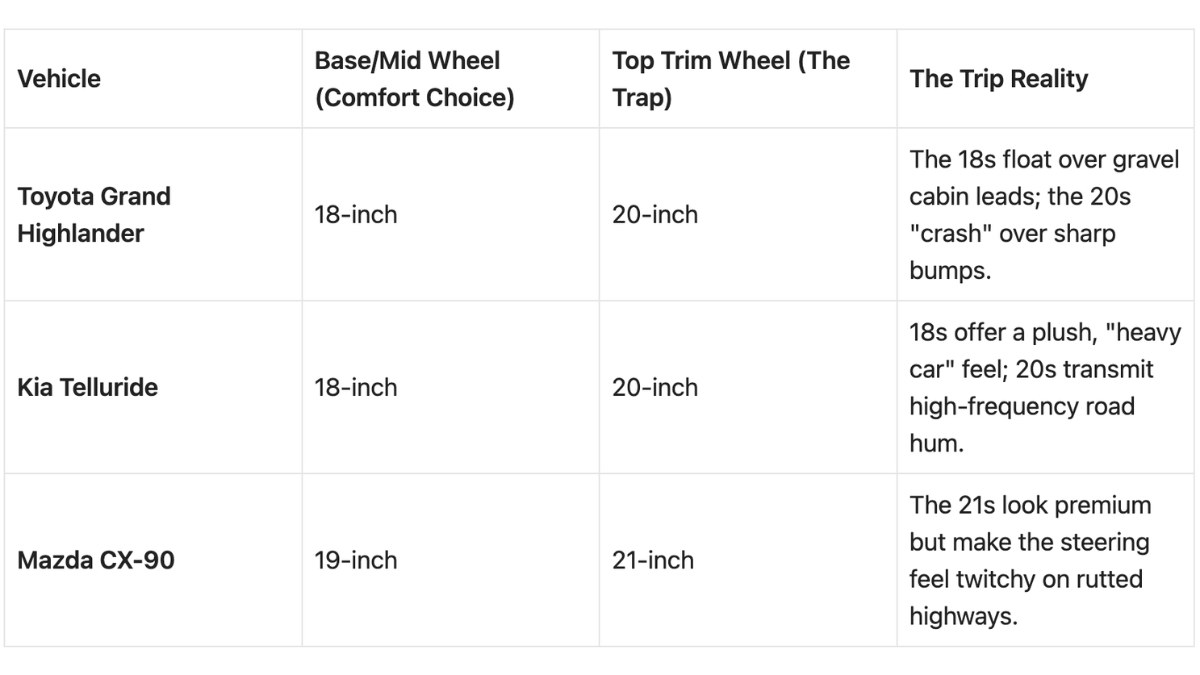
The Comfort Trade-off: Real-World Examples
In many cases, the most expensive trim level of a vehicle is actually the worst choice for a long-distance road trip.
Added Value: The Sunday Breakdown Math
The “Wheel Trap” isn’t just about comfort; it is a massive logistical risk once you leave the suburban bubble of major hubs like Chicago, Toronto, or Denver.
If you catch a sharp-edged pothole in a rural area on a Saturday afternoon with a 21-inch low-profile tire, your weekend is likely over. Here is the reality check:
- Availability: Small-town shops stock 17 and 18-inch tires for trucks and base-model commuters. They rarely keep a $400, 21-inch performance tire in the back.
- The Wait: You will likely be quoted “Tuesday morning” for a delivery from a regional warehouse.
- The Cost: A 21-inch replacement tire can cost $350–$500 USD, plus the cost of a hotel night while you wait.
- Towing: Because low-profile tires have no “give,” hitting a pothole often bends the rim itself. Now you aren’t just buying rubber; you are looking for a $600+ OEM alloy wheel.
Why the “Off-Road” Look is Actually Better
There is a reason professional overlanders and long-distance travelers prefer smaller wheels with more rubber. A “meatier” tire setup allows you to air down for comfort on washboard gravel roads and provides a safety margin against “pinch flats” (where the rim cuts the tire during an impact).
For the average weekend traveler, the mid-tier trim with 18-inch wheels is the “Goldilocks” zone. You save thousands on the purchase price, the ride is demonstrably smoother, and if a tire fails in the middle of a national park loop, the local service station probably has your size on the rack.
What drivers should check now
Before signing for that top-trim SUV, ask the dealer for a back-to-back test drive between the 20-inch model and the 18-inch model. Pay attention not to the steering “sharpness,” but to how the car reacts when it hits a manhole cover or a concrete seam. If you already own a vehicle with oversized wheels and find long trips exhausting, consider “downsizing” your wheels. Many owners find that selling their 21-inch “upgrades” and buying a set of high-quality 18s actually nets them a profit—and a much better vacation.