
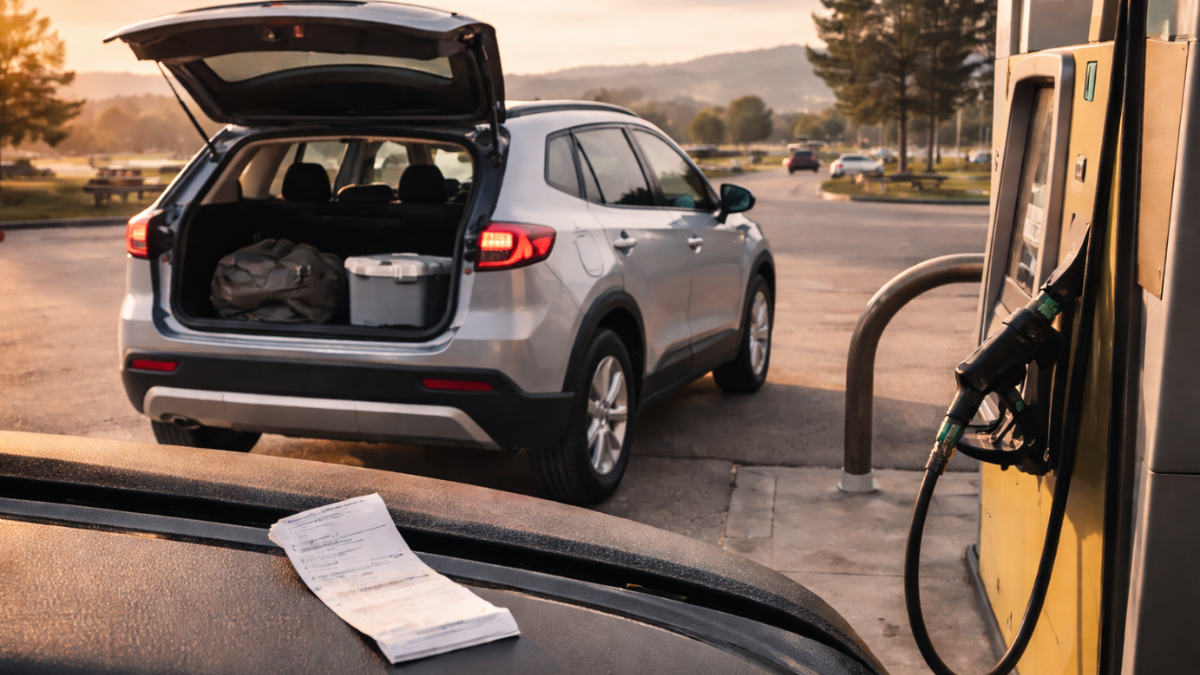
According to the U.S. Energy Information Administration’s weekly retail series, regular gasoline averaged $3.015 per gallon for the week ending March 2, 2026. AAA’s fuel tracker, meanwhile, listed a higher national-average snapshot in early March (about $3.32 as of March 6, 2026), showing how quickly trip fuel costs can move week to week. Using EPA fuel-economy labels as the baseline, a typical hybrid compact SUV can cut fuel use by about 3–4 gallons on a 500‑mile weekend compared with a typical gas AWD compact SUV. This one-page cost guide shows the math, two realistic example vehicles, and the “hidden costs” that matter once fuel is no longer the main line item.
Quick takeaways
- Fuel-only: on a 500‑mile weekend, the hybrid-vs-gas difference is usually about $10–$11 at early‑March 2026 national gas prices, using EPA label MPG and a compact-SUV example.
- The big picture: AAA’s “Your Driving Costs” research shows operating and ownership costs extend well beyond fuel, including maintenance, insurance, and depreciation—fuel is only one slice of the per‑mile cost.
- The clean method: trip fuel cost = (miles ÷ MPG) × price per gallon. Everything else (tires, oil, depreciation) is the “per‑mile overhead.”
- Stress saver: the easiest way to avoid surprises is to budget using two gas prices (an EIA baseline and a higher “spike” snapshot) and treat the higher one as the decision price.
Step 1: Fuel-only math (the part everyone can agree on)
For a weekend loop of 500 miles (two 250‑mile legs is a common pattern), fuel cost is straightforward:
Fuel cost = (Miles ÷ Combined MPG) × Gas price
To keep the estimate auditable, this guide uses:
- Gas price range (early March 2026):
- EIA weekly U.S. regular gasoline price: $3.015/gal for week ending Mar 2, 2026.
- AAA national average snapshot: $3.32/gal as of Mar 6, 2026.
- MPG from EPA labels (FuelEconomy.gov):
- Example hybrid compact SUV: 2025 Toyota RAV4 Hybrid AWD at 39 MPG combined.
- Example gas AWD compact SUV: 2025 Nissan Rogue AWD at 31 MPG combined.
The point is not to “recommend” these two models. They are simply clean, public EPA baselines that behave like the two archetypes shoppers compare in 2026.
Step 2: A concrete example (hybrid vs gas on 500 miles)
Using the EPA combined numbers above:
- Hybrid example (39 MPG): 500 ÷ 39 = 12.8 gallons
- Gas AWD example (31 MPG): 500 ÷ 31 = 16.1 gallons
- Difference: about 3.3 gallons saved by the hybrid
Now apply the early‑March 2026 gas prices:
- At $3.015/gal, the hybrid uses about $38.65 of fuel and the gas AWD about $48.63 (difference ≈ $9.98).
- At $3.32/gal, the hybrid uses about $42.56 of fuel and the gas AWD about $53.55 (difference ≈ $10.98).
That is the core reality check for a single weekend: the fuel savings are real, but they often land in the “one dinner stop” range for a 500‑mile loop unless gas prices are very high or the MPG gap is larger than typical.
Why the fuel-only number can still matter
Even if the fuel difference looks small, it can still be decisive in three common weekend patterns:
1) Frequent short trips: a 500‑mile loop every other weekend is ~13,000 miles a year. Small per-trip differences add up.
2) Winter and mountain driving: real-world consumption often rises when speeds are high, loads are heavy, and temperatures are low.
3) Price volatility: AAA’s early‑March swing is a reminder that the “right” budget uses a range, not a single number.
Fuel-only is also useful because it is the easiest cost to control in advance.
Step 3: The “hidden” part — cost per mile beyond fuel
Fuel is only one component of what a trip costs.
AAA’s “Your Driving Costs” research breaks costs into operating (fuel + maintenance) and ownership (insurance, registration, depreciation, finance charges). In AAA’s 2025 snapshot table, the operating fuel cost varies by category, and the total cost per mile includes much larger ownership components.
That is why a “fuel-only” weekend budget can feel accurate at the pump but still understate what the trip “costs” in wear and value.
Two practical ways to handle this without pretending to calculate your exact depreciation:
Option A: Use a conservative per-mile proxy
The IRS standard mileage rate is widely used as an all-in operating proxy for business travel. For 2026, the IRS set the business standard mileage rate at 72.5 cents per mile.
If that proxy is used purely as a budgeting lens (not as a tax claim), a 500‑mile weekend implies:
- 500 × $0.725 ≈ $362.50 “all-in” vehicle cost
This does not mean a personal trip “costs” exactly $362.50. It is a reminder that fuel is usually a minority share once wear, insurance, and depreciation are considered.
Option B: Use an “operating-only” overlay
If the goal is to avoid depreciation math, an alternative is to add a simple “operating overlay” for maintenance and tires. AAA’s tables separate fuel and maintenance as per‑mile operating components, which can be a useful mental model even if the exact cents-per-mile differ by vehicle category and driving style.
What changed in 2026 that affects trip cost
Three 2026 realities matter for weekend costs:
1) Gas prices can move fast. EIA’s weekly series and AAA’s daily-style snapshots can diverge in the same week. Treat that as normal and budget with a range.
2) EPA combined MPG is a baseline, not a promise. The label is still the best public comparison tool, but weather, speed, cargo load, and tires can move real results.
3) Compact SUVs are the “default” travel class. Many buyers are cross-shopping a hybrid compact SUV against a gas AWD compact SUV, which tends to produce a MPG gap similar to the example above (often ~8 MPG combined).
The result: hybrids reliably use less fuel, but the “weekend trip cost” conversation is increasingly about comfort, time, and predictability—not just the pump total.
What this means in the U.S.
For U.S. weekend travel, a 500‑mile loop often includes:
- sustained 65–80 mph cruising,
- variable weather,
- at least one urban segment with stop-and-go,
- and a “loaded” return leg.
In that environment, two cost lines dominate:
- fuel price volatility (budget with a high/low),
- driving efficiency under load (use combined MPG as a baseline, then assume a penalty for cold weather and speed).
If the weekend plan includes mountain grades or a roof box, it is reasonable to treat the EPA combined number as an optimistic case and budget a slightly lower real MPG.
What you can do: a simple 3-scenario budget
Instead of a single “trip cost,” build three scenarios in 90 seconds:
Scenario 1 — Baseline (EIA weekly)
- Gas price: $3.015/gal
- Use EPA combined MPG
Scenario 2 — Higher-price snapshot (AAA)
- Gas price: $3.32/gal
- Use EPA combined MPG
Scenario 3 — Real-world penalty
- Gas price: the higher of the two above
- Reduce MPG by ~10% for cold weather + higher speeds + cargo (a conservative planning buffer)
Then compare hybrid vs gas on all three. If the hybrid still wins on the “worst-case” scenario, it will feel easier to live with in real travel.
Bottom line: what the 500-mile weekend actually teaches
A 500‑mile weekend is long enough to make MPG differences visible, but short enough that fuel savings alone rarely “pay for” a vehicle decision.
The cleaner way to use the data is:
- Use fuel-only math to avoid surprises at the pump.
- Use a per‑mile proxy (IRS or an operating overlay) to remember that the vehicle cost is bigger than fuel.
- Then pick the SUV that makes the trip calmer—because fatigue, not fuel, is usually the real weekend tax.