
According to the U.S. Department of Energy’s Fuel Economy Guide, each 5 mph driven over 60 mph can reduce fuel economy by about 7%—a rule that becomes very visible on fast interstate weekends. Add the fact that aerodynamic drag rises quickly with speed, and the “hybrid advantage” many drivers feel in town can shrink on long highway stretches. The result is not that hybrids are “bad on road trips”—it’s that the win moves from “massive” to “modest” once the cruise control sits at 75. This utilitarian guide shows the physics, a 60‑mph vs 75‑mph table using published test numbers, and the small habits that keep a hybrid closer to its sticker.
Quick takeaways
- A hybrid’s biggest advantage shows up where it can recapture energy and use electric assist often—that is usually not a steady 75‑mph cruise.
- At highway speeds, aerodynamic drag becomes a dominant load, so the powertrain’s efficiency hinges on wind resistance more than regen.
- Real-world highway numbers often sit below window-sticker expectations at 75 mph; Car and Driver explicitly flags this pattern in its testing guidance.
- For a typical 500‑mile weekend loop, the 60→75 mph speed choice can mean about 3 extra gallons burned, even in efficient hybrids.
- The easiest highway savings are boring: moderate speed, steady throttle, and fewer drag add-ons (roof box, crossbars, windows down).
The highway reality: why “hybrid mode” feels different at 75 mph
A hybrid system has two big tricks:
1) Electric assist to reduce how hard the engine needs to work in low-to-moderate load moments.
2) Regenerative braking to capture energy that a gas-only car throws away as heat.
A weekend highway run is the opposite environment. With cruise control set, there are fewer decel events to harvest. Car and Driver’s long-distance explainer notes that highway driving is “steady-state” and offers fewer chances to recapture energy under braking, even though the hybrid system still manages power flows in the background.
The second reality is pure physics. The National Academies’ review of light-duty vehicle efficiency notes that aerodynamic drag increases with the square of speed, and that at high speeds more than half of fuel can be used to overcome aerodynamic drag. Once drag dominates, a hybrid can still be efficient, but the “city-style” advantage naturally narrows.
A clean rule of thumb for the speed penalty (and why it matters)

The Fuel Economy Guide’s rule of thumb is blunt but useful for trip math: each 5 mph over 60 mph can reduce fuel economy by ~7%.
That is not a hybrid-only rule. It applies to everything that must push air down the road. The reason it matters for hybrids is psychological: many drivers buy a hybrid expecting “big savings everywhere,” then feel disappointed when the interstate number looks merely “good,” not “amazing.”
To keep the math honest:
- Treat the 7% rule as a planning model, not a guarantee.
- Use it to estimate the “speed tax” on a weekend loop.
60 mph vs 75 mph: a table using published highway-test numbers
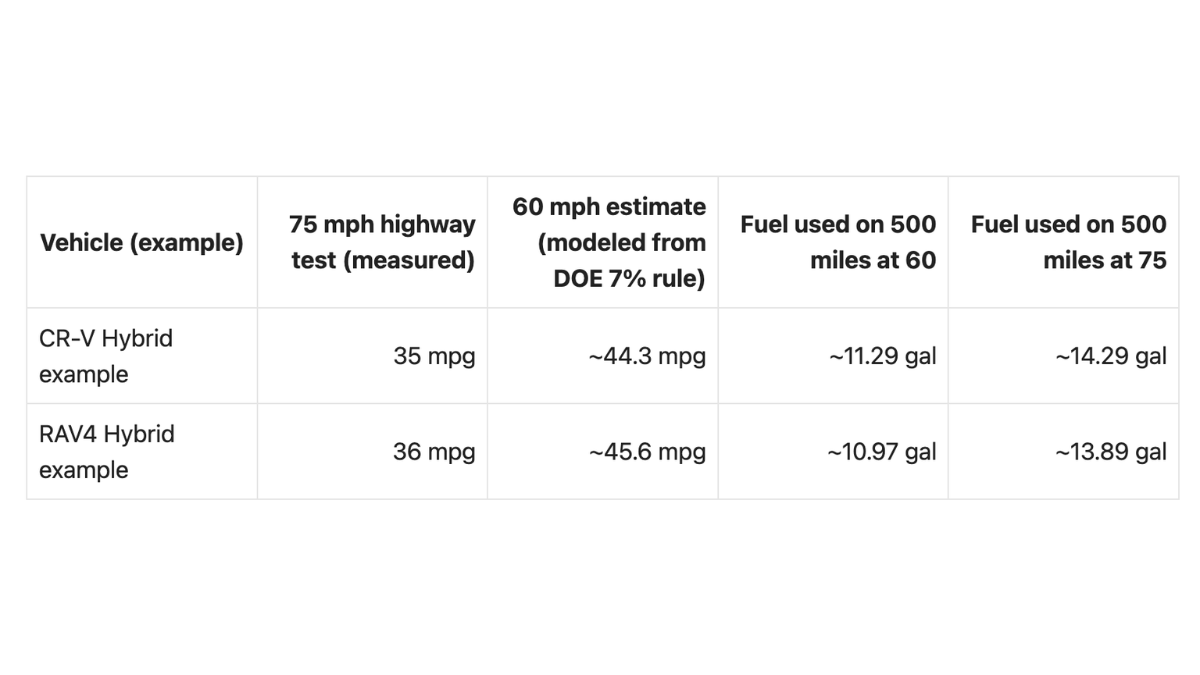
Car and Driver’s comparison tool includes a 75‑mph highway test result for two popular hybrid compact SUVs:
- CR‑V Sport Touring Hybrid: 35 mpg at 75 mph
- RAV4 Limited AWD: 36 mpg at 75 mph
To create a 60‑mph comparison without inventing new test data, the table below uses the DOE planning rule (three 5‑mph steps from 60→75, i.e., ~21% reduction). That allows a modeled “60 mph” estimate that is explicitly labeled as modeled.
Table: Highway MPG at 60 vs 75 mph (measured vs modeled)
Two important interpretations:
- The hybrid does not “stop being efficient.” It just becomes more like any other vehicle: speed starts running the bill.
- The 60‑mph column is a planning model. The 75‑mph column is a published test number.
The cost module: what that speed change can cost on a weekend
Now translate the gallons into money using early-March 2026 price anchors:
- EIA’s weekly U.S. regular gasoline series lists $3.015/gal for the week ending March 2, 2026.
- AAA’s March 5, 2026 update lists a national average around $3.25/gal.
Using $3.25/gal as a conservative “weekend budget” price:
- CR‑V Hybrid example: (14.29 − 11.29) ≈ 3.00 extra gallons → about $9.75 extra for the same 500 miles.
- RAV4 Hybrid example: (13.89 − 10.97) ≈ 2.92 extra gallons → about $9.49 extra.
That is not catastrophic, but it is exactly the kind of “why is my hybrid not saving more?” surprise that shows up after a weekend trip.
What changed for 2026 weekend-trip expectations
Two 2026 realities make this topic sharper:
- More hybrids are now default trims. Buyers increasingly land in a hybrid without seeing it as a special “city car.”
- Interstate cruising speeds are high. Many weekend routes spend hours at 70–80 mph, where drag dominates.
Car and Driver’s hybrid buying guide is unusually direct about this: at higher speeds (their 75‑mph test), hybrids often underperform their window-sticker value. That doesn’t mean the sticker is “wrong”; it means the sticker is a blended procedure, while an interstate run is a narrow, steady-state scenario.
What you can do: the highway playbook that keeps hybrids efficient
These are practical levers that work without turning a road trip into a science project.
1) Pick a “cap speed” and treat it as a budget tool
If the schedule allows it, set a realistic cap (for example, 68–72 instead of 75–80). The Fuel Economy Guide’s 7% rule makes the logic clear: a few mph can matter more than most “eco” features.
2) Minimize drag add-ons
FuelEconomy.gov’s factors page warns that cargo on the roof increases aerodynamic drag and lowers fuel economy, and the Fuel Economy Guide adds a concrete range for rooftop boxes (notably larger at interstate speeds). If the goal is real savings:
- Remove crossbars when not needed.
- Prefer rear-mounted cargo when feasible.
- Keep windows up at high speed and use ventilation efficiently.
3) Drive like the battery is a savings account (not a turbo button)
Hard accelerations demand high power, and high power at 75 mph is already expensive. Smooth inputs let electric assist do its quiet work and keep the engine closer to efficient operating points.
4) Use cruise control when conditions allow
DOE’s consumer guidance notes cruise control helps maintain a constant speed and can save fuel in many cases. The goal is fewer micro-surges that quietly inflate consumption.
5) Watch the “false economy” of constant passing
Even if the speedometer reads “75,” repeated bursts to 80–85 for passing create a different load pattern. On a flat, open interstate, fewer passes usually equals steadier consumption.
What this means in the U.S.
In U.S. weekend travel, the common pattern is: freeway → one or two climbs → windy open stretches → a return leg with more cargo.
In that pattern:
- Speed is the most controllable lever for cost and range.
- Drag is the silent tax (especially with rooftop gear).
- A hybrid still tends to be efficient, but the best expectation is “solid highway MPG,” not “city-like miracle MPG.”
If the goal is “least stress,” the practical move is to budget time for a slightly lower cruise speed and plan one extra rest stop. That trade often pays for itself in fuel, cabin calm, and fewer passes.
Bottom line
Hybrids don’t “lose” efficiency on the highway so much as they lose their biggest advantage: frequent regen and low-speed electric dominance. At 75 mph, physics takes over—drag rises fast, and the hybrid system has fewer easy wins. Use published 75‑mph numbers as the reality check, then treat speed and drag as the two weekend-trip levers that bring the sticker back into reach.
SOURCES
- Fuel Economy Guide
- Assessment of Technologies for Improving Light-Duty Vehicle Fuel Economy—2025-2035
- Many Factors Affect Fuel Economy
- Your Guide to Buying a Hybrid Car or Truck in 2025
- Are Hybrids Good for Long-Distance Driving?
- Weekly Retail Gasoline and Diesel Prices
- Gasoline and Diesel Fuel Update
- Jump at the Pump as National Average Goes Up Nearly 27 Cents
- 2026 Honda CR-V Hybrid vs. 2026 Toyota RAV4