

The compact SUV has become the default family vehicle recommendation so thoroughly that most people have forgotten why wagons existed in the first place. They existed because the station wagon body is one of the most intelligent compromises in automotive history: five adults fit comfortably, cargo loads easily over a low flat floor, and the vehicle’s center of gravity sits close enough to the ground that it handles like a car instead of a truck. Then the SUV arrived, and the American market decided that height implied capability, and wagons disappeared from most driveways.
For grandparents who own a compact or midsize SUV and drive grandchildren on weekend trips, the SUV’s height is not capability. It is a problem. It is the problem that manifests every time a knee that has a history, or a hip that was replaced in 2022, has to swing over a 24-inch door sill while holding the doorframe with one hand and trying not to touch the freshly cleaned interior with the muddy boot. It is the problem that appears again at the back of the vehicle, where the cargo floor at 30-plus inches from the ground requires a small lift for anything heavier than a bag of groceries. And it is the problem that shows up as fatigue after a four-hour drive in which the elevated seat height, while theoretically providing a good view, has produced a slightly upright riding posture that does not suit long highway miles.
A wagon does not solve all of these problems. It solves the structural ones — and in 2026, there are still two vehicles worth buying.
Quick Takeaways
- A sedan-based wagon body sits lower than an equivalent compact SUV, which reduces the step-in height for both front and rear doors — a meaningful ergonomic difference for adults with knee, hip, or lower back limitations that becomes more pronounced on a multi-day trip with frequent in-and-out cycles
- The Drive’s March 2026 last-ride review of the Volvo V60 Cross Country describes the seated experience precisely: “A sedan-based wagon is something you feel like you’re sitting ‘in’; an SUV, or even a crossover, feels more like something you’re sitting ‘on.'” For older drivers who last drove a car rather than an SUV, the wagon position is familiar and biomechanically more consistent with how they naturally move
- The cargo floor of a wagon sits notably lower than a compact SUV’s cargo floor — loading a stroller, a folded wheelchair, a heavy cooler, or a grandchild’s bicycle over a 21-inch cargo sill requires meaningfully less effort than loading over a 28-inch SUV cargo sill
- Wagons maintain a lower center of gravity than compact SUVs of the same length, producing less body roll in curves and a more planted sensation on highway on-ramps — relevant for older passengers who may be more susceptible to motion effects from lateral G-forces
- In 2026, two wagons with standard AWD remain available in North America: the 2026 Subaru Outback (mainstream, starts $36,445, standard AWD) and the 2026 Volvo V60 Cross Country (premium, starts $52,300, standard AWD) — the V60 Cross Country is entering its final weeks of production and inventory is closing
- The grandparent-specific case for a wagon has nothing to do with nostalgia and everything to do with how many times per day a human being gets in and out of a vehicle, bends over its cargo floor, and sits in a moving car for three or four hours — each of these actions is easier, less effortful, and less fatiguing in a wagon than in a compact SUV
Why Height Feels Like Safety But Acts Like a Problem
The appeal of a tall vehicle is real and partly rational. The commanding view from a high seat feels like control. The sense of being above other traffic feels like safety. These perceptions have been powerful enough to eliminate wagons from the North American market almost entirely.
What the high seating position actually provides: a better forward sightline over traffic, meaningfully more visual clearance of the vehicle’s hood at parking speeds, and the perception of security.
What it does not provide: better crash safety relative to modern wagons and crossovers of similar construction (both use unibody platforms with equivalent safety engineering), better stopping distance (center of gravity height increases weight transfer under braking, which is a disadvantage, not an advantage), or easier entry and exit.
For a grandparent in good health, the entry and exit issue is an inconvenience. For a grandparent with a replaced hip, bilateral knee osteoarthritis, or a lumbar fusion — profiles that are common in the 65-to-75 age range that typically includes active grandparents making weekend trips — the entry and exit issue is a daily physical negotiation. The compact SUV’s front door sill at 23–25 inches from the ground requires the entering driver to step up and swing the hip laterally into the seat. A wagon’s front door sill at 18–20 inches from the ground allows the driver to step in with a smaller lift and lower the hip into the seat in a more natural direction of motion.
This distinction does not appear on any spec sheet and is almost never addressed in automotive reviews aimed at the general market. It is addressed routinely in occupational therapy and physical therapy contexts, where seating height and transfer mechanics are evaluated for exactly this population.
What “Sitting In” vs. “Sitting On” Means Over Four Hours
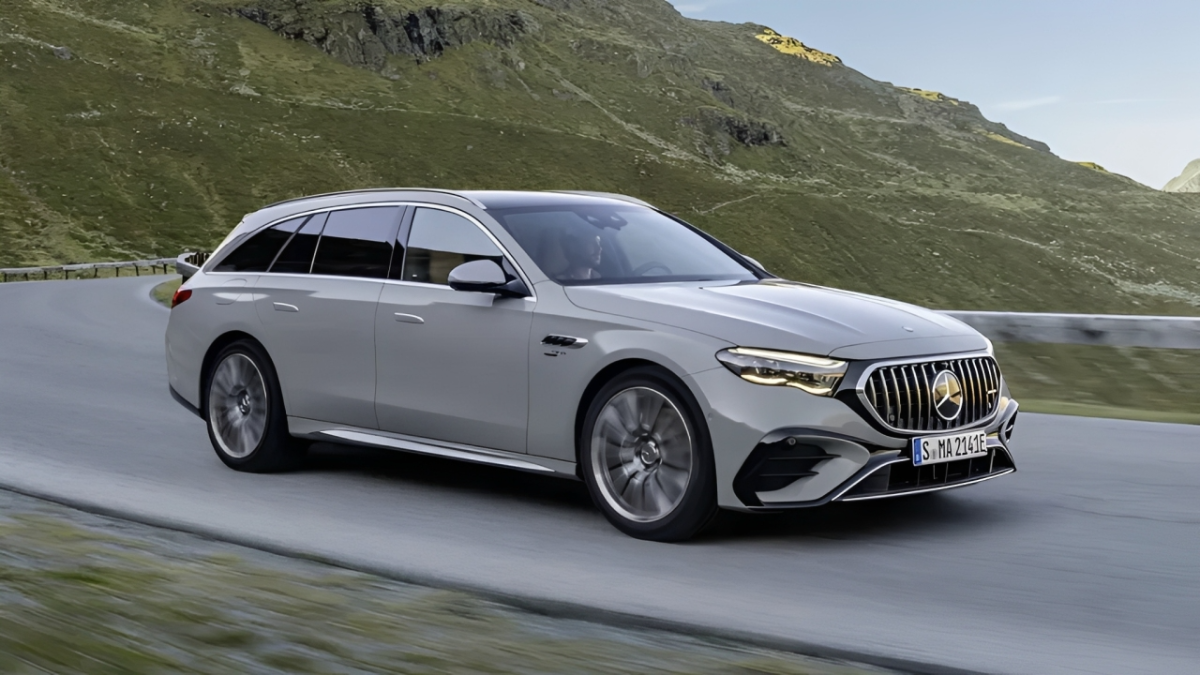
The Drive’s last-ride review of the 2026 Volvo V60 Cross Country is, among other things, the clearest description of why a wagon’s riding position suits a specific type of driver.
The distinction between sitting “in” a sedan-based wagon and sitting “on” a crossover or SUV is not merely semantic. It describes a fundamentally different hip angle, sightline, and back support geometry. In a wagon, the driver’s hip is roughly at door-sill level; the thighs are supported along their length; the seatback is more perpendicular to the road surface. In an elevated SUV, the driver’s hip is above the sill; the knees angle downward more steeply; the seatback reclines slightly to compensate for the seat’s position above the floor — producing a slightly different lumbar loading that some long-distance drivers find more fatiguing.
The practical consequence over a four-hour drive with two grandchildren varies by individual. But for the driver who grew up in a car rather than an SUV and whose body has decades of memory for that position, the wagon’s seating is a return to a familiar biomechanics rather than an adaptation to an elevated one.
The V60’s ride character reinforces this. Edmunds describes it as a vehicle where “everything from the brakes to the eight-speed automatic transmission operates relatively smoothly. Nothing is going to impress you when you’re behind the wheel, but you likely won’t be disappointed either. Simply put, this is just an easy vehicle to tool around in.” The Drive is more specific: the V60 CC “rides smoothly and quietly — it feels balanced in the sense that its calibrations are very ‘medium.’ Medium firmness, medium strength of acceleration.” That calibration — composed without being stiff, responsive without being demanding — describes the experience a driver brings to a trip to the lake house rather than a track day.
The Cargo Floor Advantage
The practical geometry of loading cargo into a vehicle varies more between body styles than most buyers appreciate until they have done it several times. A compact SUV’s cargo floor typically sits 28–32 inches from the ground. A wagon’s cargo floor sits approximately 21–24 inches from the ground, depending on the specific vehicle.
The difference is not whether a grandparent can load the cargo. It is the biomechanics of loading it. A heavy item — a portable stroller, a folded portable crib, a week’s worth of luggage, a 30-pound bag of dog food — lifted over a 28-inch sill requires a higher initial lift, a longer hold position, and a controlled descent onto the cargo floor. The same item over a 22-inch sill is a lower lift, a shorter hold, and a gentler placement. Over a weekend road trip with multiple loading and unloading cycles, the cumulative difference is real effort.
The Drive notes this explicitly in the context of dogs — “lower door heights make it easier to haul dogs” — which applies identically to anything that has to be lifted in and out repeatedly, including young grandchildren being transferred from car seat to stroller and back.
The Outback’s cargo floor is also wide and flat. At 32.6 cubic feet behind the rear seats in a wagon configuration, it holds a realistic family weekend load — two large rolling bags, a cooler, a stroller collapsed and laid flat, and a duffel — without requiring cargo management gymnastics. The rear seats fold to extend the flat floor for larger loads.
The Two Wagons Available in 2026
2026 Subaru Outback — The Practical Choice
The 2026 Outback has grown substantially into midsize SUV territory, with an expanded footprint (192.3 inches long, 68.1 inches tall) that may read as more crossover than traditional wagon to buyers who remember earlier generations. Subaru markets it as a crossover SUV for the adventure-oriented. What it retains from wagon DNA is the standard AWD on every trim without a price premium, a longer, lower roofline than a typical compact or midsize SUV, a more car-based ride character from its unibody platform, and a generous interior that the Autoblog Outback-vs-RAV4 comparison characterizes as providing 109 cubic feet of passenger volume versus the RAV4’s 98.9 cubic feet — a gap that translates directly into more rear headroom and shoulder room for grandchildren in the back seat.
For grandparents, the Outback’s three primary advantages are: standard AWD (no decision to make, no premium to pay, available on every trim for winter or mountain-road driving); EyeSight driver assistance standard across all trims (automatic emergency braking, adaptive cruise control, lane departure warning, and the hands-free driving assist that reduces highway fatigue on a long run); and a starting price of approximately $36,445 that is competitive with compact crossover SUVs without a fuel efficiency disadvantage compared to non-hybrid compact SUVs.
The new for 2026 hands-free driving assist — which Autoblog confirms as part of the redesigned Outback’s safety package — is specifically relevant for grandparent long-distance drivers. Emergency Stop Assist with Safe Lane Selection automatically brings the vehicle to a stop in its lane if the driver becomes unresponsive. For families whose grandparents travel alone or with only grandchildren as passengers, this feature is a meaningful peace-of-mind addition.
The Outback’s fuel economy on the base engine is approximately 26 city / 34 highway — competitive with non-hybrid compact SUVs in the same class, though behind the hybrid crossovers that now dominate this segment.
2026 Volvo V60 Cross Country — The Premium Choice (While Available)
The V60 Cross Country represents a different proposition at $52,300 starting: a genuine luxury wagon with standard AWD, Volvo’s comprehensive safety package, and a ride character that The Drive describes as “smooth and quiet” in a way that distinguishes it from both the Outback and from most compact luxury SUVs.
The critical fact for buyers interested in the V60 Cross Country: production ended in April 2026. The Drive’s March 2026 last-ride review confirms this explicitly — Volvo has discontinued the V60 Cross Country for the U.S. market. Remaining inventory at Volvo dealers is the available supply. For buyers who want this specific vehicle, verifying current stock with a dealer is the necessary first step.
Edmunds describes the V60 CC’s suitability for the grandparent profile in the same terms that apply to all of the above reasoning: “excellent outward visibility, aided by remote-folding rear headrests and a 360-degree camera system, which makes parking a breeze.” Volvo’s safety engineering — standard automatic emergency braking, Pilot Assist (hands-on lane centering and adaptive cruise), and cross-traffic alert with automatic braking standard — is the most comprehensive safety package in the wagon class.
The V60 CC’s passenger volume is smaller than the Outback’s (94 vs. 109 cubic feet), and rear legroom is notably tighter (4.3 inches less rear legroom). For a grandparent couple driving two grandchildren in the back seat, the Outback’s rear space is more practical. For a grandparent couple driving alone or with one passenger, the V60’s premium interior quality and ride refinement may outweigh the space advantage.
When the SUV Still Makes Sense
The wagon case for grandparent drivers is strong for specific use cases and does not apply universally.
The compact or midsize SUV remains the better answer when genuine ground clearance is needed — accessing a lakeside property with an unpaved seasonal driveway, driving a mountain access road to a ski rental cabin in shoulder season before the road is fully clear, or navigating the kind of potholed rural routes that appear between the regional airport and a rural family gathering. The Outback’s 8.7 inches of ground clearance approaches midsize SUV territory, but the V60 CC’s more modest lift puts it closer to a raised wagon than a crossover for rough-road applications.
The SUV also makes sense when the grandparent family regularly carries three or four grandchildren, requiring a vehicle that can seat seven or eight. No current wagon offers a third-row seat. For that configuration, the minivan comparison in this series remains the more relevant article.
But for the grandparent household that drives two to four passengers, makes three to four long-distance trips per year, loads cargo over the rear floor repeatedly, and values driver fatigue reduction over ground clearance — the wagon’s case is not sentimental. It is ergonomic.
U.S. and Canada Note
In cold-climate U.S. markets and throughout Canada, the AWD question is settled for both wagons in this comparison — both the Outback and V60 CC provide standard AWD with no trim or pricing decision required. For Canadian grandparents in BC, Ontario, Quebec, or the Prairie provinces who make late-autumn and early-spring road trips in weather that compact SUV buyers buy AWD specifically for, either wagon provides equivalent winter traction to a comparable AWD crossover.
The V60 Cross Country’s availability in Canada may be more limited than in the U.S. given the production end date. Canadian buyers should verify inventory with a Volvo retailer promptly. The Outback is available through Subaru’s full Canadian dealer network at prices consistent with U.S. positioning and is the practical primary recommendation for most Canadian grandparent buyers.
SOURCES
- The Drive March 2026 last-ride review: V60 CC production ending April 2026; “A sedan-based wagon is something you feel like you’re sitting ‘in’; an SUV, or even a crossover, feels more like something you’re sitting ‘on'”; “lower door heights make it easier to haul dogs”; rides smoothly and quietly with medium calibration; cargo rack access easier with lower roofline
- Edmunds 2026 V60 Cross Country review: starts $52,300; “excellent outward visibility aided by remote-folding rear headrests and 360-degree camera system, which makes parking a breeze”; “just an easy vehicle to tool around in”; “higher stance can also make for easier entry and exit”; 0–60 in 7 seconds; B5 247 hp; two trims: Plus and Ultra
- Autoblog: 2026 Outback redesigned with taller, boxier look; 192.3 inches long, 68.1 inches tall (2 in. taller than previous gen); standard AWD all trims; EyeSight driver assist standard; Emergency Stop Assist with Safe Lane Selection; 8.7 in. ground clearance; hands-free driving assist new for 2026
- Subaru.com official 2026 Outback product page: standard Symmetrical All-Wheel Drive on all trims; EyeSight Driver Assist Technology standard; base engine 2.5L BOXER four-cylinder 180 hp; starting MSRP approximately $36,445; available in six trim levels Premium through Wilderness
- Edmunds 2026 Outback review: 109 cu ft passenger volume confirmed; 32.6 cu ft cargo behind rear seats; rear seats fold flat for extended cargo floor; front legroom 43 inches; rear legroom 39.5 inches — confirmed 4.3 inches more than V60 Cross Country’s 35.2 inches; Subaru powertrain warranty 5 yr/60,000 mi; outback seats recline, V60 CC rear seats do not recline per Edmunds comparison data