
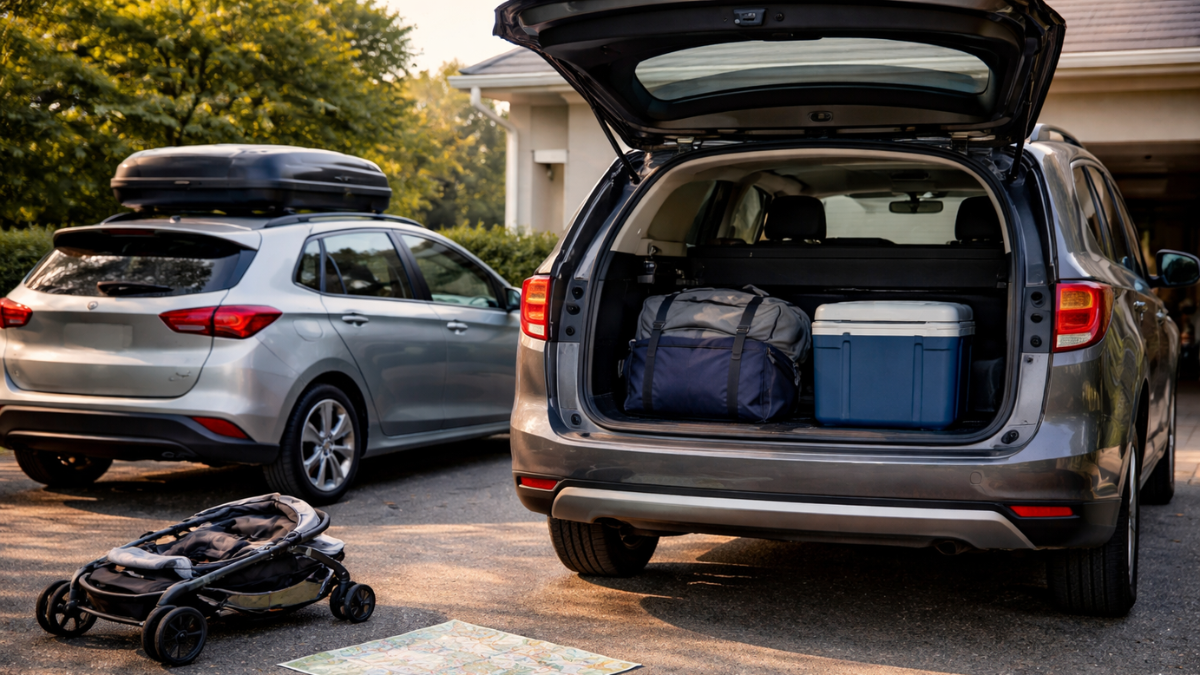
According to AAA’s late-February 2026 survey of U.S. adults, 39% said they plan to take more vacations in 2026 than in 2025, and 58% expect to take multiple trips this year. TSA’s checkpoint totals show the weekend-travel crush is already real: 2,765,657 passengers were screened on March 15, 2026, with multiple mid-March days above 2.4 million. When weekends get busier, a practical pattern appears in households that have choices: fewer “two small cars” convoys, more “one bigger car” getaways. The reason is not status. It’s friction—parking, loading, tolls, and the stop cycle—and a single bigger vehicle can reduce all four at once.
Quick takeaways
- “One bigger car” starts making sense when weekends get busy because it can replace two-car logistics, roof-cargo workarounds, and repeat loading.
- AAA’s 2026 survey shows more people planning more trips, and TSA checkpoint totals in mid-March show high-volume weekend movement is already here.
- Rooftop cargo is a hidden tax at highway speed: Car and Driver’s back-to-back test saw 25 mpg with a hitch carrier vs 21 mpg with a roof box on the same vehicle and route.
- Two vehicles can double friction costs (parking/tolls), and pay-by-plate structures can add fees; one official example notes Pay-By-Plate can be $1.60 higher than an E-ZPass rate on the same facility.
- The clean rule: if a “small car weekend” requires roof gear or a second car, the “one bigger car” setup often becomes the calmer, sometimes cheaper system.

What “one bigger car” really means
The trend isn’t necessarily “buy a huge SUV.” In practice, it usually looks like one of these:
- A household uses one midsize crossover (or minivan) for getaways instead of splitting into two vehicles.
- The larger vehicle becomes the default for spring/summer weekends, while the smaller car stays the weekday commuter.
- The household rents one larger vehicle for specific weekends (friends + gear, family + grandparents) rather than convoying.
It’s a consolidation move. And it shows up when travel volume rises because busy weekends punish complexity.
Why it shows up as weekend travel picks up
Spring weekends bring three predictable conditions:
- more people on the move,
- tighter parking at destinations,
- and less margin for “we’ll figure it out when we get there.”
AAA’s 2026 survey results point to more frequent trip-taking (more people planning more vacations; more people planning multiple trips). TSA’s daily checkpoint totals show high traffic days in mid-March, including a 2.7M+ Sunday.
More demand doesn’t just mean more traffic. It means:
- fewer good parking choices,
- longer lines and slower detours,
- and higher “coordination cost” when a group arrives in two vehicles.
That’s when one vehicle starts to feel like a real advantage.
The hidden weekend costs that make one bigger car “make sense”
A larger vehicle often costs more per mile in the abstract. But weekend travel is not abstract. It’s a chain of small frictions.
1) Two cars quietly double fees and decisions
Two vehicles can mean:
- two parking fees,
- two sets of tolls,
- and two drivers managing navigation, timing, and regrouping.
Even when the dollar difference is small, the stress difference is not:
- finding two spaces in a crowded lot,
- waiting for the second car,
- splitting gear and then re-combining at the destination.
When weekends get crowded, households start paying more attention to the “decision load.” One vehicle reduces it.
2) Rooftop cargo turns a small car into an expensive highway tool
Many two-person or small-family weekends “fit” only if a roof box is used.
The issue is drag. Car and Driver’s test provides a clean, auditable example: the same vehicle returned 25 mpg with a hitch carrier and 21 mpg with a roof box in back-to-back testing. That’s not a theoretical argument; it’s a real, repeatable effect.
So if the small car requires rooftop gear for a meaningful share of weekends, the “cheap” setup isn’t cheap anymore. The bigger vehicle that keeps everything inside can win on both stress and fuel.
3) The stop cycle is where weekend trips get annoying
Weekend trips are repeated stop cycles:
- grocery store,
- trailhead,
- hotel check-in,
- dinner parking,
- one more “quick stop” that isn’t quick.
A bigger vehicle can lower stress when it:
- keeps seats usable (no constant folding),
- keeps bags out of footwells,
- and lets you access one item without unloading everything.
If the “small car weekend” requires unpacking to reach a jacket, the vehicle isn’t too small. The system is too fragile.
4) Cashless tolling and pay-by-plate can punish the second vehicle
More routes use cashless tolling. When a second vehicle gets hit with pay-by-plate rules (or a transponder account isn’t set up properly), fees can appear later.
One official example: the Dulles Toll Road states Pay-By-Plate is $1.60 higher than the E-ZPass rate, with the added amount tied to invoicing/processing. Two vehicles can mean two chances to trigger that kind of fee.
This is not a universal rule across all toll agencies. It is a concrete example of how “two cars” can create extra administrative costs and headaches that one vehicle avoids.
The “one bigger car” threshold
A simple way to predict whether the bigger single vehicle will feel better:
If any two of these are true, one bigger car often wins:
- Seats must stay up (kids, dog barrier, grandparents, or friends).
- A rigid bulky item is coming (cooler, stroller, sports gear, folding wagon).
- Parking will be tight (city weekend, resort town, popular trailhead/beach lot).
Two people with two duffels can travel in almost anything. The trend appears when the weekend load becomes less flexible.
Where the trend does not make sense
“One bigger car” is not automatically smarter.
It usually doesn’t make sense when:
- the weekend load is consistently light,
- parking is abundant and free,
- the household doesn’t mind splitting,
- or the larger vehicle is meaningfully more expensive to operate and it’s only needed once or twice a year.
In those “rare peak weekend” cases, renting a larger vehicle can be the clean solution: bigger when needed, efficient the rest of the year.
What this means in the U.S.
In the U.S., spring weekends often combine:
- 70–80 mph highway miles,
- crowded parking at destinations,
- and unpredictable weather (layers, wet gear, one more “just in case” item).
That combination rewards a weekend setup that is robust:
- fewer workarounds (roof drag),
- fewer vehicles to park,
- and seats-up packing that stays tidy.
So the “one bigger car” trend is best understood as weekend stress management, not a lifestyle statement.
What you can do: the 12-minute “one car” test
Before assuming a bigger vehicle is needed, run a fast test:
- Seats-up load test (6 minutes): load two duffels + cooler + one bulky item with seats set as you actually travel.
- Access test (3 minutes): grab one item without unloading everything.
- Two-car realism test (3 minutes): picture your destination’s parking. If finding two spots feels fragile, you’re already paying the two-car tax.
If the small vehicle fails without roof cargo—and you do this kind of weekend more than once a month in spring/summer—consolidation starts making sense. That might mean using the bigger vehicle you already have, or renting one for those weekends.
Bottom line
As weekend travel picks up, logistics become the limiting factor. “One bigger car” often makes more sense because it reduces the hidden taxes of busy weekends: two-car coordination, rooftop drag, repeated unloading, and doubled fees. The smart version of the trend isn’t “buy bigger.” It’s choosing a weekend setup that stays boring when the roads and parking lots get crowded.