
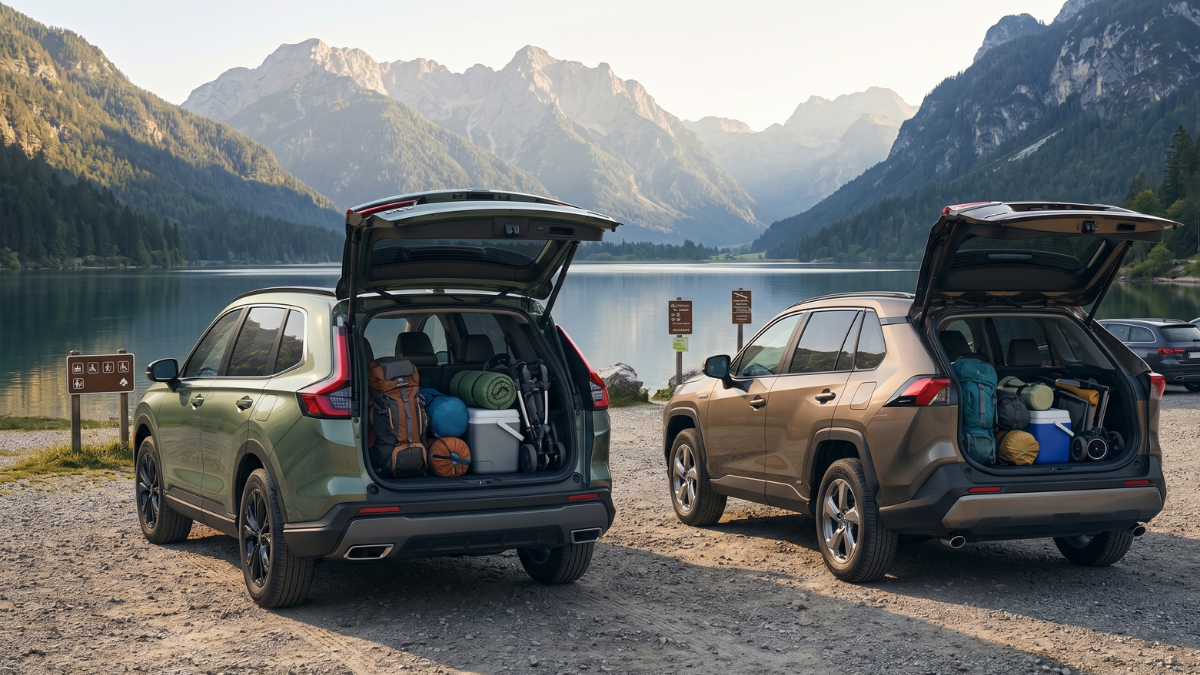
Both are compact hybrid SUVs, both carry four passengers comfortably, both land in roughly the same price bracket, and both will get you to the mountains and back on about 13 gallons of fuel. On paper, the 2026 Honda CR-V Hybrid and the all-new sixth-generation Toyota RAV4 Hybrid look nearly interchangeable. The question for a family planning a 500-mile round-trip road trip — lake house Friday to Sunday, bikes on the hitch, cooler in the back — is not which one is better in a vacuum. It is which one makes more sense for the specific combination of fuel cost, usable cargo space, and cabin comfort that a weekend trip actually requires.
The answer depends on which trade-offs matter more to your family than the other.
The Contenders at a Glance
2026 Honda CR-V Hybrid (base Sport AWD, the most popular trim for road-trippers)
- EPA fuel economy: 40 city / 34 highway (AWD), combined ~37 mpg
- System power: 204 hp
- Cargo behind rear seats: 36.3 cu ft (TrailSport); Sport Touring 34.7 cu ft
- Maximum cargo (seats folded): 71.8 cu ft
- Rear legroom: 41.0 inches
- Tow rating: 1,000 lbs
- Starting MSRP (Sport AWD): approximately $38,000
2026 Toyota RAV4 Hybrid (all-new sixth generation, standard AWD on all trims)
- EPA fuel economy: 46 city / 39 highway (LE/SE AWD), combined 42 mpg; XLE Premium AWD 45/38/41; XSE/Limited AWD 43/37/41
- System power: 236 hp
- Cargo behind rear seats: 37.8 cu ft
- Maximum cargo (seats folded): 70.4 cu ft
- Rear legroom: 37.8 inches
- Tow rating: 3,500 lbs
- Starting MSRP (LE): $33,350
Fuel Math: 500 Miles, Packed Car, One Stop
The most common weekend-trip scenario: highway-dominant driving at 65–70 mph, two adults and two kids, a packed cargo area. The fuel economy figure that matters on a highway road trip is the highway MPG, not the combined figure.
CR-V Hybrid AWD: 34 mpg highway (EPA) RAV4 Hybrid AWD (LE/SE): 39 mpg highway (EPA) — confirm your specific trim at fueleconomy.gov
On a 500-mile round trip:
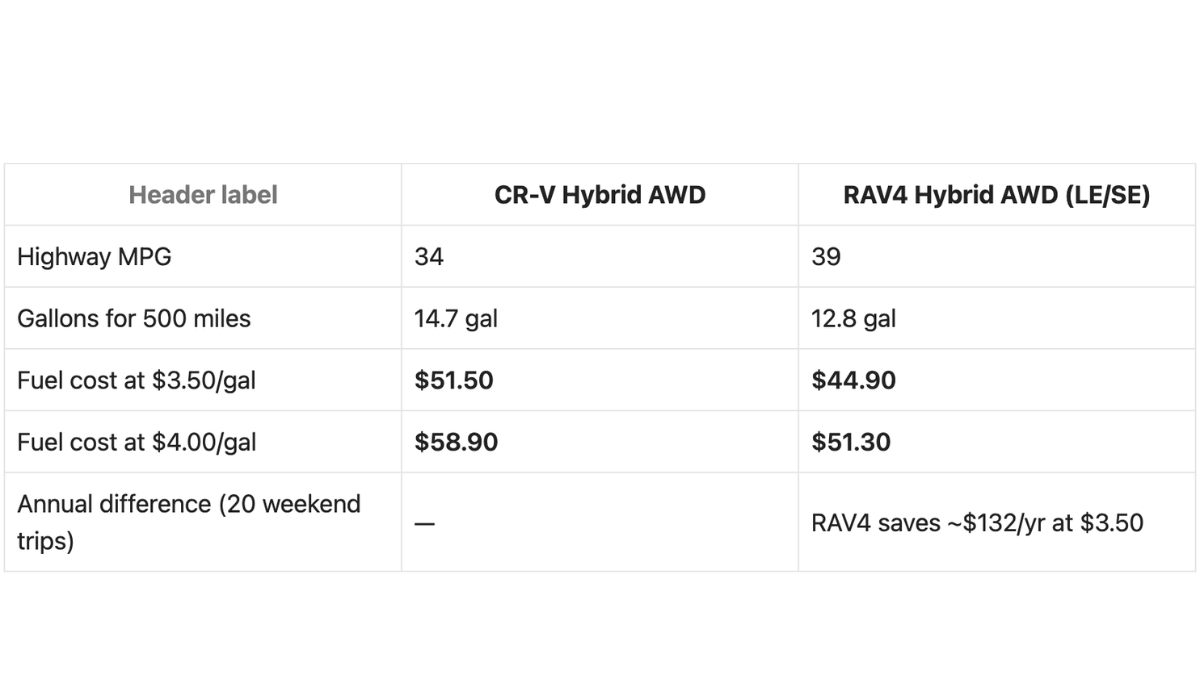
The RAV4 Hybrid’s highway fuel economy advantage — 5 mpg for the base LE/SE AWD trim — translates to approximately $6.60 per 500-mile round trip at $3.50/gal. This is a real difference, but not a decisive one. Over 20 weekend trips per year, the RAV4 saves roughly $130 in fuel at current prices.
The CR-V Hybrid’s city fuel economy (43 mpg city FWD; 40 mpg AWD) is significantly lower than the all-new RAV4’s city figures (46 mpg city, LE/SE AWD). For families whose weekend trips begin with Friday-afternoon metro traffic, the RAV4 holds a clear city-driving advantage as well — unlike the 2025 generation where the CR-V held an edge in city mpg.
Canadian note: At $1.70/litre CAD, the RAV4’s 5 mpg highway advantage translates to approximately 1.0 L/100 km less consumption. On an 800 km round trip, the savings are approximately $16 CAD per trip — meaningful over a season, not decisive for any single weekend.
The fuel verdict: The all-new 2026 RAV4 Hybrid has closed what was once a close fuel-economy race. It now beats the CR-V Hybrid in both city and highway MPG across AWD configurations. The fuel savings advantage is real, consistent, and now favors the Toyota at every speed.
Cargo Reality: What Actually Fits
The cargo-space comparison deserves more precision than the cubic-foot figures suggest.
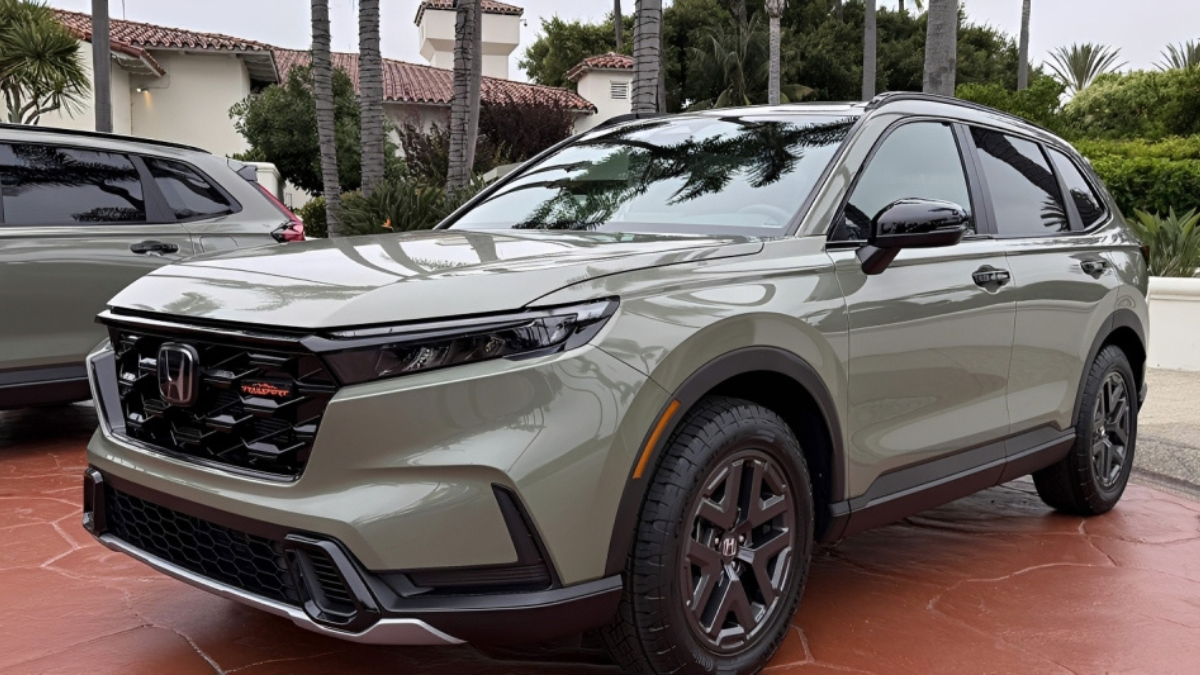
CR-V Hybrid: 36.3 cu ft behind the rear seats in Sport and TrailSport configuration. The cargo opening is wider and the lift-over height is lower than the RAV4, which matters when loading heavy coolers or unwieldy camping gear. Rear seats fold flat. Honda provides underfloor storage compartments in some configurations. Rear legroom of 41 inches means adults in the back seat are genuinely comfortable, not squeezed.
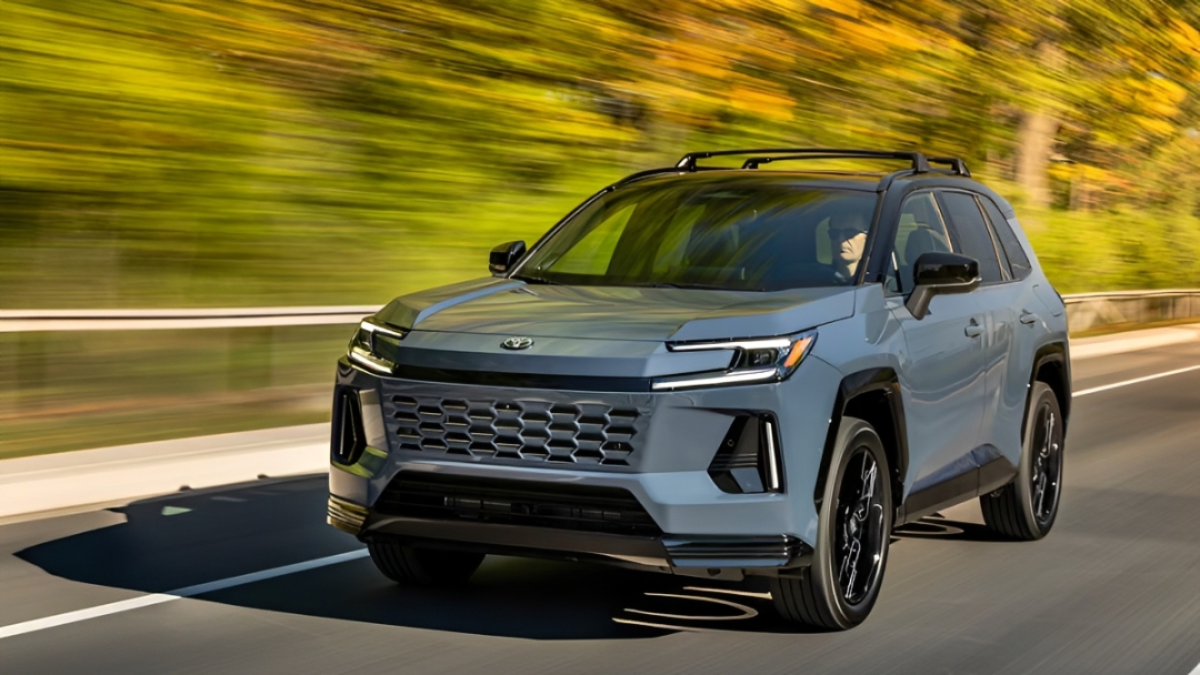
RAV4 Hybrid: 37.8 cu ft behind rear seats — slightly more raw volume. The floor layout is well-organized. However, rear legroom at 37.8 inches falls 3.2 inches short of the CR-V, which matters for taller rear passengers on a three-hour drive.
For a weekend trip specifically, the practical cargo difference is smaller than the legroom difference. Neither vehicle struggles to hold two large rolling bags, a cooler, and a duffel bag behind the occupied rear seats. The CR-V’s lower lift-over height is a genuine ergonomic advantage for weekend loading.
Where the RAV4 Hybrid decisively wins on cargo: towing. At 3,500 lbs — versus the CR-V Hybrid’s 1,000 lbs — the RAV4 can pull a small boat trailer, a pop-up camper, or an enclosed utility trailer. The CR-V’s 1,000-lb limit covers a light bike rack or a small cargo trailer but rules out most conventional trailers.
The cargo verdict: The CR-V Hybrid is more comfortable for passengers on a long drive; the RAV4 Hybrid hauls more if you need to tow. For four people with weekend bags and no trailer, either works — the CR-V’s passenger comfort advantage is real on a 3-hour drive.
Comfort: Who Gets Tired First
A 500-mile round trip across two days means roughly three hours each way of sustained highway driving. The comfort variables that matter on a trip like this are ride quality, noise level, seat support, and the ease of the infotainment and climate controls.
CR-V Hybrid ride and cabin: The CR-V Hybrid is quieter at highway speeds, with better sound insulation than the RAV4 — a meaningful advantage on a three-hour drive through open highway. Physical climate control buttons (standard on the CR-V’s Sport and EX-L trims) allow the driver and front passenger to adjust temperature without navigating a touchscreen, which reduces distraction on a road trip. Steering feel is more communicative than the RAV4, which most reviewers describe as better for spirited driving but less relevant on a family highway cruise.
RAV4 Hybrid ride and cabin: The sixth-generation RAV4 has more power (236 hp vs. 204 hp) and stronger acceleration from a standing start. On mountain approaches where the road steepens and the car needs torque for a passing maneuver, the RAV4 feels more confident. The updated infotainment includes a larger available display and more USB-C ports. Some trims offer ventilated front seats — not available on the CR-V — which is relevant on warm-weather summer trips.
On noise: The RAV4 Hybrid’s powertrain produces more engine noise under acceleration than the CR-V. Multiple reviewers note this characteristic of Toyota’s planetary gear hybrid system — louder when you push the accelerator. The CR-V’s hybrid architecture, which uses a different power-split design, tends to be quieter under moderate load.
The comfort verdict: For a standard highway family road trip, the CR-V Hybrid’s quieter cabin, better rear legroom, and intuitive physical climate controls make it the more relaxing place to spend three hours. The RAV4’s acceleration advantage matters more in spirited mountain driving than in steady Interstate cruising.
The Price Differential: MSRP vs. Total Cost
The 2026 RAV4 Hybrid starts at $33,350 (LE, including destination), while the 2026 CR-V Hybrid’s closest equivalent starting trim runs approximately $35,650–$38,000 depending on configuration. That $2,300–$4,650 MSRP gap is the most significant financial difference between the two vehicles.
Framed against the lifetime fuel savings: if the RAV4 Hybrid saves $130/year in fuel on 20 weekend trips, the fuel savings offset the MSRP premium advantage for the CR-V in approximately 18–35 years — meaning the fuel difference alone never closes the price gap in any practical vehicle ownership timeframe.
The RAV4 Hybrid’s lower starting price is the more financially decisive figure. If the budget matters — and for most families it does — the RAV4’s lower entry point buys more vehicle per dollar spent.
However: The CR-V Hybrid’s higher price at comparable trim levels comes with more standard equipment. U.S. News notes that the CR-V Hybrid takes wins in interior features, seat comfort, cargo access, and ride quality. Buyers who value standard comfort equipment included in the base price (rather than paying for optional upgrades) may find the CR-V’s effective price closer to parity at equivalent feature levels.
Which One Wins — and For Whom
Choose the 2026 Toyota RAV4 Hybrid if:
- The MSRP matters and you want a lower entry price for the same hybrid segment
- You tow regularly — the 3,500-lb rating is a genuine functional advantage the CR-V cannot match
- Highway fuel economy is your primary optimization (4 mpg advantage at steady 70 mph)
- You want more horsepower and a more responsive feel on mountain approaches
- Upper trim features like ventilated seats or a larger display screen are priorities
Choose the 2026 Honda CR-V Hybrid if:
- Rear passenger legroom is important — 3.2 inches matters on a three-hour drive with adults in the back
- You value a quieter cabin at highway speed for sustained road trips
- Physical climate controls and intuitive cockpit layout reduce driver fatigue on long drives
- Your trips are mixed urban/highway and the CR-V’s city MPG advantage applies to your actual driving pattern
- 2025 CR-V Hybrid received IIHS Top Safety Pick designation; verify 2026 model ratings at iihs.org as testing is ongoing; 2026 RAV4 safety ratings also pending
Pre-Trip Checklist: What to Confirm Before Saturday Departure
Both vehicles benefit from the same pre-trip habits on a weekend highway run:
- Tire pressure cold check the morning before departure — both vehicles specify a target pressure; a 4 PSI under-inflation reduces fuel economy by approximately 1–2 mpg
- Hybrid battery state of charge: both vehicles manage this automatically, but avoid aggressive jackrabbit acceleration in the first mile from a cold start to let the battery contribute to early acceleration efficiently
- Regenerative braking setting: in both vehicles, higher regen levels recover more energy on downhill descents — useful on mountain approach and return; setting preference varies by driver
- Cargo distribution: keep heavier items low and toward the center of the cargo floor; both vehicles’ handling is affected by high-mounted rear cargo weight at highway speed
VERDICT
On a 500-mile weekend trip, the RAV4 Hybrid saves approximately $5 in fuel and costs $2,300–$4,650 less to buy — a meaningful economic advantage, particularly if towing is ever on the agenda.
The CR-V Hybrid is the more comfortable highway companion: quieter, roomier in the back, easier to live with on a three-hour drive where physical climate buttons and a serene cabin matter more than 4 mpg.
For families prioritizing comfort, rear legroom, and a quieter ride: CR-V Hybrid. For families prioritizing price, highway fuel economy, towing capability, and acceleration: RAV4 Hybrid. Both are among the best hybrid compact SUVs available in 2026 — the decision is genuinely close enough that the right answer is the one that matches your specific trip profile, not the one with the better brochure.
SOURCES
- U.S. DOE/EPA fueleconomy.gov: 2026 Honda CR-V Hybrid AWD — 40 city / 34 highway / 37 combined mpg; FWD — 43/36/40 mpg; primary EPA source for all CR-V Hybrid fuel economy figures in this article
- U.S. DOE/EPA fueleconomy.gov: 2026 Toyota RAV4 Hybrid — LE/SE AWD 46/39/42 mpg; XLE Premium AWD 45/38/41; XSE/Limited AWD 43/37/41; Woodland AWD 41/35/38; primary EPA source for all RAV4 Hybrid fuel economy figures in this article
- U.S. News head-to-head: CR-V Hybrid wins interior features, seat comfort, cargo access, ride quality; RAV4 wins price and acceleration; CR-V rear legroom 41 in vs RAV4 37.8 in; RAV4 2026 all-new, now hybrid-only lineup; CR-V 204 hp, RAV4 236 hp
- Autoblog — RAV4 Woodland vs. CR-V TrailSport trims specifically: RAV4 tow rating 3,500 lbs vs. CR-V 1,000 lbs; CR-V steering more communicative; CR-V 103.5 cu ft passenger volume vs. RAV4 98.9 cu ft; CR-V 41 in rear legroom vs. RAV4 37.8 in; note: these are the off-road trims, not standard trims used in primary fuel math
- KBB: RAV4 2026 starts $33,350 including destination; CR-V TrailSport from $38,800; RAV4 is all-new sixth-generation model; RAV4 AWD-only for most trims; CR-V 71.8 cu ft max cargo, RAV4 70.4 cu ft; CR-V physical climate buttons; RAV4 larger available screens
- Cars.com: confirms 2026 CR-V Hybrid AWD 40/34/37 mpg per EPA; hybrid uses 2.0L naturally aspirated + two electric motors for 204 hp and 247 lb-ft; real-world comparison test on 250-mile loop; RAV4 “nearly spot on with its 39-mpg rating” in prior-gen test
- Toyota dealer comparison confirming 2026 RAV4 is “now in its 6th generation” and hybrid-only across all trims; EPA figures cited match fueleconomy.gov: 46/39/42 for LE/SE AWD, 43 city/36 highway for CR-V Hybrid FWD
- Street Toyota: complete EPA mpg table for all 2026 RAV4 trim levels confirmed: LE/SE AWD 46/39/42; XLE Premium AWD 45/38/41; XSE/Limited AWD 43/37/41; Woodland AWD 41/35/38