
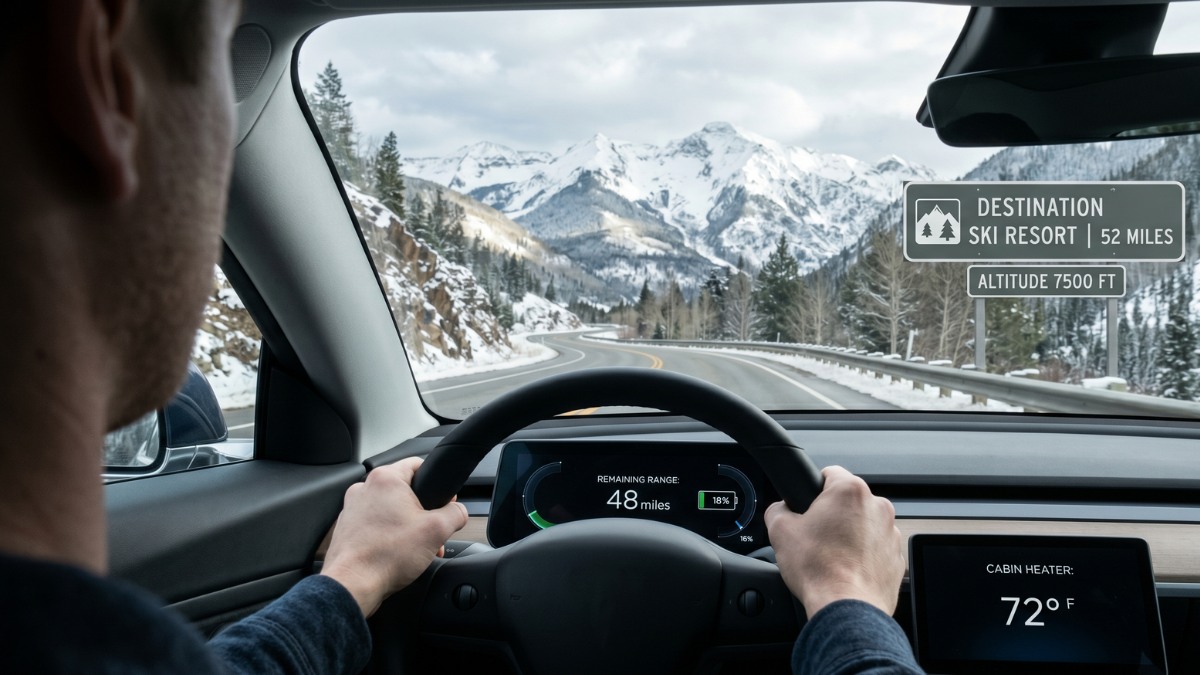
The trip looked reasonable on paper. The ski resort is 190 miles from home. The EV is rated for 250 miles. There is more than enough margin, even accounting for the mountain grades. The family leaves on a Friday afternoon in January, the adults in front with the heat on full, the kids in back asking for more heat. By mile 140, the estimated remaining range reads 48 miles. The resort is 50 miles away. The math has stopped working.
This is not a battery defect. It is not an EPA lie, exactly. It is the collision of three simultaneous factors that interact on a cold-weather mountain drive in a way that the window sticker range figure does not capture: battery chemistry slows down in the cold, cabin heating draws 3,000–5,000 watts continuously from the same battery that is trying to move the car, and the cold battery then charges more slowly at the DC fast charger where the family stops. The result is a trip that takes significantly longer and ends with more range anxiety than anyone planned for.
Quick Takeaways
- Consumer Reports’ controlled highway testing found that cold weather at 16–17°F reduces EV range by approximately 25 percent at 70 mph compared with mild conditions — tested concurrently on a Ford Mustang Mach-E, Hyundai Ioniq 5, Tesla Model Y Long Range, and VW ID.4; the loss was consistent across all four vehicles
- In earlier CR testing of short cold-weather trips with frequent cabin reheating, range loss reached 50 percent — the scenario most relevant to multi-stop mountain driving with kids
- The cabin heater in a resistive-heating EV draws 3,000–5,000 watts continuously; seat heaters draw 50–130 watts each and a heated steering wheel approximately 60–70 watts — meaning four seat heaters plus a heated wheel use roughly 270–590 watts total, or 5–17 times less energy than the cabin heater for targeted warmth
- Recurrent’s real-world analysis of 30,000+ EVs found that at 32°F, EVs retain on average 78 percent of their rated range; at 20°F, the average drops to approximately 70 percent — and the range varies significantly by model, with some models losing 45–46 percent in freezing conditions
- A cold-soaked battery arriving at a DC fast charger can accept as little as 40–60 kW on a charger rated for 150 kW or more — more than doubling the expected charging time; EnergySage research shows EV batteries accept approximately 36 percent less energy at 32°F compared with 77°F during the same charging period
- The two highest-return habits for cold-weather mountain EV trips: precondition the cabin and battery while still plugged in (saves 5–10 percent range per Consumer Reports testing); and use in-car navigation to route to chargers (triggers automatic battery preconditioning so the battery arrives warm at the charger)
Why the EPA Range Is a Summer Number
The EPA range figure on every EV window sticker is calculated at approximately 70°F. This is not a flaw in the testing methodology for its intended purpose — the EPA figure exists to allow fair comparisons between vehicles — but it is essentially a warm-weather measurement that does not represent cold-highway conditions.
“The range estimates provided by the EPA and the manufacturer assume the battery is at ideal temperature — usually around 70 degrees Fahrenheit,” Recurrent Auto, which analyzes real-world driving data from tens of thousands of EVs, explains in its annual winter range study. “In the winter, drivers may experience shorter range than expected.”
The physics behind the gap are straightforward. Lithium-ion batteries rely on electrochemical reactions to move charge. Cold temperatures increase the viscosity of the battery’s electrolyte — the liquid medium through which ions travel between anode and cathode — making the ion movement slower and increasing internal resistance. The result is reduced effective capacity: the battery physically contains the same total energy, but can only deliver a portion of it before voltage drops to the point where the battery management system (BMS) limits or terminates discharge.
This battery chemistry effect alone, without any cabin heating, accounts for part of the cold-weather range loss. The cabin heating draws from the remaining energy pool, compounding the chemistry-induced reduction.
There are two types of EV heating systems. Resistive heating, which is essentially a large electric space heater, converts electricity to heat at roughly 1:1 efficiency and draws 3,000–5,000 watts when running at high output. A heat pump, which extracts heat from the outside air and concentrates it inside the cabin, operates at roughly 3:1 to 4:1 efficiency at moderate temperatures — producing 3–4 units of heat for each unit of electricity consumed. Heat pumps have significantly lower energy consumption for the same cabin temperature, which is why vehicles with heat pumps typically show 10–15 percent better cold-weather range than equivalent resistive-heated vehicles.
As Recurrent notes: “Heat pump technology for heating and cooling the cabin is a significant factor in extending EV range, even in temperatures as low as 14 degrees — a crucial difference.” Andrew Garberson, Recurrent’s head of marketing, advises buyers: “Do a little bit of research about the technology in the car because it can make a 10 to 15 percent difference in overall range.”
Popular EVs with heat pumps as standard or available equipment: Tesla Model Y and Model 3 (standard since 2021), Hyundai Ioniq 5, Hyundai Ioniq 6, Kia EV6, BMW iX, Volkswagen ID.4 (select years), Rivian R1T/R1S.
Popular EVs without heat pumps (resistive heating only): First-generation Chevrolet Bolt (pre-2023 update), some early Nissan Leaf generations, some early Ford Mustang Mach-E configurations. Recurrent’s 2025/2026 study notes that the VW ID.4 — which has shown some of the worst cold-weather performance despite having a heat pump — underperformed relative to its heat pump peers, suggesting that thermal management system design matters as much as the presence of a heat pump.
The Heating Power Gap: Full Cabin vs. Targeted Warmth
The energy consumption difference between full cabin heating and targeted heating (seat heaters plus heated wheel) is large enough to meaningfully change the range outcome on a cold trip.
Full cabin resistive heat: 3,000–5,000 watts continuously at high setting Heated seat (per seat): 50–130 watts Heated steering wheel: 60–70 watts Four seat heaters + heated wheel: approximately 270–590 watts total
At the high end, four seat heaters plus a heated wheel draw roughly 590 watts — approximately 1/5 to 1/8 of what the full cabin heater draws. On a trip where the cabin heater would have reduced range by 15 percentage points (a plausible contribution of the heating load to cold-weather range loss), substituting targeted heating could reduce that contribution to 2–3 percentage points.
The Electric Car Scheme notes: “Seat heaters are a far more energy-efficient way to stay warm in your EV during winter months. Instead of turning on the entire cabin heat, use the seat heaters to directly warm up your body, which consumes just 50–100 watts compared to 3,000–5,000 watts for full cabin heating — a massive difference that helps preserve your battery. Combined with heated seats, many drivers find they can remain comfortable with cabin heating set to 18–19°C rather than 21–22°C — a temperature difference that can save 1–2 kW of continuous power draw.”
The practical hierarchy for a cold EV trip with a family:
- Precondition the cabin to target temperature while still plugged in. The cabin is already warm when you depart, so the heater’s job for the first 20–30 minutes is maintenance, not recovery — drawing significantly less power than cold-start reheating.
- Turn the cabin heat to a lower setpoint once underway. The car is already warm; 65°F maintained is far cheaper than 72°F recovered from cold.
- Switch to seat heaters and heated wheel for ongoing comfort. These provide conductive warmth (body contact) rather than convective warmth (warm air), which is more energy-efficient for the occupants actually in the seats.
- Reserve the cabin heater for defogging — the defroster is a safety necessity that should not be sacrificed for range.
The Actual Range Numbers: What Four Real EVs Did in the Cold
Consumer Reports conducted the most precise controlled comparison of cold-weather EV range available in North American testing: four identical drives, same route, same speed, same time of year.
Test methodology: Ford Mustang Mach-E Extended Range, Hyundai Ioniq 5, Tesla Model Y Long Range, and Volkswagen ID.4 Pro S driven in caravan on a 142-mile Connecticut highway route at adaptive cruise control set to 70 mph, regenerative braking at lowest setting to level the playing field, charged to 100 percent overnight before each run. Repeated in winter (approximately 16–17°F), mild spring (mid-60s), and summer heat (mid-80s).
Cold weather result (16–17°F):
- All four vehicles lost approximately 25 percent of range compared with their mild-weather performance at the same speed
- Ford Mustang Mach-E Extended Range (EPA 270 miles): cold weather result approximately 188 miles
- Hyundai Ioniq 5 (EPA 256 miles): cold weather result approximately 183 miles
- Volkswagen ID.4 Pro S (EPA 240 miles): cold weather result approximately 170 miles
- Tesla Model Y Long Range (EPA 326 miles): cold weather result approximately 190 miles
Consumer Reports’ additional finding on short trips: “Short trips in the cold with frequent stops and the need to reheat the cabin saps 50 percent of the range.” This is the scenario relevant to mountain ski trips with multiple stops — the vehicle’s heating system has to work hardest when the cabin is cold-soaking between stops, not when maintaining temperature during continuous highway driving.
Recurrent’s large-fleet analysis (30,000+ vehicles) confirms the population-level result: at 32°F, EVs retain an average of 78 percent of rated range; at 20°F, approximately 70 percent. The VW ID.4 showed the worst cold-weather performance in Recurrent’s fleet study, losing up to 46 percent of optimal range, while the Audi e-tron (Q8 e-tron) showed the least cold-weather sensitivity at approximately 16 percent.
Applied to the 250-mile rated EV on a mountain ski trip:
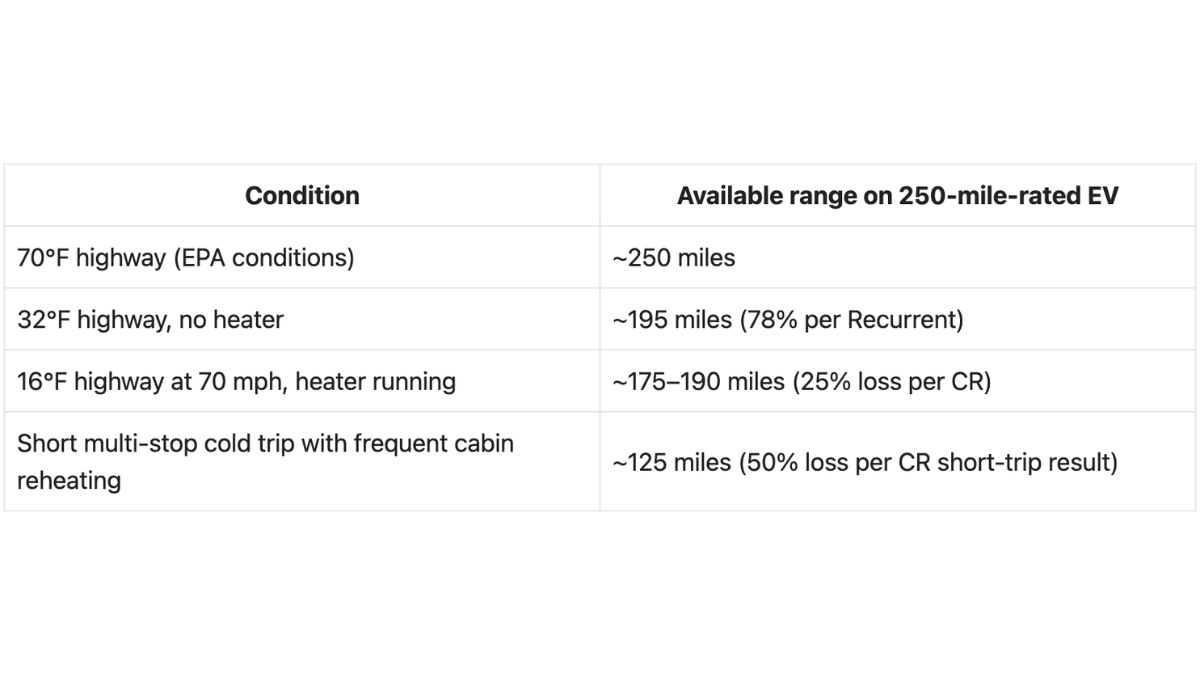
The family driving to a 190-mile ski resort in January is not experiencing unusual conditions. They are driving a vehicle in conditions significantly outside the EPA test scenario, through mountain terrain that adds grade-related energy consumption on top of cold-weather losses.
The Charging Problem: Why the Rest Stop Takes Twice as Long
Cold weather does not only reduce driving range. It also slows the charging session that replenishes it — creating a compound time problem on winter road trips.
When a lithium-ion battery is cold, the electrolyte behaves more like cold honey than warm water. Ions move slowly, internal resistance rises, and the battery management system responds by limiting the charging current to prevent lithium plating — a form of permanent damage where metallic lithium deposits on the anode surface rather than intercalating into the electrode as designed. This BMS-imposed current limit is not a charger malfunction; it is a protection mechanism.
The practical consequence at a DC fast charger: a battery that is cold-soaked from a winter parking lot or the first 15 minutes of a cold-day drive may accept 40–60 kW on a charger rated for 150 kW or more — less than half the charger’s capacity. The Kia EV Forum’s direct documentation of a cold-weather trip (3–6°F ambient) describes the experience: “Charging was slow as expected, 45–50 kW for about 15–20 minutes until battery temps got a bit better and then we would see it go to about 100 kW.”
EnergySage research quantifies the population-level effect: at 32°F, EV batteries accept approximately 36 percent less energy than at 77°F during the same charging period. At 20°F, the deficit can reach 50 percent or more, especially for a battery that was cold-soaked at the start of the session.
The implication for a winter mountain trip with one planned charging stop: what the family planned as a 25-minute charging break may extend to 40–55 minutes if the battery arrives at the charger cold. This is particularly likely if they stop early in the trip before the battery has had time to warm through normal driving operation.
The key difference: battery temperature at arrival
A battery that has been driving for 45–90 minutes at highway speed is warm. Internal heat from discharge warms the pack regardless of ambient temperature. A battery that has been sitting in a cold parking lot overnight, or that started a trip in single-digit temperatures before the thermal management system could warm it, is cold-soaked and will charge slowly.
Recharged summarizes the practical rule: “Aim to reach fast chargers between 10–30% state of charge after at least 45 minutes of driving. Preheat the cabin while plugged in and, if your EV allows, set a departure time so charging finishes just before you unplug. Route to the station in your car’s navigation so it can warm the battery automatically.”
The Two Highest-Return Habits for Winter EV Road Trips
1. Precondition while plugged in — never let the car self-warm on battery power.
The most energy-efficient way to start a cold-weather drive is to bring the cabin to target temperature before departing, using power from the wall rather than the battery. Preconditioning while plugged in preserves the full battery for driving rather than spending battery energy on cold recovery.
Consumer Reports tested this precisely: in January 2025, with single-digit-degree temperatures, three EVs (2024 Kia EV9, 2024 Acura ZDX, 2024 Tesla Model 3 Long Range) were each tested on a 100-mile highway loop with and without scheduled departure preconditioning. Result: preconditioning provided a 5–7 percent efficiency improvement and 3–4 percent more battery charge available at the route’s end.
Qmerit’s EV charging guidance documents the broader estimate: “Preconditioning by warming both battery and cabin while plugged in can reduce range loss by 15–20%, and significantly improve fast-charging acceptance.”
Most EVs allow scheduled departure preconditioning through the vehicle’s infotainment system or the manufacturer’s mobile app. The car warms the cabin and battery to target temperature before the scheduled departure time, using grid power throughout.
2. Use the vehicle’s built-in navigation to route to DC fast chargers — not a phone map.
Many modern EVs automatically precondition the battery when the built-in navigation detects a fast charger as the destination. The car begins heating the battery pack during the drive to the charger, so the battery arrives at target temperature rather than cold-soaked. Without this precondition signal, the battery may spend the first 10–20 minutes of the charging session warming up on charger power, adding both time and cost to the stop.
The Recharged guidance is specific: “Select the DC fast charger from the in-car charging menu 15–30 minutes before arrival so battery preconditioning can run in the background.”
This distinction — between the car knowing you are headed to a charger and not knowing — can be the difference between a 20-minute stop and a 40-minute stop on a winter mountain trip. Using Google Maps on a phone to navigate does not transmit destination information to the vehicle’s thermal management system. Using the car’s own navigation does.
The Mountain Trip Planning Framework
A practical framework for planning a cold-weather EV mountain trip, derived from the available range data:
Step 1: Calculate your actual usable range, not the EPA figure.
In temperatures below 30°F with highway driving and cabin heater running, plan on 60–75 percent of EPA range as your usable distance — the lower figure applies if the trip involves frequent stops and cabin reheating (ski resort driving pattern), the higher figure applies to sustained highway cruise with preconditioning. For a 250-mile rated EV: plan on 150–188 miles per charge in these conditions.
Step 2: Apply a 20 percent buffer before planning each charging stop.
Do not plan to arrive at a charger at low single-digit state of charge. The BMS limits available power at very low temperatures and very low SOC simultaneously — the worst-case scenario for charging speed. Target arriving at chargers with 15–25 percent SOC remaining.
Step 3: Add time for charging stops in cold weather.
A planned 25-minute stop may take 40–55 minutes if the battery was cold-soaked at the start of the session. If the vehicle’s navigation-based battery preconditioning is functioning (car is routing to the charger through built-in nav), the charging session will start faster. Budget the longer time estimate for the first stop of the day when the battery may be cold.
Step 4: Plan the night’s charging.
If the resort hotel has Level 2 charging (240V, typically 7–11 kW), overnight charging from 20 percent SOC to 80 percent takes approximately 5–8 hours. At 32°F, Level 2 charging is less affected than DC fast charging — the lower power level is gentler on a cold battery, and overnight duration compensates for slower acceptance. Qmerit notes: “Level 2 home charging is less affected than public DC fast charging, which can take twice as long in extreme cold.”
Check charger availability at the resort hotel before departure using PlugShare or the manufacturer’s network app. The ski resort corridor in Colorado, Utah, Vermont, and BC has seen significant Level 2 infrastructure growth at resort hotels since 2022, but not every property offers it. Book accordingly.
Step 5: For the return trip — time the departure during daylight with a full charge.
A morning departure after overnight Level 2 charging produces the best cold-weather conditions: full battery, cabin prewarmed while still plugged in, and temperatures that are at their coldest but will warm through the day as the return drive proceeds. A late-night return on a near-empty battery in sub-20°F conditions is the highest-risk EV trip scenario.
U.S. and Canada Specific Routes and Conditions
Colorado mountain corridor (Denver to Summit County ski resorts — I-70): The I-70 mountain corridor is one of the highest-volume EV ski-trip routes in North America. Keystone, Breckenridge, Vail, and Steamboat Springs are all accessible from Denver, and the Eisenhower Tunnel (11,013 feet) represents the grade challenge between the two sides. Range at altitude and grade is further reduced — climbing adds energy consumption beyond the flat-highway cold-weather estimate. Tesla Supercharger coverage is strong along I-70; non-Tesla DC fast charging is improving but less dense. Plan charging in Idaho Springs or Silverthorne on the way up.
Vermont and New Hampshire ski corridor (I-89, I-93, I-91): Cold temperatures are consistent and deep through February–March. Stowe, Killington, and Bretton Woods are all reachable from Boston, but winter temperatures regularly drop below 10°F. The Consumer Reports test route in Connecticut (the same conditions used for the 25 percent range loss finding) is representative of this corridor’s winter. Level 2 charging at major Vermont ski resorts has expanded significantly; verify at the specific property.
Washington and Oregon Cascades (US-2, SR-20, US-26): The Cascades see significant temperature variation between the Columbia Plateau and the summit passes. Stevens Pass, Snoqualmie, and Mt. Hood are within range of Seattle and Portland. Cold-weather range figures apply from November through March; the west-side approach is milder but the pass and east-side descent are cold.
Canada — Highway 99 (Sea-to-Sky, Vancouver to Whistler): 125 km with approximately 600 meters of elevation gain on the approach to Whistler from the Squamish interchange. In January–March, temperatures at the village regularly sit at or below 0°C (-18°F in cold snaps). The highway has limited DC fast charging infrastructure between Vancouver and Whistler compared with U.S. corridor equivalents. Verify charger availability and plan to arrive with at least 25–30 percent SOC at the village, accounting for elevation gain.
Canada — Trans-Canada and Highway 40 to Mont-Tremblant / Laurentians: Ottawa to Montréal to Tremblant corridor. January–February temperatures regularly reach -20°C to -30°C. At -20°C, the Recurrent 20°F (~-7°C) figure of 70 percent retention likely represents the upper bound of what most EVs can deliver; colder temperatures push retention further down. Block heater availability at parking garages and hotels in Montréal is standard, which is not an EV-specific advantage but does apply to keeping the battery from cold-soaking overnight.
SOURCES
- Consumer Reports: controlled concurrent test of Ford Mustang Mach-E, Hyundai Ioniq 5, Tesla Model Y Long Range, VW ID.4 on 142-mile Connecticut route at 70 mph; 16–17°F cold weather reduced range ~25 percent vs. mid-60s mild weather; prior CR testing: short cold trips with frequent cabin reheating = 50 percent range loss; cold weather Mach-E 188 miles, Ioniq 5 183 miles, ID.4 170 miles, Model Y ~190 miles
- Consumer Reports 2025 update: preconditioning test on 2024 Kia EV9, 2024 Acura ZDX, 2024 Tesla Model 3 at single-digit January temperatures; scheduled departure preconditioning improved efficiency 5–7 percent and battery charge 3–4 percent; “range starts to drop at 40°F”; EV specialist Alex Knizek advice on preconditioning while connected
- Recurrent Auto: 30,000+ EV analysis; at 32°F EVs retain average 78% of max range; at 20°F average 70%; VW ID.4 loses ~46% in cold; Audi e-tron loses ~16%; heat pump makes 10–15 percent difference; Bolt loses upper-20s to 30%; Model 3 half of EPA in very cold per earlier data
- Recurrent winter range report: cold weather range loss 16–46% depending on model; heat pump is significant factor; Andrew Garberson quote on adapting expectations; Audi e-tron best at 16% loss, VW ID.4 worst at 46%
- Electric Car Scheme: seat heaters 50–100 watts vs. 3,000–5,000 watts for full cabin heating; “massive difference that helps preserve your battery”; cabin heating setpoint of 18–19°C vs 21–22°C saves 1–2 kW continuous draw; vehicles with heat pumps typically cut winter consumption 10–15 percent
- EnergySage: at 32°F EV batteries accept about 36% less energy than at 77°F during same charging period; at 20°F charging speeds drop 50% or more; DC fast charging timeline stretches from 20–30 minutes to 40+ minutes; battery arriving warm from driving charges much faster than cold-soaked pack
- Recharged: cold battery may accept 40–60 kW on 150 kW rated charger; “aim to reach fast chargers between 10–30% state of charge after at least 45 minutes of driving”; select DC fast charger in car’s navigation 15–30 minutes before arrival for automatic battery preconditioning
- Qmerit: preconditioning while plugged in can reduce range loss 15–20 percent; Level 2 home charging less affected than DC fast charging which can take twice as long in extreme cold; plan charging stops before single-digit SOC
- WXPR/APM: Recurrent’s Garberson quote — “do a little research about the technology in the car, it can make a 10 to 15 percent difference in overall range” [referring to heat pump]; cold weather range loss 25–41 percent across research; cars built 2020 or later more likely to have heat pumps; Ford added heat pump to 2024 F-150 Lightning
- Kia EV Forum: documented cold-weather (3–6°F) road trip; charging started at 45–50 kW for 15–20 minutes then rose to ~100 kW; without battery preconditioning; improvement after preconditioning update — owner documentation cited as community field data
Hello, I think your website might be having browser compatibility issues.
When I look at your website in Opera, it looks fine but
when opening in Internet Explorer, it has some overlapping.
I just wanted to give you a quick heads up!
Other then that, great blog!
Thank you so much for your help!