
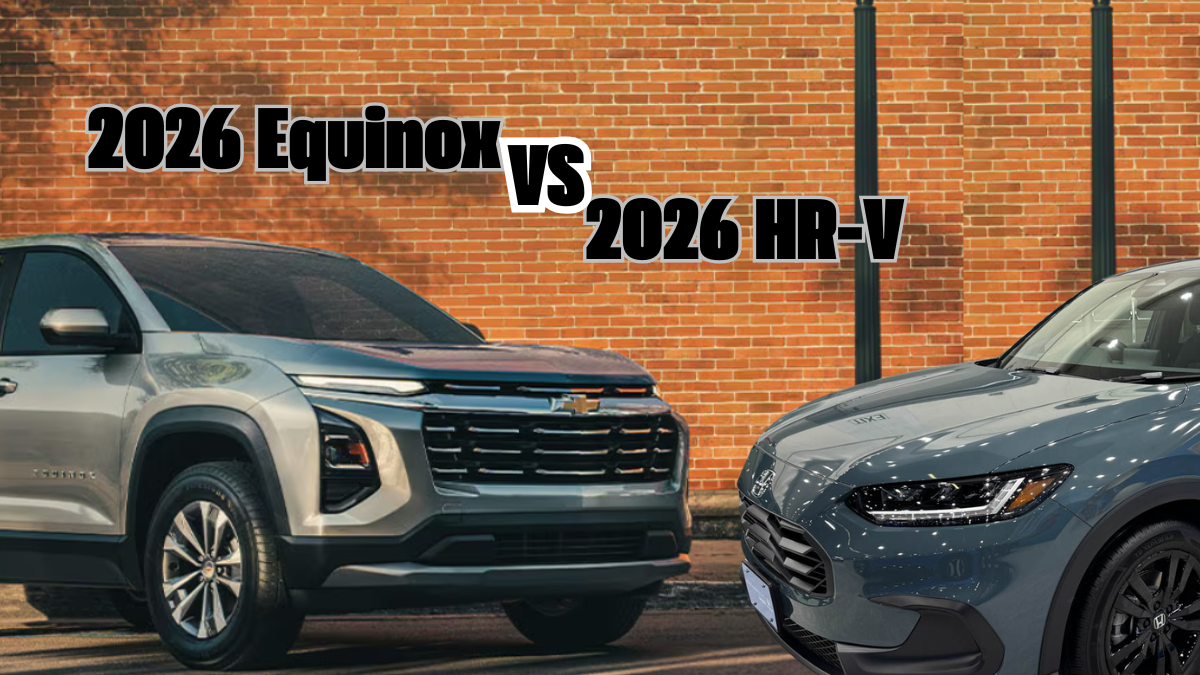
According to Honda’s official 2026 HR‑V specifications sheet, the HR‑V lists 37.7 inches of rear legroom, 38.0 inches of rear headroom, and 55.2 inches of rear shoulder room, with total passenger volume listed at 98.7 cubic feet. Car and Driver’s specs for the 2026 Chevrolet Equinox, meanwhile, list passenger volume of 52/49 cubic feet front/rear (and cargo volume of roughly 64/30 cubic feet behind the front/rear rows), reflecting a larger footprint and a roomier second row feel on paper. For a 4‑hour drive, “cramped” rarely means one measurement is slightly smaller—it means knees, shoulders, and posture start fighting for space by hour two. This comparison uses checkable dimensions plus a repeatable test‑drive method to decide which small SUV feels less tight for U.S. long‑drive weekends.
Quick takeaways
- If “less cramped” means rear-seat comfort: the Equinox’s larger class and Car and Driver’s front/rear passenger-volume figures (52/49 ft³) point to a more relaxed second-row experience than the HR‑V’s subcompact-class packaging.
- If “less cramped” means front-seat posture over 4 hours: both can work, but the Equinox’s broader cabin typically makes arm and shoulder positioning easier (steering reach, elbow room, console width).
- HR‑V is not tiny—but it is narrower: Honda’s spec sheet lists 37.7 inches of rear legroom and 55.2 inches of rear shoulder room, which can feel fine for two adults in back, but tighter for three across.
- The practical divider: Equinox’s larger cargo and rear volume can keep bags out of the passenger area, which reduces “cramped” feeling even when legroom is similar.
- Best method: decide with a 20‑minute “4‑hour predictor” loop: rear-seat sit test + highway noise + seat posture + armrest/console check.
What “cramped” really means at hour two
On a 4-hour drive, people rarely complain about “one inch.” They complain about a pattern:
- knees pointing inward because foot space is tight,
- shoulders rubbing because the cabin is narrow,
- head tilted because the roofline pinches,
- or constant shifting because the seat posture never settles.
So the comparison below is built around the three places crampedness shows up most:
1) Rear-seat geometry (legroom + foot space + shoulder room)
2) Front-seat working space (elbow room + steering reach + console width)
3) Cargo spillover (when luggage ends up in the cabin)
The spec reality (as-of snapshot for 2026)
As of March 12, 2026, the cleanest checkable dimension anchors from the sources used here are:
2026 Honda HR‑V (official Honda specs)
- Passenger volume: 98.7 cu ft
- Rear legroom: 37.7 in
- Rear headroom: 38.0 in
- Rear shoulder room: 55.2 in
- Front legroom: 41.9 in
These numbers describe a well-packaged small SUV, but one that must stay efficient with width.
2026 Chevrolet Equinox (Car and Driver specs)
- Passenger volume (front/rear): 52/49 ft³
- Cargo volume (behind front/rear): 64/30 ft³
Car and Driver’s layout makes the main point: Equinox is the “bigger small SUV” in this matchup, and that usually reads as less cramped on longer stints.
[[PUBLISHER NOTE: add a small “spec snapshot” graphic here — caption: “HR‑V: 37.7 rear legroom / 55.2 rear shoulder. Equinox: passenger volume 52/49 ft³ (F/R).” ]]
Rear seat: where the difference is most noticeable
If the trip includes adults in the second row, crampedness becomes a rear-seat problem first.
HR‑V: fine for two, tight for three
Honda’s spec sheet points to a usable rear row: 37.7 inches of rear legroom is enough for many adults, and 38.0 inches of rear headroom keeps the roof from feeling too low. The pressure point is usually shoulder space. At 55.2 inches of rear shoulder room, three-across can feel like a posture compromise even if legroom is acceptable.
Weekend reality: two adults in the back can be comfortable. Three adults for four hours is where it can start to feel “cramped,” especially if everyone is wearing jackets and carrying small bags.
Equinox: more relaxed “second row zone”
The Equinox’s passenger volume split (52/49 ft³ front/rear) signals a larger rear zone than the HR‑V’s total passenger volume figure would imply by class. Even without isolating a single legroom figure here, the larger rear passenger volume typically shows up as:
- easier knee clearance behind a tall driver,
- more shoulder comfort for two adults,
- and fewer “where do my feet go?” moments.
For a 4-hour drive, that’s the difference between “fine” and “easy.”
Front seat: the hidden crampedness driver
Many long-drive complaints come from the front seat, not the back. The driver spends four hours with:
- one hand on the wheel,
- one arm on the console,
- and a shoulder posture that either relaxes or tightens.
This is where a bigger cabin often wins even when the brochure highlights the same infotainment features.
HR‑V: efficient packaging
The HR‑V gives the driver strong legroom on paper (41.9 inches). The question is whether the steering reach, armrest height, and console width allow a neutral posture. In smaller cabins, drivers sometimes “brace” unconsciously—elbow has nowhere to rest, or the wheel reach forces shoulders forward.
Equinox: more elbow room, less posture negotiation
A larger cabin tends to reduce the small frictions that become fatigue: where the right elbow sits, whether the seat bolsters pinch, and how easy it is to rest shoulders back while still reaching the wheel comfortably. That’s the “less cramped” feeling drivers notice by hour two.
Cargo spillover: why the bigger SUV can feel less tight even with similar seating
Crampedness is not only about bodies. It’s also about where stuff goes.
Car and Driver lists the Equinox at roughly 30 cu ft behind the rear seat, and about 64 cu ft with the second row down. That’s enough to keep a cooler, carry-ons, and jackets out of the passenger footwells.
For the HR‑V, cargo is smaller and more likely to push into the cabin—especially on a four-hour family trip where the rear seat is occupied. When a bag ends up on the seat or in the footwell, perceived crampedness spikes even if the legroom number is decent.
What this means in the U.S.
A U.S. 4-hour drive is usually:
- sustained highway speed,
- one short stop,
- and a destination with a parking lot and bags-in-hands moment.
In that pattern:
- the Equinox tends to feel less cramped because it keeps bodies and gear separated more easily.
- the HR‑V can still work well for two adults up front and one or two in the back, but it’s the “efficient package” where seating and cargo must be managed more deliberately.
What you can do: a 20-minute “4‑hour predictor” test
Bring one carry-on and one soft duffel (or a cooler) and run this loop on both SUVs:
1) Rear-seat sit test (3 minutes): sit behind your own driving position. Check knee clearance and foot space.
2) Three-across simulation (2 minutes): even without three passengers, sit centered and note shoulder pinch.
3) Highway noise check (8 minutes): audio off, fan low. Noise fatigue can feel like crampedness.
4) Armrest/console check (5 minutes): can your elbow rest naturally? Does the wheel reach allow shoulders back?
5) Cargo isolation check (2 minutes): load the bags and see whether anything spills into the cabin.
Bottom line
If the goal is the least cramped feel over four hours, the Equinox is the safer bet because it is the larger vehicle in this pairing and Car and Driver’s passenger-volume split (52/49 ft³) points to a more relaxed rear zone—and more space to keep luggage out of the cabin.
The HR‑V can still be a smart choice when the “4‑hour drive” is mostly two people, light luggage, and occasional rear-seat use. But if the weekend pattern includes adults in back or a full load of gear, the Equinox is more likely to feel like the trip is happening around the passengers, not on top of them.