

The window sticker says AWD. The salesperson confirms it. The driver clicks the highway on-ramp in January with a quiet confidence that the vehicle is managing all four wheels through the ice — and in many cases, it is not. It is managing the front two wheels until the front tires slip, at which point electronics detect the loss of grip and begin routing power rearward. That detection-and-response cycle takes fractions of a second on a dry road test bench. On a cambered, icy mountain pass switchback at 40 mph with crosswind, fractions of a second is the interval during which the rear of the vehicle can begin stepping sideways.
The term “all-wheel drive” covers at least two fundamentally different engineering philosophies: systems that always power all four wheels, and systems that power two wheels until slip is detected and then attempt to correct. Calling both “AWD” is accurate in the sense that both can, under the right conditions, drive all four wheels. It is misleading in the sense that these systems behave differently in exactly the conditions where the distinction is most safety-relevant: the first moments of grip loss on a high-friction-coefficient road surface — packed snow, black ice, iced-over mountain asphalt.
This article explains the distinction, names the vehicles and systems that fall into each category, and addresses the question that often matters more than either: whether winter tires on a two-wheel-drive vehicle outperform AWD on all-season tires in a real winter driving scenario.
Quick Takeaways
- “AWD” on a window sticker describes two different mechanical realities: full-time systems that continuously power all four wheels (Subaru Symmetrical AWD, Audi Quattro), and on-demand systems that operate as FWD or RWD until wheel slip is detected and then route power to the second axle
- On-demand systems are sometimes described in automotive coverage as “slip-and-grip” — the vehicle must slip before the system responds; on flat asphalt under normal conditions this delay is imperceptible; on a low-traction surface like black ice or iced-over packed snow at speed, the delay produces the rear step-out or oversteer event that the driver feels before the system stabilizes
- Consumer Reports’ multi-week snow driving tests confirmed: “All-wheel drive didn’t aid in braking or in certain cornering situations. Our evaluations conclusively showed that using winter tires matters more than having all-wheel drive in many situations”
- Tire Rack’s controlled ice braking test found winter tires stopped from 10 mph in approximately 21 feet; all-season tires required approximately 40 feet — nearly double the distance — on the same ice surface; the drivetrain was the same vehicle in both tests
- Consumer Reports tested a FWD Toyota Camry on winter tires against an AWD Honda CR-V on winter tires, braking from 60 mph on snow: both stopped in approximately 300 feet — the same distance. AWD’s grip advantage on acceleration had vanished at the point of maximum risk: the stop
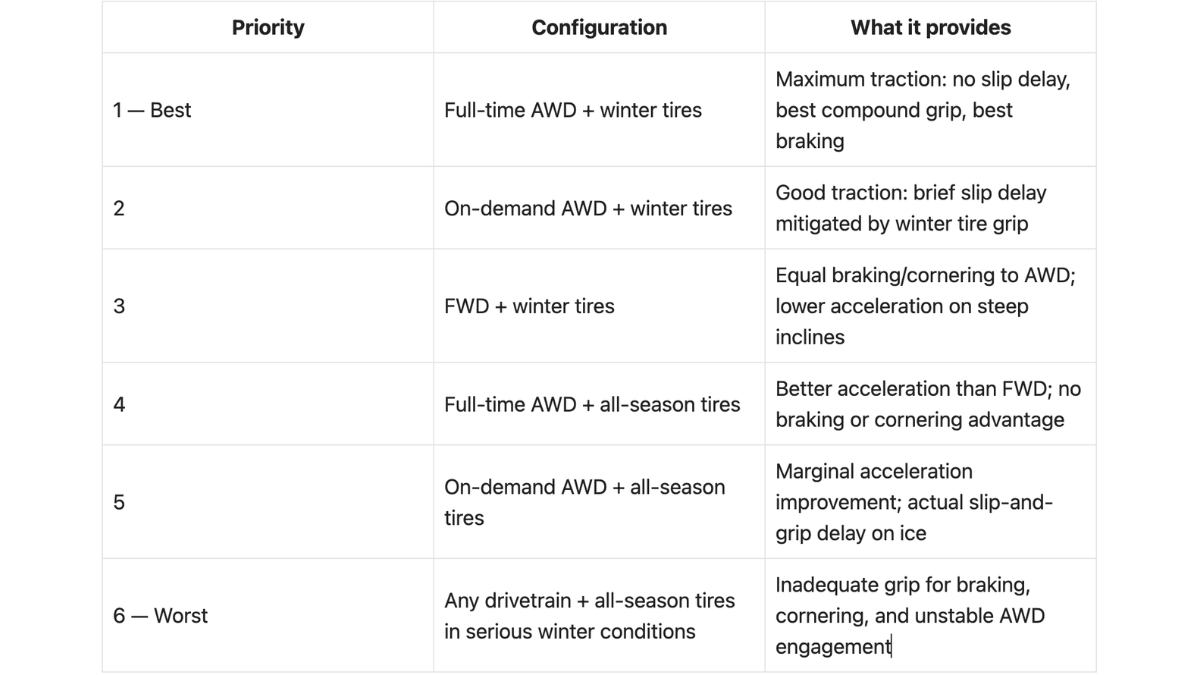
- The correct winter driving hierarchy: (1) winter tires on any drivetrain; (2) full-time AWD with winter tires for mountain-pass and deep-snow conditions; (3) on-demand AWD with winter tires for typical snow-belt use; (4) FWD with winter tires for flat-to-moderate terrain; and well below all of these: (last) any drivetrain on all-season tires in serious winter conditions
The Mechanical Difference: What “AWD” Actually Describes
All-wheel drive means all four wheels can receive power. What the label does not tell you is when, and how quickly.
Full-time AWD maintains a mechanical connection to all four wheels at all times. The front and rear axles are linked through a center differential that actively manages how torque is divided between them. In normal conditions, the split may be weighted toward the front or rear for efficiency. The critical property is that when the traction environment changes — the road surface transitions from dry asphalt to ice-covered asphalt in a single car length — the system’s response does not require a detection event first. Power is already flowing to all four wheels; the distribution adjusts.
Subaru’s Symmetrical AWD is the most common example in the mainstream crossover segment. It uses a continuously variable torque split managed through a viscous center coupling or planetary gearset, always directing some power to the rear axle. Consumer Reports describes this directly: “Subaru’s mechanical AWD system always directs at least some of the engine’s power to all four wheels, and it can direct a larger amount aft if needed.” The system does not need to wait for slip at the front wheels to engage the rear — because the rear is already engaged.
Audi’s Quattro system, in its full mechanical form used in the A4 Allroad and larger models, operates similarly: a self-locking center differential can send up to 70 percent of power forward or 85 percent rearward depending on conditions, without first requiring slip detection.
On-demand AWD — the system found in the majority of mainstream SUVs and crossovers — operates primarily as FWD (in FWD-platform vehicles) or RWD (in RWD-platform vehicles) under normal conditions, engaging the second axle when the primary axle’s wheels begin to slip. The engagement is managed electronically: wheel speed sensors detect a difference between front and rear axle rotation rates, the ECU identifies this as slip, and an electronically controlled coupling routes torque to the secondary axle.
Consumer Reports describes the majority of AWD systems: “Most AWD systems deliver power primarily to one set of wheels, front or rear. When slippage is detected at one axle, power is diverted to the other axle, in hopes of finding more traction there.”
The Honda CR-V, Toyota RAV4 (standard, not AWD versions with more sophisticated systems), Nissan Rogue, and Chevrolet Equinox — the best-selling crossovers in North America — all use on-demand AWD on FWD platforms. Under normal driving conditions, these vehicles operate as front-wheel-drive vehicles. The AWD engages reactively.
What the Delay Means in Practice
The on-demand engagement delay is generally imperceptible on dry pavement, minimal on wet pavement, and potentially consequential on low-friction surfaces where control is already marginal.
The sequence on a snowy mountain switchback:
- The front wheels begin to lose lateral traction as the vehicle rounds the curve
- Wheel speed sensors detect differential rotation rates
- The electronic coupling activates and begins routing torque to the rear wheels
- Rear torque reaches a level sufficient to restore balance
Steps 2–4 happen in well under a second in modern systems — often in 200–500 milliseconds. At 40 mph on a switchback, 300 milliseconds of uncorrected front-axle slip covers approximately 5–6 meters of lateral drift. Whether that translates to a recoverable correction or an unrecoverable step-out depends on the road camber, the curve radius, and the coefficient of friction — all of which are worse on an iced mountain pass than in the parking lot where the salesperson tested the system.
The Dax Street assessment of Nissan’s Intelligent AWD describes the real-world character: “a part-time, front-biased system that only sends power rearward after slippage occurs. On snow or ice, the lag can be unnerving, especially when pulling out onto slick roads or navigating unplowed driveways.”
Full-time systems eliminate this sequence because the detection event is not required. The rear wheels are already receiving torque at the moment the front wheels begin to lose traction.
The More Dangerous Misconception: AWD and Braking
The slip-and-grip delay matters for traction on acceleration and while cornering under power. The more dangerous misconception about AWD is separate from this: that AWD helps with stopping.
It does not.
AWD is a drivetrain system. It controls how the engine’s power reaches the road. Braking is managed by the brake system and the tires. The four wheels’ traction patches — approximately the size of a hand each — generate friction against the road surface during braking. Whether those wheels are connected to one axle or two does not change how much friction the rubber compounds can generate against the ice.
Consumer Reports’ conclusion from its extended snow testing is explicit: “All-wheel drive is far better than two-wheel drive when it comes to driving on slick surfaces where you need serious traction to get going, such as a snowy uphill driveway. But our tests found that all-wheel drive by itself won’t help if you’re heading too fast toward a sudden sharp curve on a snowy night.”
The precise test data: Consumer Reports measured a FWD Toyota Camry on winter tires and an AWD Honda CR-V on winter tires braking from 60 mph on snow. Both stopped in approximately 300 feet — the same result. The AWD car had no braking advantage over the front-wheel-drive car, because both were equipped with tires that could actually grip the surface.
The Tire Rack controlled ice test, conducted on an actual skating rink surface to replicate black ice, found the following stopping distances from 10 mph:
- Summer tires: approximately 47 feet
- All-season tires: approximately 40 feet
- Winter tires: approximately 21 feet
Nearly half the stopping distance, on the same vehicle, same drivetrain, same speed. The tires were the variable. The drivetrain was held constant.
U.S. News summarizes the practical conclusion: “A front-wheel-drive car with dedicated winter tires will have significantly better braking and turning grip on snow and ice than an all-wheel-drive car using standard all-season tires.”
The Correct Winter Driving Matrix
Winter tires vs. all-season tires: what the data shows
Winter tires use a rubber compound that remains pliable below 7°C (45°F) — the temperature at which all-season compounds begin to harden and lose contact-patch flexibility. They feature a tread design with fine sipes (lateral cuts) that multiply biting edges on compacted snow and ice. The Three-Peak Mountain Snowflake (3PMSF) symbol on the sidewall — not simply “M+S” — certifies that the tire meets industry winter traction standards.
The performance gap between winter and all-season tires on snow and ice is not marginal. Tire Rack’s acceleration test from a standing start on snow: winter tires crossed a 200-foot finish line in approximately 8 seconds; all-season tires completed the same run in approximately 11 seconds — 38 percent longer. The directional grip that provides acceleration traction is the same grip that resists lateral slip in a corner.
What AWD adds, and what it does not
AWD improves acceleration traction on slippery surfaces. It meaningfully helps drivers get moving from a stop on snow, climb steep inclines, and maintain forward momentum in conditions where a two-wheel-drive vehicle would spin one axle and stall. This is genuine, real-world utility that justifies AWD as a feature.
AWD does not improve braking. It does not improve cornering grip. It does not improve lateral stability on ice at high speed. These are all tire-dependent properties.
The practical consequence: a driver in an AWD vehicle on all-season tires can accelerate confidently onto a snowy mountain pass — and then discover that the cornering grip and braking grip needed to navigate that pass safely are governed by the tires, not the drivetrain.
The priority ranking for winter mountain driving:
Which Systems Are Which: A Vehicle Guide
Full-time AWD standard on all trims:
- Subaru Outback, Forester, Crosstrek, Ascent, Impreza (all generations, all trims)
- Audi Quattro (mechanical center differential versions: A4 Allroad, Q7, Q8 — not the e-quattro electric versions)
- BMW xDrive (on most non-hybrid models; maintains RWD bias with front engagement as needed)
- Mercedes 4MATIC (most configurations; E-Class and above with mechanical center differential)
On-demand AWD (FWD primary, rear engages on slip):
- Honda CR-V, Pilot, Passport (Real Time AWD)
- Toyota RAV4 (standard AWD; the RAV4 Hybrid and some higher trims have a more responsive electric rear motor system — verify by trim)
- Nissan Rogue, Murano (Intelligent AWD)
- Hyundai Tucson, Palisade (HTRAC; more sophisticated than basic slip-detect, uses predictive element)
- Kia Sportage, Sorento, Telluride (similar to HTRAC)
- Chevrolet Equinox, Traverse (optional AWD, on-demand)
- Ford Escape, Edge (AWD optional, on-demand)
- Mazda CX-5, CX-50, CX-90 (i-ACTIV AWD — uses predictive sensors to anticipate slip before it occurs; closer to full-time in behavior than basic slip-detect; among the more capable on-demand systems)
A note on “predictive” on-demand systems: Mazda’s i-ACTIV AWD and some Hyundai HTRAC configurations use additional sensors (steering angle, yaw rate, wiper speed, outside temperature, road surface friction estimation) to begin pre-loading torque to the rear axle before slip occurs. These are meaningfully better than basic slip-detect systems in their responsiveness, though they still operate primarily as FWD under normal conditions.
The Honest Case for FWD With Winter Tires
In Canada and northern U.S. states, the most commonly encountered difficult winter driving scenario is not a mountain pass at 40 mph — it is a flat residential street, a parking lot exit, a stop-sign intersection on packed snow, and the occasional icy bridge deck. For these conditions, the relevant safety variables are:
- Cornering grip — entirely tire-dependent
- Braking grip — entirely tire-dependent
- Acceleration from stop — the one variable where AWD provides a genuine advantage
For a driver in Calgary, Montréal, or Minneapolis who commutes on flat ground and occasionally drives to a ski destination once or twice per winter, a FWD vehicle on winter tires is a safer daily driver than an AWD crossover on all-season tires — because the all-season tires cannot generate the braking and cornering grip needed when the light turns red on glare ice.
Consumer Reports has run this test. A FWD Camry on winter tires and an AWD CR-V on winter tires stopped in the same distance from 60 mph on snow. The FWD car’s advantage: it costs less, the tires cost what four winter tires cost, and the driver has invested in the safety variable that actually improves braking and cornering.
The AWD car’s advantage: getting moving from a stop on a steep icy driveway, climbing a steep unpaved snow road, and greater driver confidence — a real psychological benefit on a long winter drive. Both advantages exist. Neither cancels the other.
The decision the data supports: if you live in a winter climate and drive in snow regularly, four winter tires are the highest-return safety purchase available, regardless of drivetrain. Then choose your drivetrain based on the terrain you regularly encounter.
U.S. and Canada Note
Canada: British Columbia’s Connector highways (Coquihalla, Okanagan Connector), the Trans-Canada through Rogers Pass, and the Sea-to-Sky Highway (Highway 99) are the routes where the distinction between full-time and on-demand AWD is most consequential. These are steep, cambered, high-speed mountain passes where the first moments of traction loss at a switchback happen at 70–90 km/h. British Columbia requires that vehicles driving Connector highways in winter carry winter tires or chains meeting the Mountain Snowflake standard — this regulation acknowledges what the tire testing data confirms: the tire is the primary safety variable, not the drivetrain.
Alberta: The Icefields Parkway (Highway 93) and the Trans-Canada through the Kananaskis are regularly closed in severe conditions — but when they are open, they are driven in conditions where black ice patches transition instantly between clear asphalt and glazed ice. Here, full-time AWD’s elimination of the detection delay is genuinely relevant.
Northern U.S.: Minnesota, Wisconsin, Michigan, and upstate New York have mandatory or strongly recommended winter tire practices in northern counties. The Minnesota DOT winter driving guide notes that winter tires reduce stopping distances on ice by 25–50 percent versus all-season tires — a range consistent with the Tire Rack and Consumer Reports test data.
Provincial reminder: Quebec’s Highway Safety Code requires winter tires (3PMSF or studded) on all passenger vehicles from December 1 through March 15 on public roads. This is the only jurisdiction in North America with a legal winter tire requirement of this scope. It reflects the same understanding: the tire is the safety variable that mandates regulation, not the drivetrain.
SOURCES
- Consumer Reports: multi-week snow testing at 327-acre Connecticut facility; AWD didn’t aid braking or cornering; “winter tires matter more than AWD in many situations”; FWD Camry on winter tires stopped in same ~300 ft from 60 mph as AWD Honda CR-V on winter tires; AWD CR-V with all-season tires struggled; “all-wheel drive by itself won’t help if you’re heading too fast toward a sudden sharp curve on a snowy night”
- Consumer Reports: “Subaru’s mechanical AWD system always directs at least some of the engine’s power to all four wheels”; “most AWD systems deliver power primarily to one set of wheels — when slippage is detected at one axle, power is diverted to the other”; AWD helpful on slippery surfaces; tire choice makes a big difference; winter/snow tires help you stop and turn — AWD doesn’t
- Tire Rack ice braking test on skating rink: from 10 mph — winter tires stopped in ~21 ft; all-season tires ~40 ft; summer tires ~47 ft; ABS engaged in all tests; cornering test: all-season and summer tires lost traction and ran wide; winter tires maintained cornering on ice
- Tire Rack snow acceleration test: winter tire car crossed 200-foot line in ~8 seconds; all-season tire car took ~11 seconds — 3 seconds longer; confirms winter tire directional traction advantage
- U.S. News: “a front-wheel-drive car with dedicated winter tires will have significantly better braking and turning grip on snow and ice than an all-wheel-drive car using standard all-season tires”; AWD adds 1–3 mpg fuel economy penalty vs. FWD equivalent
- Dax Street: Nissan Intelligent AWD “only sends power rearward after slippage occurs — the lag can be unnerving on snow or ice”; Audi Quattro “unlike slip-then-grip systems that wait for wheelspin before intervening, Quattro anticipates changes in traction”; Mazda i-ACTIV AWD uses predictive sensors; Chevy Equinox AWD “optional on-demand setup requires driver activation in some trims”
- Consumer Reports: winter tires use compound that stays pliable in cold; numerous biting edges for gripping snow and ice; CR tests snow traction in Michigan and ice braking at skating rink; recommends four winter tires for any vehicle in snow belt
- Men’s Journal: “Consumer Reports and specialty testers like Tire Rack have repeatedly documented shorter stopping distances for winter tires on packed snow and ice — the advantage often spans car-lengths at neighborhood speeds”; three-peak mountain snowflake (3PMSF) symbol identification guidance