
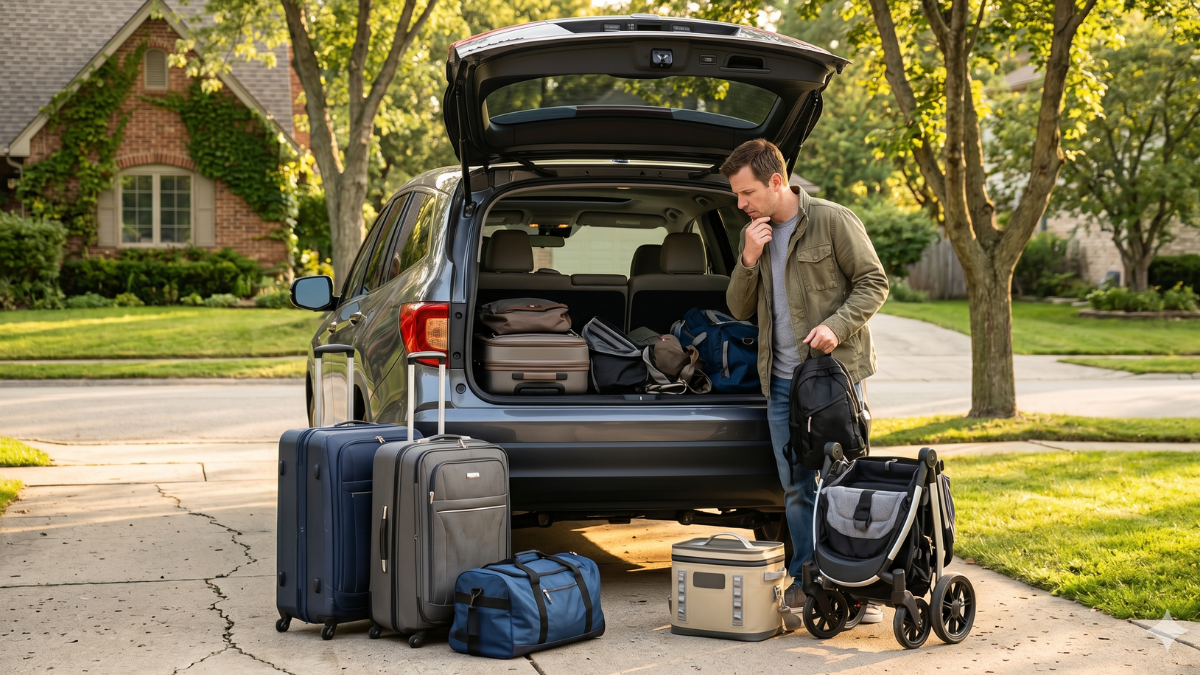
Two families plan a long weekend together. Four adults, two kids, one SUV. The vehicle has three rows of seats and the brochure claims over 80 cubic feet of cargo space. The math seems to work. Then the driveway loading begins.
Two parents in the front, two adults in the second row, two kids in the third — seven seats filled, six people, everyone seated. What remains behind the third row is the space where the entire trip’s luggage must live: every bag, every coat, the dog’s crate, the cooler, the stroller. On a Toyota Highlander, that space measures 16 cubic feet. On a Hyundai Palisade, it measures 19.1 cubic feet. On a Kia Telluride — the segment’s most popular choice — it measures approximately 21 cubic feet. These numbers mean something specific in terms of what fits. And what fits is considerably less than the families in the driveway have loaded from their front doors.
The midsize three-row SUV is not a bad vehicle. It is a misunderstood one. Buyers who do the right research confirm the cargo space behind the third row is smaller than the number looks. Buyers who do not make the same discovery in a parking lot at a rest stop, surrounded by bags that did not fit, two adults deciding who sleeps with what coat as a pillow.
Quick Takeaways
- The cargo space figure on a three-row SUV brochure is the maximum — measured with all seats folded; the figure that applies when all six or seven seats are occupied is the behind-third-row measurement, which is typically 16–23 cubic feet depending on the model
- Autoblog’s standardized luggage test — conducted with two checked-size roller bags, two carry-on roller bags, and one small overnight bag — found that behind an occupied third row, the Kia Telluride and Toyota Grand Highlander can fit all six bags (in the best-case configuration); the Toyota Highlander (standard, not Grand) fits only three
- A standard carry-on bag measuring 22 × 14 × 9 inches occupies approximately 2.7 cubic feet; six people traveling with one carry-on each would require 16.2 cubic feet — filling the smallest vehicles entirely and leaving nothing for shoes, a jacket, or food for the drive
- The Honda Odyssey minivan has 32.8 cubic feet of cargo space behind its third row with all seats occupied; the Kia Carnival has 40.2 cubic feet; both are larger behind the occupied third row than the best midsize SUVs are with the third row folded
- Weekend rental of a Honda Odyssey or Toyota Sienna typically runs $100–$200 per day at major rental companies — cheaper than the annual fuel and depreciation cost of buying a midsize SUV with a roof box to compensate for inadequate cargo space
- The decision is not “3-row SUV or minivan” in all cases — it depends on how often the third row is occupied simultaneously with significant cargo; for families who use all rows monthly, the minivan’s cargo advantage is material; for occasional third-row use, the SUV may be correct
What “80+ Cubic Feet” Actually Means
Every midsize three-row SUV advertises its maximum cargo volume: 86.7 cubic feet for the Hyundai Palisade, 89.3 for the Kia Telluride, 97.5 for the Toyota Grand Highlander, 96.6 for the Volkswagen Atlas. These are real numbers. They are also completely irrelevant for the specific scenario of six people traveling for a weekend with luggage.
The maximum cargo volume is calculated with every rear seat folded flat. It describes an empty cargo hauler, not a passenger vehicle on a road trip. The moment the third row is occupied — which is the entire premise of buying a three-row vehicle — that 80-something cubic foot figure collapses to the behind-third-row number, which ranges from 16 to 23 cubic feet across the mainstream midsize SUV segment.
The behind-third-row figure is the number that matters. It is the only figure that describes what is available for luggage when everyone is seated.
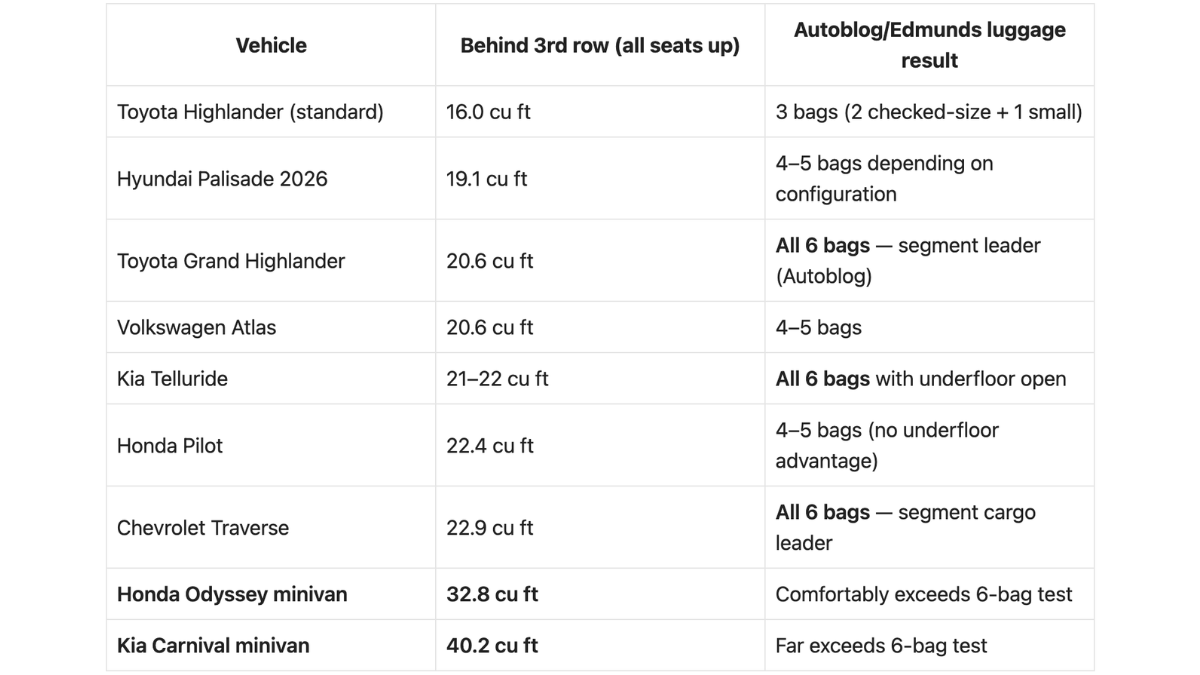
The top of the SUV range (Traverse, Grand Highlander, Telluride with underfloor) can fit six standard bags. The standard Toyota Highlander — the vehicle that gave rise to the “I need a three-row” conversation for millions of American families — cannot.
The Carry-On Arithmetic
Abstract cubic footage is useful for comparison but unintuitive for actual trip planning. Carry-on bags — the standard 22 × 14 × 9 inch cabin bag that fits overhead on most domestic flights — provide a relatable unit.
A standard carry-on occupies approximately 2.7 cubic feet. Six people each traveling with one carry-on require a minimum of 16.2 cubic feet of cargo space. That is: every cubic foot available in a Toyota Highlander, 85 percent of the Palisade, and 77 percent of the Telluride — before counting any shared items, the weekend cooler, or the dog that someone assumed would just sit in the back seat.
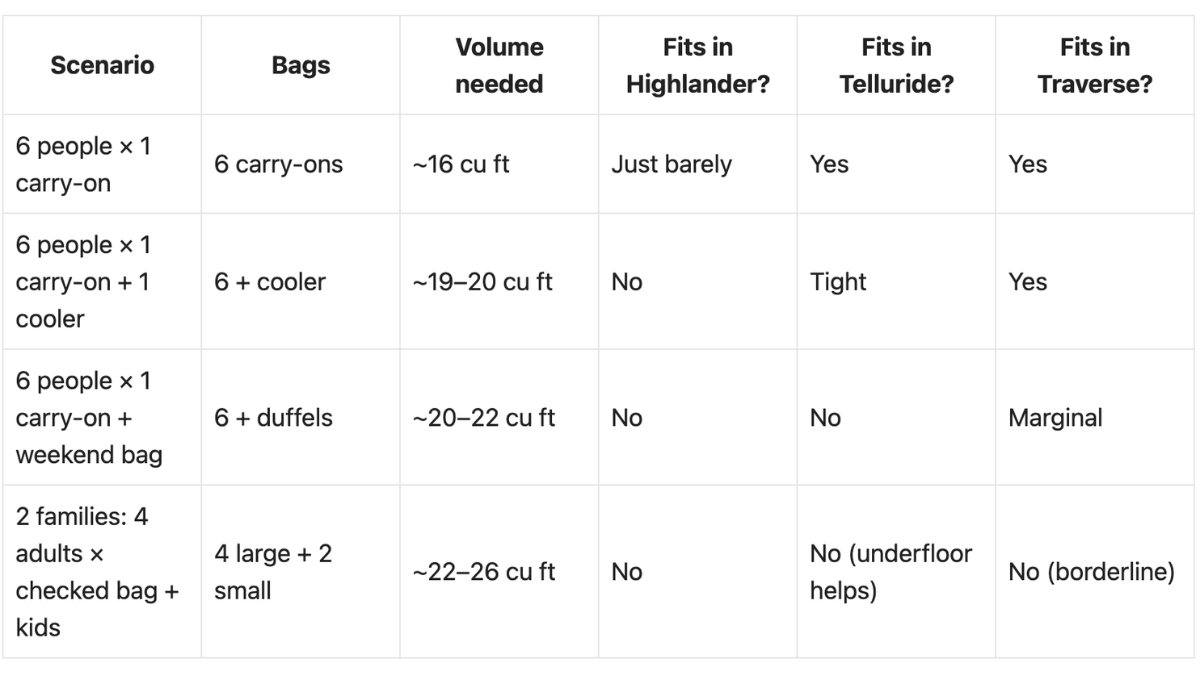
The practical threshold for a six-person two-family weekend trip with normal luggage is approximately 22–26 cubic feet of cargo behind the third row. Only the Traverse reliably clears this range among mainstream midsize SUVs. The Grand Highlander and Telluride reach it in their best configurations, with underfloor space used, third-row seatbacks at their most upright comfortable position, and bags specifically arranged for geometry rather than convenience.
Autoblog’s Traverse luggage test result is explicit: “The Traverse has the most cargo space behind its third row in the three-row crossover segment” — and even so, notes that the test bags nearly filled the space. The review also confirmed that a cooler fit, but “I was restricted to four bags and an awkward remaining space.” The Traverse is the best-in-class midsize SUV for this specific use case, and even it is marginal for six people with normal weekend luggage.
What Happens When It Doesn’t Fit
Three common solutions — each with a real cost.
Solution A: The roof box. A Thule Motion XT Large roof cargo box adds approximately 18 cubic feet of exterior cargo space and retails for $500–$700. Combined with the Telluride’s 21 cubic feet behind the third row, total cargo capacity reaches approximately 39 cubic feet — comparable to the Kia Carnival minivan’s behind-third-row figure, but at $600+ in box cost, 6–17 percent in highway fuel economy penalty from the added aerodynamic drag (→ see “The Factory Roof Rack Penalty” in this series), and the ongoing annual fuel cost of approximately $70–$150 from carrying the box’s crossbars even when not in use.
Solution B: The hitch cargo carrier. A hitch-mounted tray adds 8–12 cubic feet of external cargo capacity, causes significantly less aerodynamic drag than a roof box (→ see “Hitch-Mounted Cargo Carriers vs. Roof Boxes” in this series), and costs approximately $200–$400. Items carried on it are exposed to weather and require separate waterproofing. Not all midsize SUVs have the tow hitch receiver necessary to mount one without dealer installation.
Solution C: Leave bags behind. The most common real-world outcome on the first trip. The second-most-common outcome is re-purchasing the same item at the destination.
None of these solutions is obviously wrong. All of them represent costs — financial or logistical — that did not appear in the buyer’s mental model of what a “three-row family SUV” would enable.
The Minivan Comparison That Buyers Skip
The vehicle category that actually solves the six-people-plus-luggage problem is one that roughly half of families eliminate from consideration before they start shopping: the minivan.
Behind the third row with all seats occupied:
- Honda Odyssey: 32.8 cubic feet — 56 percent more than the segment-best Traverse
- Toyota Sienna: 33.5 cubic feet — 46 percent more than the Traverse
- Kia Carnival: 40.2 cubic feet — 76 percent more than the Traverse
These gaps are not marginal. The Odyssey carries six people and has more cargo space than the Traverse with the third row folded. The Carnival has more behind its occupied third row than the Chevrolet Tahoe — a full-size body-on-frame SUV — has behind its third row.
The gap is the product of fundamental geometry: minivan cargo floors extend from behind the third row to the tailgate at the same height as the floor of the second row when folded, creating a long, flat, uninterrupted loading surface. SUV cargo floors sit behind a third-row seat that intrudes into the space, at a height determined by the vehicle’s lift-over height, with a narrower opening width than a minivan’s wide-opening rear hatch.
U.S. News summarizes the structural advantage directly: “Even the largest full-size SUVs can’t match the size of a minivan’s cargo hold.” The comparison between a midsize SUV and a minivan on this metric is not competitive.
The Weekend Rental Calculation
For families who take two or three multi-family trips per year — the lake house weekend, the grandparents visit, the one extended road trip — a minivan rental is worth running through the math before a purchase decision.
Weekend rental scenario: Friday pickup to Monday return, four days, standard minivan rental.
Major rental company pricing for a Honda Odyssey or similar minivan: approximately $100–$180 per day at major U.S. markets, or $400–$720 for a four-day weekend. At this price, an annual three-trip rental budget is approximately $1,200–$2,200.
Compare this to the supplemental costs of owning a midsize SUV with a roof box for the same trips:
- Roof box initial cost: $500–$700 (amortized over five years: $100–$140/year)
- Annual fuel cost of crossbars alone (highway miles only): $70–$150/year
- Fuel economy penalty from roof box when loaded: 6–17% at highway speed, translating to approximately $150–$300 in additional annual fuel on trip miles
- Installation/removal time: approximately 30–45 minutes per trip
The rental-versus-supplement calculation is not always obvious in favor of renting — it depends heavily on how often the third row is actually occupied with full cargo. For families who use the third row with cargo twice a year, the supplemental cost of owning a crossbar and roof box system to compensate for insufficient cargo space is approximately $320–$590 annually — versus $800–$1,450 for two minivan rental weekends. Owning the SUV is more economical in this scenario.
For families who use the third row with cargo six or more times per year, the rental economics change: six minivan weekends at $400–$720 each = $2,400–$4,320 annually in rentals — significantly more than the annual supplement cost of the SUV accessories. At this frequency, buying the minivan directly makes financial sense.
The break-even point depends on frequency, rental market, and whether the family’s day-to-day driving also benefits from the minivan’s interior. For many buyers, the honest answer is that the three-row SUV was purchased for the three times per year it is genuinely needed, and a rental van on those occasions would have been the more economical solution to the specific problem.
Before the Next Purchase: Three Questions Worth Answering Honestly
1. How many times per year is the third row occupied at the same time as significant cargo?
Not how many times per year someone sits in the third row — how many times the third row has people in it and the vehicle also needs to carry luggage for the journey. Car pool pickups with two kids in the third row and empty seats elsewhere do not count. Weekend trips with all rows full and bags in the cargo area count. If the honest answer is fewer than four times per year, the economic case for a three-row purchase over a two-row plus rental is weaker than most buyers realize.
2. What is the cargo floor width of the specific vehicle?
Width matters as much as volume. A cargo area that is 22 cubic feet but narrow forces bags to be stacked vertically; a wider area of the same volume allows side-by-side placement. The Toyota Grand Highlander’s cargo floor is wider than any other midsize SUV tested by Autoblog — wider than the Chevrolet Tahoe and Ford Expedition in their testing. Width determines whether two large rolling bags sit side-by-side or fight for vertical space.
3. Can the vehicle be tested with the actual bags the family uses?
This is the single most reliable pre-purchase check. Bring the specific bags to the dealership, load the third row with adults and the cargo area with luggage, and close the liftgate. If it closes: problem solved. If it does not close: the vehicle requires supplemental cargo solution from day one.
U.S. and Canada Note
For Canadian families, the three-row SUV vs. minivan calculation has two regional dimensions worth noting.
First, winters in Ontario, Quebec, and the Prairie provinces make all-weather AWD meaningful. The Toyota Sienna is the only minivan currently offering AWD in the Canadian market, at a meaningful premium over FWD configurations. The Kia Carnival and Honda Odyssey do not offer AWD. For families in snow-belt regions who do the multi-family winter weekend trip — ski cabin, ice fishing, family Christmas — the AWD Sienna at 33.5 cubic feet behind the third row may be the correct answer, delivering both the cargo advantage of a minivan and winter capability.
Second, Canadian rental pricing for minivans tends to run higher than U.S. equivalent rates in markets like Toronto, Vancouver, and Calgary — $150–$250/day at peak times. At these prices, the annual rental calculation for three or more multi-family trips approaches $1,500–$2,250 CAD annually, tilting the economics further toward purchasing the right vehicle rather than supplementing the wrong one.
L/100 km note: The Kia Carnival Hybrid at approximately 9.0 L/100 km combined compares favorably to midsize three-row SUVs at 10.5–12.0 L/100 km, while carrying 40.2 cubic feet of cargo behind the occupied third row. On a 500-km round trip at $1.70/litre CAD, the Carnival Hybrid saves approximately $11–$17 CAD per trip in fuel versus a midsize SUV — while simultaneously solving the cargo problem rather than compensating for it.
SOURCES
- Edmunds/Autoblog Telluride cargo test: 21 cu ft includes underfloor space; best result requires removing cargo floor; when third-row reclined at comfortable angle, not all six bags fit without modification; underfloor opens additional capacity; test uses standardized 2 checked + 2 carry-on + 1 small overnight bags
- Autoblog Telluride luggage test: all bags fit with underfloor removed; without underfloor, biggest bag and one medium left behind; “worse than the Palisade and only slightly better than the Toyota Highlander”
- Autoblog Grand Highlander luggage test: all six bags fit behind raised third row; cargo floor “wider than every three-row crossover tested” including Tahoe and Expedition; new three-row crossover luggage test champion; no underfloor storage to expand capacity but wider floor compensates
- Edmunds Traverse cargo test: all bags fit; “Traverse has the most cargo space behind its third row in the three-row crossover segment”; cooler also fits but leaves limited additional space; Traverse beats Grand Highlander as segment leader when underfloor used; visibility concerns noted at near-ceiling stack height
- Autoblog Highlander standard luggage test: 16 cubic feet; only three bags fit with third row at passable recline angle; Highlander is smaller than all primary competitors
- Autoblog Telluride vs. Enclave/Traverse: Enclave/Traverse swallows all test luggage without fuss; Telluride hatch would not close with same bags; “The loss of 2.6 cubic-feet of space was indeed felt much harder than what it looks like on paper”
- Edmunds minivan comparison: Carnival Hybrid 40.2 cu ft behind third row; Sienna 33.5 cu ft; Odyssey 32.8 cu ft; “minivans offer more interior space per dollar than any three-row SUV”
- U.S. News: “even the largest full-size SUVs can’t match the size of a minivan’s cargo hold”; Honda Odyssey 155.8 cu ft maximum; Chevrolet Suburban 144.7 cu ft; midsize SUVs significantly smaller than minivans in cargo; Sienna AWD availability noted as differentiator