

The feature was supposed to be the restful part of the trip. Set the speed, set the following distance, let the car manage the Interstate. For hundreds of miles across the Midwest or through the rain-heavy Pacific Coast corridors, adaptive cruise control genuinely earns its keep — reducing the fatigue of manual throttle management while keeping a safe gap to the vehicle ahead.
Then a semi overtakes in the left lane. Its wake throws a curtain of spray across the windshield. The front-facing camera, positioned behind the glass, instantaneously loses its view of the road ahead. The radar sensor, which should see through water better than a camera, gets a confused reading from the wall of water droplets. And the vehicle brakes — hard, suddenly, for a second or two — in response to a hazard that does not exist.
The driver’s heart rate spikes. The car behind closes the gap unexpectedly. The ACC resumes. Nobody crashes. But nobody is less fatigued than before, either. The system that was supposed to reduce stress has just produced the highest-intensity stress event of the drive.
This is not a rare bug. It is a predictable, documented consequence of how ADAS sensors behave in conditions that are extremely common on North American highways.
Quick Takeaways
- In AAA’s controlled test simulating moderate-to-heavy rain, vehicles equipped with automatic emergency braking — the same sensor system used by adaptive cruise control — collided with a stopped vehicle 33 percent of the time at 35 mph; in dry conditions, the same vehicles produced zero crashes in the same test
- Lane-keeping assistance, which shares camera-based sensing with ACC, failed to maintain lane position in the same rain test 69 percent of the time — meaning the paired system that keeps the car centered in its lane is largely non-functional in wet conditions that also degrade ACC
- AAA’s Greg Brannon, director of automotive engineering: “Vehicle safety systems rely on sensors and cameras to see road markings, other cars, pedestrians and roadway obstacles. So naturally, they are more vulnerable to environmental factors like rain”
- The phantom braking event — an unexpected, sharp deceleration for an obstacle that does not exist — is physiologically equivalent to a near-miss scare: it produces a rapid cortisol and adrenaline spike that takes 20–40 minutes to fully resolve, increasing fatigue rather than reducing it
- Manufacturer guidance is explicit: ADAS Project documents that manufacturers “caution that adaptive cruise should not be used in heavy rain, snow, fog, or when road spray reduces visibility”
- The correct response: switch from ACC to standard cruise control in heavy rain, truck spray, fog, or when wipers are at maximum speed; standard cruise maintains the set speed without the braking logic that phantom-brakes on false sensor readings
How ACC Sees the Road — and What Rain Does to That Vision

Adaptive cruise control uses two primary sensing systems working in parallel: forward-facing radar and a windshield-mounted camera. Most mainstream ACC systems combine data from both — the radar provides distance and velocity information, the camera provides lane and obstacle context. The fusion of the two signals is what allows the system to distinguish between a concrete bridge abutment and the open road beyond it, between a stopped car and an overpass shadow.
Radar in rain: Automotive radar operates at millimeter wavelengths (typically 76–77 GHz) and can generally penetrate falling rain better than a camera can. This is radar’s primary advantage in wet conditions. However, two rain-related failure modes exist. First, if water accumulates on the radar’s radome — the plastic or painted bumper cover behind which the radar sits — the signal is attenuated and the effective detection range shrinks. Second, dense road spray from heavy trucks can create a return signal cluster that the radar interprets as a moving object. A semi truck throwing a 20-meter wall of rooster-tail spray at 60 mph creates a transient radar return that the system cannot always distinguish from the vehicle itself. The result: the ACC perceives an obstacle, closes the throttle, and applies the brakes.
The I-CAR industry documentation on ADAS sensor limitations is precise: “Most forms of precipitation, such as rain, snow, and ice, can blind the camera and block the radar. Direct sunlight may also make it difficult for the camera to see. A dirty windshield or bumper cover can block the camera’s or radar’s field of view.”
Camera in rain: The windshield-mounted camera — in most mainstream vehicles, this is the forward-facing camera positioned behind the glass near the rearview mirror — shares the driver’s visual field. When heavy rain reduces driver visibility, the camera’s field is degraded at the same rate or faster. Windshield wiper streaking, water droplets between wiper strokes, and the visual noise of heavy precipitation all degrade the camera’s ability to classify what it sees.
Critically, the two failure modes can occur simultaneously: rain attenuates radar range while degrading camera classification, leaving the sensor fusion algorithm with degraded data from both inputs. Under these conditions, the ACC’s decision logic can generate false obstacle detections — phantom braking events — or fail to detect real obstacles — the miss scenario that AAA’s test quantified.
The AAA Test: What the Numbers Actually Mean
The most precisely documented measure of ADAS performance in rain comes from AAA’s 2021 closed-course test, conducted in collaboration with the Automobile Club of Southern California’s Automotive Research Center. The methodology: simulated moderate-to-heavy rainfall was directed at the vehicle’s windshield using a precision spray nozzle while the vehicle approached a stationary obstacle (simulating a stopped vehicle in the lane ahead).
Results under moderate-to-heavy simulated rain:
- At 25 mph: 17 percent of test runs resulted in a collision with the stopped vehicle
- At 35 mph: 33 percent of test runs resulted in a collision
Under dry conditions in the same test configuration: zero collisions across all test runs.
The shift from 0 percent to 33 percent failure rate represents a complete change in the system’s operational profile. Under dry conditions, the test vehicles reliably avoided the obstacle. In wet conditions, one in three approaches at 35 mph resulted in a crash. Autoblog’s reporting on the AAA test noted: “You can extrapolate from there as to the dangers at highway speeds.”
The same test found that lane-keeping assistance failed to maintain lane position 69 percent of the time in wet conditions. This matters for ACC users because modern vehicles increasingly pair adaptive cruise with lane centering — the ACC manages longitudinal spacing while lane centering manages lateral position. When both systems are degraded simultaneously by the same weather event, the driver is relying on a system that can neither reliably brake for obstacles nor reliably stay in its lane.
One additional AAA finding is particularly important for drivers who use ACC in rain: in the test conditions that produced these failure rates, “some systems may provide an alert or deactivate in extreme situations; however, the conditions AAA tested under provided no such alert or warning.” The vehicle continued operating in ACC mode while its sensor performance had degraded to the point where it was colliding with stopped obstacles at 35 mph — without informing the driver.
The Physiology of Phantom Braking
The term “phantom braking” describes unexpected, hard deceleration initiated by ACC or automatic emergency braking in response to a sensor false positive — an obstacle the system detects but which does not exist, or an obstacle that poses no real collision risk at the current following distance.
For the driver, phantom braking is not merely surprising. It is a stress event at the physiological level.
Unexpected braking at highway speed — particularly when initiated by the vehicle rather than the driver — triggers an immediate startle response: the sympathetic nervous system activates, adrenaline and cortisol are released within seconds, heart rate and blood pressure spike, and the driver’s attention is involuntarily captured by the event. The experience is functionally equivalent to a near-miss scare: the body does not distinguish between “I almost hit something” and “the car suddenly stopped for no reason.” Both events trigger the same emergency response cascade.
The cortisol spike produced by an acute startle event takes approximately 20–40 minutes to metabolically clear. During this period, residual arousal can manifest as heightened anxiety, reduced patience, and — paradoxically — increased cognitive fatigue as the stress response taxes mental resources. A driver who experiences two or three phantom braking events during a 90-minute rain segment emerges from that segment more fatigued, not less, than they would have been from manual driving with standard cruise control.
This is the central irony of ACC in heavy rain: the feature that reduced fatigue during the dry portion of the drive increases it during the wet portion, through a mechanism most drivers have not encountered in any review of the feature.
The Volvo XC40 forum captures this owner experience directly: one driver reports “more than half a dozen phantom braking episodes” on a single 250 km highway run, describing several as “quite full on,” causing the driver to “smash the accelerator to get the car to speed back up again” — an active, high-stakes intervention that is the opposite of the passive supervision ACC is supposed to require.
When to Switch From ACC to Standard Cruise
The decision to disable ACC and switch to standard cruise control (or full manual driving) is one that manufacturer guidance, AAA, and Edmunds’ automotive editors all support in specific conditions. The practical framework:
Switch to standard cruise control when:
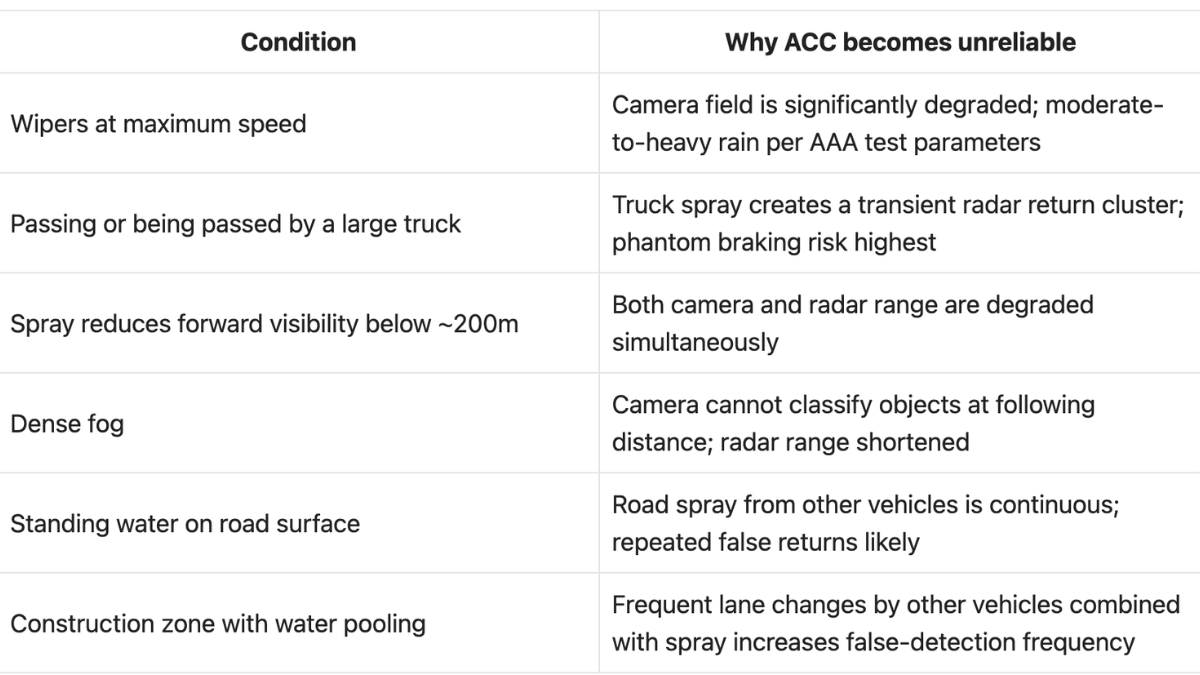
Standard cruise control maintains the driver-set speed using throttle only. It does not have brake authority — it will not decelerate below the set speed, and it will not phantom-brake. In the specific failure mode described here — heavy rain producing false sensor readings — standard cruise is not degraded by the rain at all, because it does not use the forward sensors for its primary function. The driver resumes responsibility for following distance and obstacle avoidance, which in heavy rain is exactly where that responsibility belongs.
Edmunds editor Will Kaufman’s guidance, cited by AAA’s Via publication: “If you’re worried about how close your car is following, or concerned about poor road or weather conditions, turn off your adaptive cruise and drive in a way you feel safe.”
Switching back to ACC is appropriate when rain intensity drops below wiper maximum, when road spray from trucks clears, or when the weather window closes and dry conditions return. The switch takes one button press in either direction and is faster than any other dashboard adjustment.
What Drivers Should Check Before a Rain-Heavy Highway Drive
Three maintenance items that directly affect ACC performance in wet conditions:
1. Wiper blade condition. The windshield-mounted ADAS camera sees the same field the driver sees. If wiper blades are leaving streak bands or skipping across the windshield, the camera’s view is degraded even between rain-event response cycles. Consumer Reports and AAA both recommend annual wiper replacement in hot climates or high-UV environments. If blades squeal, streak, or skip, replace before a long rain-heavy drive — for the driver’s visibility and for the camera’s. Worn blades that streak can trigger false readings in camera-dependent systems even in relatively light rain.
2. Front bumper cover cleanliness. The radar sensor sits behind the front bumper cover or grille insert. Road film, mud, and debris accumulate on the cover’s inner surface over time. This does not wash off in rain — it is already on the interior surface, between the radar and the road. I-CAR’s technical documentation notes: “A dirty windshield or bumper cover can block the camera’s or radar’s field of view. Dead bugs, dust, and mud may need to be removed for the collision warning/braking system to work properly.” In spring and summer, insects accumulate rapidly; a pre-trip wipe of the lower bumper area with a microfiber cloth removes the most common front-sensor obstruction.
3. Radar-blocked dashboard warning. Most vehicles with ACC will display a “radar blocked” or “ACC unavailable” warning on the instrument cluster when the radar’s signal is sufficiently degraded. Knowing where this warning appears on the specific vehicle — and recognizing it immediately rather than ignoring it as a transient notification — is the fastest way to know the system has self-identified a problem. Once this warning appears, ACC should be switched to standard cruise immediately; the system is already telling the driver its sensor input is compromised.
The Specific Highway Segments Where This Matters Most
Phantom braking risk from rain and road spray is highest in three conditions that concentrate on specific route types:
U.S. Interstate routes with heavy truck concentration: I-5 through Oregon and Washington (near-continuous rain from November through April), I-90 through Montana and Idaho in rain seasons, I-70 through the Ohio Valley. High truck density on these routes means constant spray exposure when following at highway speed behind semis. The truck spray wake extends 30–60 meters behind a loaded semi at 65–75 mph, covering the entire length of the following interval that ACC is trying to manage.
Trans-Canada Highway rain corridors: Highway 1 through the Lower Mainland and Fraser Valley in British Columbia, and through Ontario’s Great Lakes corridor, both receive consistent highway-speed rain that produces the exact conditions of the AAA test. The combination of loaded trucks heading to Pacific coast ports and sustained rain from October through April makes this one of the highest phantom-braking-risk corridors in North America.
Post-storm construction zones: After heavy rain events, construction zones with water pooling and frequent vehicle lane changes create compound ACC confusion: vehicles entering the detected zone from adjacent lanes, changing relative speeds as they merge around equipment, and road spray from puddled areas all generate simultaneous sensor events. This is the condition where switching ACC off fully — not to standard cruise but to manual driving — is most appropriate.
SOURCES
- AAA / Automobile Club of Southern California ARC: closed-course test with simulated moderate-to-heavy rainfall; AEB in rain: 17% crash rate at 25 mph, 33% crash rate at 35 mph; dry conditions: 0% crashes; lane keeping assist: 69% lane departure rate in rain; no automatic alert or deactivation under test conditions; 2020 Buick Enclave, Hyundai Santa Fe, Toyota RAV4, VW Tiguan tested; Greg Brannon quote on sensor vulnerability to rain
- AAA/Via: Edmunds editor Will Kaufman: “Rain, snow, heavy fog, and even bright, direct light can obstruct or confuse the sensors”; “if you’re worried about how close your car is following, or concerned about poor road or weather conditions, turn off your adaptive cruise and drive in a way you feel safe”; windshield washer fluid incident causing ADAS failure described by first-person Subaru Impreza driver
- ADAS Project: “manufacturers caution that adaptive cruise should not be used in heavy rain, snow, fog or when road spray reduces visibility — moisture or dirt can block the radar sensor and camera”; ACC can be ineffective in fog; recommendation to switch to manual control in slippery conditions
- I-CAR: “most forms of precipitation, such as rain, snow, and ice, can blind the camera and block the radar”; “a dirty windshield or bumper cover can block the camera’s or radar’s field of view — dead bugs, dust, and mud may need to be removed”; radar behind bumper cover can be attenuated by accumulated material
- Autoblog: AAA rain test coverage; “you can extrapolate from there as to the dangers at highway speeds” — appropriate extrapolation from 25 and 35 mph test results to higher speeds
- Automotive World: “cameras work by passively observing light reflected or emitted by the surface environment — changes that block light from reaching the camera will degrade or render them non-functional — these obscurations could be caused by rain or snow in the air”; “radar can transmit and receive radio waves through falling snow and rain with less loss, however current radar technologies are still extremely limited and are sensitive to ice or snow build-up”
- Volvo XC40 forum: documented owner experience of “more than half a dozen phantom braking episodes” on 250 km highway run; “a couple of them were quite full on” requiring driver to “smash the accelerator”; similar Mercedes-owning driver reports; attributed as owner community documentation