
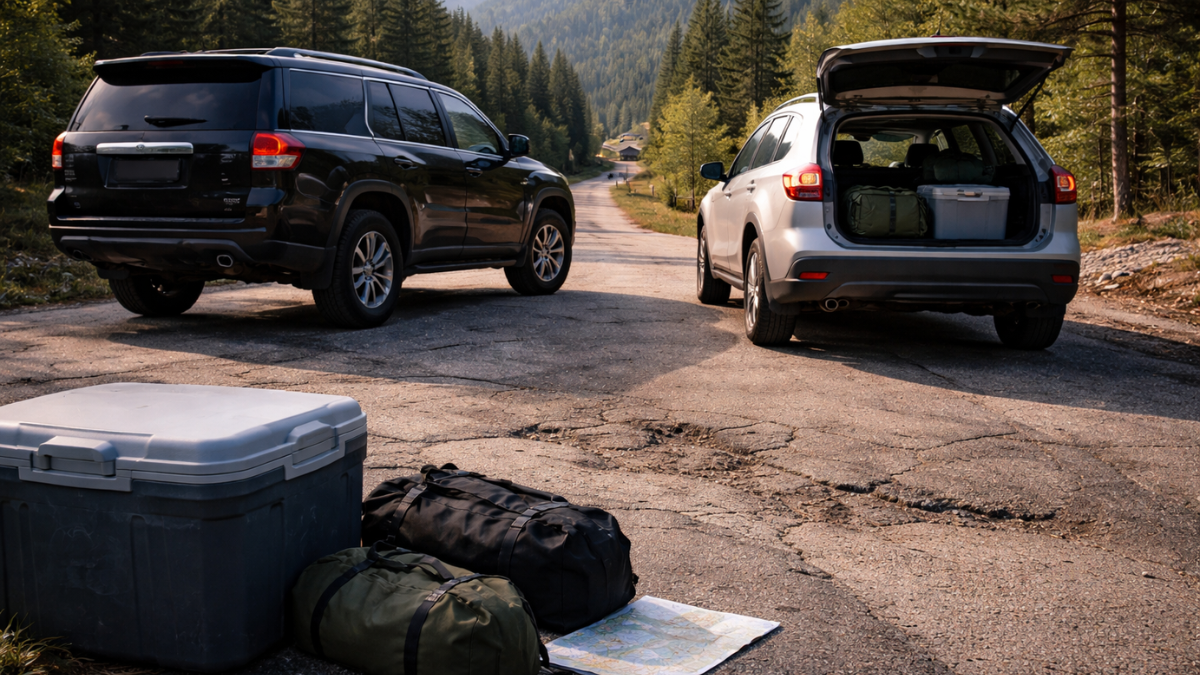
Truck-based toughness still sells hard in 2026. It also gets expensive fast when the trip is mostly pavement, potholes, parking lots, and one rough cabin road at the end. Edmunds’ latest Chevrolet Tahoe review says the body-on-frame Tahoe has clear strengths over unibody SUVs in towing, hauling, and off-road use, but it also spells out the trade: those same truck bones come with drawbacks versus more popular crossovers. That is the real travel question now. At what point does old-school toughness stop helping and start making the weekend noisier, thirstier, and more annoying than it needs to be?
Quick takeaways
- Body-on-frame still makes sense when towing, repeated rough-road use, or genuinely heavy-duty weekend work are part of normal life.
- Crossovers win more often when the real trip is highway miles, potholes, parking, loading groceries and coolers, and one easy gravel road at the end.
- The cost gap is not imaginary. AAA’s 2025 Your Driving Costs study lists 83.89¢ per mile for a medium SUV versus 68.53¢ for a compact SUV and 66.11¢ for a subcompact SUV.
- The ride and noise tax shows up faster than buyers expect. Car and Driver says the current 4Runner remains a task to daily drive and that ride quality on pockmarked pavement is mediocre at best.
- The wrong choice gets exposed on cabin weekends. If the road is 95 percent pavement and 5 percent gravel, a truck-style SUV can be solving the wrong problem.
What the old-school toughness still buys you
There is a reason body-on-frame SUVs are not dead.
A traditional truck-based SUV still does three things better than most crossovers:
1) Towing and hauling
Edmunds says the 2027 Chevrolet Tahoe can tow and haul much more than the slightly smaller Chevrolet Traverse. Toyota’s 2026 4Runner materials say the latest 4Runner can tow up to 6,000 pounds. If the weekend means a real trailer, a boat, or repeated heavy loads, this is not fake macho marketing. It is a real difference.
2) Low-speed rough-road confidence
This is where old-school toughness earns its keep. A body-on-frame SUV is usually the better answer for repeated rough access roads, more serious off-pavement driving, and the kind of use where underbody durability and tougher hardware actually matter.
3) Heavy-duty feel under load
A full-size truck SUV or tougher midsize body-on-frame SUV often feels less bothered by:
- a full cabin,
- coolers and gear,
- a trailer tongue,
- and rougher approaches at the destination.
That part is real. The problem is how often many buyers actually use it.
Where it starts to stop making sense
This is the part brochures skip.
The same body-on-frame construction that helps with towing and rough use can become a tax on the 90 percent of miles that are less dramatic.
1) Cabin noise and daily-driver friction
Body-on-frame SUVs are often bigger, taller, and heavier. That can mean more road noise, more truck-like responses, and more of that “big thing doing small errands” feeling.
Car and Driver’s current 4Runner coverage puts this in blunt road-trip language. The magazine says the new 4Runner remains a task to daily drive, describes it as large, heavy, and ponderous, and says ride quality over pockmarked pavement is mediocre at best. That is exactly the kind of line that matters for a cabin weekend because most of the route is not rock crawling. It is patched pavement, expansion joints, and two-lane highways.
2) Parking and placement stress
A body-on-frame SUV can still be the right answer and still be annoying in town.
That shows up as:
- wider turns,
- more “park farther away” behavior,
- more mirror-checking in tight lots,
- and more mental load at trailheads, lodge lots, and grocery stops.
For a lot of weekend travelers, this is the first place old-school toughness starts to feel like overkill.
3) Cost per mile
AAA’s 2025 numbers are useful here because they frame the ownership tax in broad categories. A medium SUV comes in at 83.89¢ per mile. A compact SUV sits at 68.53¢, and a subcompact SUV at 66.11¢.
That does not mean every body-on-frame SUV equals a medium SUV and every crossover equals a compact. It does show the direction of the cost curve: bigger, heavier utility usually costs more, and the gap is big enough to matter when weekends repeat.
The crossover case is stronger than enthusiasts like to admit
Crossovers win this argument more often because the average weekend is less dramatic than the average SUV ad.
The easy example: Honda CR-V

Edmunds says the 2026 Honda CR-V has a smooth and comfortable ride, easy-to-use tech, and a roomy interior. Honda’s own CR-V materials highlight a low, wide cargo opening and up to 76.5 cubic feet of cargo space. That is what a lot of real travelers need:
- easy loading,
- less step-up into the cabin,
- cleaner road manners,
- and enough cargo space to avoid roof-box workarounds.
A crossover like the CR-V does not win the fantasy. It wins the actual Friday.
The bigger family example: Chevrolet Traverse

Chevrolet says the 2026 Traverse offers up to 98 cubic feet of cargo space. Edmunds says the 2026 Traverse is a solid pick among three-row crossover SUVs and calls out its class-leading cargo space.
That is an important second-layer point. The family buyer who thinks “I need a tough body-on-frame SUV because I need space” may be solving the wrong problem. A big crossover can deliver the space, easier loading, and easier road manners without truck-SUV penalties.
Cabin trips are where the mismatch gets obvious
This is the most roadmapmag part of the article.
A lot of “rugged” buyers are not really driving off-road. They are doing:
- two and a half hours of highway,
- one bumpy county road,
- a few potholes near the town,
- maybe a gravel driveway at the end.
That is not nothing. But it is also not the same as living on rough roads or towing every other weekend.
For this kind of trip, the crossover often wins because it keeps the whole day calmer:
- less noise,
- easier parking,
- easier loading,
- less fuel guilt,
- and fewer moments where the SUV feels like too much machine for too little problem.
That is when old-school toughness stops making sense. Not when it loses all value, but when the trip pattern stops justifying the trade.
When body-on-frame still clearly wins
This should not read like a blanket takedown.
Body-on-frame still makes more sense when:
- towing is frequent and real,
- the route regularly includes rough access roads,
- ground clearance and toughness are used, not imagined,
- the SUV carries heavy loads often enough to justify the weight and size.
A Tahoe towing a camper is using the right tool.
A 4Runner climbing repeated rough approaches is using the right tool.
A body-on-frame SUV doing suburban errands, one summer cabin weekend, and a few potholes is much closer to a debate.
What this means in the U.S. and Canada
This works on both sides of the border because the pattern is the same even if the roads and fuel prices vary.
In the U.S., the mismatch often shows up as:
- long highway runs,
- bigger gas bills,
- and oversized vehicles in crowded parking.
In Canada, the same question lands with a little more weather and rough-road relevance in some regions, but the core trade is unchanged:
- if the SUV spends most of its life on pavement,
- the pavement manners matter more than the truck mythology.
That is why the crossover keeps winning the city-to-cabin test for a lot of people.
What drivers should check before buying
1) Count the real rough-road miles.
Not the imagined ones. The actual ones.
2) Look at towing honestly.
If there is no trailer, towing argument, or heavy load in your life, that matters.
3) Test broken pavement, not just smooth roads.
That is where truck-like harshness gets obvious.
4) Do the loading test.
A lower cargo floor and easier liftgate opening can matter more than off-road stance on a family weekend.
5) Think about the whole route.
If the road is mostly highway with one gravel stretch, buy for the 95 percent.
Bottom line
Body-on-frame SUVs still make sense when the toughness gets used. That part has not changed. What has changed is how visible the tradeoffs feel now that fuel, parking, road noise, and loading friction matter more to everyday travel. Edmunds’ Tahoe review still credits truck-based SUVs with towing and off-road strengths. Car and Driver’s 4Runner coverage shows the road-manners tax clearly. And modern crossovers like the CR-V and Traverse keep getting better at the exact jobs many buyers used to think required old-school hardware. If the trip is mostly pavement with one rough ending, the tougher SUV may be solving the wrong problem.