
You drove the route in daylight and it was fine. Tonight, on the same stretch of unlit highway between town and the campsite, something feels different. Your eyes keep working to pull detail out of the dark ahead. The pool of light in front of the car seems shorter than it should be. A reflective sign appears and you find yourself tensing slightly earlier than you used to on this road. By the time you arrive, two hours after dark, you are more tired than the drive warrants.
You are not losing your night vision. Your headlights are losing their job.
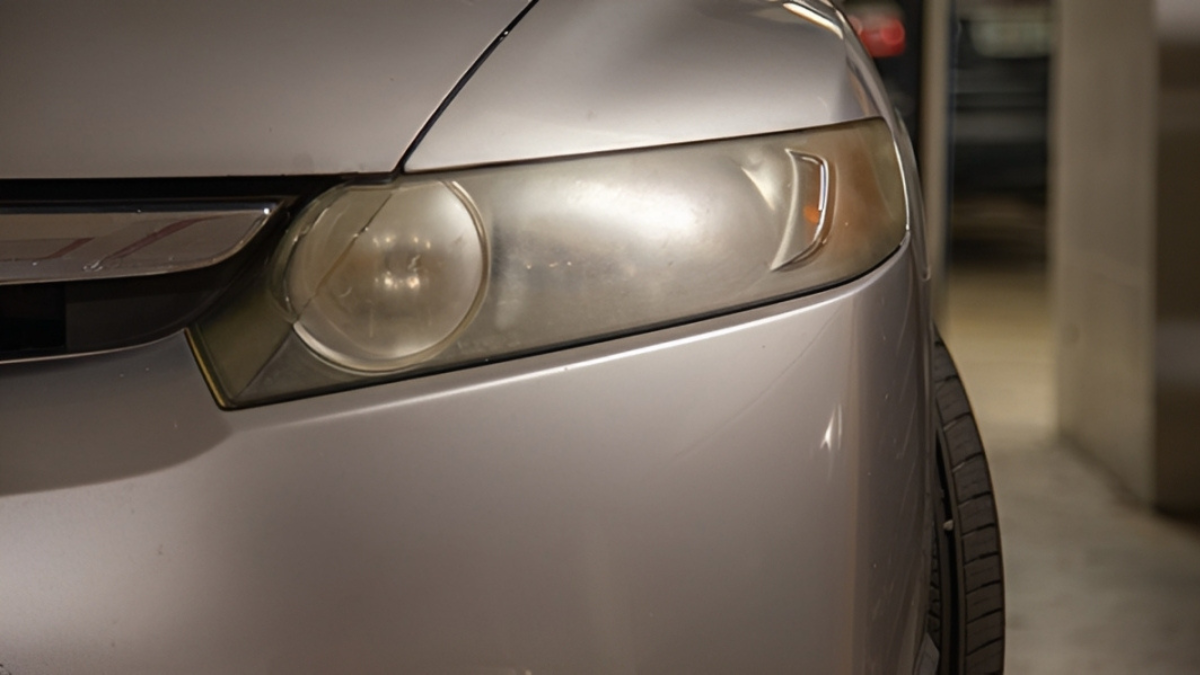
Most families who buy five-to-seven-year-old SUVs for road trips buy them in daylight, inspect the interior, check the tire tread, and take a brief test drive on a well-lit street. The headlight lenses — round or swept polycarbonate covers over the bulb assembly — look fine. Slightly hazy, perhaps. A little yellow in direct sunlight. Nothing alarming. What nobody measures at point of sale is how much of the light those lenses are now blocking.
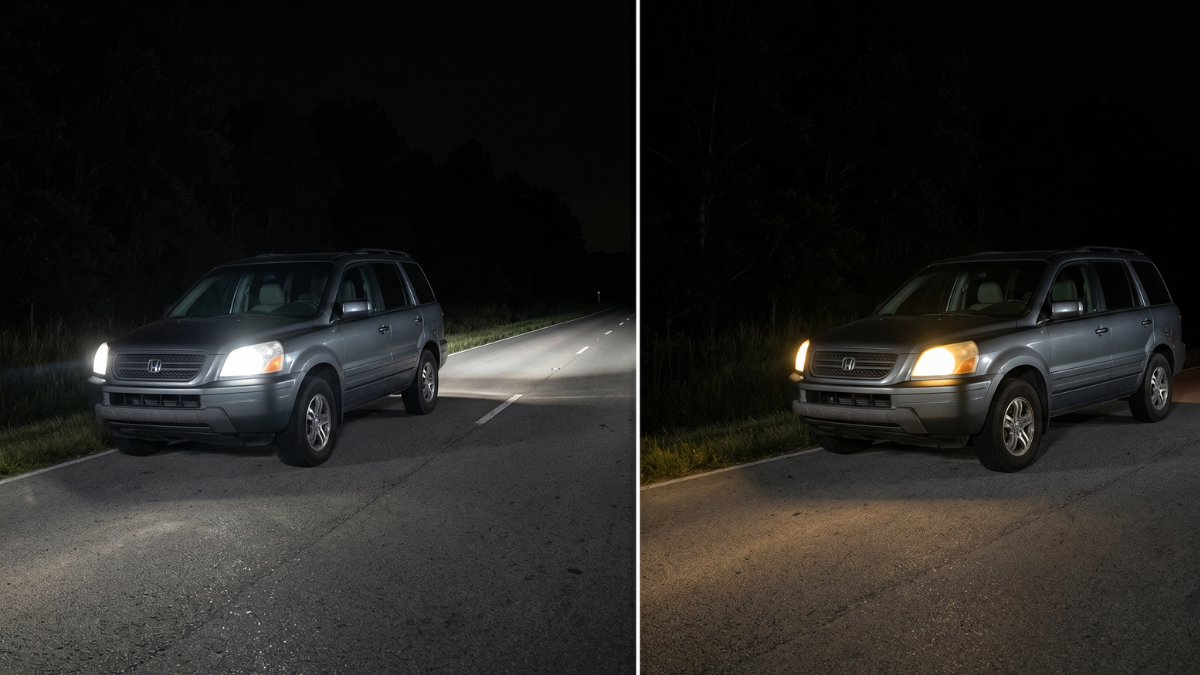
According to AAA laboratory testing, clouded and yellowed headlights on a vehicle approximately 11 years old produced only 22 percent of the light output that new headlights produce, tested to the same Federal Motor Vehicle Safety Standard 108 criteria used for factory certification. A headlight giving 22 percent of its original output is not a slightly dimmer headlight. It is a headlight that has functionally failed — still on, still legal in appearance, but delivering less than a quarter of the light the driver expects.
Quick Takeaways
- AAA laboratory testing of headlights from vehicles approximately 11 years old found they produced only 22 percent of the light output of new headlights when tested to Federal Motor Vehicle Safety Standard 108 — meaning deteriorated lenses can reduce usable road illumination by up to 78 percent
- The factory UV protective hard coat on polycarbonate headlight lenses typically begins failing within 3 to 5 years of exposure; the yellowing and hazing that follows is not cosmetic — it scatters the beam and reduces the reach of the light pattern on the road
- Consumer Reports confirms: “Drivers need a minimum of 300 to 350 feet to see, react, and brake for something in the road when traveling at 60 mph. If headlight illumination drops to 20 percent of original brightness, visibility could drop enough to make night driving riskier than it already is.”
- At 60 mph with a 1.5-second average reaction time, the driver has already traveled approximately 132 feet before the foot reaches the brake — leaving less than 200 feet of braking distance to avoid a deer, a stopped vehicle, or road debris the dim headlights barely revealed
- The cost options range dramatically: DIY restoration kit, $15–$30 (results last approximately one year, restores roughly 70 percent of original output per AAA); professional restoration, $75–$150 per pair (lasts 1–3 years with UV coating, similar light recovery); OEM replacement assemblies, $300–$700+ per headlight (restores to 100 percent; AAA recommends replacement as the most effective option)
- Used SUV buyers should inspect headlights in daylight by looking at the lenses at an angle: any visible milky haze, yellow discoloration, or surface crazing (fine cracks) means the factory UV coating has failed and light output is already measurably reduced
What Polycarbonate Does, and What UV Does to It
Glass headlights were replaced by polycarbonate plastic in the late 1980s and early 1990s across most passenger vehicle production. Polycarbonate is lighter, shatter-resistant, and mouldable into the complex curved geometries that modern headlight design requires. It is also, in its raw state, vulnerable to ultraviolet radiation in a way glass is not.
To manage this vulnerability, manufacturers apply a thin UV-resistant hard coat to the outer surface of each lens at the factory. This coating is typically 8 to 18 microns thick — roughly the diameter of a red blood cell — and is applied in a cleanroom and UV-cured. It is the only barrier between the polycarbonate and the sun. ECP Industries’ automotive materials documentation notes that this factory coating typically lasts no more than three years before oxidation begins; in high-UV climates (the U.S. Southwest, Florida, the California Central Valley, southern Ontario in summer), the timeline shortens.
When UV radiation penetrates the failed or worn coating and reaches the polycarbonate below, it begins breaking polymer chain bonds through a process called photo-oxidation. The molecular chains fragment; the surface develops micro-cracks; the originally transparent material becomes first milky-white and then progressively yellower as the oxidation products absorb and scatter light. What the driver sees as a cosmetic flaw — yellowing, haziness — is a physical change in the optical properties of the material: instead of transmitting light efficiently in a controlled beam, the lens now scatters light in all directions.
The automotive surface repair documentation from I-CAR (the Inter-Industry Conference on Auto Collision Repair) notes: “Most forms of precipitation, such as rain, snow, and ice, can blind the camera and block the radar. Direct sunlight may also make it difficult for the camera to see. A dirty windshield or bumper cover can block the camera’s or radar’s field of view.” The same document specifically addresses headlight lens integrity as a safety item distinct from cosmetics.
The light scattering from a degraded lens is not simply dimmer — it is disorganized. The headlight reflector and optics are designed to produce a specific beam pattern: a defined cutoff on the horizontal to avoid blinding oncoming drivers, and a directed illuminated zone ahead. When the lens scatters light instead of transmitting it, the beam pattern degrades. Light that should travel 250 to 300 feet down the road center instead scatters upward (glare for oncoming drivers), sideways, or into the road surface close to the vehicle — bright at 50 feet, essentially dark at 200 feet.
The AAA Number: 22 Percent
The most rigorously documented measurement of degraded headlight output comes from an AAA study conducted in 2018 at an accredited automotive headlamp testing laboratory, using headlight assemblies from two popular sedans approximately 11 years in age. Testing was conducted to FMVSS-108 standards, the same federal criteria used to certify new vehicle headlights. The results were measured against new headlights to quantify the performance reduction.
AAA’s finding: “Deteriorated headlights, when used on low beam, provided just 22 percent of the amount of light a new headlight does when operating at full capacity.”
Consumer Reports summarized the safety implication in the same month: “Driving at night with headlights that produce only 20 percent of the light they did when new, which is already subpar, is a real risk drivers shouldn’t take.”
Two contextual points make this number more significant than it appears on its own.
First, AAA’s separate research on headlight adequacy found that even new halogen headlights on low beam may only safely illuminate the road at speeds up to approximately 40–50 mph. The consumer expectation that low-beam headlights provide safe visibility at 65–70 mph on an unlit highway overstates what new headlights actually deliver in controlled testing. Deteriorated headlights at 22 percent of new output reduce this already marginal condition further.
Second, the 78-percent reduction in light output is not proportional to a 78-percent reduction in the visible distance of the beam. Because the degraded lens scatters light rather than focusing it, the distance at which an obstacle can be detected falls faster than the light output percentage would suggest. The useful illuminated range — the distance at which a driver can see and recognize an obstacle clearly enough to react — collapses at a rate disproportionate to the raw lumen reduction.
The Deer Scenario: Why Dim Headlights Change the Math at 60 MPH
Night driving creates a specific mechanical problem for stopping distance that is often described in driver’s education but rarely calculated precisely for the conditions a road trip driver actually encounters.
At 60 mph, the average driver’s reaction time — the interval from perceiving a hazard to beginning to press the brake — is approximately 1.5 seconds. During those 1.5 seconds, the vehicle travels approximately 132 feet. After the driver’s foot reaches the brake, the vehicle’s braking distance on dry pavement adds another 140–175 feet. Total stopping distance at 60 mph: approximately 300 feet under ideal conditions.
Standard low-beam headlights in good condition illuminate approximately 150–200 feet ahead. High beams extend this to approximately 350–400 feet. Even with functioning high beams, the stopping distance at 60 mph (300 feet) is within the outer range of what the headlights reveal — and many drivers do not run high beams when approaching curves, oncoming headlights, or when following another vehicle.
When headlights are producing 22 percent of their original output, the effective illuminated range at which the driver can actually identify an obstacle — not just see a vague shape, but recognize what it is and begin reacting — shrinks significantly. An obstacle at 150 feet that would have been clearly visible to a driver with full-output headlights may be only marginally perceptible with degraded headlights. By the time the driver acts, 132 feet of that margin is already spent on reaction time alone.
A peer-reviewed study in Transportation Research Part D on nighttime driver detection of wildlife (ScienceDirect, 2023) found that high-beam headlight use increased deer detection distances by approximately 21 meters compared to low beams, and that the time spent driving (fatigue, progressive darkness adaptation degradation) reduced detection distances by roughly 0.7 meters per minute. The study’s headline conclusion: “Most drivers could not detect wildlife at safe distances to avoid a collision.” This finding was produced with functioning headlights. Degraded headlights compound every variable in that calculation.
AAA’s director of automotive engineering, Greg Brannon, in the original headlight study: “Driving at night with headlights that produce only 20 percent of the light they did when new, which is already subpar, is a real risk drivers shouldn’t take, especially when there are convenient and inexpensive solutions that can dramatically improve lighting performance.”
The wildlife detection study’s practical implication for deer-country road trip routes — the Upper Midwest, the Appalachians, the Canadian Shield through Ontario and Quebec, the Pacific Northwest — is direct: the combined effect of marginal stock low-beam headlights, faded polycarbonate lenses, and driving into the 10 PM–2 AM period when deer movement peaks creates conditions where the stopping-distance math no longer works.
The Fatigue Connection: Why Your Eyes Work Harder Than You Realize
The driver fatigue experienced after a night highway run with degraded headlights is not imaginary, and it is not age-related. It is a documented physiological consequence of operating under reduced contrast and luminance conditions for an extended period.
A 2002 study cited by the Association for the Advancement of Automotive Medicine documented that increased processing time occurred as contrast and luminance were decreased for nighttime driving tasks. The “processing time” in question is not a dramatic response — it is the milliseconds added to the detection, identification, and decision phases of each observation cycle. Over two or three hours of driving, these milliseconds compound into sustained cognitive load that accelerates the rate of fatigue relative to daytime driving at equivalent speeds.
The mechanism is pupil load. The eye continuously adjusts pupil diameter to optimize the image reaching the retina. In low-light conditions with inadequate headlights, the pupil dilates to gather more light — maximizing its own aperture — while the visual cortex attempts to extract detail from an image that is both dim and scattered (because the degraded lens scatters light rather than focusing it). This combination of maximum pupil dilation and processing a low-contrast, diffuse scene is more cognitively demanding than processing a well-illuminated scene, and the effort is sustained for every second of the drive.
The driver does not perceive this as effort in the way they perceive the effort of mental arithmetic or sustained attention to a complex conversation. It registers as a general tiredness that arrives earlier in the drive than expected, a tendency to keep the eyes moving more than usual, and an awareness that the road feels like it requires more watching than it did in daylight. After the trip, the driver often attributes this to the late hour or general fatigue rather than to the SUV’s 2018 headlight assemblies.
The Cost Options: What Actually Works and What It Costs
Option 1: DIY restoration kit ($15–$30)
Consumer Reports has tested multiple headlight restoration kits and found that “even the poorest performer of the bunch can dramatically improve light output depending on how badly the lenses are weathered.” The critical limitation is durability: CR’s testing found that many restored lenses had begun to haze over again within eight weeks. A year is a typical useful life for a DIY kit restoration without a professional-grade UV topcoat.
AAA’s testing of restoration methods found that both professional and DIY restoration returned light output to approximately 70 percent of new headlight output. The kit approach restores significant function — from 22 percent to roughly 70 percent — but the restoration is temporary, and the process requires care. Sanding with progressively finer grits, applying compound, polishing, and then sealing with a UV topcoat takes approximately one hour for both headlights, with each step requiring accuracy to avoid scratching the surrounding paint.
Car Talk’s automotive editor, citing AAA testing: “In some AAA testing, we have found that cleaning the stock lights can restore as much as 70% of the original headlight effectiveness.”
Option 2: Professional restoration ($75–$150 per pair)
A professional restoration uses industrial sanding equipment, multi-stage wet sanding with finer grits than most DIY kits include, and commercial-grade UV sealants or ceramic coatings that bond more durably to the polycarbonate than the topcoat wipes included in retail kits. A quality professional job — multi-stage sanding, machine polishing, commercial UV coating — typically lasts one to three years before the lenses require retreatment.
The light output result is approximately the same as DIY (back to roughly 70 percent of new output), but the durability advantage means the cost-per-year of maintained clarity is often lower than repeated DIY applications. Heading into a summer that includes one or more multi-day road trips, a $120 professional restoration two weeks before departure is a reasonable pre-trip safety investment.
Option 3: OEM replacement assemblies ($300–$700+ per headlight)
AAA’s recommendation is explicit: “Replacing headlights with original equipment manufacturer parts is the most effective method to restore light output back to 100 percent.” Aftermarket assemblies also performed well in AAA’s testing, restoring light output to 83–90 percent of new output. Both replacement options eliminate the degraded polycarbonate entirely rather than partially removing it. Neither can return a restored lens to full output because sanding removes material progressively — each restoration leaves the remaining polycarbonate slightly thinner.
For a used SUV already showing moderate-to-severe headlight degradation — significant yellowing, visible crazing (surface micro-cracks), or haze that extends to the inner surface of the lens — replacement is the correct option. The cost is substantial: OEM assemblies for a mid-2010s Toyota Highlander, Honda Pilot, or similar run $500–$800 each at dealer prices. Quality aftermarket assemblies run $150–$400 each. Installation adds $50–$150 per side at most shops.
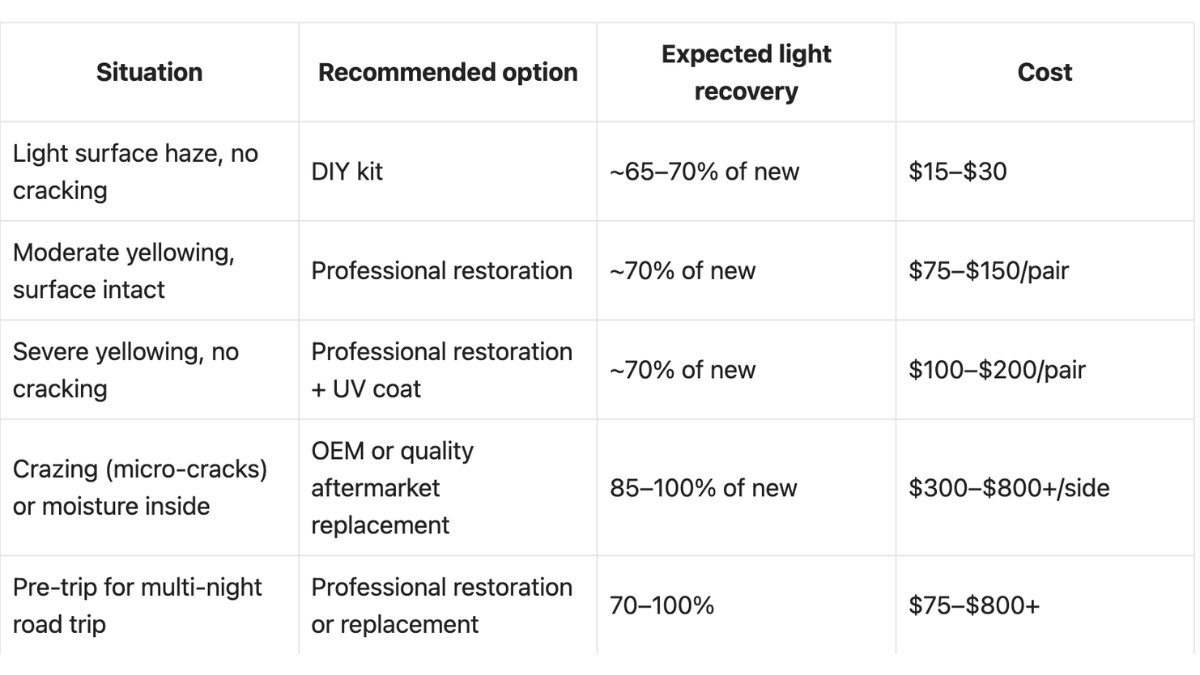
The threshold for choosing replacement over restoration: if the lens has deep crazing (visible surface cracking, not just yellowing), or if the inside surface of the lens is hazy (indicating moisture intrusion into the assembly), restoration will not be fully effective. If the lens is uniformly yellowed but smooth and crack-free, restoration is appropriate.
Decision table:
The Used SUV Pre-Purchase Inspection
A headlight condition check adds approximately three minutes to any used vehicle inspection and requires no tools.
Visual inspection in sunlight: Stand in front of the vehicle with the sun behind you and look directly into each headlight lens. New or recently restored lenses are perfectly clear; the reflector behind them is sharply visible. A hazy lens shows a milky-white diffusion. A yellowed lens shows amber-to-brown coloration. Visible cracks or crazing appear as a fine network of lines across the surface. If any of these are visible, the lens has degraded beyond the factory coating failure stage.
Angle inspection: Move to one side and look at the lens at a shallow angle. Surface oxidation that appears subtle head-on becomes more obvious in oblique light as a matte texture or uneven sheen.
Check inside the lens: If possible, look through the lens at the reflector inside from a low angle. A clear lens shows a sharp, reflective surface behind it. A lens with internal moisture intrusion (a failure of the assembly seal) shows a fogged interior that restoration cannot address.
Night check if possible: If the purchase inspection extends to dusk, park the vehicle 30 feet from a garage door or wall and turn on the low beams. A functioning headlight pair in good condition projects a defined, sharp-edged beam that reaches the wall clearly at 30 feet. Degraded headlights produce a diffuse, yellowish glow with no sharp beam pattern cutoff.
For a used SUV being purchased as a family road trip vehicle, headlight condition is a negotiating point in any market. The cost of a professional restoration ($75–$150) or the cost differential toward replacement ($300–$1,600 depending on model) can reasonably be incorporated into the purchase price negotiation where visible headlight degradation is present at inspection.
U.S. and Canada Note
U.S. climate and geography: The rate of polycarbonate headlight degradation is highest in the U.S. South and Southwest — Texas, Arizona, California, Florida, and Nevada — where UV intensity and vehicle sun exposure accumulate faster. A 5-year-old vehicle from Phoenix has typically experienced more UV-driven headlight degradation than a 7-year-old vehicle from Seattle or Minneapolis.
Road trips that cross into high-deer-density zones — the Upper Midwest (Minnesota, Wisconsin, Michigan, Iowa), the Appalachian corridor (Pennsylvania, West Virginia, Virginia, Tennessee), and rural Ontario and Quebec in late summer and fall — combine peak wildlife activity with the reduced headlight illumination range of degraded headlights. In these zones, the practical consequence of a 22-percent-output headlight is real — not abstract.
Canada: The same UV degradation timeline applies, with the UV exposure front shifted by latitude but not eliminated. Ontario, Quebec, and BC’s Interior see sufficient summer UV to degrade headlight lenses on a 5–7 year timeline. Quebec and Ontario provincial vehicle inspection programs (SAAQ and MTO) do not specifically test headlight output against degradation benchmarks — a vehicle can pass inspection with visibly hazy lenses that are producing a fraction of their rated output, because inspection checks for illumination (working bulb) not illumination level (photometric output).
Canadian road trip routes with highest deer/moose collision risk that overlap with dim headlight exposure: Highway 17 north of Sudbury, Trans-Canada through northern Ontario, Highway 48 and 35 in cottage country, all highways through New Brunswick and Nova Scotia, and the Trans-Canada through rural Quebec. For any road trip on these routes departing before or after dark, headlight condition is a safety issue that precedes the trip planning rather than following from it.
SOURCES
- AAA Newsroom: deteriorated headlights from ~11-year-old vehicles provided only 22 percent of new headlight output on low beam, tested to FMVSS-108 at accredited laboratory; professional and DIY restoration return output to ~70 percent; OEM replacement = 100 percent; aftermarket parts = 83–90 percent but may cause glare issues; Greg Brannon quote on safety risk
- Consumer Reports: confirms AAA finding that lenses can give off only 20 percent of original light; “drivers need a minimum of 300 to 350 feet to see, react, and brake for something ahead when traveling at 60 mph”; restoration kits tested — results vary, hazing often returns within a year; local body shop confirms annual lens refinishing is common
- Consumer Reports headlight restoration kit buying guide: clouded lenses can reduce effectiveness by up to 80 percent based on CR measurements; UV from sun is primary culprit; Sylvania kit provided greatest improvement; hazing returned after 8 weeks in many cases; even poorest DIY kit can dramatically improve output on badly weathered lenses
- AAA Colorado: “Clouded or yellowed headlights generate only 20 percent of the amount of light that new headlights do”; testing conducted according to FMVSS-108 standards; methodology available in full research report
- ScienceDirect / Transportation Research Part D: Nighttime driver detection of wildlife study; high-beam headlights increased deer detection distance by ~21 meters; driving time decreased detection distances by 0.71 m per minute; “most drivers could not detect wildlife at safe distances to avoid a collision”; headlight intensity influences detection distance
- AAAM / Association for the Advancement of Automotive Medicine: 2002 study showed increased processing time when contrast and luminance decreased; AAA research found modern headlamps on low beam may provide adequate lighting only up to 40–50 mph; half of fatal crashes occur between 6 PM and 6 AM per IIHS/FARS data; 50-year-old driver may need twice as much light as 30-year-old
- Professional restoration cost: $50–$150 per pair; DIY kits $20 or less; factors affecting price include oxidation severity, vehicle type, number of steps
- Car Talk: AAA John Paul — “in some AAA testing, we have found that cleaning the stock lights can restore as much as 70% of the original headlight effectiveness”; aftermarket lights can bring back ~83%; DIY kits under $25; Sylvania and 3M kits recommended
- ECP Industries: factory UV coating lasts 3 years at most before oxidation begins; UV rays bake environmental contaminants into lens; light beams become cloudy rather than sharp