
According to the U.S. Department of Energy’s Alternative Fuels Data Center, a plug‑in hybrid (PHEV) typically drives on electricity until the battery is nearly depleted, then automatically switches to its gasoline engine—meaning the trip does not end when charging isn’t available. The U.S. EPA also notes that some PHEVs operate mostly on electricity until the battery is nearly empty, while others use a “blended” approach that mixes gasoline and electricity even before depletion. The cabin‑weekend question in 2026 is less “can it make it?” and more “can it stay low‑stress?”—especially in cold weather, where Energy Saver guidance notes fuel economy can drop notably for hybrids on short trips. This guide explains what causes charging drama, when a PHEV is the calmest weekend tool, and the simple plan that keeps it from turning into a logistics problem.
Quick takeaways
- Yes, a PHEV can do a cabin weekend without charging because it can switch to gasoline when the battery is low, per DOE’s Alternative Fuels Data Center and EPA descriptions of PHEV operation.
- “Charging drama” usually isn’t about getting stranded. It’s about wasted time, low confidence, and surprise fuel use—especially if the weekend is cold and short-trip heavy.
- The lowest-stress setup is simple: arrive with battery buffer, treat charging as a bonus, and have a “no‑charger needed” plan for the return drive.
- Cold weather changes the math: DOE’s Energy Saver notes fuel economy drops in cold conditions, with hybrids often affected notably on short trips. Consumer Reports also found cold temperatures reduce EV range at highway speeds.
- If you don’t plug in regularly, the “hybrid savings” can shrink: multiple studies and analysis summarized by UCS note real-world PHEVs often use more gasoline than certification assumptions suggest when charging behavior differs from tests.

What “charging drama” actually is
Most cabin weekends aren’t ruined by lack of charging. They’re ruined by small compounding frictions:
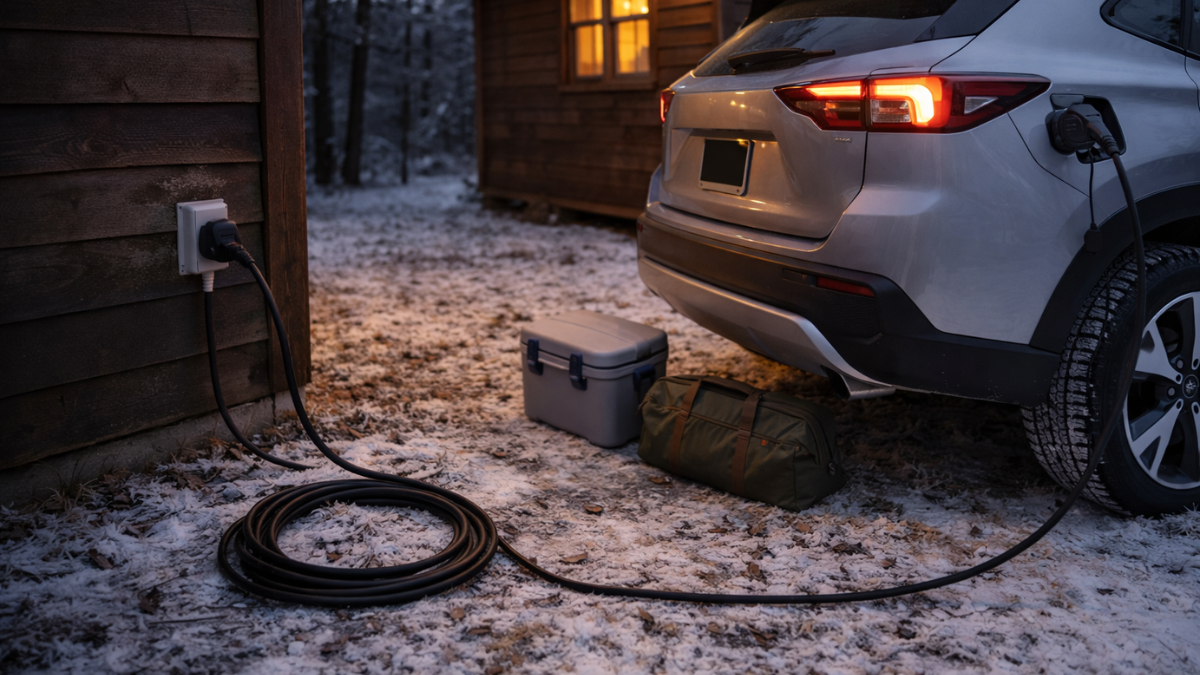
- the rental doesn’t have an accessible outlet,
- the public charger is slow or occupied,
- it’s cold and the car wants energy for cabin heat,
- and the driver keeps checking apps instead of enjoying the weekend.
A PHEV can reduce this stress—if it’s treated like a hybrid-first vehicle with optional electric miles, not like a pure EV that must charge.
The core PHEV behavior (why the trip still works)
The DOE Alternative Fuels Data Center explains a simple operating pattern: many PHEVs run on battery power until it’s nearly depleted, then automatically switch to the internal combustion engine. EPA adds nuance: some PHEVs stay electric until near empty, while others operate in blended mode, using gasoline and electricity together even with charge remaining.
Weekend meaning:
- If you can charge: you’ll likely use more electric miles and less gasoline.
- If you cannot charge: the trip continues normally, but you are effectively in hybrid mode for more of the weekend.
So the “can it handle it?” answer is generally yes. The “will it feel effortless?” depends on trip design.
The stress point most people miss: short trips at the destination
Cabin weekends often look like this:
- long highway approach,
- then a string of short trips (groceries, coffee, trailhead, town).
DOE’s Energy Saver guidance notes cold weather can reduce fuel economy, and that hybrids can be impacted notably on short trips. That matters because cabin weekends often happen in shoulder season or winter, and short hops multiply the effect.
If the trip includes lots of 5–10 minute drives, a PHEV can still be convenient—but the “electric-only” range can be consumed quickly, and the engine may cycle for heat or to manage battery/temperature in some conditions.
Cold weather: why “electric range” feels smaller at the cabin
Charging drama spikes in cold weather because the same battery has to do more work:
- heat the cabin,
- manage battery temperature,
- and push through denser air at highway speed.
Consumer Reports found cold temperatures can reduce EV range during highway cruising, and DOE’s cold-weather guidance highlights how fuel economy drops in cold conditions, especially on short trips for hybrids. Translation: a winter cabin weekend is a “worst case” for expecting advertised electric miles to feel exactly the same as in mild weather.
The stress-reducing move is to plan with buffer:
- assume the electric portion is a bonus,
- and make sure the gasoline plan is comfortable and easy.
“Will it use way more gas than I expect?”
This depends less on the vehicle and more on charging behavior.
The Union of Concerned Scientists summarizes research suggesting many plug-in hybrids drive more on gasoline in the real world than certification assumptions, particularly when drivers do not charge as frequently as test procedures assume. European data analyses have made similar points about real-world PHEV fuel use versus official ratings.
Weekend takeaway: if charging is unreliable at the cabin, a PHEV may behave like a hybrid for much of the trip. That can still be fine—just don’t buy the weekend plan based on the best-case electric label scenario.
When a PHEV is the calmest cabin-weekend choice
A PHEV tends to be low-stress when:
- the highway approach is long, but you don’t want public fast-charging as a dependency,
- the destination has at least one easy option (garage outlet, exterior outlet, or a nearby charger you can use opportunistically),
- and you want quiet electric miles for town runs without committing to full EV infrastructure.
In other words: a PHEV shines when the electric portion is convenient, not mandatory.
When a PHEV can feel like unnecessary complexity
A PHEV can feel higher-stress when:
- there is no realistic place to charge overnight and you feel “wasting potential,”
- the cabin is off-grid and outlets are far or not accessible,
- or the weekend is extremely cold and the trip is dominated by short hops.
In those scenarios, a regular hybrid can deliver similar “no-drama” travel without the charging expectations.
What this means in the U.S.
In the U.S., cabin weekends often include:
- long interstate legs,
- cold shoulder-season mornings,
- and mixed access (some rentals have garages, many do not).
That environment rewards plans that don’t depend on a specific charger. PHEVs are well suited when families treat charging as “nice to have,” use it when it’s easy, and keep a normal gasoline fallback.
What you can do: the 8-step “no charging drama” plan
Use this plan to make a PHEV feel effortless:
1) Arrive with buffer. Don’t arrive at the cabin with a near-empty battery if you expect short trips.
2) Make charging optional. Treat overnight charging as a bonus, not a requirement.
3) Ask one specific question before booking: “Is there an accessible standard outlet within cord reach of the driveway/parking spot?”
4) Pack the right cable. If your PHEV uses a portable cord, bring it; don’t assume the cabin has one.
5) Use the car’s drive modes intentionally. If your model offers “hold” or “save” modes, use them on the highway so you have electric miles for town runs at the destination.
6) Plan for cold. In winter, expect reduced electric miles and more engine involvement; use seat heaters where available and avoid short trips that never warm the cabin.
7) Know the fallback. Identify one normal gas station near the cabin so the “gas mode” feels boring, not stressful.
8) Stop chasing perfection. If charging requires waiting or rerouting, skip it—your weekend time is worth more than a marginal fuel saving.
Bottom line
A plug‑in hybrid can absolutely handle a cabin weekend without charging drama—because it can run as an efficient gasoline hybrid when the battery is low, and may operate in blended mode depending on model design. The key to keeping it low-stress is treating charging as a convenience, not a dependency, especially in cold weather and short-trip-heavy weekends. Build the plan around a normal hybrid-style weekend, then take the electric miles when they’re easy.