
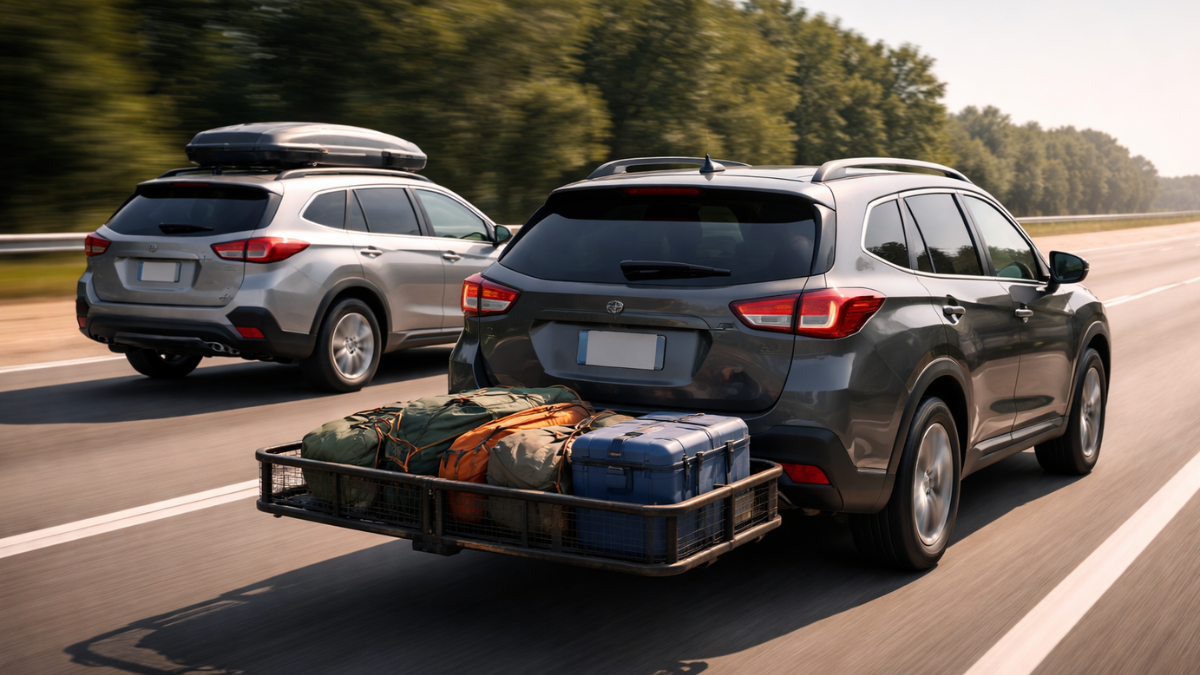
The camping gear has to go somewhere. The SUV is already full of people, and what’s left is a choice between strapping a cargo box to the roof or bolting a hitch carrier out back. Most buyers decide based on access, aesthetics, or what they already own. Almost none of them run the aerodynamic numbers first. At 65 mph those numbers don’t matter much. At 75 mph on a 500-mile interstate run, the roof box costs you real money and real gallons — more than most people realize, and significantly more than the hitch alternative for reasons that have nothing to do with the weight being carried.
Quick Takeaways
- A Car and Driver back-to-back highway test on the same Toyota Grand Highlander found: hitch carrier = 25 mpg, roof box = 21 mpg — a 4-mpg difference on the same road at the same speed with the same driver
- Consumer Reports tested a Nissan Altima at 65 mph: bare vehicle = 48 mpg; rack only = 43 mpg (−11%); rack plus loaded cargo box = 39 mpg (−19%)
- The physics reason: aerodynamic drag force grows with the square of speed. At 75 mph, roof-mounted cargo causes a significantly larger drag penalty than at 55 mph for the same box
- Hitch carriers sit in the vehicle’s turbulent wake — the low-pressure zone where air has already separated from the body — and in Car and Driver’s back-to-back test, produced no measurable mpg penalty relative to the baseline
- On a 500-mile highway trip, the 4-mpg difference between a roof box and a hitch carrier costs roughly 3.8 extra gallons, adding $13–$17 at current pump prices
- The tongue weight limit on a Class III hitch (the standard 2-inch receiver on most midsize SUVs) is approximately 500 lbs — but that budget must cover the carrier’s own weight (50–70 lbs) and shrinks further when the vehicle is carrying passengers
- A fully loaded family plus a full cargo carrier on a vehicle with a 3,500-lb tow rating may have less usable tongue weight than most people assume
Why the Roof Is the Worst Place for Speed-Sensitive Cargo
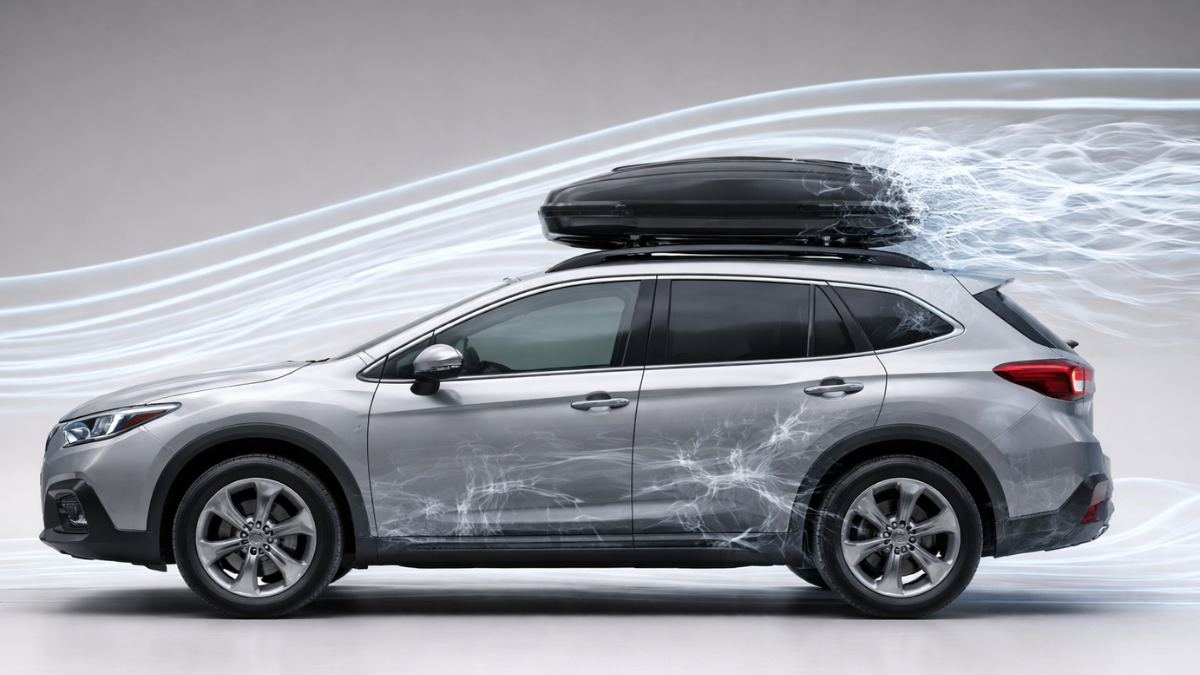
The fundamental physics here is not complicated, but its consequences at highway speed are underappreciated.
Aerodynamic drag force is proportional to the square of vehicle speed. This means that doubling your speed quadruples the drag force your engine must overcome. At 30 mph, drag is a minor concern. At 60 mph, it accounts for approximately 60 percent of the energy your engine is producing. At 75 mph, it is dominant — and anything you have strapped to the roof is contributing to that load at full intensity.
The roof is the worst possible location for highway-speed cargo for one specific reason: it sits directly in the vehicle’s primary high-speed airflow. Clean air hitting the windshield travels up and over the roofline. A cargo box placed in that path increases the vehicle’s frontal area, disrupts the smooth separation of airflow over the roof, and adds turbulence that extends behind the vehicle for a substantial distance. The result is a measurable increase in drag coefficient that the engine must overcome at the speed-squared rate — meaning the faster you go, the worse the penalty grows.
Consumer Reports quantified this clearly in testing with a 2019 Nissan Altima at 65 mph. Without any rooftop hardware, the car returned close to 48 mpg on the highway. Installing only the crossbars — no box — dropped it to roughly 43 mpg, a loss of about 11 percent purely from the empty rack disrupting airflow. Adding a loaded cargo box to that rack brought the car down to approximately 39 mpg, a cumulative 19-percent decline from the baseline.
The SUV in the same test showed a smaller percentage penalty — SUVs already have higher frontal area and greater aerodynamic resistance — but the absolute mpg penalty remained meaningful.
Where the Hitch Carrier Hides
A hitch-mounted cargo carrier does not escape physics. It is still a drag-producing object attached to a moving vehicle. But where it sits relative to the airflow changes everything about the penalty it imposes.
The rear of a vehicle is a zone of separated, turbulent air — the wake that forms behind the body as it moves through the atmosphere. Per standard automotive aerodynamic drag modeling, this region is already low-pressure relative to the ambient air around the vehicle. Cargo placed here does not add new frontal area to the vehicle’s leading edge (the face that the clean incoming air hits first). It sits inside the turbulent zone the vehicle has already paid for aerodynamically.
Car and Driver’s back-to-back test on a Toyota Grand Highlander, conducted on the same route at the same speed, made the difference visible with actual fuel measurements. With a hitch-mounted carrier, the Grand Highlander returned 25 mpg. With a rooftop cargo box, it returned 21 mpg. That 4-mpg difference is not a rounding artifact — it is the direct aerodynamic cost of where the cargo was placed, with no other variable changed.
A separate observation in the same Car and Driver testing: simply removing the roof crossbars from a long-term Kia Carnival improved highway fuel economy from 25 to 28 mpg. The bars themselves — not a loaded box, just the empty mounting hardware — carried a 3-mpg penalty at highway speed. This is the speed-squared relationship in practice: those crossbars create almost no drag at 30 mph and substantial drag at 75 mph.
The 500-Mile Fuel Cost Calculation
The 4-mpg difference between hitch and roof for the same load is real and consistent with the physics. Translating it into trip cost makes the tradeoff concrete.
Baseline vehicle: midsize SUV averaging 25 mpg on the highway without cargo
Roof box configuration (assuming 16% mpg penalty, roughly middle of Consumer Reports range for an SUV): 25 mpg × 0.84 = approximately 21 mpg
Distance: 500 miles Fuel needed: 500 ÷ 21 = approximately 23.8 gallons
Hitch carrier configuration (minimal aerodynamic penalty in wake zone): Approximately 24–25 mpg maintained
Distance: 500 miles Fuel needed: 500 ÷ 25 = 20 gallons
Difference: approximately 3.8 extra gallons for the roof box over 500 miles
At $3.50/gallon (U.S. average mid-2025): roughly $13 more for the roof box trip. At $1.65/L (approximate Canadian prices): roughly $6.27 per gallon equivalent, or approximately $24 CAD more for the roof box trip.
Over a two-way road trip of 1,000 miles, that doubles to approximately $26 USD or $48 CAD. For a family that takes three to four extended road trips per season, the fuel penalty from a consistently roof-mounted cargo system runs to over $100 per season compared to a hitch solution.
The calculation assumes a loaded roof box. An empty box left on the vehicle — a habit that Consumer Reports noted is extremely common, with roof racks often left attached year-round — carries a persistent smaller penalty every day it is mounted.

Based on Car and Driver back-to-back Toyota Grand Highlander highway test; 25 mpg baseline. Individual results vary by vehicle, speed, and load.
The Tongue Weight Number Most Travelers Skip
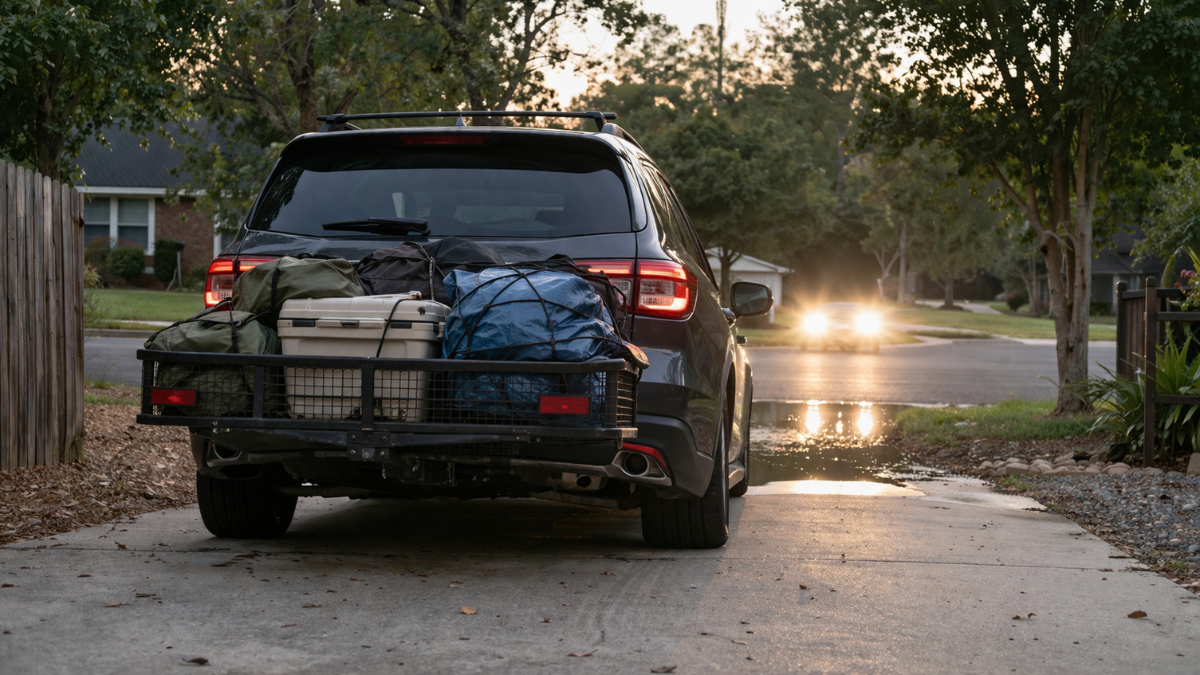
Hitch carriers have a strong aerodynamic advantage over roof boxes on the highway. They also have a specific mechanical constraint that many users misunderstand before loading up for a trip: tongue weight.
Tongue weight is the downward force that a hitch-mounted carrier — or any hitch-attached equipment — exerts on the vehicle’s hitch receiver. It is not the same as towing capacity, and the two numbers are not interchangeable.
The standard Class III hitch, which uses a 2-inch receiver and is standard equipment on most midsize SUVs, is typically rated for approximately 500 lbs of tongue weight. This is the downward load limit on the hitch point — the maximum combined weight of the carrier itself plus everything loaded onto it.
The complication that most travelers miss: tongue weight is generally calculated as approximately 10–15 percent of a vehicle’s maximum tow rating. An SUV rated to tow 3,500 lbs has a tongue weight limit of roughly 350–525 lbs. An SUV rated to tow 5,000 lbs can handle up to 500–750 lbs of tongue weight depending on the manufacturer’s specification.
The second complication: the carrier itself counts. A standard steel cargo basket weighs 50–70 lbs on its own. A larger platform carrier can weigh more. That weight must be subtracted from the available tongue weight budget before any cargo goes on. A 500-lb tongue weight limit with a 65-lb carrier leaves 435 lbs for actual gear.
The third complication — and the one most relevant to a full family road trip — is that tongue weight capacity decreases as passenger and interior cargo weight increases. Per forum members on Piloteers.org referencing the 2013 Honda Pilot owner’s manual, that vehicle’s tongue weight allowance drops from 450 lbs with two occupants to as little as 160 lbs with six occupants. Always verify the equivalent chart in your own vehicle’s manual. A fully loaded family SUV — parents in front, children in the back rows, luggage filling the cargo area — may have far less tongue weight available for the hitch carrier than the hitch rating suggests.
What Happens When You Exceed the Limit
Exceeding tongue weight limits produces specific handling consequences: the rear of the vehicle squats, front steering lightens, headlight aim changes (pointing higher than intended, creating a glare hazard for oncoming traffic), and braking distance increases because the front tires are carrying less load. None of these consequences are announced by a warning light. They appear gradually as the hitch is increasingly overloaded, and they are most dangerous at highway speed where stability matters most.
Before loading a hitch carrier for a trip, check three numbers in the owner’s manual:
- Vehicle tongue weight capacity (not tow capacity — the specific tongue weight figure)
- Carrier’s own weight (subtract from the capacity before counting cargo)
- Passenger and interior cargo load effect on tongue weight — some manuals include a chart; others simply specify the maximum under full occupancy
A useful rule of thumb from published sources: if the manufacturer’s tongue weight limit is 300 lbs, assume a realistic safe cargo limit of 200–230 lbs after accounting for carrier weight. Carriers rated at 500 lbs by the manufacturer describe the carrier’s structural limit, not the vehicle’s hitch limit. Always go by the lower of the two.
The Practical Tradeoffs That Don’t Appear in the Fuel Math
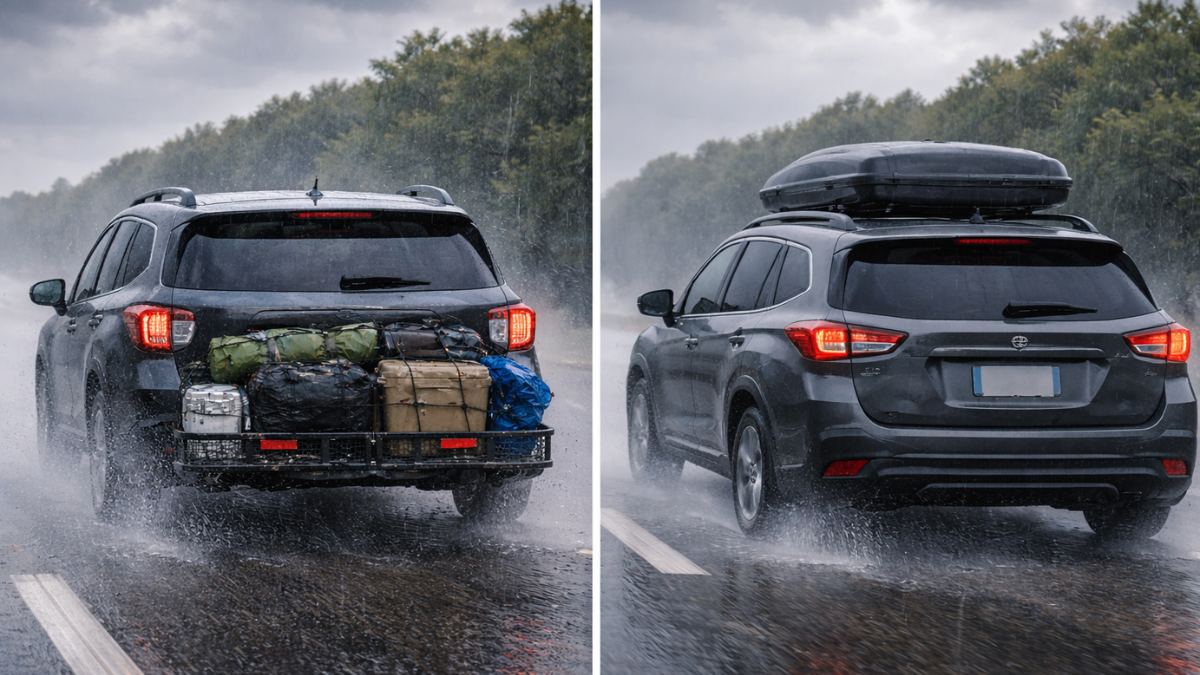
The aerodynamic and tongue-weight story favors the hitch carrier for highway fuel economy. The practical story is more complicated.
What hitch carriers are worse at:
A hitch carrier is an open platform. Everything on it is exposed to rain, road grime, mud spray, and highway debris. A weatherproof cargo bag is not optional on a multi-day trip — it is essential. Additionally, the carrier physically blocks access to the vehicle’s rear hatch or tailgate on many setups. Swing-away adapters allow full rear access while loaded, but they typically reduce the effective tongue weight by adding a moment-arm effect. Tilting carriers allow partial access when unloaded. Most standard baskets without either feature require unloading and detaching to open the hatch.
Modern backup sensors and cameras can also mistake a hitch carrier for an obstacle, triggering false proximity alerts or, in vehicles with automatic reverse braking, activating the brakes during low-speed maneuvers. This is an increasingly common complaint as driver-assist systems become more sensitive.
What roof boxes are better at:
A roof box keeps gear enclosed, secure, and dry without needing supplementary weatherproof bags. It does not interfere with rear hatch access. It adds no tongue-weight complication. For short-duration or low-speed trips — loading the ski box for a mountain weekend on winding state routes at 50 mph — the aerodynamic penalty is substantially lower than at highway speed, and the protected enclosed storage is genuinely useful.
The right answer depends on the trip profile. For a 600-mile interstate run at 70–75 mph, a hitch carrier saves meaningful fuel and avoids the roof drag penalty entirely. For a 200-mile mountain weekend on roads with variable grades and speeds rarely exceeding 55 mph, the roof box’s protection and convenience may outweigh the smaller speed-squared penalty at those speeds.
The Speed-Squared Rule for Practical Planning
One practical calculation worth keeping in your trip planning: aerodynamic drag force grows as the square of speed. This means the roof box penalty at 75 mph is not just “a bit worse” than at 60 mph — it is proportionally worse by the ratio of 75² to 60², which is roughly 1.56. The same box generates 56 percent more drag force at 75 mph than at 60 mph, requiring the engine to produce proportionally more power to maintain speed.
The speed-squared rule: Drag force at 75 mph = drag force at 60 mph × (75 ÷ 60)² = 1.56×. Every roof-mounted box that was manageable on a 60 mph mountain route is working 56% harder against your engine at 75 mph interstate speed. Nothing changed about the box. Everything changed about the speed.
For trips that are primarily highway at 70–75 mph, the aerodynamic argument for the hitch carrier is at its strongest. For trips with significant slower-speed segments — mountain passes, national park roads, small-town drives — the roof box’s penalty is compressed and the practical benefits of enclosed storage become proportionally more important.
This is the information that is usually missing from the buying decision: not “roof box or hitch carrier” as a static preference, but “what is my actual trip profile, and which configuration costs less to run on that specific route?”
U.S. and Canada Note
Gas prices in Canada make the fuel penalty calculation more acute than in most U.S. markets. At $1.65/L, the approximately 3.8 extra gallons that a roof box costs over a 500-mile trip translates to roughly $24–$28 CAD rather than $13–$14 USD. Over a cross-province trip of 1,000+ miles — Trans-Canada segments in particular — the differential compounds. Canadian travelers who do multiple highway road trips per season and currently use a roof box may find the hitch carrier pays back the purchase cost within a single season of trip fuel.
The tongue-weight complication also applies in both markets equally: Canadian tow ratings use the same percentage-based tongue weight formula as U.S. ratings. The SAE and Transport Canada standards are aligned on tongue weight calculation. Always verify the specific figure in the owner’s manual rather than using a percentage estimate.
SOURCES
- Car and Driver via Yahoo Autos: Toyota Grand Highlander back-to-back highway test — hitch = 25 mpg, roof box = 21 mpg; aerodynamic explanation; Kia Carnival crossbars removed = 25 to 28 mpg; hitch carrier in wake zone produced no measurable mpg penalty vs. baseline
- Consumer Reports: Nissan Altima at 65 mph — no rack 48 mpg; rack only −11%/5 mpg; rack + box −19%/9 mpg; rooftop carrier reduces fuel economy up to 25%; roof racks commonly left on year-round
- Wikipedia: aerodynamic drag force proportional to square of velocity; power proportional to cube of velocity; drag dominant factor at highway speeds; standard automotive aerodynamic drag modeling
- ARC: aerodynamic drag proportional to speed squared; power to overcome drag proportional to speed cubed; wake zone / separated rear airflow as standard automotive aerodynamics context
- Rackfaction: Class III 2-inch receiver = ~500 lbs tongue weight; tongue weight generally 10–15% of tow rating; carrier own weight deducted; 200–230 lb practical cargo limit on 300-lb tongue weight rating
- Let’s Go Aero: hitch class ratings Class II through V; tongue weight definition; carrier own weight counts toward limit; exceeding tongue weight = handling consequences
- Discount Ramps: unibody chassis hauling tongue weight vs. towing distinction; adapter reduces tongue weight by 50%; lever-arm effect of carrier extending beyond hitch ball
- Piloteers.org: forum members referencing 2013 Honda Pilot owner’s manual — tongue weight 450 lbs at 2 occupants, 160 lbs at 6 occupants; occupant/cargo load effect on available tongue capacity
- ScienceDirect: at highway driving, aerodynamic drag accounts for approximately 60% of propulsion energy; proportionally greater than rolling resistance at speed