
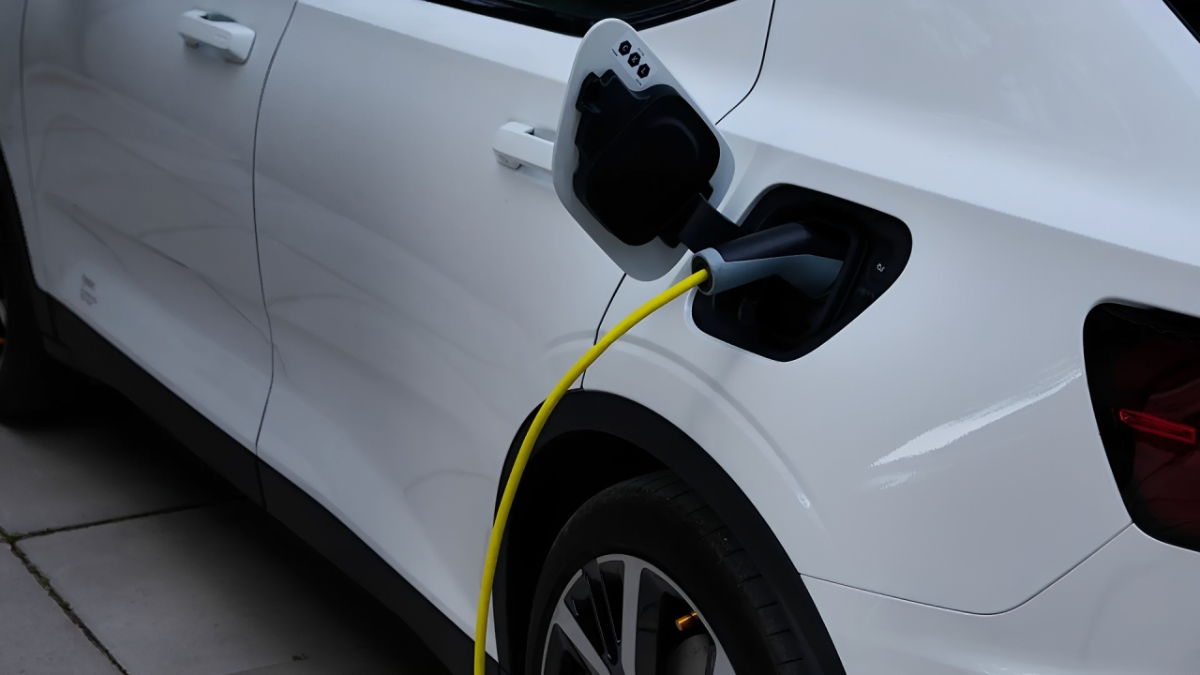
The filter said “EV charging available.” The hotel confirmed it on the phone. You arrived at 7 PM with 22 percent battery, plugged in, went upstairs for dinner, and felt like you had solved the road trip. By 6 AM checkout, the car shows 58 percent. The next leg is 180 miles. The math doesn’t work, and now you are standing in a parking garage trying to decide whether to delay checkout or gamble on the range.
This is not a malfunctioning charger. It is a Level 2 station doing exactly what it was designed to do — slowly, quietly, at a rate the hotel optimized for its electrical budget rather than for your departure time. Understanding why this happens, and how to run the numbers before you book rather than after you park, is the skill that separates a smooth EV road trip from an early-morning scramble.
Quick Takeaways
- “EV charging available” at a hotel typically means Level 2 AC charging — not DC fast charging. Level 2 delivers 3–11 kW depending on the equipment; at 7.2 kW, a 10-hour overnight session adds roughly 50–70 kWh, or 150–200 miles for most EVs
- Many hotel chargers use dual-port stations wired on a shared circuit. When two vehicles are charging simultaneously, each receives half the available power — 7.2 kW becomes 3.6 kW per car, cutting the overnight range gain nearly in half
- The U.S. Department of Transportation defines Level 2 as charging that takes 4–10 hours to bring a BEV to 80 percent from empty on a full dedicated circuit; a shared or reduced-output hotel circuit extends that window past a typical overnight stay
- The one calculation that matters: (charger kW) × (hours plugged in) × 0.9 efficiency ÷ your EV’s kWh per mile = miles added. At 3.6 kW shared for 10 hours at 3 miles/kWh: roughly 97 miles. At full 7.2 kW for 10 hours: roughly 194 miles
- Ask the hotel for the per-port kW rating and whether ports share a circuit — not just whether chargers exist
- If the hotel has fewer than one charger per eight to ten rooms, assume full occupancy will create competition and plan arrival state-of-charge accordingly
What “Level 2” Actually Means in a Hotel Context
Level 2 EV charging is defined by the equipment type, not by any guarantee of speed. It means 208–240-volt AC power, delivered through a wall unit with a J1772 or NACS connector, and processed by the vehicle’s onboard charger. The U.S. Department of Transportation’s framework describes Level 2 as capable of charging a battery-electric vehicle to 80 percent from empty in 4–10 hours on a dedicated circuit. That range — 4 to 10 hours — is enormous, and the difference between 4 and 10 hours is the difference between waking up with a full charge and waking up with 40 percent.
Most EV drivers picture something close to the faster end of that range when they see “Level 2” in a hotel listing. The industry definition does nothing to correct that assumption.
A hotel-installed Level 2 charger can be any of the following:
A 7.2 kW unit on a dedicated 40-amp circuit, which delivers roughly 25–30 miles of range per hour and will add 150–200 miles over a 7-hour night for most EVs. This is the scenario the hotel marketing implies.
A 6.2 kW unit on a lower-capacity circuit, common in commercial installations wired at 208 volts rather than 240 volts, adding perhaps 20–25 miles per hour.
A dual-port station on a shared 30- or 40-amp circuit, where two J1772 connectors share a single electrical feed. When both ports are in use, each car receives approximately half the circuit’s capacity. ChargePoint, which produces many of the commercial dual-port units common in hotel installations, documents this power-sharing behavior explicitly in its technical literature: its Equal Charge algorithm divides available power equally among vehicles plugged in simultaneously.
A 3–4 kW reduced-output unit, where the hotel or local utility has configured the station to draw less power. This is common at hotels that installed chargers primarily for marketing purposes and set them conservatively to avoid electrical panel upgrades.
None of these configurations are broken or fraudulent. All are correctly described as “Level 2 EV charging.” The problem is that they represent a tenfold range in overnight range gain, from roughly 30 miles on a limited 3 kW station shared overnight to 200+ miles on a full-power dedicated unit.

*Assumes 3.0 miles/kWh vehicle efficiency and 0.9 AC charging efficiency factor. All four configurations qualify as “Level 2 EV charging.” Only the first row delivers the overnight result most drivers assume when they book.
The Shared-Circuit Problem Nobody Warns You About

The most commonly encountered failure mode in hotel overnight charging is not a broken station. It is a working station that silently divides its output the moment a second guest plugs in.
Most commercial dual-port Level 2 chargers — the type most hotels install — are wired on a shared circuit. The logic from the hotel’s perspective is sound: rather than run two dedicated 40-amp circuits to two adjacent parking spots, a single shared circuit costs less to install and still delivers “EV charging” to two spots simultaneously. For commuter use, where a vehicle charges for two hours and leaves, a shared circuit is often adequate. For overnight road-trip use — where the vehicle arrives partially depleted and needs 8–10 hours to recover — the math breaks down when both ports are occupied.
ChargePoint’s technical documentation confirms the behavior: its Power Management system uses an Equal Charge algorithm that divides available power equally among vehicles plugged into stations on a shared circuit. For a common dual-port installation on a 30-amp circuit at 240V (7.2 kW total), each car receives 3.6 kW when both ports are occupied. Over a 10-hour night, that is 32.4 kWh per car — approximately 97 miles of range at 3 miles/kWh, versus 194 miles on a dedicated full-output port.
The driver who arrives first gets the full 7.2 kW. The driver who plugs into the second port at 10 PM watches both cars drop to 3.6 kW, without any visible notification on the station itself.
Rivian forum members and other EV road-trippers document this experience routinely. One Rivian owner describing a hotel ChargePoint setup noted: “ChargePoint L2 chargers that are REALLY slow — especially if someone is sharing yours — but also really cheap.” The experience is consistent enough that it functions as a known planning variable for experienced EV travelers, not an exception.
The compounding problem: hotel charging spots are typically first-come-first-served. There is no mechanism to reserve a dedicated port in advance, no notification that the port you are on has shifted to shared mode, and no compensation if overnight range falls short of what the original “Level 2 charging available” listing implied.
The kWh Math That Plans Your Morning
Every overnight hotel charging decision reduces to a single equation. The U.S. Department of Transportation defines Level 2 charging time as a function of charger power output and battery capacity — the same relationship expressed as a range formula: running it before you book, using numbers specific to your vehicle and the specific charger, eliminates the morning surprise.
The formula:
Miles added overnight = (Charger kW per car) × (Hours plugged in) × (0.9 charging efficiency factor) × (Vehicle efficiency in miles per kWh)
The 0.9 efficiency factor accounts for standard AC charging losses — typically 10–12 percent of energy is lost as heat during Level 2 AC conversion. The vehicle’s efficiency figure (miles per kWh) appears in the vehicle’s trip computer or owner’s manual; it typically ranges from 2.5 to 4.5 miles/kWh depending on the vehicle, speed, temperature, and load.
Three scenarios for a common mid-range EV (75 kWh battery, 3.0 miles/kWh efficiency, arriving at 20% battery = 15 kWh remaining = needs 60 kWh to reach full):
Scenario A — Full dedicated 7.2 kW port, 10 hours: 7.2 × 10 × 0.9 × 3.0 = 194 miles added. Leaves with a full battery and then some.
Scenario B — Shared dual-port at 3.6 kW per car, 10 hours: 3.6 × 10 × 0.9 × 3.0 = 97 miles added. Leaves with roughly 50% battery — enough for a 100-mile next segment, not 180.
Scenario C — Hotel-limited 3.8 kW station, both ports shared = 1.9 kW, 10 hours: 1.9 × 10 × 0.9 × 3.0 = 51 miles added. Leaves with the battery barely improved from arrival.
The difference between Scenario A and Scenario C is 143 miles of morning range — from a vehicle plugged into what the hotel listing called the same thing.
Cold weather compresses these numbers further. Most EV batteries charge at reduced rates in temperatures below 40°F, and overnight parking garages without climate control in northern states and Canadian provinces can easily reach those temperatures in shoulder season and winter. A vehicle that accepts 7.2 kW at 65°F may accept only 4.5–5 kW at 20°F while the battery thermal management system works to bring the pack to operating temperature.
Practical overnight charging formula for trip planning:
- Find the charger’s rated output per port in kW (not the shared total — per port)
- Multiply by your planned hours plugged in
- Multiply by 0.9 (efficiency loss)
- Divide by your vehicle’s kWh per mile (or multiply by miles per kWh)
- Compare the result to your next day’s planned driving distance plus a 15–20% buffer
If the result falls short, the options are: arrive with more charge, find a hotel with dedicated higher-output ports, or plan a DC fast charge stop before or after the hotel stay.
The Questions to Ask Before Booking
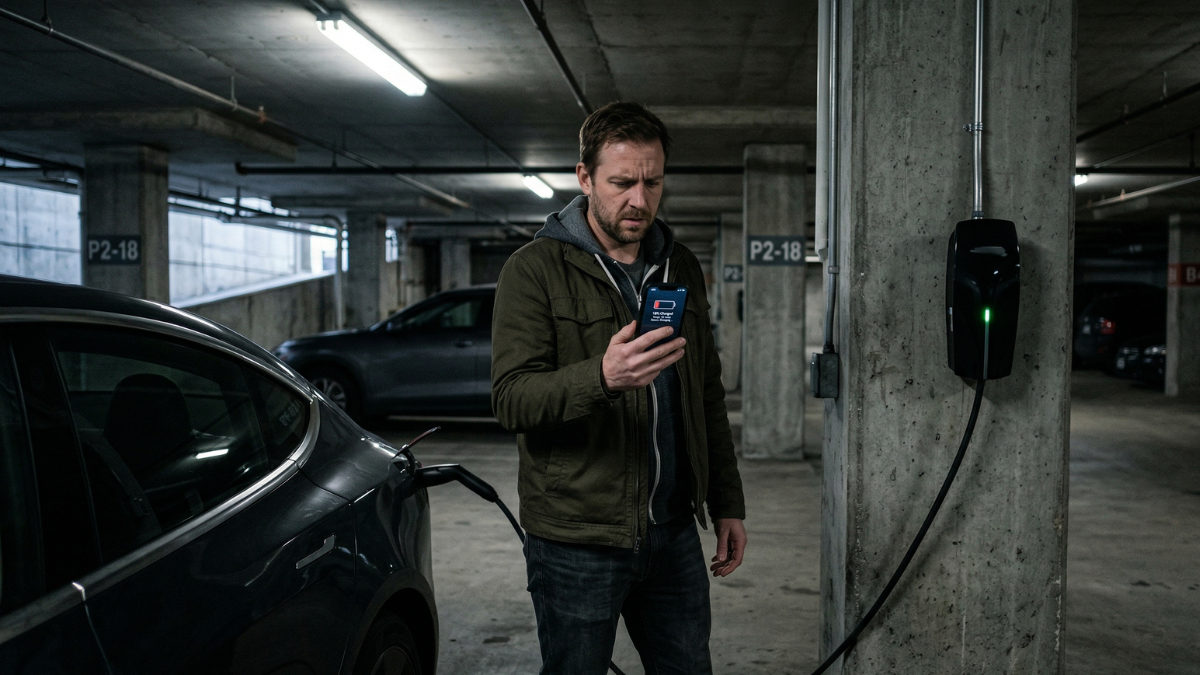
The standard hotel booking process is designed to answer zero of these questions. The EV charging filter on Expedia, Hotels.com, and similar platforms confirms presence of charging equipment. It says nothing about output, port configuration, circuit sharing, or access restrictions.
The information that determines whether overnight charging works is available — but only if you ask for it specifically, either by calling the hotel or by searching the charger on PlugShare before booking.
Five questions that determine the answer:
1. What is the rated output per port in kW? “Level 2” is not sufficient. A 7.2 kW dedicated port and a 3.8 kW shared port are both “Level 2.” The number determines the math.
2. Are ports on a shared circuit, and if so, what is the total circuit capacity? A dual-port unit sharing 7.2 kW delivers 3.6 kW per car when both are occupied. Knowing this before arrival allows you to adjust arrival state-of-charge expectations.
3. How many charging ports serve how many rooms? A 200-room hotel with four charging ports is a different proposition than a 60-room hotel with four ports. The ratio of ports to rooms determines competition overnight.
4. Is access first-come-first-served, or is there a reservation or valet rotation system? Some hotels require leaving keys for valet staff to rotate cars through charging spots. This introduces the possibility of your car being unplugged before charging completes.
5. What is the access procedure? Some stations require a ChargePoint account, an RFID card, or a hotel-specific activation code. Arriving at 11 PM to discover a registration requirement — and no front desk staff familiar with the system — is a documented experience in EV travel forums.
PlugShare is the most useful pre-booking verification tool. Hotel charging stations appear on PlugShare with user-submitted reviews that frequently document actual output received, whether power sharing was observed, and whether the station was working at last check-in. A five-minute PlugShare search before booking provides more relevant information than the hotel’s booking filter.
Planning Arrival State-of-Charge Around a Slow Station
Once the charger output is known, the departure time calculation runs in reverse from the morning target.
The math is the same formula above, solved differently: instead of “how many miles will I add overnight,” the question becomes “what state of charge do I need to arrive at to leave with enough range for tomorrow?”
Example: Next day’s drive is 170 miles. Vehicle efficiency is 3.0 miles/kWh. Hotel charger is a shared dual-port, 3.6 kW per car. Planned time plugged in: 9 hours.
Energy added overnight: 3.6 × 9 × 0.9 = 29.2 kWh Miles added: 29.2 × 3.0 = 87.5 miles
Required departure energy: 170 miles ÷ 3.0 miles/kWh = 56.7 kWh needed Buffer (15%): 8.5 kWh Total needed at departure: ~65 kWh
Battery capacity: 75 kWh (this is an 87 percent state of charge, or roughly 87 percent) Overnight gain: 29 kWh Arrival kWh needed: 65 − 29 = 36 kWh minimum at check-in, or about 48 percent state of charge
This means arriving at 48 percent or higher on a shared 3.6 kW overnight charger covers the next day’s drive with buffer. Arriving at 20 percent — which many drivers do, reasoning they will “charge overnight” — leaves a 16 kWh deficit that cannot be recovered by morning.
The practical implication: when hotel charging is slow, the work happens before the hotel, not at it. A DC fast charge stop 30–60 minutes before hotel arrival, bringing the battery to 60–70 percent, converts the hotel’s slow charger into a supplemental top-up rather than the primary recovery source.
A Pre-Trip Hotel Charging Checklist
Before booking any hotel on an EV road trip with overnight charging as a dependency:
On PlugShare or the charger network app:
- Search the hotel address for nearby and on-property chargers
- Read the most recent three to five check-in comments — look for mentions of actual kW received, sharing issues, and whether the station was working
- Note the charger hardware model; ChargePoint CT4000 is the most common dual-port hotel unit and shares power when both ports are occupied
By calling the hotel:
- Ask specifically: “What is the kW output per port when both ports are in use?”
- Ask: “How many charging ports serve the property, and how many rooms does the hotel have?”
- Ask: “Are the charging spots first-come-first-served, or is there a reservation system?”
At planning time:
- Run the overnight formula for the specific charger output — not for “Level 2 in general”
- Determine the minimum arrival state-of-charge needed given the next day’s distance
- Identify the nearest DC fast charger to the hotel as a morning backup option if the overnight result falls short
At arrival:
- Plug in before going to the room, not after dinner
- Note whether the station shows current output in the ChargePoint or PlugShare app — this is visible in real time and will immediately reveal if power-sharing is active
- Set a vehicle charge-complete alert for the morning so a drop to shared mode after midnight is visible when you wake
U.S. and Canada Note
Canadian highway corridors present the hotel charging problem in a more concentrated form than most U.S. routes. Between cities in the Prairie provinces, northern Ontario, and coastal British Columbia, DC fast charger density is lower than on major U.S. interstates, which means overnight hotel charging carries more of the trip’s range recovery responsibility rather than serving as a supplement to readily available DCFC stops.
In cold-weather Canadian markets — anywhere that sees sustained sub-zero overnight temperatures — the efficiency reduction during overnight Level 2 charging is more than theoretical. EV batteries in temperatures below −10°C typically charge at reduced current while the thermal management system warms the pack, extending the time to a given state of charge. A 7.2 kW charger that would add 194 miles in 10 hours at 20°C may add only 130–150 miles on a cold northern night in the same time. The formula-based approach to arrival state-of-charge planning is more important on Canadian winter road trips than in temperate climates.
When booking hotels on Canadian road trips, the same five questions apply. But the cold-weather efficiency penalty means building a larger buffer — 20–25 percent rather than 15 percent — into the arrival state-of-charge calculation.
SOURCES
- U.S. Department of Transportation: Level 2 defined as 4–10 hours to 80% from empty on dedicated 208/240V circuit; charging speed determined by charger output × battery capacity relationship — basis for the overnight range formula; common at hotels, workplaces, home
- ChargePoint Power Management: Equal Charge algorithm divides power equally among vehicles on shared circuit; oversubscription ratio explained; four stations sharing 40 amps = each gets proportional share; power-sharing as designed behavior, not a malfunction
- ChargePoint FAQ: drivers notified charging may be slower when Power Management is active; real-time status visible in ChargePoint app; average charging time impact documented
- Chevy Bolt EV Forum: “Some ChargePoint stations are set up on a single circuit for two vehicle spots, so you get half power when two cars are charging”; ChargePoint CT4000 dual-port shared-circuit behavior documented by owners
- Rivian Forums: owner documents hotel ChargePoint experience — “REALLY slow — especially if someone is sharing yours”; first-come arrival strategy for overnight charging described
- Lectron EV: Level 2 output range 3.3–19.2 kW; 7.2 kW charger adds approximately 25 miles/hour; 8–12 hours to charge large BEV from empty on full-power dedicated circuit; charging efficiency factors
- Power Sonic: Level 2 3–19.2 kW in U.S., 10–75 miles per hour; charging time formula basis
- Plug In America: Level 2 up to 19.2 kW; federal grant-funded stations commonly max at 6.6 kW — explains why many public and hotel chargers underperform the Level 2 ceiling
- EV Infrastructure News: dual charger load balancing — static vs. dynamic; 7.4 kW unit splits to 3.7 kW per car; 22 kW unit to 11 kW per car; one car gets full capacity; technical basis for shared-port behavior