
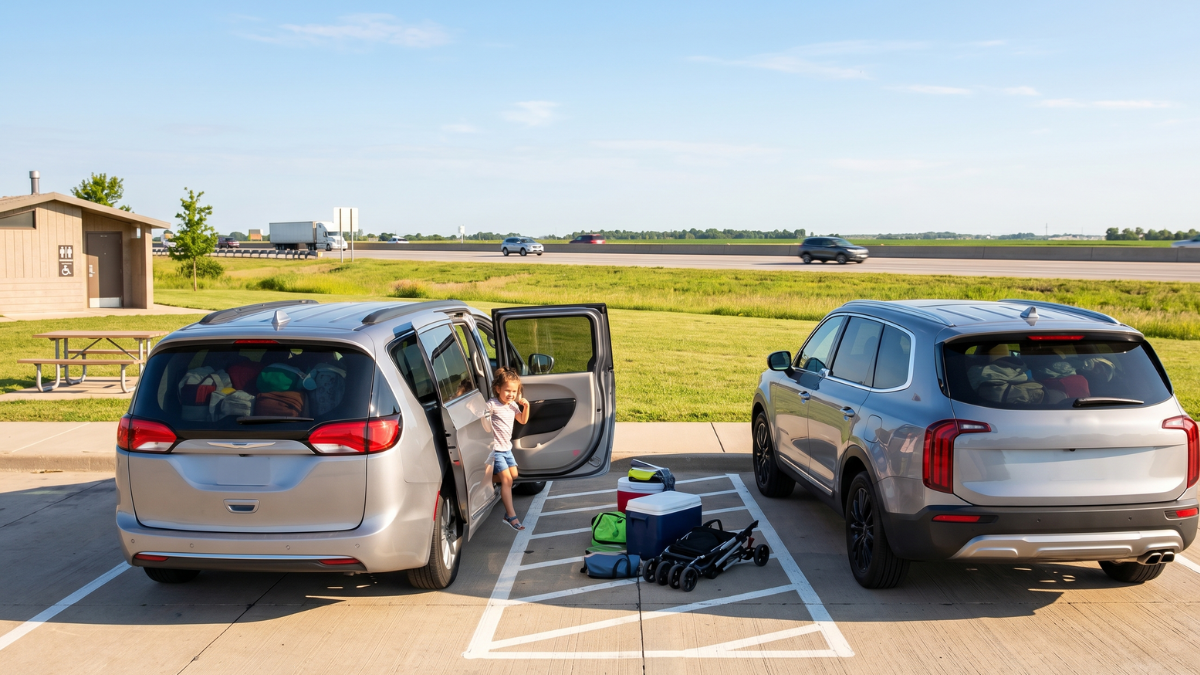
Every family that buys a three-row midsize SUV tells themselves the same story: the minivan is for a different kind of family. They are more outdoorsy, or the third row is just for occasional use, or the kids are young enough that the space doesn’t really matter yet. The SUV looks better, handles better, sits higher, and does not immediately announce that the family has permanently surrendered all remaining automotive ambition.
Then a 1,000-mile summer road trip happens. Three kids buckled across two rows. A week of luggage filling the cargo area behind the third row. Eight hours of driving on day one, another eight on day two. And somewhere around hour six, when the seven-year-old in the third row of the Telluride has her knees against the seatback and is asking how much longer, and the parents cannot hear each other over the road noise and the competing audio requests from the middle seats, the story starts to sound different.
The question for 2026 is not which vehicle is cooler. It is which one is genuinely better for a specific task: moving three children and their parents across 1,000 miles in reasonable comfort, at a cost that does not require a spreadsheet to justify. The math and the physics both tell a consistent story. Most families are just not told it at the right time.
Quick Takeaways
- Minivans offer approximately 15 more inches of interior floor space than the average three-row midsize SUV and roughly 5 more inches of third-row legroom, per Kelley Blue Book’s SUV-versus-minivan analysis — on an 8-hour driving day, this difference shows up in real passenger comfort
- The Toyota Sienna is the only current minivan with both hybrid-only powertrain and available AWD; at 36 mpg combined (FWD), it returns significantly better fuel economy than any non-hybrid three-row midsize SUV
- A 1,000-mile round trip in a Toyota Sienna FWD (36 mpg combined) versus a non-hybrid Kia Telluride (21 mpg combined) costs approximately $49 more in fuel in the Telluride at $3.50/gallon — meaningful over a summer, not decisive for a single trip
- Sliding doors are the most underrated specification for families with three children in car seats: they allow loading in tight parking spaces without swinging-door clearance, and children can operate them independently from inside, which reduces the physical task load at every gas station, hotel, and rest stop over a 1,000-mile trip
- Edmunds’ concurrent three-way minivan comparison for 2025/2026 placed the Toyota Sienna first (8.3/10), Honda Odyssey second (8.1), and Kia Carnival Hybrid third (8.0) — all three scored within 0.3 points, meaning the three strongest minivans are closely competitive; the winning factor for road trips is fuel economy for the Sienna and cargo flexibility for the Odyssey
- For families where AWD is a genuine seasonal need (mountain winter access, Upper Midwest winters, BC interior routes), the Toyota Sienna’s electric AWD and the Chrysler Pacifica AWD are the only minivan options; for all other families, FWD minivans with proper winter tires outperform AWD SUVs on all-season tires in grip and stopping
What “Third-Row Seating” Actually Means in Each Vehicle Class
The phrase “three-row SUV with seating for seven or eight” has become a marketing category that encompasses an enormous range of actual usability. A 2026 Kia Telluride, Toyota Highlander, and Honda Pilot all offer third-row seats. None of them is designed for the third row to be occupied by anyone other than children — or adults on very short trips — and none of the three-row midsize SUVs is designed for those occupants to be genuinely comfortable for four-plus hours.
Kelley Blue Book’s SUV-versus-minivan analysis is precise on this point: “Minivans typically offer more space than the average three-row SUV, with about five additional inches of legroom on average in the third row. That’s a big deal if you have a large family, older teens, or typically drive around with multiple generations.” For a family with three children — one of whom will inevitably be in the third row — those five inches are the difference between a manageable long day and a complaint-generating one.
The interior floor space gap is even larger. KBB documents minivans as offering more than 15 additional inches of total interior space compared to the average three-row midsize SUV. This is not a marginal difference in the way that 2 cubic feet of cargo space is marginal. It is a structural difference between a vehicle designed primarily as a passenger carrier and a vehicle designed as a crossover that has added a third row.
Behind the third row — the actual cargo space available when all seven or eight occupants are seated and the family’s luggage needs to go somewhere — the disparity is equally significant:
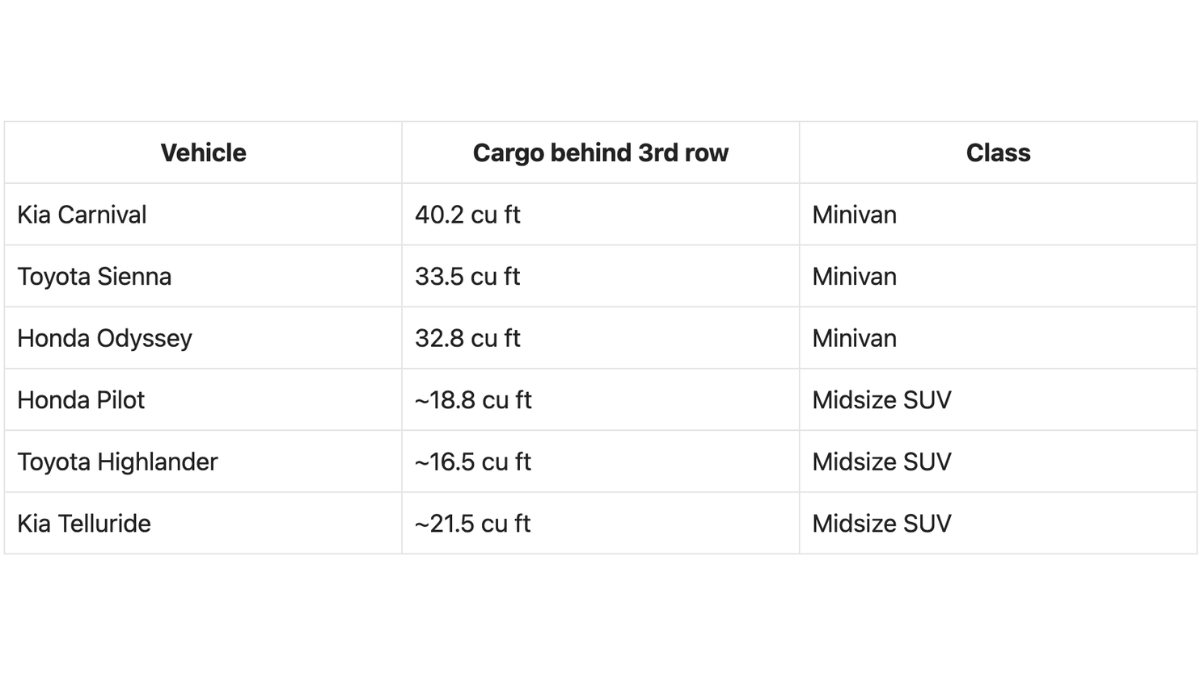
For a five-person family on a one-week trip, the cargo comparison is not between two numbers on a spec sheet. It is the difference between fitting the luggage behind the third row and fitting half the luggage behind the third row. Families in midsize SUVs with three kids frequently end up with bags on laps, bags on the floor of the middle row, or a roof box — adding aerodynamic drag and a loading challenge that disappears in a minivan.
The Fuel Math: 1,000 Miles in Each Vehicle
The fuel economy gap between a hybrid minivan and a non-hybrid three-row midsize SUV is significant and consistent. The 1,000-mile trip is a clean test case:
Toyota Sienna FWD (hybrid-only): 36 mpg combined
Honda Odyssey (V6): 22 mpg combined
Kia Carnival Hybrid: 32 mpg combined
Kia Telluride (non-hybrid): approximately 21 mpg combined
Toyota Highlander (non-hybrid): approximately 21–24 mpg combined
Kia Telluride Hybrid / Highlander Hybrid: approximately 35–36 mpg combined
At $3.50/gallon, fuel cost for 1,000 miles:
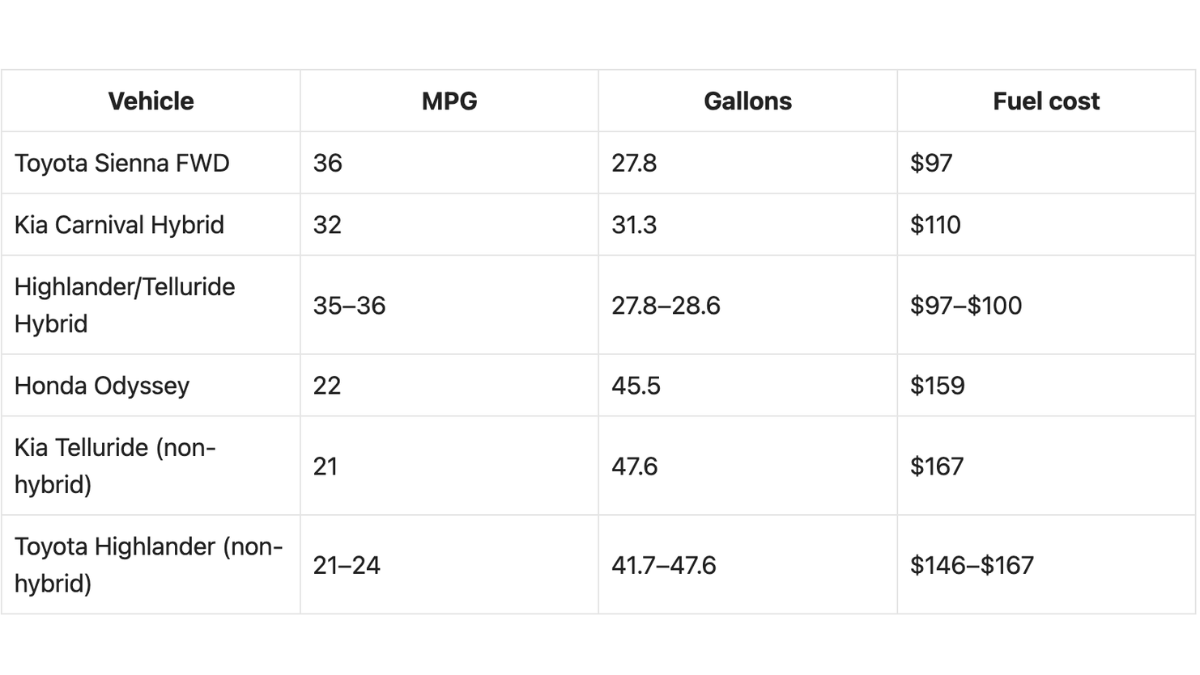
The Odyssey’s fuel economy deficit — approximately $60 more per 1,000 miles than the Sienna — is the vehicle’s clearest practical weakness for road trips. Edmunds’ side-by-side comparison confirms this: “The Odyssey lags far, far behind at just 22 mpg combined, meaning its range suffers — around 430 miles out of a tank in the Odyssey, versus around 600 miles in the Sienna and Carnival.”
For a family making three or four 1,000-mile trips per summer, the Odyssey’s annual fuel cost premium versus the Sienna is approximately $180–$240 — real money, though not the defining purchase-decision variable. For single-trip evaluation, the hybrid minivans and hybrid midsize SUVs land within a few dollars of each other. The non-hybrid comparison is where the gap widens.
The Sliding Door Argument: Why It Matters More Than Fuel
Most family vehicle comparisons treat sliding doors as a convenience feature. For a family with three children — particularly children young enough to be in car seats or booster seats — sliding doors are a functional advantage that compounds across every in-and-out movement of the trip.
A 1,000-mile trip typically includes: 3–4 fuel stops, 1–2 meal stops, 1–2 overnight hotel check-ins, and arrival and departure at both ends. That is 12–16 loading and unloading events per 1,000 miles. At each event, a conventional swing-out door requires: adequate clearance from the adjacent vehicle; the parent to hold the door while buckling the child; the risk of a door ding if another car parks nearby while loading; and the child being unable to independently open or close the door from inside without swinging it into the adjacent car.
Sliding doors eliminate every one of these friction points. The child presses a button and the door opens parallel to the vehicle, requiring no clearance on either side. The parent has full access to the car seat area without contorting. Power sliding doors — standard or available on all current minivans — can be triggered from the driver’s seat, meaning a parent can open both rear doors from the front before getting out. This is not a luxury; it is a meaningful reduction in the physical and cognitive load of managing three children in and out of a vehicle repeatedly across a two-day drive.
Kelley Blue Book addresses this directly: “Any parent with little kids knows the struggle of an independent toddler insisting on getting into the car without any help — sliding doors with a lower step-in height than most SUVs give you, and your tiny dictator, easy access to enter and exit the vehicle.”
U.S. News confirms the structural case: “These doors provide a much wider opening than standard doors, making it easier to get kids on board or load groceries and cargo. Sliding side doors are convenient if you’re in a tight parking space — they allow you to gain easy access without the risk of the door swinging out and hitting the vehicle parked adjacent.”
The Three Minivans for 2026 — What Each Brings
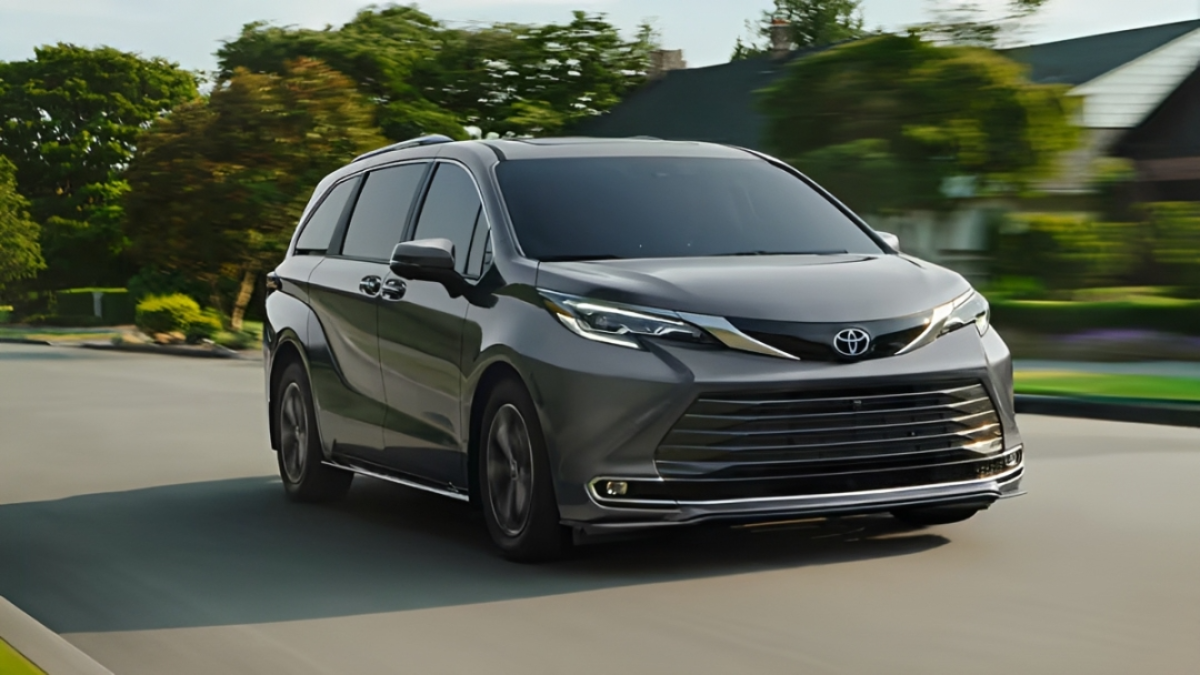
Toyota Sienna ($41,615 base, FWD LE): The segment leader for fuel economy at 36 mpg combined, available AWD, and a hybrid system that has been in production since 2021 with an established reliability record. Edmunds’ concurrent comparison scored the Sienna at 8.3/10. The cargo flexibility is strong (33.5 cu ft behind the third row), and the Woodland Edition adds modest trail capability and a tow hitch. For families prioritizing fuel economy and long-term reliability data, the Sienna is the primary recommendation. The trade-off: Edmunds’ real-world testing shows 0–60 in approximately 8.6 seconds — slower than the Odyssey.
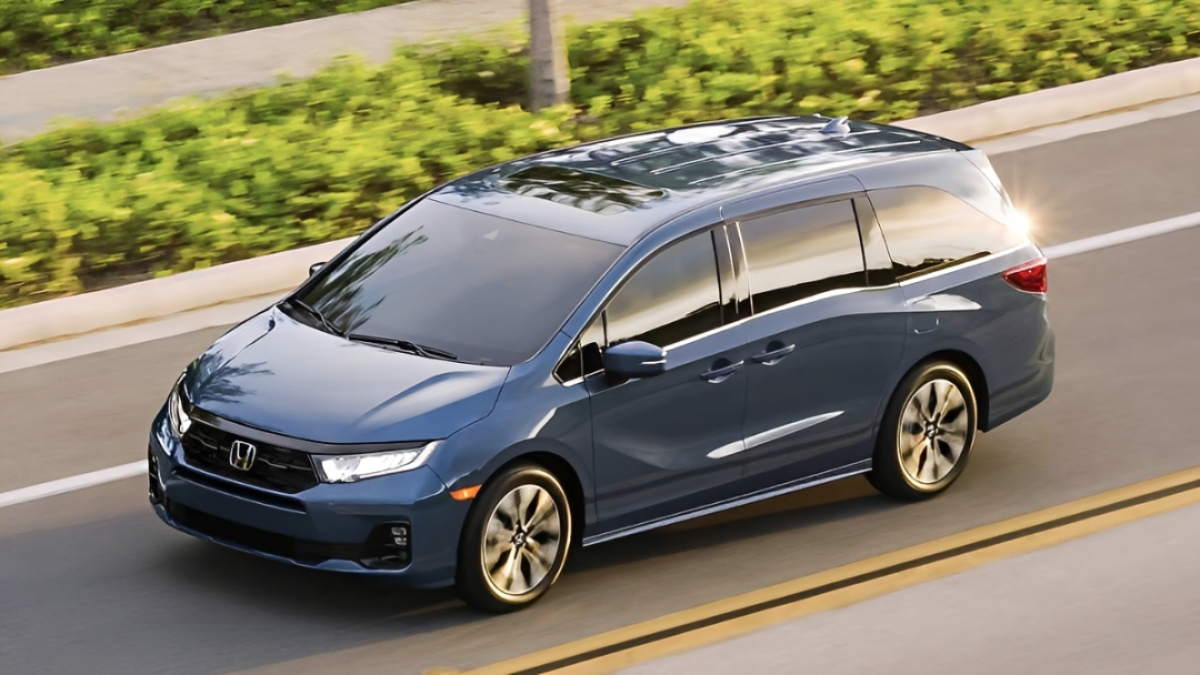
Honda Odyssey ($44,290 base, EX-L): The highest maximum cargo volume in the segment at 140.7 cubic feet, thanks to its removable second-row seat and flat cargo floor. Scored 8.1/10 in Edmunds’ comparison. At 280 horsepower and 7.6 seconds to 60 mph in Edmunds’ testing, it is the most capable at highway passing — relevant for mountain approach roads where brief acceleration opportunities close quickly. The serious weakness: 22 mpg combined from its V6. Over 1,000 miles, the Odyssey costs approximately $60 more in fuel than the Sienna, and its tank range of approximately 430 miles means an additional fuel stop per 1,000 miles. Standard leather seating across all trims is a practical advantage for the cleaning challenge that three children on a road trip represent.
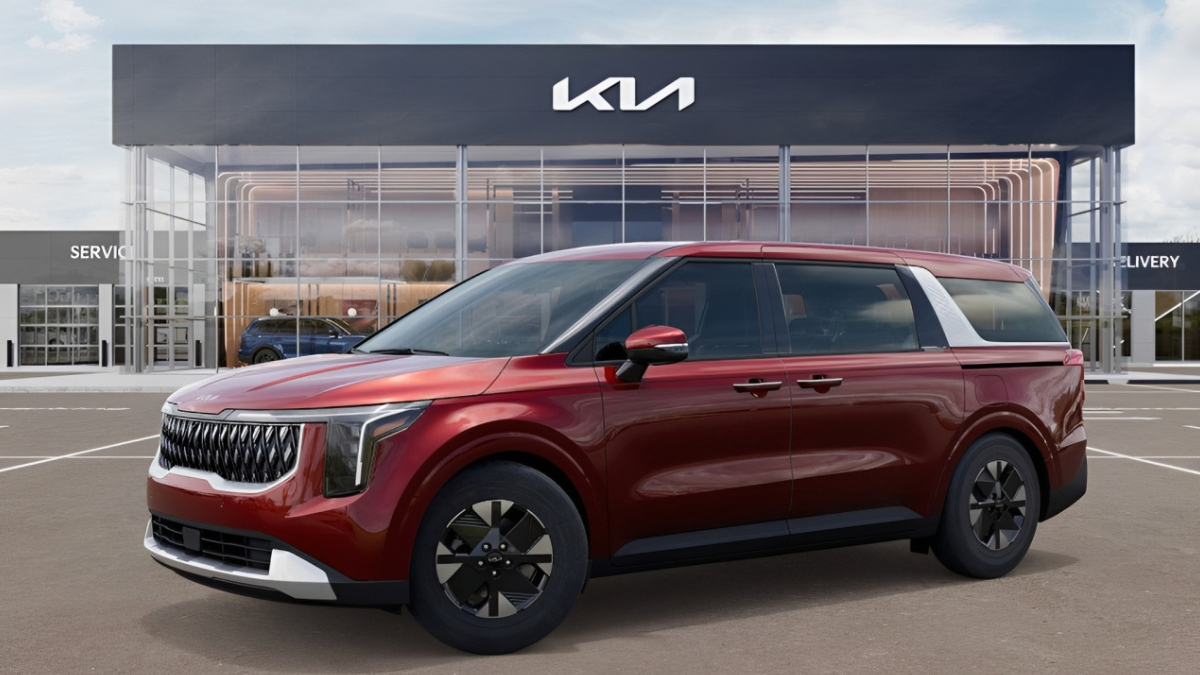
Kia Carnival Hybrid ($42,935 base, LXS): The most cargo space behind the occupied third row at 40.2 cubic feet, and the most modern interior design of the three. At 32 mpg combined and a 10-year/100,000-mile powertrain warranty, the Carnival Hybrid offers a compelling value case. Scored 8.0/10 in Edmunds’ comparison. The trade-off: Edmunds notes the Carnival Hybrid is tighter in second and third rows than the Odyssey or Sienna, and front-wheel drive only (no AWD available). The 10-year powertrain warranty is the strongest in the segment — directly relevant for a vehicle a family will likely keep for ten years of road trips.
When the Midsize SUV Still Wins
The minivan’s advantages are substantial and consistent for the specific use case described — three children, sustained highway driving, 1,000+ miles. But the midsize SUV wins in specific scenarios:
AWD genuinely needed beyond highway use. Families in mountain states who regularly access unpaved access roads, ski resort parking in unplowed conditions, or off-highway campsites need ground clearance and AWD that most minivans cannot provide. A Highlander Hybrid or Telluride on legitimate winter terrain is in a different capability class than a Sienna AWD on a packed-snow road.
Towing is part of the trip. Midsize SUVs can tow 5,000+ pounds; minivans typically max at 3,500 lbs. A family towing a camper, boat trailer, or enclosed utility trailer on the same vehicle that does the road trip will find the SUV’s tow rating more relevant than the minivan’s third-row legroom.
Social judgment is a real factor for the purchasing family. This sounds trivial until you are the one making the decision. The minivan is functionally superior for the trip described. If the family will not buy it because they cannot reconcile with owning a minivan, the best-performing vehicle is the one that gets purchased and used. A Highlander Hybrid they will own for eight years beats a Sienna they will resent every time they back out of the garage.
U.S. and Canada Route Note
The routes that most expose the minivan’s advantages — and most punish the midsize SUV’s third-row limitations — are the sustained summer runs on major family road trip corridors: I-95 Boston to the Outer Banks, I-80 Chicago to the Rockies, Trans-Canada Ontario to the Maritimes, and I-90 Seattle to Glacier National Park. These are full-day drives with high-speed cruise conditions where third-row legroom, fuel tank range, and loading-stop efficiency accumulate across the hours into measurable differences in how everyone arrives.
The Toyota Sienna’s AWD model is the only minivan fully prepared for the Trans-Canada’s winter conditions through Ontario and Quebec if the trip extends into autumn, or for mountain approach roads into Banff or Whistler from Calgary and Vancouver in spring shoulder season. For summer highway-dominant routes, the FWD Sienna, Odyssey, and Carnival Hybrid all perform equivalently on traction — any of the three with summer or all-season tires on dry or wet interstate pavement is safe and predictable.
SOURCES
- Edmunds concurrent three-way comparison: Sienna winner at 8.3/10, Odyssey 8.1, Carnival Hybrid 8.0; Odyssey 22 mpg combined and ~430-mile range vs. Sienna/Carnival ~600-mile range; Odyssey 0–60 in 7.6 seconds; Sienna 0–60 ~8.6 seconds; Odyssey best for families with young children due to second-row flexibility; Carnival best for parents prioritizing comfort up front
- Edmunds Sienna vs. Odyssey 2026: Sienna starts $41,915 FWD LE; Odyssey EX-L starts $44,290; Sienna 36/36 mpg; Odyssey 19/28/22 mpg; Odyssey real-world 21 mpg per Edmunds; Sienna FWD real-world 42.7 mpg; AWD Sienna 32.9 mpg over 20,000-mile test; Odyssey 280 hp vs. Sienna 245 hp; Odyssey cargo 32.8 cu ft behind third row, max 140.7 cu ft; Sienna 33.5 cu ft behind third row, 101 cu ft max
- The Weekly Driver 2026 minivan comparison: Carnival Hybrid starts $42,935; Sienna LE $41,615; Kia 10-year/100,000-mile powertrain warranty; Sienna and Pacifica only AWD minivans; Carnival 40.2 cu ft behind third row, 145.1 cu ft maximum; Sienna leads in fuel economy at 36 mpg; Carnival leads in cargo; no 2026 minivan earned IIHS Top Safety Pick
- KBB SUV vs. minivan analysis: minivans offer ~5 more inches of third-row legroom vs. average 3-row SUV; “more than 15 inches of extra space” in interior vs. average 3-row midsize SUV; sliding door advantage for families with young children; captain’s seats essential for car-seat families; SUVs win on towing and AWD availability
- U.S. News: midsize SUVs including Telluride and Pilot offer less cargo than minivans; sliding doors provide wider opening and parking-space safety advantage; hands-free power-sliding doors available; full-size SUVs comparable to minivans in cargo start at $58,500+; minivans start under $43,000
- U.S. News SUV vs. minivan: minivans unibody design provides car-like handling vs. body-on-frame SUVs; average minivan performance score 7.65 vs. ~7.3 for SUVs; minivan third rows spacious enough for adults on longer journeys; Sienna hybrid and Pacifica are AWD minivan options