

The math seems obvious: you already own the car, so driving it costs almost nothing. The rental is the expensive option. What families planning summer road trips frequently discover is that this logic, while intuitive, is incomplete — and that the actual cost difference between renting a midsize SUV for a four-day trip and driving your own depends on three variables most people have never calculated for their specific situation.
How old is your vehicle? How many miles are on it? And how many miles per year are you actually putting on it?
AAA’s 2025 Your Driving Costs study pegs the total annual cost of owning and operating a new vehicle at $11,577 — or $964.78 per month. That figure includes depreciation, finance charges, fuel, insurance, maintenance, and registration. Spread across 15,000 miles of annual driving, the all-in cost of ownership comes to approximately 77 cents per mile. A 1,500-mile round trip — the realistic scope of a four-day Pacific Northwest or Great Lakes summer road trip — costs a new-SUV owner approximately $1,155 in ownership cost when measured this way.
That number deserves comparison against what a rental actually costs in the summer of 2026. The comparison is closer than most people expect. Which side wins depends on your vehicle, your situation, and a few questions nobody asks before pulling out of the driveway.
Quick Takeaways
- AAA’s 2025 Your Driving Costs study puts the average total cost of owning a new vehicle at $11,577 per year ($964/month), amounting to roughly 77 cents per mile at 15,000 miles per year
- Summer midsize SUV rentals in peak July pricing run approximately $90–$120 per day at major airports and travel destinations per KAYAK/NerdWallet market data; a four-day rental with taxes typically lands at $400–$600 all-in
- Depreciation alone accounts for $4,334 per year of AAA’s ownership cost figure — the single largest cost component; a vehicle that spends a high-mileage summer adding 3,000+ road-trip miles accelerates this depreciation meaningfully on vehicles already approaching 60,000 miles
- For owners of newer vehicles under 50,000 miles, the per-mile ownership cost is high enough that a rental often saves money on trips over 1,200 miles while also protecting the vehicle’s resale value — the math shifts clearly toward renting
- For owners of paid-off vehicles over 100,000 miles where depreciation has already occurred, the marginal cost of a road trip is primarily fuel — and driving your own becomes the obvious choice
- The breakeven calculation: a four-day rental at $500 total equals the ownership cost of approximately 649 miles at 77 cents/mile — meaning any road trip substantially longer than that is roughly cost-neutral between the two options before the depreciation variable tips the scale
The Two Sides of the Ledger
The reason this calculation requires care is that “it costs me nothing to drive my own car” treats a fixed cost as though it were zero. Depreciation, insurance, and registration are costs you pay whether you drive 10,000 miles per year or 20,000. They are fixed. But wear-and-tear, oil changes, tire wear, and — critically — the marginal acceleration of depreciation from high mileage are not fixed. They rise with miles driven.
AAA’s cost breakdown for 2025 separates these cleanly:
Ownership costs (largely fixed over the ownership period):
- Depreciation: $4,334/year
- Finance charges: $1,131/year
- Insurance: $1,694/year
- License, registration, taxes: $813/year
- Subtotal: ~$7,972/year
Operating costs (variable with miles driven):
- Fuel: 13.0 cents/mile
- Maintenance, repair, tires: variable (~10–12 cents/mile average)
- Subtotal: ~23–25 cents/mile
The fixed costs exist regardless of your summer road trip. You cannot “save” your insurance premium by staying home. What you can influence by choosing to rent instead of drive is the operating cost per mile — and the marginal depreciation.
What a rental actually covers for you: When you rent a midsize SUV for a four-day road trip and put 1,500 miles on the rental, those are 1,500 miles that did not go on your odometer. That matters for:
- The oil change interval (pushed back 1,500 miles)
- Tire wear (1,500 miles of wear on rental tires, not yours)
- The trade-in or resale value (the vehicle shows 1,500 fewer miles when you sell)
None of these is enormous in isolation. Together, they represent real economic value — particularly for a vehicle that will be sold or traded in within the next 24–36 months.
The Summer 2026 Rental Market

The context for any renting-versus-owning analysis is what the rental actually costs. Summer 2026 pricing for midsize SUVs at major travel airports and destinations is relevant here.
KAYAK market data shows July as the most expensive rental month, with midsize and standard SUVs averaging $90–$110 per day at major airport locations. NerdWallet’s analysis of seven-night rental pricing across major U.S. rental companies found average weekly rates running $414–$600 depending on company and location.
For a four-day weekend trip (Friday pickup, Monday return), realistic 2026 summer pricing for a midsize SUV from a major rental company — including mandatory taxes and airport fees but before optional collision damage waiver — runs approximately $350–$550 depending on market and booking timing. NerdWallet’s research found that booking seven days in advance tends to be approximately 13 percent cheaper than booking 91 days out, which is counterintuitive but documented.
Add collision damage waiver at $20–$35/day if you do not have credit card coverage (many premium travel cards cover rentals at no additional charge — verify before paying), and the all-in cost for a four-day midsize SUV rental lands at $400–$650 for most summer 2026 scenarios.
This is the baseline against which the ownership cost calculation applies.
The Three Scenarios That Determine Which Wins
Scenario A: New or Near-New Vehicle, Still Financed (under 50,000 miles)
This is the family that bought a 2024 RAV4 Hybrid or CR-V Hybrid eighteen months ago and is still in the first three years of loan payments. The vehicle costs — finance charges, insurance, depreciation — are all running at maximum. AAA’s 2025 data puts average annual depreciation at $4,334 for the fleet average; for a $40,000+ compact SUV in years 1–3, the depreciation per year is higher.
At 15,000 miles per year, this vehicle costs approximately 77 cents per mile to own and operate on AAA’s all-in basis. A 1,500-mile summer road trip costs $1,155 in full-cost terms — though the marginal cost (operating costs only) is approximately 25 cents/mile, or $375 for the same trip.
The relevant question for this owner is not “how much does it cost to drive versus rent” but rather “is protecting my vehicle’s resale value worth $400–$650?” The answer is often yes. A 2024 RAV4 Hybrid with 42,000 miles on it at trade-in time is worth meaningfully more than the same vehicle with 49,500 miles. The difference in resale value for 7,500 miles of road trips across three summers can easily exceed $800–$1,200 on a vehicle in this price range.
For the owner of a new or near-new financed SUV: Renting for summer trips over 800 miles frequently protects more in resale value than the rental costs. The math favors renting.
Scenario B: Mid-Life Owned Vehicle, 60,000–100,000 Miles, Paid Off
The paid-off vehicle changes the calculation significantly. Finance charges are gone. Depreciation has slowed — AAA’s own data shows vehicles losing 15–20 percent of value in year one, declining to roughly 10–15 percent per year thereafter; by years four and five, depreciation is substantially lower than the first-year hit.
For a paid-off 2020 RAV4 with 85,000 miles, the all-in cost per mile is lower than AAA’s fleet average because depreciation and finance charges are reduced or eliminated. Operating costs — fuel, maintenance, tires — are approximately 23–28 cents per mile at current prices.
A 1,500-mile road trip at 25 cents/mile (operating cost only) costs $375 to drive. A rental costs $400–$650. Driving your own paid-off vehicle is economically equivalent or slightly cheaper. The non-financial factors — a familiar car you know, no mileage anxiety, no rental return logistics — favor driving your own.
For the mid-life paid-off vehicle owner: Driving your own SUV is competitive with or cheaper than renting. The extra mileage matters less because depreciation has already largely occurred.
Scenario C: High-Mileage Vehicle Approaching Major Service Interval
The 2018 Highlander with 118,000 miles that needs a timing belt service at 120,000, rear brake pads, and has a weather-cracked rear wiper blade. This is the vehicle many families are actually driving into summer 2026 on a ten-year road trip anniversary with the kids.
Here, two factors intersect: the vehicle’s resale value is largely established and lower mileage adds little; but adding 2,000+ hard summer miles to a vehicle already needing services can trigger unplanned maintenance costs on the trip itself. The rental provides not just cost protection but mechanical insurance against a repair breakdown at mile 840 in rural South Dakota.
For this scenario, the relevant comparison is rental cost ($400–$650) against the expected cost of maintaining and insuring the trip: if the vehicle needs scheduled service within 2,000 miles anyway, paying for that service on a 118,000-mile vehicle before a road trip is a sunk cost regardless. The rental avoids the breakdown risk on the trip itself — which, beyond the financial cost of a road-trip repair, represents a significant safety and logistical concern when traveling with children.
For the high-mileage vehicle approaching service intervals: Renting provides mechanical insurance with known cost. Worth the premium.
What the Rental Price Does and Doesn’t Include
The sticker price of a rental omits several real costs that the honest calculation must include:
What the rental price includes: The vehicle, unlimited miles (most major companies), 24/7 roadside assistance, the vehicle’s insurance for liability in most states (verify coverage levels before relying on this).
What you add to the rental price:
- Collision Damage Waiver: $20–$35/day unless covered by your credit card (Chase Sapphire, American Express Platinum, and several others provide primary or secondary CDW coverage at no charge when you pay with the card and decline the rental company’s CDW)
- Fuel: you return it full; same cost structure as your own vehicle
- Return logistics: if the trip is one-way, drop fees can be substantial
What a rental saves you over your own vehicle:
- No incremental wear on your tires, brakes, suspension
- No addition to your odometer before trade-in
- No oil change driven by trip mileage
- No breakdown risk and the associated repair cost at an unfamiliar location
The Breakeven Table
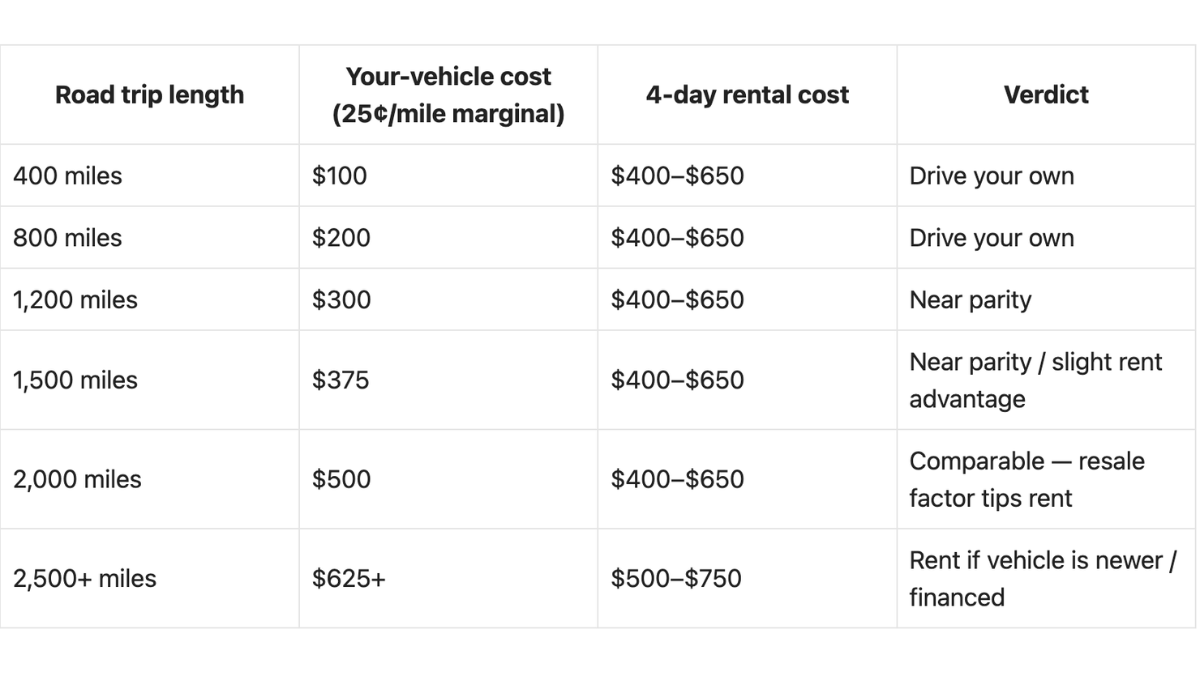
Marginal cost (operating only, fuel + maintenance) on paid-off vehicle. All-in cost on financed vehicle is 3× higher at 77¢/mile. “Resale factor” refers to protection of trade-in value on vehicles under 60,000 miles.
The Non-Financial Factors That Tip the Decision
Cost is not the only variable. Several practical factors fall consistently on one side:
Favor renting: You’re flying to a start city and need a car on arrival. You want a specific type of vehicle (large SUV for six passengers, AWD for mountain terrain) that you don’t own. Your daily driver has an unresolved mechanical issue. You’re towing — and your vehicle’s tow rating is marginal for the trailer you’ve already rented.
Favor driving your own: You need specific aftermarket equipment — a roof box, a hitch rack, a dog crate that fits the specific cargo floor. You have young children whose car seats are already installed and adjusted. The rental pickup logistics add two hours and $80 in airport fees to a drive that could start from the driveway. Your vehicle has 130,000 miles and the depreciation question is moot.
U.S. and Canada Note
For Canadian drivers, rental pricing in major markets (Toronto, Vancouver, Calgary) runs approximately 15–25 percent higher than equivalent U.S. markets in peak summer season, particularly at airport locations. A four-day midsize SUV rental in July from YYZ or YVR typically costs $550–$850 CAD including taxes — meaningfully more than the U.S. baseline.
This shifts the breakeven in Canada toward driving your own vehicle in more scenarios. A paid-off family vehicle at Canadian fuel prices ($1.70/litre) costs approximately $0.20–$0.25 CAD per km in fuel alone on a highway trip — for a 2,400 km round trip, that’s $480–$600 in fuel regardless, making the rental add-on cost harder to justify unless the resale value or mechanical insurance arguments apply.
SOURCES
- AAA 2025 Your Driving Costs: total annual ownership cost $11,577 / $964.78/month; depreciation $4,334/year; finance charges $1,131; insurance $1,694; license/registration/taxes $813; fuel 13.0 cents/mile; Greg Brannon quote on full ownership cost consideration; methodology: five-year ownership, 15,000 miles/year, 75,000 total miles
- NerdWallet citing AAA 2025: total ownership cost $11,577; $965/month; depreciation $4,334 average annual; insurance average $1,694 annual; fuel 13 cents/mile at 15,000 miles = $1,950 annually
- NerdWallet rental pricing analysis: average weekly rental $481–$555 depending on advance booking; 13% cheaper booking 7 days vs 91 days in advance; National highest at $600.92/week; Thrifty cheapest at $414.34/week; prices up ~35% since pre-pandemic baseline
- KAYAK market data: July is most expensive rental month at average $110/day for SUVs; October cheapest at ~$80/day; booking 3+ days in advance helps pricing
- AAA/ACG 2025 vehicle cost overview: depreciation largest single ownership cost; fuel one of most variable costs; hybrid vehicles have second-lowest total ownership costs; 15-20% depreciation in first year; ~15% annually for next four years