

The 2026 Toyota RAV4 Hybrid is, by almost every conventional measure, excellent. It is the best-selling nameplate globally, just edging the Tesla Model Y. It has been completely redesigned for 2026 in its sixth generation. It gets 39–42 mpg highway depending on trim. It tows 3,500 pounds. It is reliably brilliant at being a hybrid compact SUV.
It may still be the wrong vehicle for your weekend road trips.
This is not a flaw article. The RAV4 Hybrid does not have flaws so much as it has a specific character — an engineering philosophy optimized for certain buyers and certain use cases. When those buyers try to use it as a long-haul weekend vehicle for two adults and two kids, or as a quiet two-hour highway cruiser, or as the vehicle whose rear seat adults find genuinely comfortable for three hours, that engineering philosophy stops being an advantage.
Here is a clear-eyed assessment of when the 2026 RAV4 Hybrid is the wrong choice — and what to buy instead.
Quick Takeaways
- The 2026 RAV4 Hybrid has been fully redesigned and is genuinely improved — but Motor1’s first-drive review of the 2026 model calls it “still too loud for my liking,” with road and engine noise described as “noticeable across the lineup”
- Rear legroom of 37.8 inches makes the RAV4 Hybrid tighter in the back seat than the Honda CR-V Hybrid (41.0 inches) by 3.2 inches — a meaningful difference over a three-hour drive for adult rear passengers
- The RAV4 Hybrid’s front seats are the softest of the mainstream compact hybrid SUV segment, which reads as comfortable in a showroom test and becomes postural instability after two hours of sustained highway driving
- U.S. News’ 2026 RAV4 review describes steering that is “heavily boosted and more artificial than natural” — a characteristic that reduces highway engagement and confidence on mountain curves
- The RAV4 Hybrid now offers FWD configurations for the first time in 2026 — if you are cross-shopping the LE or SE FWD to save on price, you are removing the AWD that has historically been one of the vehicle’s primary value propositions
- Three alternatives that outperform the RAV4 Hybrid in specific road-trip scenarios: the Honda CR-V Hybrid (better space and ride quality on rough roads), the Mazda CX-50 (quieter, better seats, more driver engagement), and the Toyota Sienna Hybrid (for families who have quietly been trying to fit three kids into a compact SUV and failing)
The Noise Problem the Sixth Generation Did Not Fully Solve
Let’s start with the RAV4 Hybrid’s most persistent complaint, because the 2026 redesign raised expectations that acoustic quality would be substantially improved.
Motor1’s first drive of the sixth-generation 2026 RAV4 is specific: “Just like the previous model, though, the 2026 RAV4 is still too loud for my liking. The engine is rumblier than many of its competitors, and road noise is noticeable across the lineup.” The reviewer goes further, noting that the Woodland trim — with its all-terrain tires — is “the worst offender” for noise.
Consumer Reports, reviewing the RAV4’s prior generation, characterized the noisy engine as something that “hurts the driving experience” and rated the hybrid version’s overall noise as “just average among peers.”
For a daily commuter, average-among-peers noise is acceptable. A short drive through suburban traffic gives the cabin acoustics little time to register. For a weekend road trip — say, the five-hour drive from Denver to Moab, or the four-hour run from Minneapolis to the Boundary Waters, or the Highway 99 run from Vancouver to Whistler — sustained cabin noise is the background condition for every conversation, every attempt at the kids sleeping, and every hour of highway audio. The difference between a genuinely quiet cabin and an average-among-peers cabin becomes measurable fatigue.
The Mazda CX-50, in direct comparison, illustrates the gap. Edmunds’ review is precise: the CX-50 “settles down nicely on the highway, with only a mild amount of wind and road noise.” The two vehicles occupy similar price points. They carry similar passenger capacity. The acoustic character is not similar, and that matters on a 500-mile weekend run.
The Rear Seat Problem No One Discusses at the Dealership
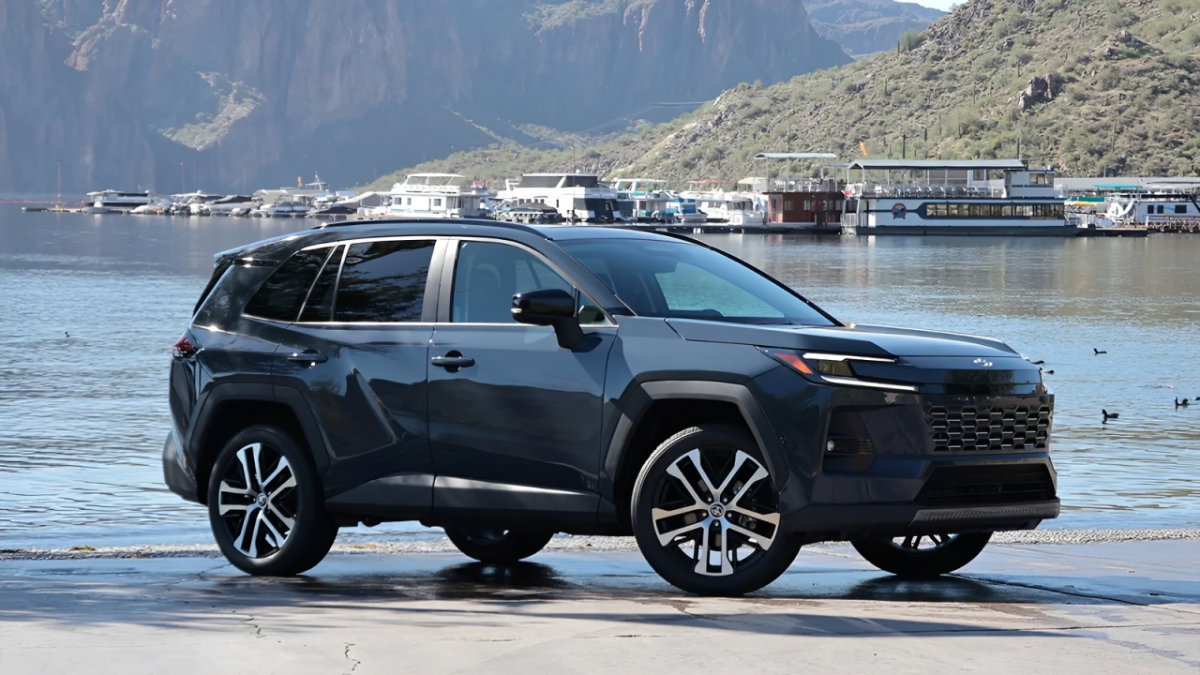
The 2026 RAV4 Hybrid’s rear legroom is 37.8 inches. The 2026 Honda CR-V Hybrid’s rear legroom is 41.0 inches. That 3.2-inch gap does not appear in any dealership conversation and rarely survives contact with the excitement of test-driving a new vehicle.
Three hours into a drive, the adult in the back seat of a RAV4 Hybrid notices it.
This is not a manufacturing defect or an oversight. The RAV4’s packaging was optimized for a different configuration: compact exterior footprint, elevated ride height, all-wheel drive hardware that consumes floor space. The result is a vehicle whose interior dimensions do not match its exterior presence. The RAV4 Hybrid looks like a spacious SUV from the outside. Inside, the rear seat is competitive with much smaller vehicles.
For a family of four where the adults ride in front, this is irrelevant. For a family where grandparents, teenagers, or adult friends ride in the back seat for multi-hour trips, it becomes a recurring compromise. The CR-V Hybrid costs approximately $2,000–$4,000 more at equivalent trim levels and provides a rear seat that adults can actually use for a three-hour trip without mentioning their knees.
Autoblog’s direct 2026 comparison between the RAV4 and CR-V documents this: “The 2026 Honda CR-V Hybrid boasts 103.5 cubic feet of passenger volume, 41.0 inches of rear legroom… The 2026 Toyota RAV4 has just 98.9 cubic feet of passenger volume, 37.8 inches of rear legroom.”
If the back seat is occupied by more than young children on your weekend trips, the RAV4’s packaging works against you.
The Seat Comfort Paradox
The RAV4 Hybrid’s front seats are well-received in short-duration testing, and that reception is genuine: the seats are soft, supportive-feeling on first contact, and unremarkable in the best sense for the first 45 minutes of any drive.
The problem is what “soft” means at the two-hour mark. A softer seat cushion compresses under sustained load. The initial pliant surface that felt supportive at the dealership becomes a less-differentiated surface at hour two of a highway cruise. Drivers who are attentive to their lumbar support begin making micro-adjustments — shifting, pressing back against the seat — that signal the transition from support to insufficient support.
This is not unique to the RAV4, but it is more pronounced here than in either the Mazda CX-50 or the Honda CR-V. The CX-50’s seats are firmer by design — Mazda’s engineering explicitly prioritizes what the company calls a “driver’s seat” approach to seating — and this firmness, which feels less immediately comfortable in a showroom, sustains support better over three hours of highway driving. The CR-V’s seats are between the two: neither the CX-50’s firmness nor the RAV4’s softness, with a lumbar support that is adequate for most adult body types over medium-duration drives.
For road trippers who spend five to eight hours per driving day, seat character is a purchasing criterion that showroom tests structurally cannot evaluate.
The FWD Edition: Removing the Best Argument for the Price
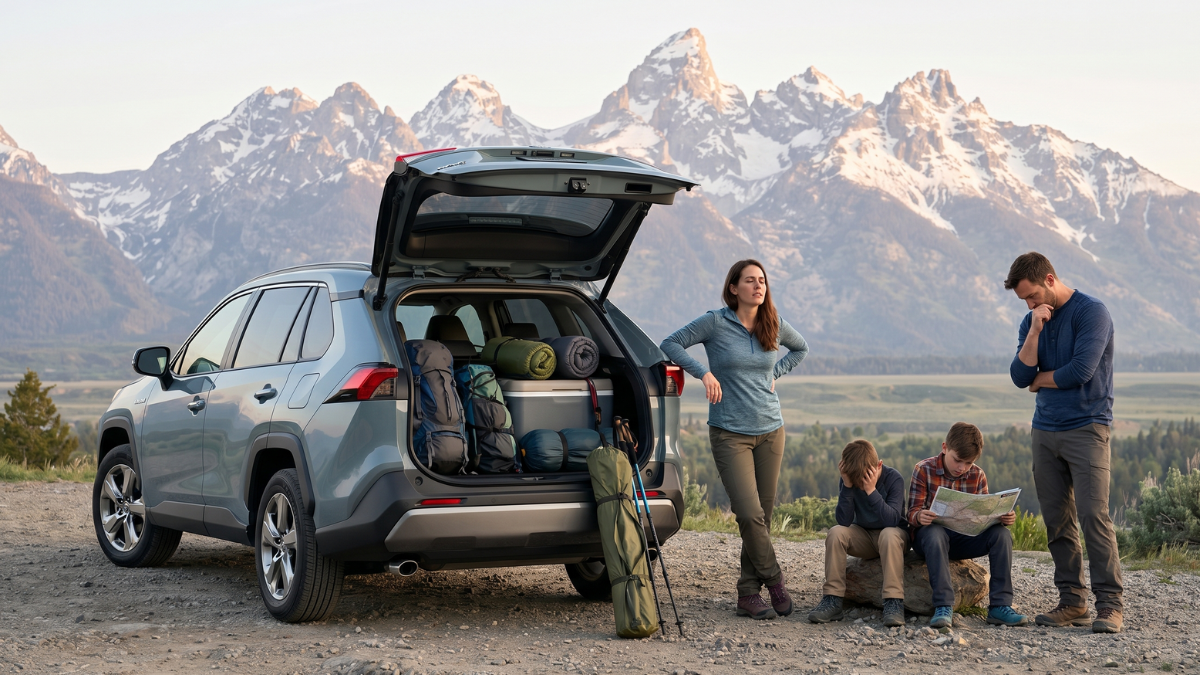
The 2026 RAV4 Hybrid introduces front-wheel drive configurations for the first time — the LE FWD and SE FWD, starting around $33,350. This is a meaningful change in the vehicle’s value equation, and not necessarily in the direction buyers expect.
The RAV4 Hybrid’s historical value case rested on this proposition: you pay a premium over a non-hybrid compact SUV, and you receive both improved fuel economy and standard AWD. The hybrid system’s rear electric motor provides the AWD at a cost lower than mechanical AWD, bundling two features — efficiency and traction — into a single price.
Remove the AWD and the proposition changes. A 2026 RAV4 Hybrid LE FWD at $33,350 is a front-wheel drive hybrid SUV with excellent fuel economy (47 city / 40 highway per EPA for LE FWD). That is genuinely impressive efficiency. But the buyer is now in a category where the Honda CR-V Hybrid FWD (43 city / 36 highway) and the Mazda CX-50 Hybrid (39 city / 37 highway) are direct competitors, and neither has the RAV4’s cabin noise or rear legroom compromise.
For buyers cross-shopping the FWD LE to get into the $33,000–$35,000 range: the number on the window sticker is right, but the configuration removes the feature — AWD — that most buyers considered the RAV4’s defining practical advantage over the competition.
When the 2026 RAV4 Hybrid Is Unambiguously the Right Choice
This requires saying: the RAV4 Hybrid earns its sales numbers for legitimate reasons, and there are specific situations where it is the correct answer.
You tow a small trailer or boat regularly. At 3,500 lbs — versus the CR-V’s 1,000 lbs — the RAV4 Hybrid is the only hybrid compact SUV in the segment that handles a legitimate trailer. If a camping trailer, utility trailer, or small boat is part of your road trip profile, the RAV4 Hybrid is the only compact hybrid SUV that serves the use case.
You need genuine AWD on mountain winter approaches. The RAV4 Hybrid’s electric AWD system is specifically calibrated for this. Toyota’s hybrid AWD delivers torque independently to the rear wheels with no mechanical connection — meaning it responds faster than a mechanical system to traction loss. For families in Colorado, Utah, Montana, or BC who regularly access ski resorts or mountain towns on snow-covered grades, this system is a meaningful functional advantage.
Reliability and long-term ownership certainty matter above everything else. Toyota’s reliability reputation is not a marketing claim; it is documented in J.D. Power and Consumer Reports data over years of accumulated ownership reports. For a family that will own this vehicle for ten years and 150,000 miles, the RAV4 Hybrid’s long-term dependability record is a purchasing argument that no competitor fully matches.
You drive primarily in city and suburban conditions. The RAV4 Hybrid’s noise, seat, and legroom characteristics matter most at sustained highway speed on long trips. For a family whose primary use case is school runs, grocery trips, and occasional 90-minute drives to a regional destination, the RAV4’s compromises are largely invisible.
The Alternatives — Matched to the Right Buyer
If you want a quieter, more engaging highway cruiser with better seats: Mazda CX-50 (2.5 Turbo or Hybrid). Firmer ride, 38.3 inches of rear legroom, significantly lower highway noise floor. Not as quiet as the CR-V for rough-road compliance, but the best seat support in the segment for sustained highway driving. The CX-50 Turbo starts around $36,000 and represents a different engineering philosophy: driver-oriented rather than passenger-comfort-led.
If rear legroom and ride quality on rough roads matter more than noise or seat firmness: Honda CR-V Hybrid. Three more inches of rear legroom than the RAV4, better suspension compliance on patched interstate and Trans-Canada Highway surfaces, physical climate controls that reduce driver-distraction on long runs. The CR-V Hybrid AWD starts approximately $3,500 more than the RAV4 LE AWD — a real price gap, but one that buys a meaningfully different road-trip experience for rear passengers.
If you have three children and have been trying to make a compact SUV work: Toyota Sienna Hybrid. This is the option that compact-SUV buyers most consistently resist and most consistently appreciate after making the switch. The Sienna provides more than 15 additional inches of interior space, five more inches of third-row legroom, sliding doors that transform every rest stop loading sequence, and 36 mpg combined from its standard hybrid powertrain. It starts at $41,615. It is a minivan. It is also, for a specific family profile, a dramatically better road trip vehicle than any compact SUV — including the RAV4 Hybrid.
The Honest Summary
The 2026 RAV4 Hybrid is an excellent vehicle. It is not excellent for every use case. It is noisier than its competitors at highway speed. Its rear seat is tighter than the CR-V’s in a category where the difference matters over time. Its seats are optimized for short-term comfort rather than long-haul support. And its new FWD configurations, while correctly priced, remove the feature that has historically made the RAV4 Hybrid’s premium defensible.
Buy it if you tow, need proven AWD for winter mountain access, or prioritize long-term ownership reliability above all else. Look elsewhere if your primary use case is highway road trips where cabin acoustics, rear passenger space, and sustained seat support are the variables that determine whether everyone arrives in good condition.
SOURCES
- Motor1 2026 RAV4 first drive: “still too loud for my liking — the engine is rumblier than many of its competitors, and road noise is noticeable across the lineup”; Woodland worst for noise; steering “feels slightly more vague and less engaging” than CR-V; composed handling balance noted
- Consumer Reports RAV4 overview: “the noisy engine hurts the driving experience”; hybrid version “rated its overall noise as just average among peers”
- U.S. News 2026 RAV4 review: steering “heavily boosted and more artificial than natural, sending little feedback to your hands”; RAV4 acceleration advantage confirmed; seat comfort characterized as adequate; composure on mountain roads noted
- Autoblog 2026 direct comparison: CR-V 41.0 in rear legroom vs. RAV4 37.8 in; CR-V 103.5 cu ft passenger volume vs. RAV4 98.9 cu ft; RAV4 3,500-lb tow rating vs. CR-V 1,000 lbs; CR-V steering more communicative. Note: review covers off-road Woodland and TrailSport trims specifically; legroom and passenger volume specs apply across lineups
- Edmunds CX-50: “settles down nicely on the highway, with only a mild amount of wind and road noise”; firmer ride confirmed; seats “supportive and well-cushioned”
- U.S. News CR-V Hybrid vs. RAV4 Hybrid: CR-V wins interior features, seat comfort, cargo access, ride quality; RAV4 wins on price and acceleration; CR-V AWD 40/34/37 mpg; RAV4 AWD 46/39/42 mpg for LE/SE
- Toyota dealer source confirming 2026 RAV4 is “now in its 6th generation” hybrid-only; EPA figures LE/SE AWD 46/39/42 mpg; LE FWD 47/40/43 mpg; RAV4 LE FWD starting $33,350