

According to Car and Driver’s specs table for the 2026 Toyota RAV4, cargo volume is listed at 37.8 cu ft behind the rear seats and 70.4 cu ft with the seats folded. Honda’s official 2026 CR‑V trim comparison, meanwhile, lists 39.3 cu ft / 76.5 cu ft (rear seat up/down) on several gas trims, while some hybrid trims show smaller “rear seat up” cargo figures (for example 36.3 or 34.7 cu ft) even as the chart still lists 76.5 cu ft max. Those headline numbers are close, but weekend travel is rarely decided by a single cubic‑foot figure. The “cooler + luggage” question is really about shape (wide and square vs narrow and tall), load height, and whether the second row folds and locks in a way that keeps the cargo floor usable. This guide compares the 2026 Toyota RAV4 and 2026 Honda CR‑V through a practical weekend lens: one mid-size cooler, two carry‑ons, and the soft bags that always show up last.
Quick takeaways
- Numbers (rear seats up): Honda’s trim comparison lists 39.3 cu ft behind the second row on multiple gas trims, while Car and Driver lists the 2026 RAV4 at 37.8 cu ft. The difference is small on paper.
- The real decider: Edmunds describes the RAV4 cargo area as wide and square, which can make cooler-and-suitcase packing simpler than a “tall but narrow” space.
- Folded-seat reality: Car and Driver lists the RAV4 at 70.4 cu ft with the rear seats folded.
- Folded-seat advantage: Honda lists 76.5 cu ft max cargo with the second row down on the CR‑V, which can matter if the weekend plan includes bulkier gear.
- Hybrid note (CR‑V): Honda’s trim chart shows smaller “rear seat up” cargo on some hybrid trims (for example 36.3 and 34.7 cu ft) than on gas trims, so confirm the exact trim before assuming 39.3.
- Best practice: Bring the cooler’s measurements to the test drive and do a fast “floor-shape check” (wheel-arch intrusion, cargo-floor step, lift-over height).

Step 1: Use one set of numbers, then move to shape
Cargo-volume figures are useful, but they do not always tell how easy a weekend load will be.
For 2026:
- Car and Driver’s specs table lists the 2026 RAV4 at 37.8 cu ft cargo capacity (rear seats up) and 70.4 cu ft with the seats folded.
- Honda’s official CR‑V trim comparison lists 39.3 cu ft (rear seats up) on gas trims and 76.5 cu ft with the second row folded (max cargo, SAE).
- Edmunds lists the 2026 RAV4 at 37.8 cu ft behind the second row and 70.4 cu ft with the rear seats folded.
- Edmunds lists the 2026 CR‑V at 39.3 cu ft cargo capacity with all seats in place and 76.5 cu ft maximum cargo capacity.
As of March 8, 2026, Car and Driver lists the RAV4 cargo figures above, and Honda’s trim chart lists the CR‑V figures above; automaker and outlet pages can be updated mid‑year, so verify the specific trim on the vehicle being cross‑shopped.
The takeaway: both are in the “big compact SUV” tier, and either can do a weekend. Now shift to the pieces that change lived experience.
Step 2: The “cooler + luggage” test (what actually fits)
A common weekend kit looks like this:
- One medium hard cooler (typical “mid-size” footprint),
- Two carry-on suitcases,
- One soft duffel (the “flex” bag),
- And one odd-shaped item (camp chair, stroller, folding table).
Here’s what changes packing difficulty:
Cooler fit is about width and a flat floor
A cooler usually wants to sit flat and stable. The RAV4 tends to score well here because Edmunds describes its cargo bay as wide and square, with little intrusion from wheel arches and a boxier, upright shape that creates a taller cargo area.
If the cooler can sit flat behind the second row without stealing suitcase space, the rest of the packing becomes easy.
Suitcases care about floor length, not just cubic feet
Carry-ons are rectangular. They prefer a long, uninterrupted floor rather than a tall vertical stack.
A cargo area can have strong “cu ft” numbers but still feel fussy if the floor steps up, narrows between wheel wells, or forces the suitcases into a tilted orientation.
The duffel is the tell
The soft duffel is usually the last bag. If the cargo space is square, the duffel tucks beside the cooler. If it is narrow, it ends up on top, raising the load height and blocking rear visibility.
Step 3: Where the CR‑V can win (and why it matters)
Honda’s official specs emphasize the CR‑V’s max cargo capacity of 76.5 cu ft with the second row folded down, which is a meaningful “bulk gear” advantage on paper versus the 70.4 cu ft figure listed for the RAV4 in Edmunds’ 2026 specs.
That gap matters when the trip includes:
- a stroller or pack‑and‑play,
- a large dog crate,
- coolers plus bulk grocery boxes,
- or a “bring the gear home” return leg.
It can also matter for people who like to keep one seat folded most of the time. A larger max capacity often correlates with a more forgiving cargo shape when one side is down and one passenger still rides in the back.
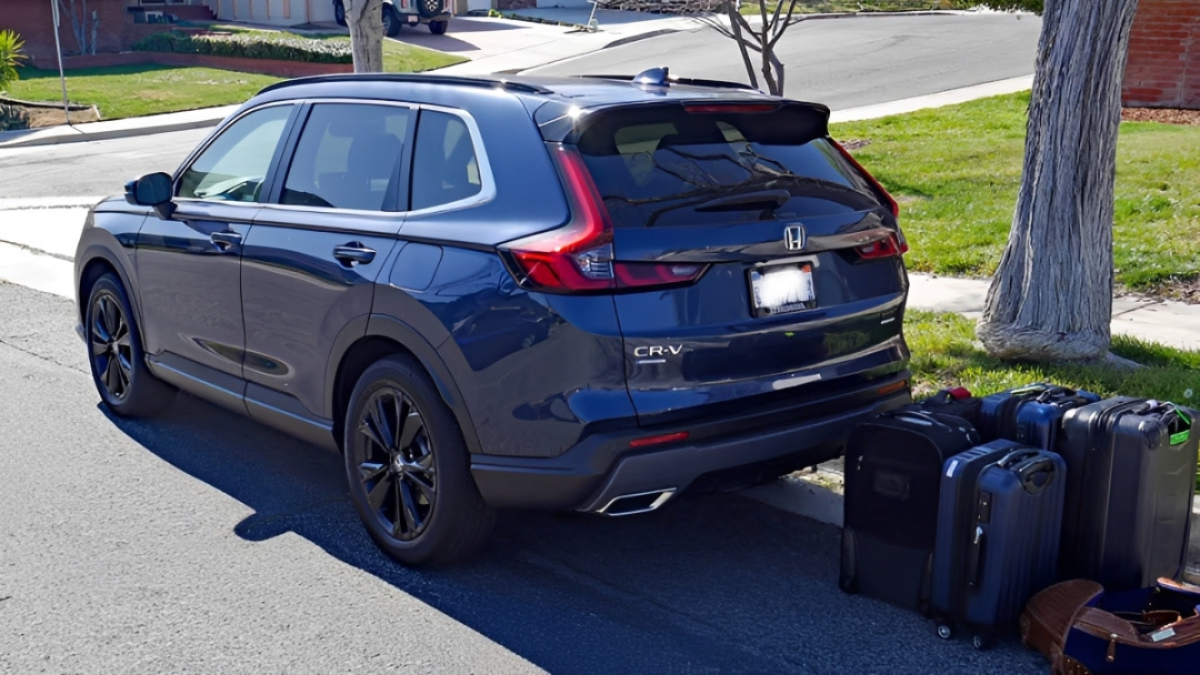
Step 4: Where the RAV4 can feel easier on a simple two-person weekend
The RAV4’s practical advantage tends to show up with the “normal” weekend load: cooler, luggage, and a couple of grocery stops.
Edmunds’ description of the RAV4 cargo area as wide and square is not just marketing language—it points to a packing reality: fewer awkward gaps and fewer forced vertical stacks.
Toyota’s consumer RAV4 page typically presents cargo capacity by configuration and footnote, so it’s safer to treat Car and Driver’s 37.8‑cu‑ft figure as the clean comparison baseline here. Even if the headline numbers are close, the “ease” can still be better if the space is more rectangular.
In weekend travel, a cleaner rectangle often beats a slightly larger but more irregular volume.
Step 5: Hybrid trims can change the CR‑V’s “seats up” space
One detail that can trip up shoppers: Honda’s trim comparison lists different cargo volumes behind the second row depending on powertrain/trim.
In Honda’s 2026 CR‑V trim chart:
- Several gas trims list 39.3 cu ft / 76.5 cu ft (rear seat up/down).
- Hybrid trims list smaller rear-seat-up cargo figures (for example 36.3 and 34.7 cu ft), even while the chart still shows 76.5 cu ft max with the rear seats down.
The weekend lesson is simple: if the shopper is cross‑shopping a CR‑V Hybrid against a RAV4, confirm the exact “seats up” number for the trim being considered before treating 39.3 as universal.
What changed (and why this is a 2026 shopping question)
The cargo conversation is shifting a little in 2026 for one reason: many compact SUVs now come in multiple powertrain flavors, and the battery/packaging decisions can affect “seats up” practicality even when the “seats down” max number looks similar.
That is why the most reliable approach is not to pick a winner from a single table. It is to decide what the weekend load really is—and then validate it on the trim that will actually be purchased.
What this means in the U.S.
A U.S. weekend trip often has three cargo moments:
1) Day 1 load: cooler + luggage + groceries.
2) Mid-trip add-ons: a case of drinks, a souvenir box, wet gear.
3) Return leg: everything is messier and slightly bigger than it started.
In that pattern:
- a wide, square opening reduces the “parking lot puzzle,”
- a low-effort fold helps when a bigger box shows up late,
- and a cargo floor that stays usable with one seat down makes a real difference for families.
What you can do: a 6-minute test you can repeat on both
Bring a tape measure or write down three numbers:
- cooler length/width/height,
- carry-on size,
- and the longest “odd item” (chair, stroller, etc.).
Then do this at the dealership:
1) Open width check: eyeball wheel-arch intrusion and the narrowest point.
2) Floor step check: fold the second row and feel for a step-up that forces tilting.
3) Cooler placement: try the cooler “flat and forward” (closest to seatbacks).
4) Suitcase pairing: place two carry-ons side-by-side; note whether one must rotate.
5) Visibility check: close the liftgate and see how high the load would sit if the duffel goes on top.
6) One-seat-down reality: fold only one side and see whether the remaining side still has usable floor.
Bottom line: who fits cooler + luggage better?
For a typical two‑adult weekend with a medium cooler and two carry-ons, the RAV4 often feels easier because the cargo area is described as wide and square and the “rectangle” is friendly to rigid items.
For a weekend that involves bulk gear, a stroller, or “half the row down all the time,” the CR‑V’s larger listed max capacity and strong official cargo numbers make it the safer bet—especially if the buyer confirms the exact trim’s “seats up” volume.
The best answer comes from combining the official numbers with a fast in-person packing test. A 6‑minute check in the lot beats a 60‑minute argument about cubic feet.