
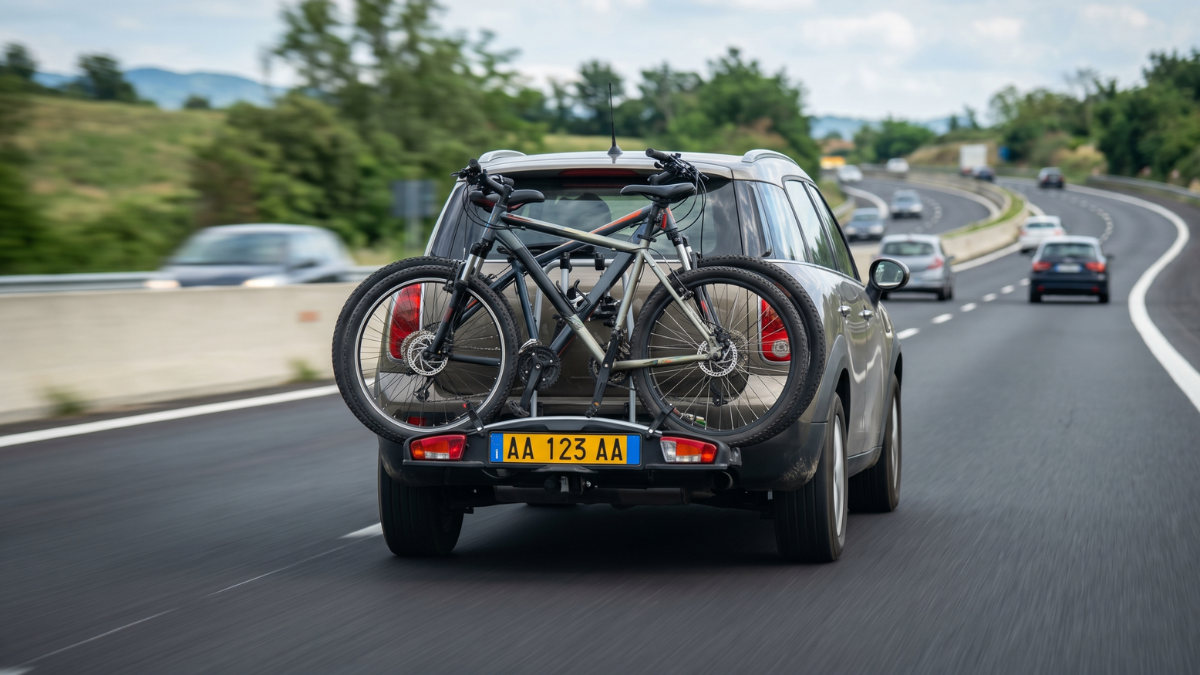
The family bought the hitch for exactly this purpose: four bikes, one rack, one vehicle, the trailhead on the other side of a two-hour Interstate run. The rack slides into the receiver, the bikes go on, the liftgate barely clears the rear bike, and the SUV pulls out of the driveway with a barely visible rear plate and a rear suspension that has dropped two inches. On the highway, everything feels fine at 45 mph. At 65 mph, the steering begins to feel different — slightly lighter, slightly vague, not quite connected to the road the way it was forty miles back. The driver moves the wheel a few degrees to correct for a lane change and the car moves a half-beat later than expected.
This is not a strange road. It is the same road. The difference is the weight behind the rear axle.
The physics of a hitch-mounted bike rack acting on a crossover’s steering is straightforward once it is explained, and almost nobody explains it before the purchase. The hitch class, the tongue weight rating, and the rack’s weight capacity are all printed clearly on spec sheets. The lever-arm dynamics that determine how much of that weight actually lifts off the front wheels — and what that does to steering feel at highway speeds — appear nowhere on the box.
Quick Takeaways
- A hitch-mounted bike rack positions all its weight on a lever arm extending behind the rear axle; the rear axle acts as the fulcrum, so weight behind it pushes the rear down and lifts the front up — reducing front tire contact pressure and making steering feel lighter and less responsive
- The Honda Element Owners Club forum technical discussion documents the practical ratio: “Every three pounds on the hitch lifts one pound off the front wheels” — at 150 lbs of hitch load, that is approximately 50 lbs removed from front-axle contact pressure
- Most compact crossovers (Honda CR-V, Toyota RAV4, Subaru Forester) have a vehicle tongue weight limit of 150–200 lbs in their owner’s manual — a figure that is the limiting constraint, not the hitch’s rated capacity; a 4-bike rack loaded with four typical mountain bikes or two e-bikes can exceed this figure before the first mile
- A substantial 4-bike platform rack such as the Hollywood Racks Sport Rider SE weighs approximately 80 lbs empty; four typical mountain bikes at 25–35 lbs each add another 100–140 lbs; total system weight: 180–220 lbs, which reaches or exceeds the 150–200 lb vehicle tongue weight limit of most compact crossovers
- E-bikes at 50–70 lbs each are the highest-risk scenario: two e-bikes on a 60-lb rack already total 160–200 lbs at the hitch ball — matching or exceeding the vehicle limit before adding the second pair
- In every U.S. state (with very few exceptions) and every Canadian province, bikes loaded on a hitch rack that obscure the license plate and rear lights constitute a traffic violation with fines ranging from $85–$500 CAD in Canada and $50–$300 in the U.S.
The Seesaw: Why Weight Behind the Rear Axle Lifts the Front
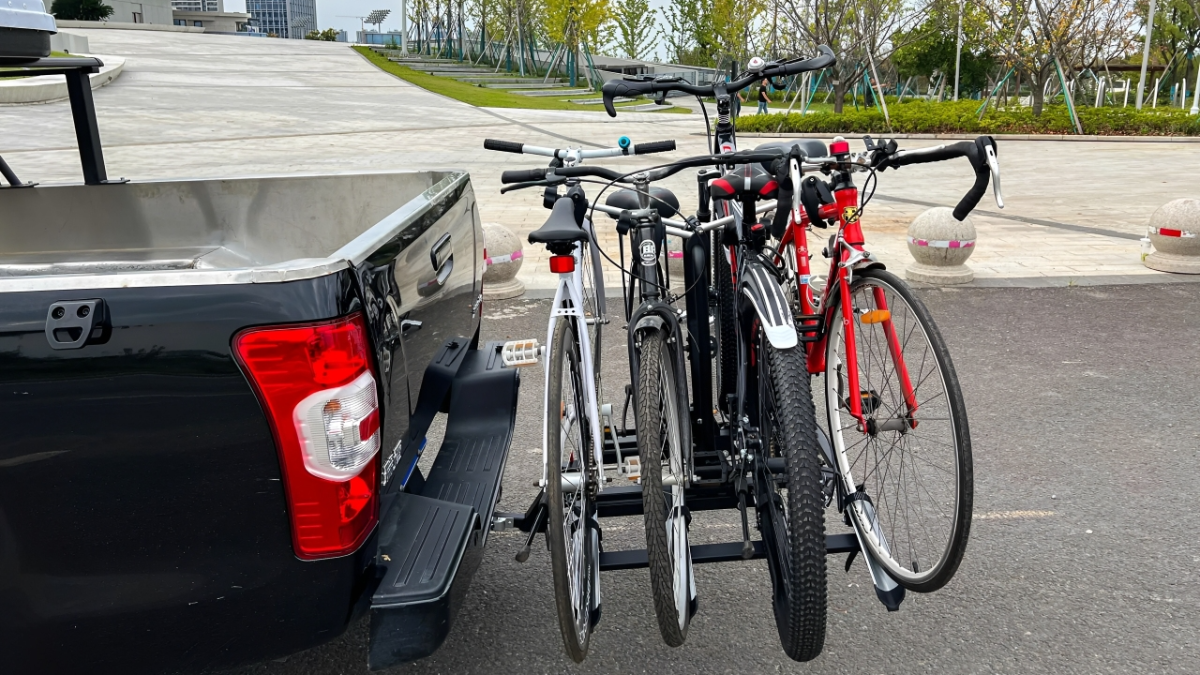
The steering effect of a heavy hitch rack is not intuitive when you are loading bikes in the driveway. The rack is on the back of the car. The car has four wheels. It does not seem like anything is being lifted.
The key is where the rear axle sits relative to the hitch receiver. On any passenger vehicle, the hitch receiver is mounted behind the rear axle — typically 18 to 30 inches behind the center of the rear axle on a midsize crossover. The rear axle is the pivot point. Everything behind it acts as one side of a seesaw. Everything in front of it acts as the other.
When weight is added behind the rear axle, the rear end is pushed downward. The vehicle pivots around the rear axle. The front end rises. The Honda Passport forum’s technical discussion of this mechanism describes it clearly: “The downward force applied further away from the rear axle will transfer load from the front axle and apply it to the rear axle — think of a see-saw. You can imagine that if the downward force was great enough or the distance from the rear axle sufficiently large, the car would pivot about the rear axle and the front suspension would lighten, upsetting weight distribution.” The same forum describes a motorcycle carrier scenario: “400 lbs of free-movement cantilevered weight on the end of a 2-ft ball mount lever, bouncing up and down, pivoting over the rear axle suspension like a see-saw.”
The amount of front-axle weight transferred depends on three things: the weight behind the hitch ball, the distance of that weight from the rear axle, and the vehicle’s wheelbase. Compact crossovers, which typically have shorter wheelbases than full-size SUVs, are more sensitive to this effect than larger vehicles.
The Mountain Bike Reviews forum captures the consequence for steering: “If the tongue weight is too heavy, the steering of the tow vehicle will be affected. Having more than 200 pounds out on a moment arm behind the car could affect steering and handling at high speeds.”
The RV towing physics literature describes the steering consequence at the tire contact patch level: “All that weight on the back acts like a lever, lifting the front wheels of your tow vehicle… reduces their contact with the pavement, making your steering feel light, vague, and unresponsive. In an emergency maneuver, you might not be able to turn effectively.”
Tongue Weight Explained: What the Number in Your Owner’s Manual Actually Means
“Tongue weight” is the downward force applied to the hitch ball by whatever is attached to it. For a bike rack, it is the total weight of the rack plus all bikes, because the rack’s extension arm holds that weight in the air, cantilevered from the receiver.
The critical number is the vehicle’s tongue weight limit, not the hitch’s.
A Class III aftermarket hitch installed on a compact crossover may be rated for 350–600 lbs of tongue weight — the hitch itself is structurally capable of handling that load. But the vehicle’s frame, rear unibody structure, suspension geometry, and handling dynamics were designed for a specific maximum tongue weight, stated in the owner’s manual. For most compact crossovers, this is 150–200 lbs.
The etrailer.com technical response on Honda CR-V bike rack loading is explicit: “You also need to check your manual for the car’s own tongue weight capacity, which could be less than the hitch’s. Neither limit can be exceeded.”
Hollywood Racks’ official technical documentation confirms what this means for Class I hitches: “They are not recommended for carrying more than 65 lbs/30 kg. The weight from the bikes can easily exceed the tongue weight due to the fact that as you move the bikes farther from the trailer hitch it dramatically increases the tongue weight.”
The lever arm problem. A bike rack does not position all four bikes directly over the hitch ball. The rack has an extension arm — typically 18 to 36 inches long — and the bikes are distributed across its width. Each bike’s distance from the rear axle determines its leverage contribution. The Electric Bike Review forum documents this: “This creates a ‘lever’ effect and can more than double the weight when measured at the hitch ball location.”
The practical weight calculation for 4 bikes on a crossover:
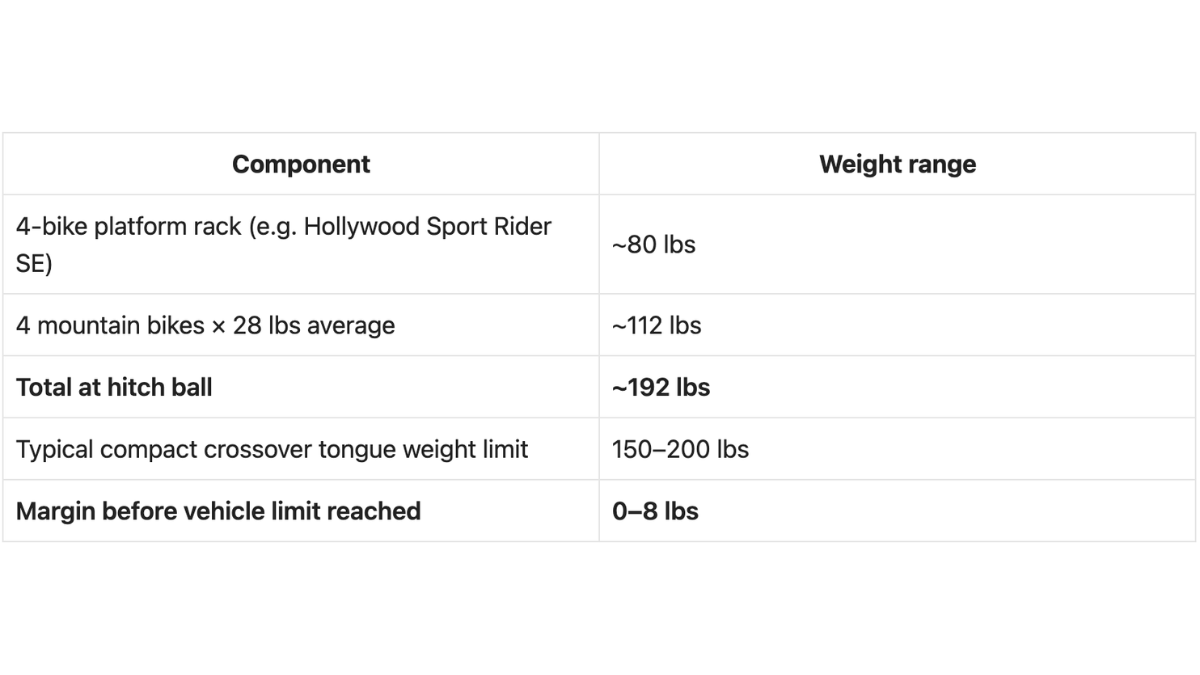
With any bike heavier than average, with gear strapped to the bikes, or with the rack extended via an adapter, this calculation hits or exceeds the vehicle’s limit.
For e-bikes, the margin disappears immediately:
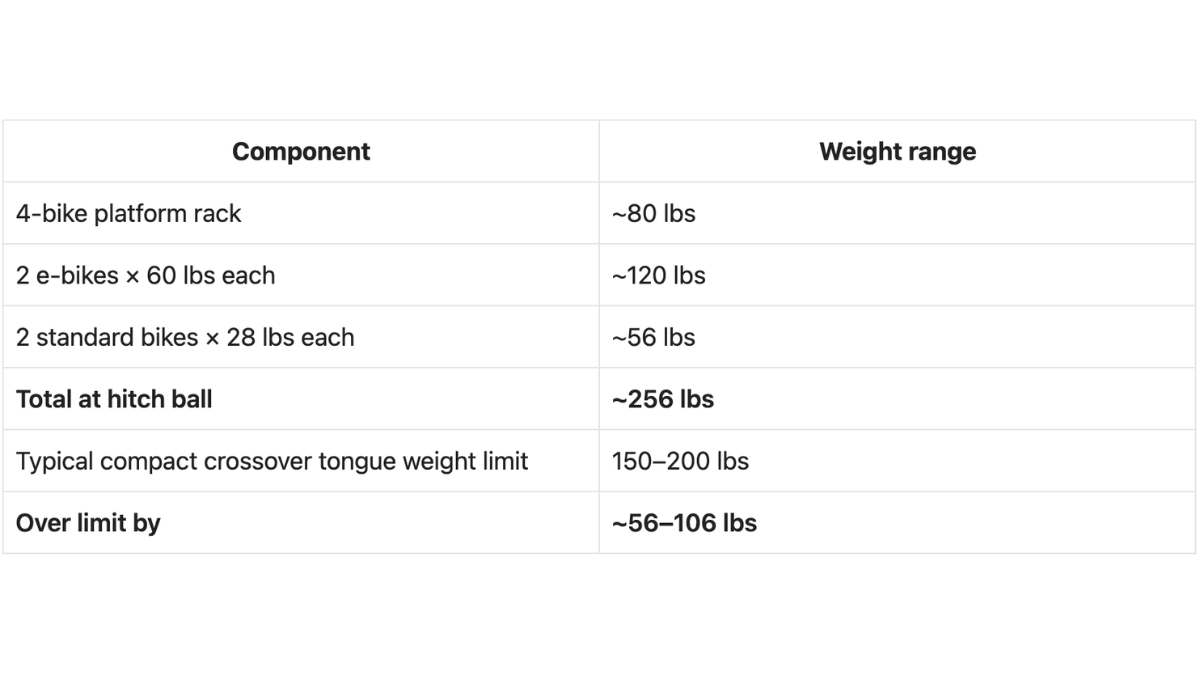
This is not a marginal exceedance. It is a configuration that many families with electric bikes may be running on every weekend trip.
Which Crossovers Have Which Limits
The vehicle tongue weight limit is found in the owner’s manual under the towing or hitch section. Below are typical limits for the crossovers most commonly paired with 4-bike racks:
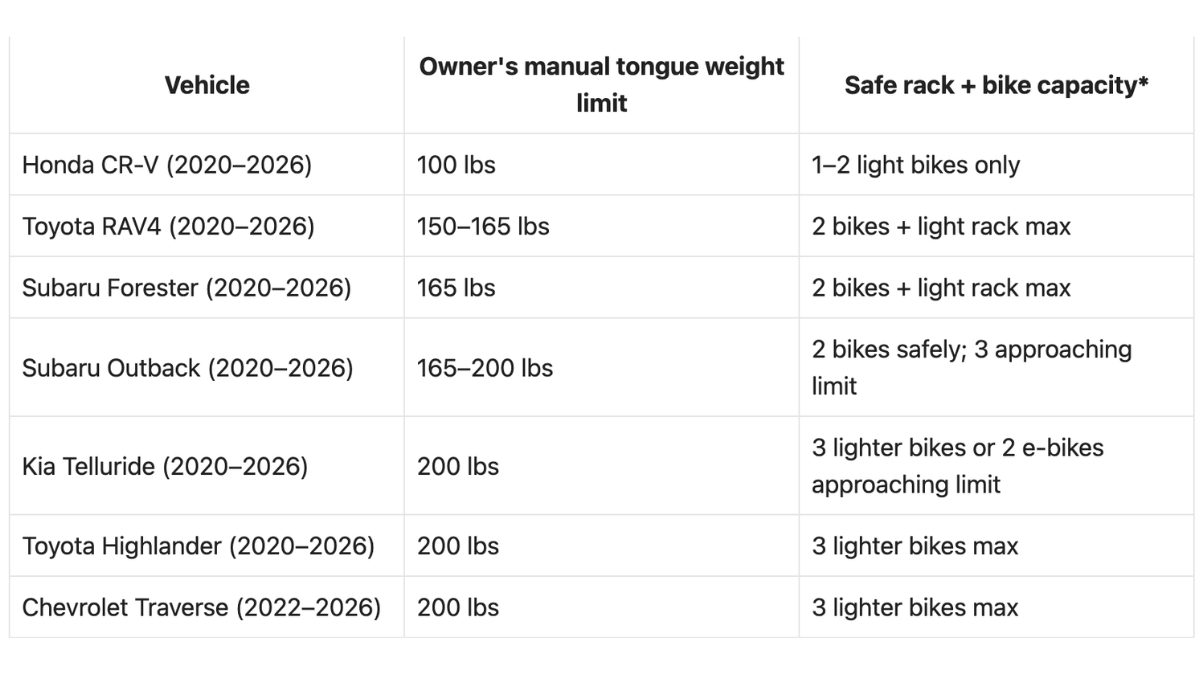
*Before the rack’s own weight; verify your specific model year’s owner’s manual before loading.
The MTBR forum community’s practical summary: “It’s very likely that the limiting factor is car controllability. If the tongue weight is too heavy, the steering of the tow vehicle will be affected. This!!! More so with shorter crossovers/SUVs that have a taller stance.”
What “Vague” Steering Actually Feels Like at Highway Speed
Front-end lift does not produce an immediate alarming event. The vehicle does not swerve. It does not feel dangerous in the way a blowout or skid does. The effect is more subtle and accumulates gradually as speed increases.
At 45–55 mph: No perceptible change. The rear suspension is compressed, the front is slightly lighter, but the steering still returns normal feedback.
At 60–65 mph: The first sign appears as a slight delay between steering input and vehicle response. The car still follows the wheel accurately, but the immediacy — the sense of being directly connected to the road — is reduced. Drivers often attribute this to tire pressure or a rough road surface.
At 70–75 mph: The steering feels “empty” or “floating.” Quick lane changes require larger inputs than usual. Wind gusts produce more lateral movement than the driver expects. The vehicle tracks straight but does not feel planted. In a crosswind, the front end wanders more than it did when the rack was empty.
The Electric Bike Forum owner who loaded two heavy bins on a hitch cargo carrier for a 230-mile move described the result directly: “Slightly squirrely steering for those miles as the front end lifts.” This is the driver-level description of the same physics that a 4-bike rack produces at higher load.
The effect is most consequential in three specific scenarios: rapid lane changes at highway speed (the margin for correction is reduced), emergency evasive maneuvers (the steering is less responsive precisely when maximum steering authority is needed), and crosswind exposure on bridge decks, open Interstate cuts, and rural plains routes.
Getting Four Bikes to the Trailhead Without Exceeding the Limit
For families that genuinely need to carry four bikes, several configurations can stay within the vehicle’s tongue weight limit:
Option 1: Mix roof and hitch. Two bikes on the roof, two on the hitch. This distributes the weight so neither system is at its limit. The aerodynamic penalty from roof-mounted bikes applies (→ see “The Factory Roof Rack Penalty” in this series), but the tongue weight stays within bounds.
Option 2: Use the lightest bikes closest to the vehicle. Position the two heaviest bikes closest to the receiver (minimizing lever arm for the heaviest contributors) and lighter bikes at the outer positions. On a typical 4-bike rack, the bike closest to the vehicle has roughly half the lever arm distance of the bike furthest out — so positioning heavier bikes nearest to the receiver reduces effective tongue weight contribution.
Option 3: Tow a small bicycle trailer. A properly loaded bicycle trailer distributes weight across the trailer’s own axle, dramatically reducing the tongue weight contribution at the vehicle’s hitch ball — typically to 10–15 percent of the trailer’s total load. For a trailer carrying 120 lbs of bikes, the tongue weight contribution is approximately 12–18 lbs, well within any crossover’s limit.
Option 4: Upgrade to a vehicle with a higher tongue weight limit. For families who regularly carry four full-size bikes, the vehicle’s tongue weight rating should be a purchase criterion. A full-size SUV like the Toyota 4Runner (500 lb tongue weight limit), Chevrolet Tahoe (750 lbs), or a truck with a Class IV hitch (900–1,000 lbs) eliminates the problem entirely.
The Hidden Ticket: License Plates, Taillights, and the Law
When four bikes are loaded on a platform-style hitch rack, the bikes’ frames, wheels, and pedals extend behind and above the rack’s tray. In most configurations, this load obscures the rear license plate, taillights, brake lights, and turn signals.
United States: NHTSA FMVSS 108 requires all required vehicle lighting to remain visible and functional at all times. If bikes obscure taillights, supplemental lighting that replicates brake, turn, and running light functions is required — connected to the vehicle’s trailer wiring harness. License plate visibility is governed by state law; most states require the plate to be “clearly visible” or “plainly legible” at all times.
- Virginia: $150 fine documented; no warning — hitch-mounted rack with two bikes was the obstruction
- Florida: $100–$150 per reader and enforcement reports; FHP actively patrols major routes
- California: ticket for obscured plate; supplemental lighting and plate relocation required
- New York: VTL 402 requires plates to be “conspicuously displayed”; actively enforced
- Colorado: mountain town police and State Patrol check rack setups regularly on cycling-destination routes
- Michigan: a 2018 law explicitly exempts bicycle racks and bikes from the plate obstruction statute — one of the very few U.S. exceptions
Canada: Every Canadian province requires the license plate to be unobstructed and visible at all times. There are no provincial exceptions equivalent to Michigan’s. Vancouver criminal lawyer Kyla Lee, quoted in the Globe and Mail: “As long as the licence plate was obstructed, you are guilty of the offence. Ignorance of the law is no excuse.”
- British Columbia: $109–$230 per DriveSmartBC; approximately 100 tickets issued annually in BC specifically for obscured plates; intersection safety camera systems and RCMP highway patrol both scan for plate visibility
- Ontario: $85 CAD per Highway Traffic Act Section 13, which requires plates to be “entirely unobstructed” at all times; Ontario Provincial Police enforce regularly
- Quebec: $30–$500 (Sûreté du Québec confirmed range)
- Alberta: fines under Highway Safety Act, Section 71(1); amount at officer’s discretion
The practical fix for both countries: A light board that plugs into the vehicle’s 7-pin or 4-pin trailer connector replicates all rear lighting on a bar mounted behind the bikes. A plate relocation bracket moves the license plate to the back of the rack, keeping it visible. Combined cost: approximately $50–$120 USD. The Virginia $150 fine alone pays for that kit twice over.
Three Checks Before the Next Trip
1. Look up your vehicle’s tongue weight limit. Open the owner’s manual and find the towing or hitch section. The number listed there is the vehicle’s limit — not the hitch’s. If you cannot find it, search “[make] [model] [year] tongue weight limit” at the manufacturer’s website.
2. Weigh the system. A bathroom scale under the loaded rack’s extension arm gives an approximate tongue weight reading. The number should be below the vehicle’s limit with margin for dynamic loading — bumps add momentary peak loads above the static figure.
3. Check the lights and plate before every departure. Walk to the rear of the loaded vehicle and confirm: license plate is fully visible, taillights are visible from directly behind, brake lights activate when the pedal is pressed, turn signals are visible through or around the bike load. If any check fails: the light board and plate relocation bracket install in under 30 minutes.
U.S. and Canada Route Note
The routes most traveled by families with bike racks are also the routes most subject to enforcement: mountain-access highways where cycling is a primary seasonal activity see concentrated bike rack traffic and corresponding enforcement attention.
U.S. routes: I-70 into Colorado’s Summit County corridor (Vail, Breckenridge, Keystone); I-90 into the Cascades; Highway 1 in Marin County, California; mountain roads in Colorado’s Front Range.
Canadian routes: Highway 99 (Sea-to-Sky) between Vancouver and Whistler — DriveSmartBC documents this corridor as actively monitored for plate obstruction in BC; Highway 93 (Banff–Jasper); Route 15 (Laurentians) north of Montréal. The $230 BC fine or $150 U.S. fine pays for approximately three light boards and two plate relocation brackets — enough to equip three vehicles for all future trips.
SOURCES
- Honda Element Owners Club forum: “Every three pounds on the hitch lifts one pound off the front wheels” — community-documented lever arm ratio; tongue weight technical analysis for 4-bike configurations; torque analysis showing rack weight distributed across lever arms can exceed rated tongue weight even under overall weight limit
- Mountain Bike Reviews forum: “If the tongue weight is too heavy, the steering of the tow vehicle will be affected — having more than 200 pounds out on a moment arm behind the car could affect steering and handling at high speeds”; “More so with shorter crossover/SUVs that have a taller stance”
- Honda Passport forum: “400 lbs of free-movement cantilevered weight on the end of a 2-ft ball mount lever, bouncing up and down, pivoting over the rear axle suspension like a see-saw”; front suspension lightens with excessive cantilevered hitch load
- Electric Bike Review forum: “This creates a lever effect and can more than double the weight when measured at the hitch ball location”; owner reports “Slightly Squirrely Steering for those miles as the front end lifts” from heavy cargo carrier load
- etrailer.com: “You also need to check your manual for the car’s own tongue weight capacity, which could be less than the hitch’s — neither limit can be exceeded”; Hollywood Racks Sport Rider SE 4-bike rack weighs approximately 80 lbs
- Hollywood Racks official technical guide: Class I hitches not recommended for more than 65 lbs/30 kg; “the weight from the bikes can easily exceed the tongue weight due to the fact that as you move the bikes farther from the trailer hitch it dramatically increases the tongue weight”
- RV tongue weight physics: “All that weight on the back acts like a lever, lifting the front wheels of your tow vehicle — reduces their contact with the pavement, making your steering feel light, vague, and unresponsive”; restoring front-axle weight restores steering
- Globe and Mail: Vancouver criminal lawyer Kyla Lee — “as long as the licence plate was obstructed, you are guilty of the offence — ignorance of the law is no excuse”; Ontario fine $85; BC fine range $109–$230; Quebec fine $30–$500
- DriveSmartBC: BC Motor Vehicle Act Regulations require lights not to be “shielded, covered or obscured”; licence plate must not be obstructed; $230 fine for obscured plate; BC issues approximately 100 such tickets annually
- mycargoracks.com: Virginia $150 fine for obscured plate from hitch-mounted bike rack — documented reader example, no warning issued; Ontario HTA Section 13 requires plate “entirely unobstructed”; practical license plate relocation and light board guidance
- Letrigo: U.S. state-by-state bike rack law summary; California, New York, Florida, Virginia enforcement; Texas explicit exemption for properly installed bike racks; Michigan 2018 exemption law