
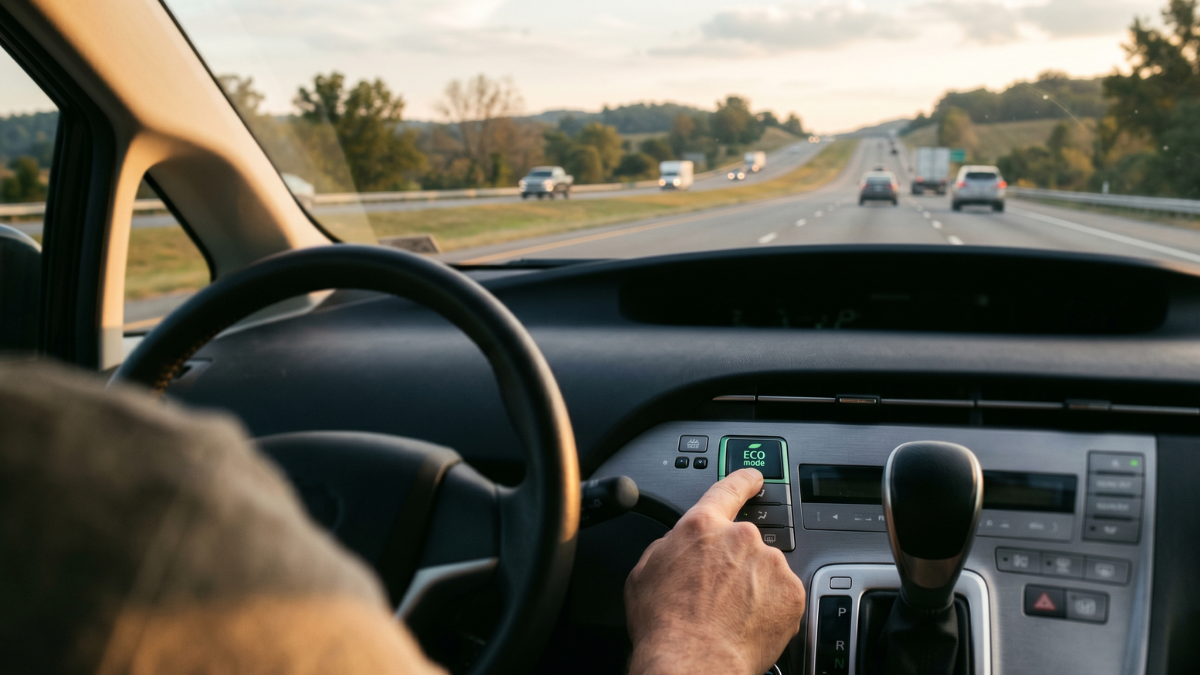
The button is right there on the console, labeled with a leaf or the word ECO, and the logic of pressing it before a road trip seems airtight: you want to save fuel, the car has a fuel-saving mode, you press the button. Done.
Except the button was designed for a different problem than the one you have on the highway. Eco mode is built around the physics of city driving — frequent stops, moderate speeds, an engine that keeps trying to accelerate when it should be coasting. On a flat street at 35 mph, Eco mode’s early upshifting and dampened throttle produce genuine fuel savings. On a rolling Interstate at 75 mph, those same behaviors work against you. The transmission resists downshifting when a grade demands it, the engine lugs in too tall a gear trying to maintain speed, the throttle opens further to compensate — and the fuel burned during that extended lugging period exceeds what a clean, prompt downshift in Normal mode would have cost.
Consumer Reports tested exactly this. Their highway fuel economy measurement at a steady 65 mph — an idealized flat-road scenario with the transmission already in overdrive — found that Eco mode “had no measured benefit.” And that result was for a flat road. Add rolling terrain, and the picture gets worse.
Quick Takeaways
- Eco mode adjusts three things: throttle response (dulled), transmission shift points (upshifts earlier, resists downshifts), and in many vehicles, AC output (reduced) — all calibrated for low-speed city use
- Consumer Reports found Eco mode had no measurable highway fuel economy benefit in steady 65 mph flat-road testing; the transmission is already in its tallest gear, so Eco’s early-upshift programming has nothing left to optimize
- On rolling terrain at 75 mph, Eco mode actively works against efficiency: the resistance to downshifting causes the engine to lug in an overly tall gear on grades, requiring more throttle input — and more fuel — than a prompt downshift in Normal mode would need
- Honda’s own Econ mode documentation explicitly warns: “In hilly/steep conditions, you may find that your vehicle actually loses speed and consumes more fuel on inclines with the mode on compared to off”
- The fuel penalty on a 400-mile highway run through rolling terrain can reach approximately 1–2 mpg compared to Normal mode — translating to roughly $4–$9 extra in fuel at current prices
- The right mode for the right road: Eco in stop-and-go city traffic (where early upshifting and throttle dampening actually reduce fuel consumption), Normal on rolling Interstate terrain, and Normal or Sport on mountain grades where prompt downshifts are essential
What Eco Mode Actually Does — and What It Was Built For
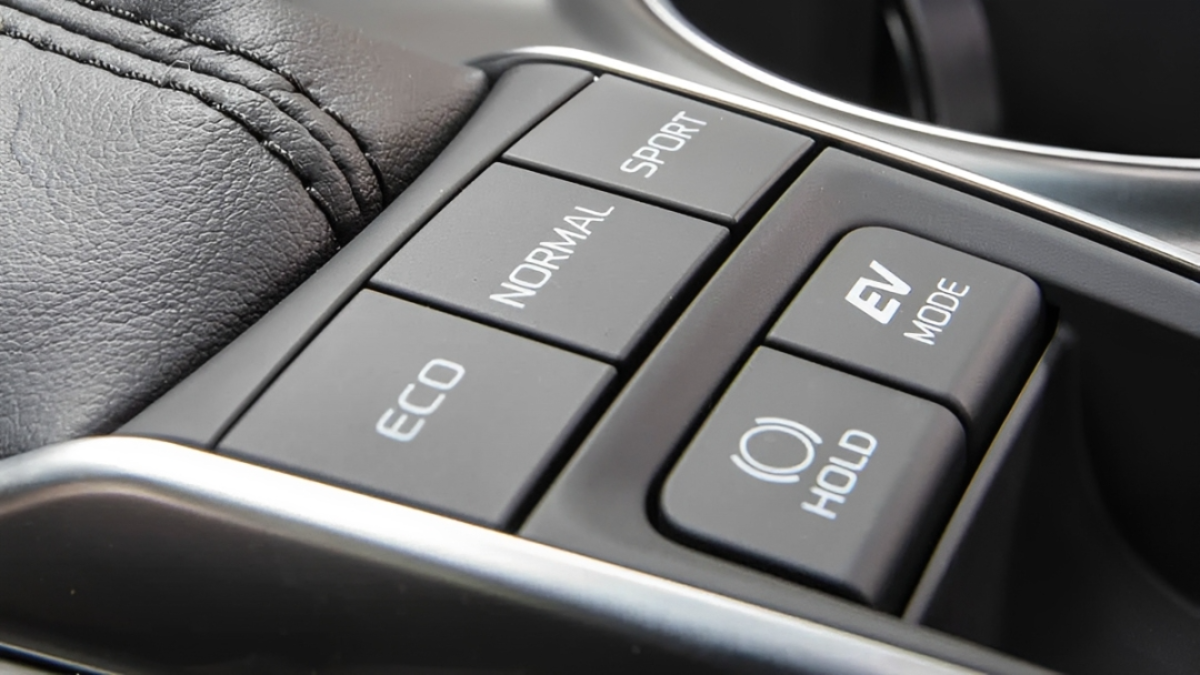
Every driving mode selector reconfigures the same three systems: throttle mapping (how sensitively the accelerator responds to pedal input), transmission shift programming (when the gearbox changes up or down), and in many vehicles, ancillary loads like the air conditioning compressor.
In Eco mode, these three systems are adjusted in the same direction: toward restraint. The throttle mapping is softened so that a given pedal position produces less engine response than it would in Normal mode. The transmission is programmed to upshift earlier — reaching the tallest available gear at a lower speed — and to resist downshifting when load increases. The AC compressor cycles more conservatively to reduce the parasitic load on the engine.
Consumer Reports describes the mechanism directly: “Eco typically reduces throttle response, for milder acceleration, while shifting earlier, keeping the engine rpm lower to conserve fuel.”
All three adjustments make engineering sense for their intended environment. In stop-and-go city traffic at 25–40 mph, an engine that upshifts early and resists unnecessary acceleration does burn less fuel. The driver isn’t going anywhere fast anyway; the system’s goal is to reach higher gears as quickly as possible and stay there. A dampened throttle also discourages the aggressive acceleration surges that are the primary source of fuel waste in urban driving — the instinct to close the gap quickly when traffic briefly opens, then brake hard at the next light.
The problem appears when this city-optimized system meets highway terrain.
Why Flat Highway Is Different — and Rolling Highway Is the Real Problem
Consumer Reports’ highway fuel economy test is conducted at a steady 65 mph on flat ground, with the transmission already in its tallest overdrive gear. In this specific condition — constant speed, level surface — Eco mode has nothing left to optimize. The gearbox has nowhere higher to go; it is already in the gear that Eco mode would have rushed it to. The throttle is barely open at cruise. The result: “In this evaluation, Eco mode had no measured benefit.” The mode is running, consuming its configuration overhead, and producing zero measurable improvement over Normal.
The flat highway scenario is the best possible case for Eco mode on the highway. Add rolling terrain — the grade profiles typical of Interstate driving through the Appalachians, the Ozarks, the Colorado foothills, the BC interior — and the mode’s behavior actively costs fuel.
Here is the mechanism, step by step, on a 2% uphill grade at 75 mph:
In Normal mode: The transmission detects the speed and load condition. As the grade increases resistance, the RPM begins to fall. The TCU (transmission control unit) recognizes this as a load event and downshifts to a numerically lower gear — providing more torque to maintain speed. The engine operates at a higher RPM but within its efficient power band. The throttle opens moderately. The grade is handled cleanly.
In Eco mode: The same grade creates the same load. But Eco mode’s shift programming resists downshifting — it is configured to stay in the tall gear as long as possible. The engine lugs: it is being asked to produce more torque than is comfortable at its current RPM in its current gear. The throttle must open further to compensate for the reduced mechanical advantage of the tall gear ratio. The engine operates at a high load, high throttle, low RPM condition — the combination that maximizes fuel consumption for the work being done. Eventually, if the grade is steep enough or long enough, the system does downshift — but only after burning extra fuel through the lugging phase.
A Chrysler Minivan forum’s technical summary captures the paradox of Eco mode on grades: “It works on the false idea that lower RPMs mean less fuel. With light loads it’s right, but as the load increases so does the fueling.”
The 2018 Honda Accord Owner’s Manual is explicit on the cruise control interaction: “When the ECON mode is on, the system limits the throttle position to prevent excessive throttle application to improve fuel efficiency when there is a change in vehicle load — for example, it will take longer for the vehicle to accelerate to the set speed or applying throttle to maintain speed when climbing a hill.” Honda’s published guidance across CR-V, Accord, and other ECON-equipped models further specifies the failure case under “When Not to Use Econ”: hilly and steep conditions are explicitly listed — “you may find that your vehicle actually loses speed and consumes more fuel on inclines with the mode on compared to off.”
The Fuel Math on a 400-Mile Highway Run
The penalty from misapplied Eco mode on rolling terrain is not dramatic on any single hill — it is cumulative over the course of a long drive.
A 400-mile Interstate route with moderate terrain — the kind typical of most U.S. highway trips outside the Great Plains — might include 60–80 miles of genuine grade segments where the transmission would normally downshift. Eco mode’s resistance to those downshifts produces a fuel penalty on each grade, repeated across the route.
Worked scenario — midsize SUV, 400-mile run, rolling terrain:
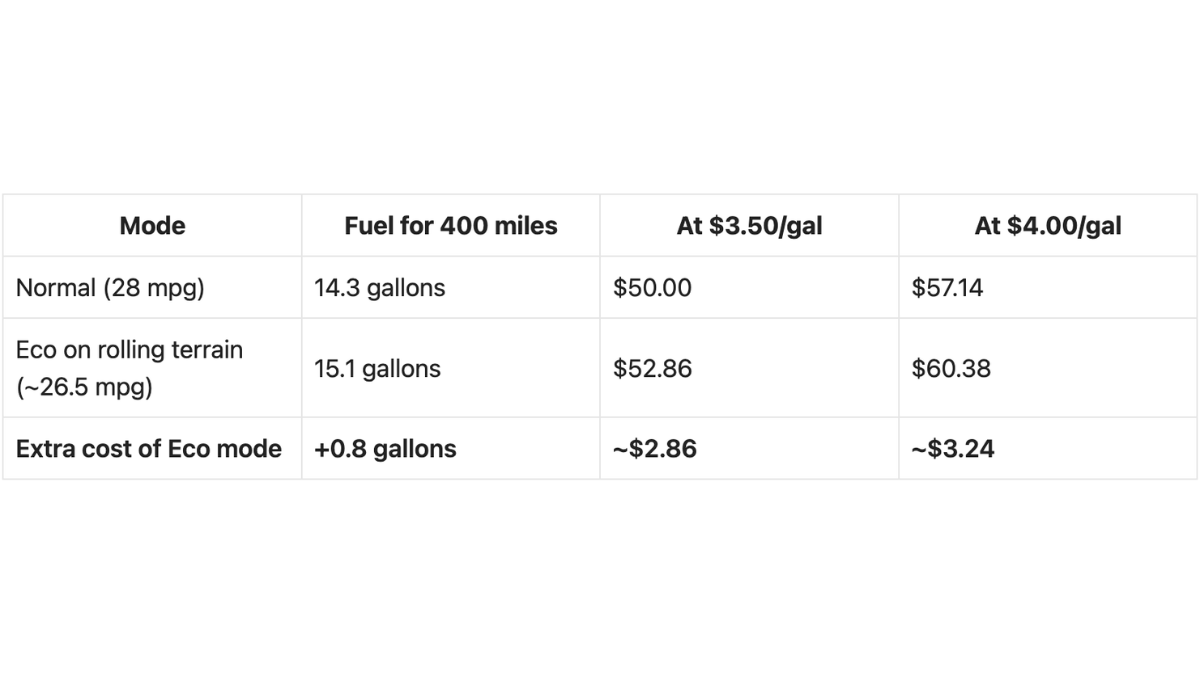
Assumed Normal mode highway fuel economy: 28 mpg at 75 mph (approximate for current midsize SUV; actual figures vary by vehicle and route — verify at fueleconomy.gov for your specific model)
Eco mode penalty on rolling terrain: Consumer Reports testing and owner documentation across multiple forums consistently point to 1–2 mpg on routes with grade variation in Eco versus Normal mode. For this calculation, a conservative 1.5 mpg penalty is applied.
Eco mode highway fuel economy on rolling terrain: 28 − 1.5 = 26.5 mpg
At the high end of the penalty range (2 mpg), the extra cost rises to approximately $4.50–$5.75 per 400-mile run. This is modest on any individual trip — but it is the opposite of the result that pressing Eco mode was supposed to produce.
The more relevant number is not the dollar figure but the direction: Eco mode on rolling highway terrain makes the trip slightly more expensive, not cheaper. A driver who presses Eco believing it is saving fuel is paying more while believing they are paying less.
When Eco Mode Does What It Promises
Precision matters here: this article describes a specific misapplication of Eco mode, not a condemnation of the feature.
Eco mode’s real value is in stop-and-go city traffic — the environment it was designed for. In genuine urban driving at 20–45 mph with frequent acceleration cycles, the early upshifting and throttle dampening produce measurable improvements. Honda’s CR-V owners report 2–3 mpg gains from Econ mode in city driving. This is the system working as intended: more conservative acceleration, earlier overdrive, less fuel burned per acceleration event across a hundred stop-light cycles.
The ORNL/DOE data behind this series (→ see “How Much Time Does 80 MPH Really Save” in this series) shows that aerodynamic drag at highway speeds rises roughly with the square of velocity — and at 75 mph in overdrive, the engine is already managing this drag at its most efficient operating point. There is little for Eco mode to improve. The transmission is already where it should be. Eco mode’s only remaining lever — the throttle mapping — either costs nothing (on flat ground) or costs fuel (on grades, where the dampened response delays appropriate downshifts).
The right mode by road type:

The Cruise Control Interaction
One specific combination amplifies the Eco mode problem on highway terrain: Eco mode with cruise control engaged.
With cruise control set, the driver is not actively modulating the throttle. The system holds the set speed by managing throttle position automatically. In Normal mode, when a grade increases resistance and speed begins to drop, the cruise control system commands a downshift promptly — the transmission responds, torque increases, speed is maintained efficiently.
In Eco mode with cruise control, the transmission’s resistance to downshifting creates a conflict. The cruise control keeps opening the throttle to try to maintain speed in the too-tall gear. The engine lugs, throttle position increases, and fuel consumption spikes — for longer than it would in Normal mode, because the system is fighting to hold the tall gear. Eventually one of two things happens: the grade exceeds what the system can handle in the tall gear and a late, forced downshift occurs, or the speed drops below the set point before the downshift comes.
Either outcome represents a worse fuel and driving result than Normal mode’s prompt response. Honda’s own documentation acknowledges this directly. The 2018 Honda Accord Owner’s Manual states for the cruise control system: when ECON mode is on, “it will take longer for the vehicle to accelerate to the set speed or applying throttle to maintain speed when climbing a hill.” The longer throttle application time is not a euphemism — it means the engine is burning more fuel at higher throttle position, for a longer duration, than a Normal-mode downshift would require.
U.S. and Canada Note
The Eco mode problem is most pronounced on specific U.S. and Canadian highway routes where rolling terrain is unavoidable:
Routes where Eco mode’s grade-related penalty is likely:
- I-40 through Tennessee and the Arkansas Ozarks
- I-70 through western Pennsylvania and the Appalachians
- I-81 through Virginia and West Virginia
- US-2 and I-90 through the Cascades
- Trans-Canada Highway through northern Ontario and the Shield
- Highway 1 through the Fraser Canyon in BC
- Highway 17 in Ontario (Shield terrain)
Routes where Eco mode is largely neutral on the highway:
- I-10 through Texas and New Mexico flats
- I-80 through Nebraska and Iowa
- I-94 through the Dakotas
- Trans-Canada through the Prairies (Saskatchewan, Manitoba)
Canadian L/100 km note: The fuel penalty at the high end of the estimate range (2 mpg worse in Eco) translates to approximately 0.5 L/100 km of additional consumption. At $1.70/litre CAD over 600 km, this is approximately $5 CAD additional per round trip — modest individually but misaligned with the driver’s belief that they are saving fuel.
The practical recommendation is the same on either side of the border: Eco mode for the city approach to the highway, Normal once you are on it. Switching takes one button press.
SOURCES
- Consumer Reports: Eco mode “had no measured benefit” in highway steady 65 mph test; Eco reduces throttle response for milder acceleration while shifting earlier; throttle mapping, shift mapping, AWD response are what modes adjust; Sport mode extracted ~2 mpg penalty; past tests found no city fuel economy benefit from Eco
- DriveAccord forum — contains verbatim excerpt from 2018 Honda Accord Owner’s Manual: “Cruise Control System Description: When the ECON mode is on, the system limits the throttle position to prevent excessive throttle application to improve fuel efficiency when there is a change in vehicle load — for example, it will take longer for the vehicle to accelerate to the set speed or applying throttle to maintain speed when climbing a hill.” This is OEM primary documentation. Note: Honda owner manual PDFs are accessible behind the owners.honda.com login portal; the DriveAccord thread quotes the text verbatim.
- Honda CR-V Owners Club — supporting reference: Honda Econ official guidance excerpts including “When Not to Use Econ” covering hilly/steep conditions and highway entry; owner: “commute on the turnpike has rolling hills and with Econ, the CVT is in a higher gear, so the cruise will open up the throttle to maintain speed up the hill, using more gas than normal”
- Chrysler Minivan forum: “It works on the false idea that lower RPMs mean less fuel. With light loads it’s right, but as the load increases so does the fueling”; “It tries to upshift as early as possible and pretends as if it’d rather let the engine stall than downshift”
- BobIsTheOilGuy: “Eco — upshifts sooner, feels like its lugging to a certain extent. Trans is more sluggish, and the throttle by wire is less responsive”; transmission recalibrated to save money by shifting at lower RPMs; cruise control less likely to downshift in Eco
- Jeep Grand Cherokee forum: “Shift map too low. Engine lugging”; “On freeway, it is off or sport mode”; multiple owners document throttle kill and sluggish highway feel; “I had to push the throttle pedal a lot further to get any kind of normal acceleration”
- HowToGeek: “That more aggressive throttle input can offset any potential fuel savings Eco mode is designed to provide”; Eco mode can make drivers push harder, counteracting intent; safety concern for merges
- DOE Fact #982 / ORNL: aerodynamic drag and fuel economy relationship at speed — foundation for understanding why overdrive efficiency is already optimized at 75 mph highway cruise; referenced via cross-series link